MAKING A STAND
By MICHAEL PERKINS
CALIFORNIA IS HISTORICALLY THE BUTT OF JOKES launched by the rest of America, mostly, I think, because it is a land of many firsts. Some of these innovations, from politics to entertainment and back again, are accurate forecasts of what will eventually spread like prairie grass across the continent and be absorbed into the “normal”. Others fall into the category of “fads” and merely add to the reputation of the state as “the land of fruits and nuts”. Photographically, CA’s “let’s try this” mentality adds a lot of flavor and not a little fascination. If Oregon now markets itself with the motto “keep Portland weird”, well, that’s just an unofficial franchise. We invented weird.
You’re welcome.
Cali has redefined dining for over a century, having established itself, early on, as the place where car culture met cuisine culture. We not only pioneered the “drive-in” (for both restaurants and theaters), we refined the concept further, later on, as the “drive-thru”, extending the stay-in-your-car ethos to banks, dry cleaners, and who knows, maybe confessionals. But before the drive-in, there was the walk-up, the “stand”, buildings designed almost exclusively for take-away, as the Brits call it. Take an enclosed kitchen and attach a wall of windows and a counter, and you’re in the eats business. Hot dog stands, burger stands, soft-serve stands, many of them sporting bright colors and garish architecture, like billboards with a side of food. Entire mini-libraries and reference works have been created to photographically chronicle these unique and bizarre roadside grub huts, even as many have vanished, only to rise again as food trucks.
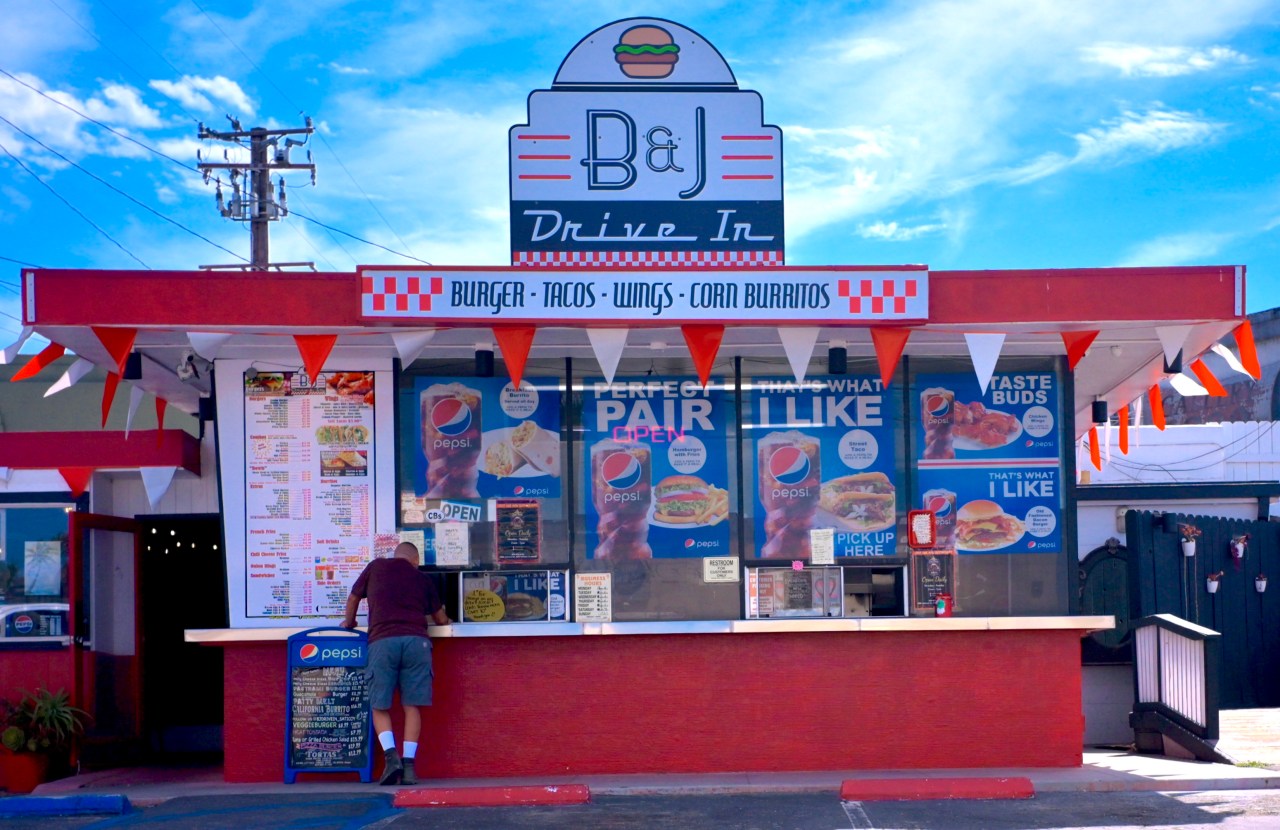
B&J Drive-In (but mostly walk-up), Ventura, California, 2026
It’s no spoiler to restate that I adore “joints”, places where the owner is also the fry cook and his kids are working the counter. No chain or conglomerate can compare for sheer quirky individualism. I love the crazy contours, the misspelled menus, the cheesy murals, the unabashed carny out-thereness of them all. When I see signs that start with “since 19—” or “home of the original—-“, I’m already halfway sold. Drive-ins are about distancing the customer from where the magic happens. Stands say, step right up, how’s it goin’, what can I getcha. California is a magnet for new ideas, a laboratory for things that at first seem odd to the rest of the country, but soon become everyday, even invisible, in their universality. From the day in 1924 that a Pasadena joint called The Rite Spot became the first place to put a slice of cheese on a hamburger, we’re all about trying things out. What doesn’t work, we lose. What does work stays on the menu.
THE SLOW, DEEP, DEVINE CURTAIN CALL
By MICHAEL PERKINS
ALTHOUGH I HAVE MADE MANY VISITS TO NEW YORK CITY, both before and after 2011, November of that year holds a near-magical place in my heart, as that most theatrical of towns chose that particular time to stage the most glorious welcome for me of my lifetime.
The old admonition to “never meet your heroes” has never applied to my encounters with NYC, as it has always lived up to the lofty and majestic dreams of my landlocked youth in the American midwest, where I grew up in towns that boated “the” big local skyscraper instead of an entire forest of them, places where dreams had cramped parameters, limits, unlike the Apple, which had its own accent, its own vocabulary, its own Seven Wonders Of The World. As a photographer, I found that many of my visual bucket lists were composed of local Manhattan landmarks, complete with daydreams on just how I would shoot the neighborhoods and boroughs, and all their native must-sees. I visited other places, but I breathed, even prayed, in fluent, fervent New York.
And so, 2011 was something of a mission year, in that it was the first time my wife (born and bred) and myself were to visit the resurrection that was already well underway at Ground Zero, and within that, to experience the Great City for the first time in the depths of autumn. “Autumn In New York, why does it seem so inviting…?” Not only autumn, but the singular transformation in color that could only be seen at its peak in Central Park. However, in the weeks before we were to fly in, weather bulletins were alarming.
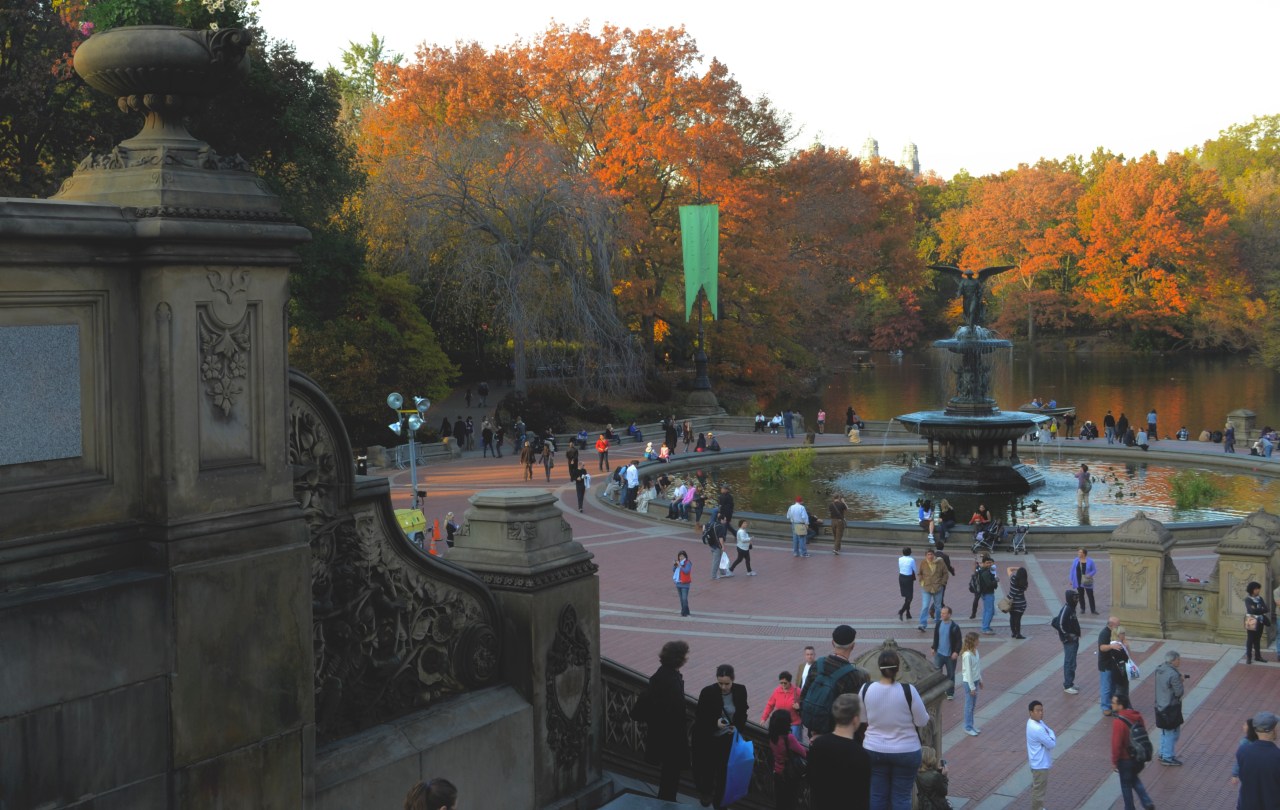
Bethesda Fountain Plaza, November 2011.
Just weeks prior to our arrival date, the city had endured a massive low pressure-generated storm called, alternatively, the 2011 “Halloween Nor’easter”, “Snowtober”, “Shocktober”, “Storm Alfred” and “Oktoberblast”, a severe system that, as it cruised up the east coast from the Carolinas, broke snowfall records in twenty cities, covering NYC in a spooky blanket of Halloween white. My heart sank; there went fall color. The trees, whipped by merciless gusts, would almost certainly be bare for our visit. Oh, well, another year…..
In the end, the snow melted before we flew in, and, by early November, the leaves in the park had held, cradling my dream site at the Bethesda Fountain Plaza in explosive hues of red, green, brown and gold. A magical framing of my fantasy location within the bounds of my favorite place on the planet. Living for twenty-five years in Arizona, this transplanted farm-belt boy had lived for many a fall season without the wondrous palette that was a birthright for most of the country. Now, the city had given me Thanksgiving and Christmas in one big, brightly wrapped bundle. That year, autumn was no sign of the end of things, or a season of sad slowing. It was divine, and for that one amazing afternoon, it belonged to me.
WE MEANT TO DO THAT (OF COURSE)
By MICHAEL PERKINS
IN 2026, BEATLES FANS THE WORLD OVER ARE CELEBRATING the 60th anniversary of the debut of the group’s seminal album Rubber Soul, a record which dramatically re-set the terms of engagement between the world’s greatest pop band and its audience. Long-playing records, prior to the mid-60’s, tended to be composed mostly of songs that were originally released as independent singles, with the priority on reaching the “youth market” placed primarily on 45’s rather than 33’s. By the second phase of their fast-evolving life as recording artists, however, the Beatles were, by ’66, moving quickly from being a “live” band that recorded to a studio to a band that was unbound by either the formal moon-june-spoon songwriting rules of I Want To Hold Your Hand or the limits imposed by what could be performed on the road. Rubber Soul, like Brian Wilson’s Pet Sounds from the same year, was a document of that new-found freedom, of the studio-as-instrument, or as an album as a feature-length construct rather than a hits package.
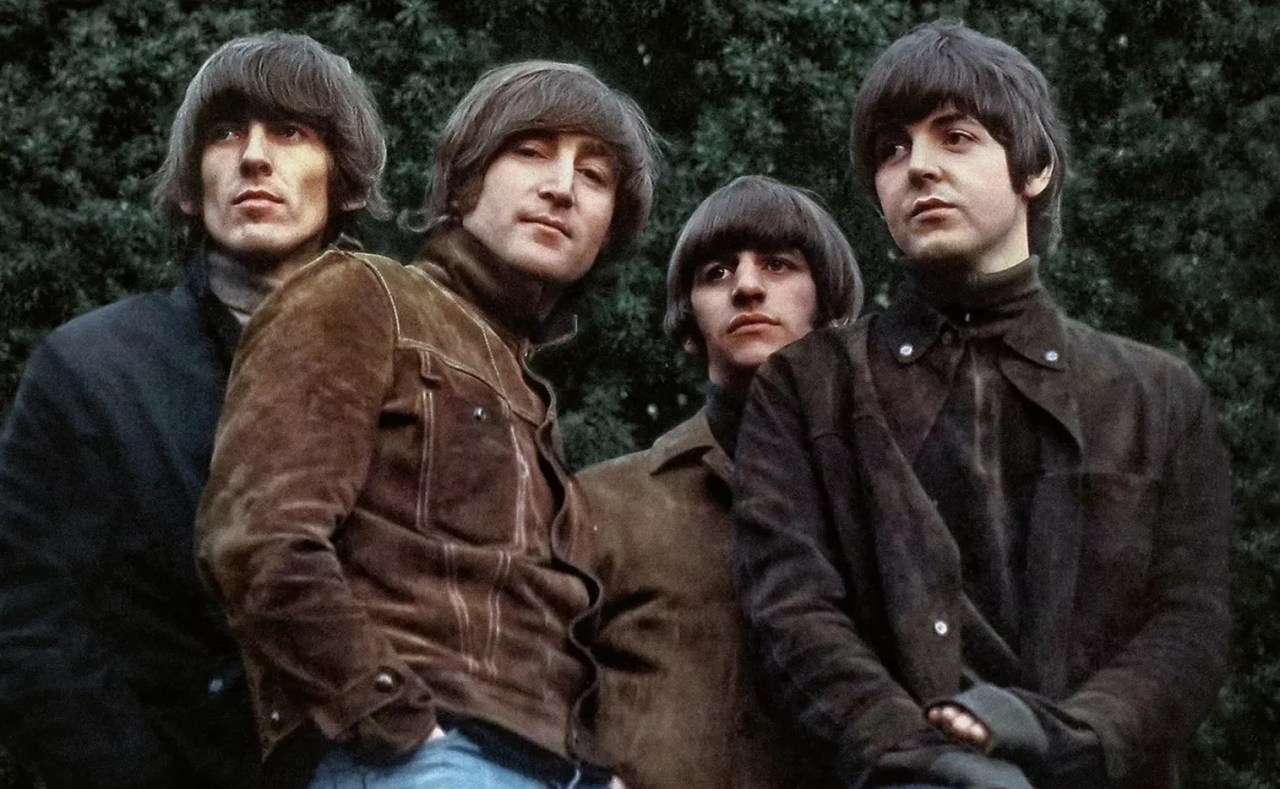
One of photographer Robert Freeman’s original test shots for the cover of the Rubber Soul album in 1966.
Alongside the band’s expanding bag of tricks as musicians was their interest in extending that control to the actual graphics of their album covers, leading, from Rubber Soul onwards, to a mutiny against the record industry’s habit of labels assigning cover design to formal studio photographers. The Beatles truly led the charge in the idea of bands being photographed more “in the wild”, choosing their own favorite shooters and settings as well as contributing directly in the process of the shoots. The title of the album, a bit of a pun but also their way of expressing how “soul” could be elastic enough to embrace a variety of musics…..that is, “stretchable, or “rubber”, was in their mind when they first viewed possible group shots for the album cover.
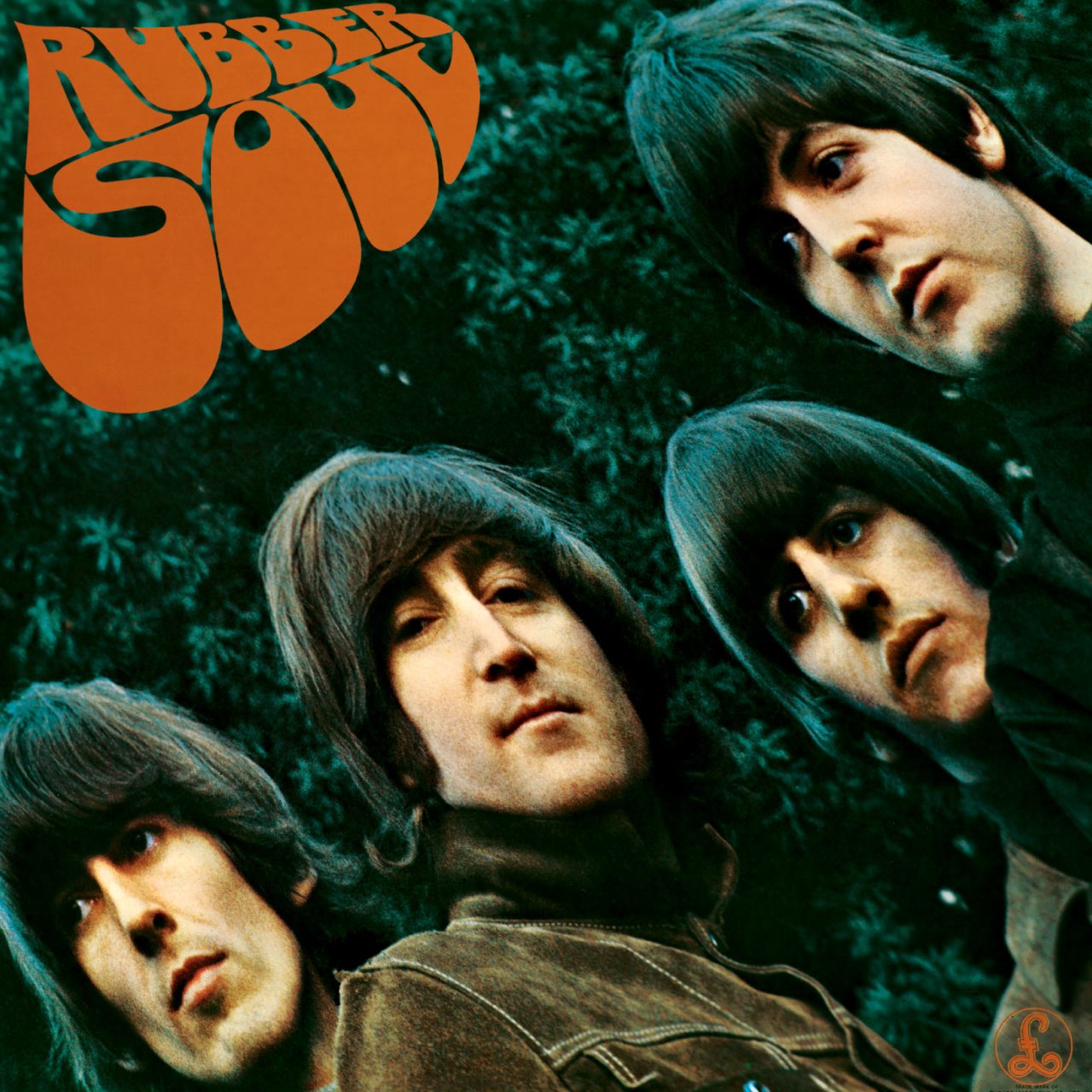
The accidental distortion of the top image that inspired the Beatles to a trippier approach to the cover.
At the time, photographer Robert Freeman had a set method for helping groups get an idea of what their covers might look like at scale, projecting color slides from his shoots onto bits of white cardboard sized to resemble the dimensions of a record jacket. In showing proofs of the Rubber Soul shoot to the Fab Four, Freeman’s cardboard fell backwards a bit, distorting the image, making the band look stretched, or “rubbery”, in a rather trippy way. The group immediately asked if the finished cover could intentionally be made that way, and thus was born one of the most iconic, if accidental, images of a very psychedelic decade. Soon after, artists began to routinely lobby for their own input on album packaging, but, as in so many other ways, it was the Beatles who initially decided not only to bend the rules, but to chuck the rule book out the window altogether.
THE EASY WAY OUT. OR BACK IN.
By MICHAEL PERKINS
THE FIRST COMMERCIAL EXPLOSION IN CAMERA SALES that began in the late 1800’s was a triumph of design innovation, as manufacturers created devices that answered the two main barriers to the adoption of photography as a general hobby instead of a tinkerer’s plaything. Ease of operation and affordability combined to induce people to purchase their first cameras and to use them regularly. This was not an ingenious plan to sell more cameras.
It was an ingenious plan to sell more film.
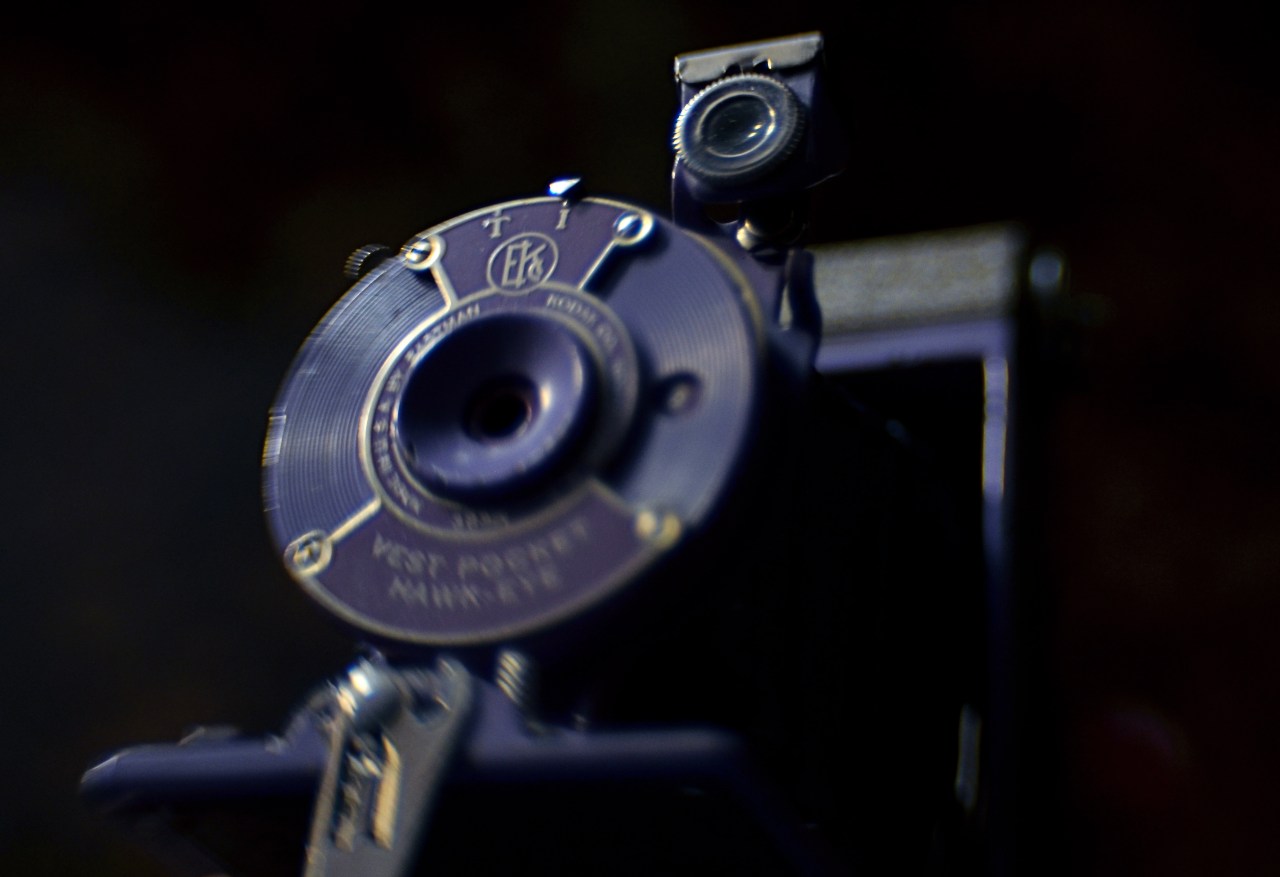
The idea was simple. Make it easier and more enjoyable to take pictures and people will do it more often. Oh, and we also make film for the camera, btw. This revolution was repeated throughout the 20th century and into the first part of the 21st, as technical improvements began to warrant users against failure. As the cameras became ever simpler and the results are more predictably satisfactory, interest remained high, as did film sales.
Now, in a largely filmless world, makers have continued to anticipate more and more of the annoyances that would inhibit the taking of lots and lots of pictures, the aim being to make devices that are so intuitive that they present no obstacle whatever to quick and frequent use. But is convenience, or the guarantee of at least a usable image every time, enough for the shooter who chooses to expand his/her mastery or knowledge? Taking the cell phone as the largest and most dependable baseline of camera use worldwide, can a significant number of people be counted on to grow beyond said phones, to want devices that are a smidge more complex than the world’s most dominant point-and-shoots?
If recent statistics are to be trusted (I’m writing this toward the end of 2026), there has been a modest but definite upsurge in the sale of compact cameras, hardly a return to the sales levels they once enjoyed, but a confirmable swing away from the deep dips of the last fifteen years or so. There are several potential reasons for the rise: some consumers have expressed a longing for a stand-alone camera rather than one which is merely one more feature within their phones: others have indeed expressed an interest in something that is still small and portable but which simply “does more” than their pocket cells. Still others have been lured by nostalgia, as manufacturers are working classic visual cues into their designs, creating a longing for a simpler era. And, finally, there is the inclusion of many features which were confined to more upscale, full-function models only a few years ago. Result: compacts are staging a comeback.
Those of us who rode our pet dinosaurs to school back in the Before Times were more than accustomed to the fact that people would buy a series of cameras over a lifetime, spurred on by either a hunger to go deeper on tech or a bigger budget or both. The idea of “outgrowing” a camera was considered a basic part of one’s evolution. Now that the act of snapping a frame has been reduced to its very simplest terms, some will find that “good enough” is, well, not good enough, and find themselves shopping for the next big thrill. Convenience is still, as in the days of the one-button Kodak, a huge selling point. But, as it turns out, humans will sometimes opt for the unpredictable or risky in the name of growth.
MASTERING THE MAP
By MICHAEL PERKINS
In a portrait, I’m looking for the silence in somebody.”
– Henri Cartier-Bresson
PHOTOGRAPHY WAS, IN ITS BEGINNINGS, regarded as something rather soulless, a purely mechanical means of recording things that consisted mainly of the mapping of surfaces. In one way, making a picture was agreeing on strict terms of engagement. The object in the photograph is so high, so wide, so close, so far, and has only the details you see represented here. To make an images was to map out an area as precisely, and as coldly, as a surveyor documenting a field, a kind of “what you see is all you get” arrangement. Complete. Sterile.
That viewpoint quickly yielded to the belief that photographing a thing, any thing, was an act of both giving and taking away. The activity in the image was all of what you see, but a whole lot more; everything that was in the frame was but a partial, piecemeal capture of what the eye beheld. Photographers, as well as the public that viewed their work, got used to the strange terms set by the medium, the proposition that this….this box saw something that the taker could not, and yet left the task of telling the complete truth maddeningly undone.
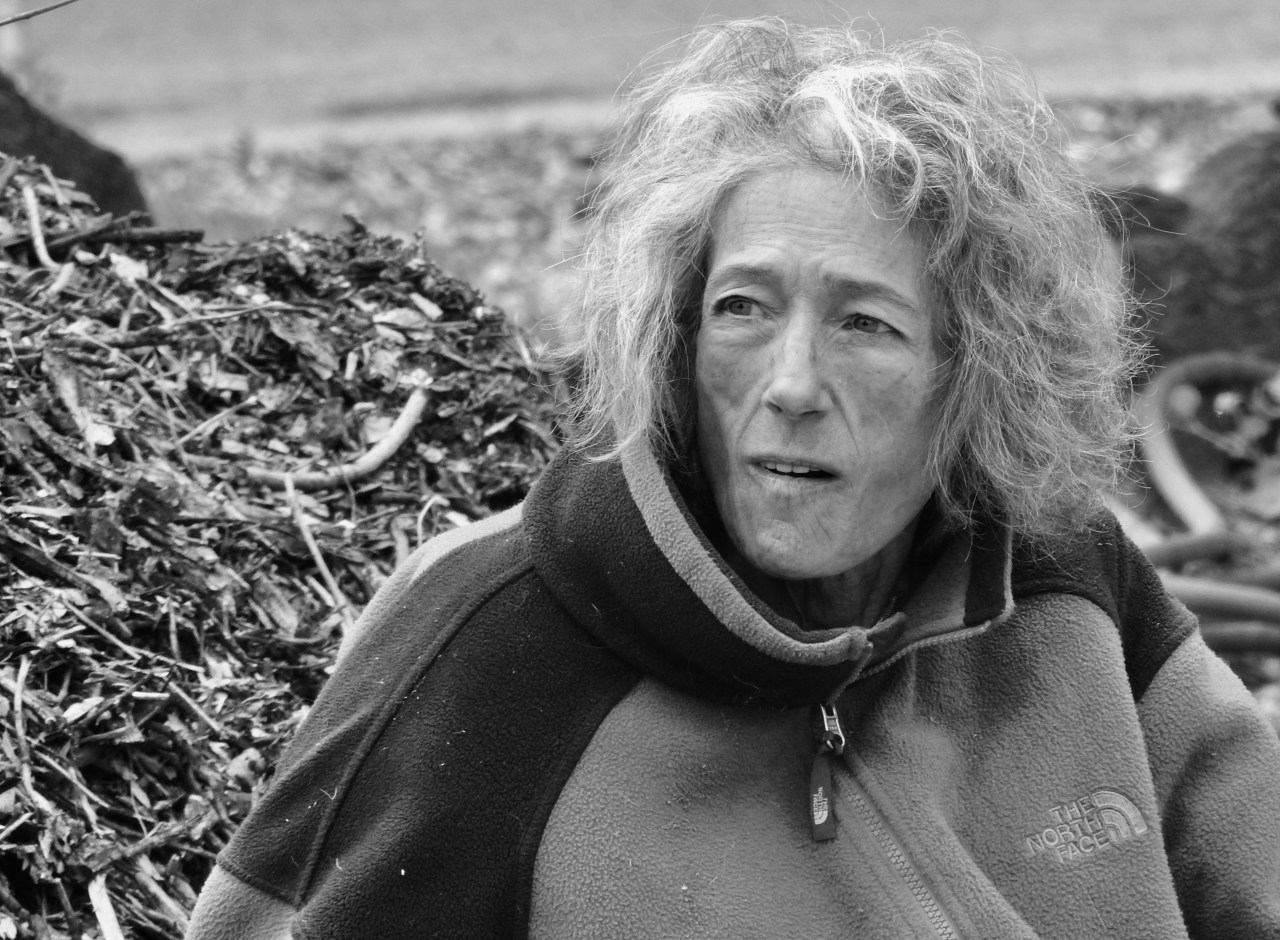
The human face is the greatest representation of this mystery, perhaps because we bring our own experience and memory to, if you will, flesh out any features or aspects of the person we are pursuing. We both come up short (what else is going on here?) and drown in abundance (I never saw that before!). When you aim a camera at a person, you are both unleashing mysteries and daring to withhold evidence at the same time. How can this be? How can a mechanism that is designed to help us see render us so blind? And does doing it repeatedly, that is, trying to “know” more and more faces, add to our wisdom or merely act as additional reminders of how limited is our vision?
The act of photographing a face is made even harder by the fact that none of us can ever really forget that we are being photographed; we are warned ahead of the click that the click is inevitably coming, giving us our cue to make a performance of our faces, to curate them, market them for mass consumption. Candids are possible, but they are becoming more rare, like seeing a pileated woodpecker and her young in the wild. Perhaps that’s what we use the word “capture” to describe the taking of a picture. We are running, net in hand, after something untamable. Photography is a game of tennis between reality and illusion. The volley creates a flurry of activity, but is the game ever decided?
LEAVING BAD ENOUGH ALONE
By MICHAEL PERKINS
I never saw no miracle of science / that didn’t go from a blessing to a curse. Sting
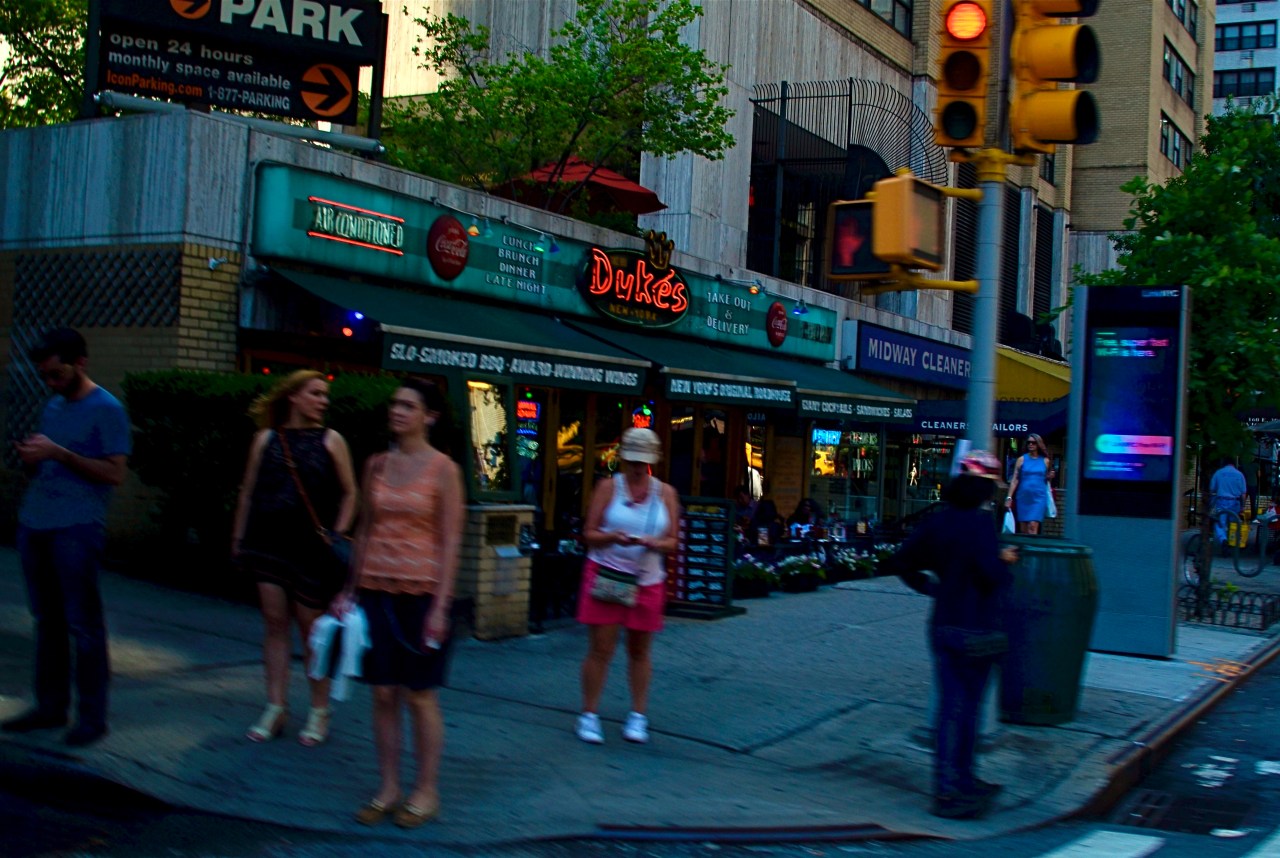
Duke’s, New York City, 2018
MY FIRST STUMBLING FIRST BABY STEPS WITH A.I. haven’t focused on creating photo-ish fantasy worlds or creating with a logarithm what can’t be accomplished with a camera. If I had wanted to be a painter, I would have become one. Full disclosure: I’m not yet certain what I truly need from this portentous tool, or if I need anything at all. And so my explorations have largely been in seeing how much more efficient or precise it can be as an alternative to standard post processing, an adventure that, as you’ll discover, has yielded mixed results.
In asking A.I. to make corrections in my images, I find myself somewhat amputated. My fingers are no long pushing sliders, but rather pushing words up against each other, trying to second-guess, in written prompts, what the entity will likely deliver for me. This all comes down to a crap-ton of trial and error, and, in many cases, lots of hair-pulling and screaming “no! no! NO!” at the monitor. Thus, most of my A.I. explorations are largely repair jobs, and the mildest and simplest repair jobs possible. The grander fix I envision for an image, the harder it is to get the beast to give me what I want without adding its own two cents in the bargain. Either it, or I, need more training, and I can’t yet decide which of us that is.
The image you see up top has been the subject of an earlier post, in which I argued for the fact that even your most technically imperfect pictures might also be among your favorites; that, on average, their overall “workability” outshines whatever technical flaws they contain. The shot was taken out of the window of a slow-moving, Uber on my way back to JFK, and I had nearly zero fine control in the moment over the taking of it, hence the underexposure and motion blur. There was nothing in standard Photoshop that allowed me to satisfactorily “correct” it, and so I had finally decided that it was a better picture left undisturbed. It was only recently that I decided to envision anew what it might have looked like without the mistakes, and so I wrote a very simple prompt in ChatGPT to see what was possible. The entire prompt read, “Sharpen image by 50% an even out the contrast.”
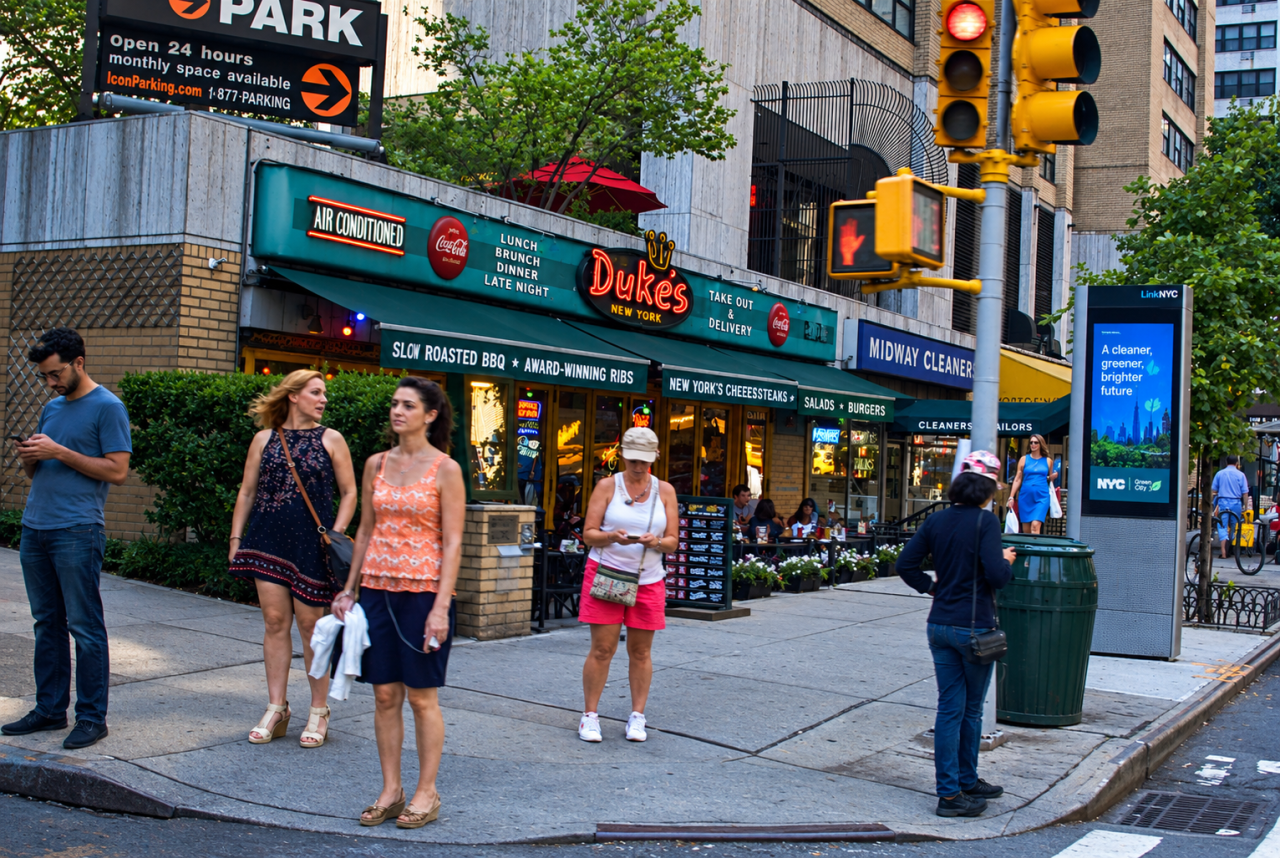
A botched A.I. enhancement of the above shot. Things that never were, words that appear from nowhere, night into day…
That was it. No “place details in the picture that weren’t originally there” or “replace the text on the various signs with whatever the hell you like” or “transform the mood from a dusk shot to a daylight image”. In fact, however, what I got improvised in all three of those areas, all without specific instructions from me. I wasn’t trying to get rid of all the shadows; I merely wanted to modulate them a bit. I also didn’t need to place details in the picture that weren’t in the original capture. And yet here we are. And I am right back to re-loving my original, warts and all (to be fair, A.I. did not add any warts to anyone).
In “Hal’s” defense, there are shots that originally came off softer than I wanted that have benefitted from the kind of A.I. sharpening that out-performs more standard processing. But the rule that seems to be emerging, at least for me is, a little is a lot, and a lot is way too much. I don’t want my pictures to suffer merely because I’m lousy at typing in instructions. A.I. as a scalpel is fine, but A.I. as a bludgeon is disappointing and a little scary.
TWO SIGNATURES REQUIRED
By MICHAEL PERKINS
PRIOR TO THE 21st CENTURY, THE AVERAGE PHOTOGRAPHER produced his/her/their work on one platform at a time. For many whose creative energy was rooted in analog, film was the tablet on which the work was “written”. That meant that, for the most part, the look of that medium was the underlying visual “signature” of whatever was recorded on it. Go back even farther, and mediums like tintypes or daguerreotypes, with their respective looks and limits, defined what we now regard as an “old time” image. Each process conferred a certain look upon whatever the photographer captured. When you were born, the recording medium you worked in dictated, to a degree, what your pictures would look like.
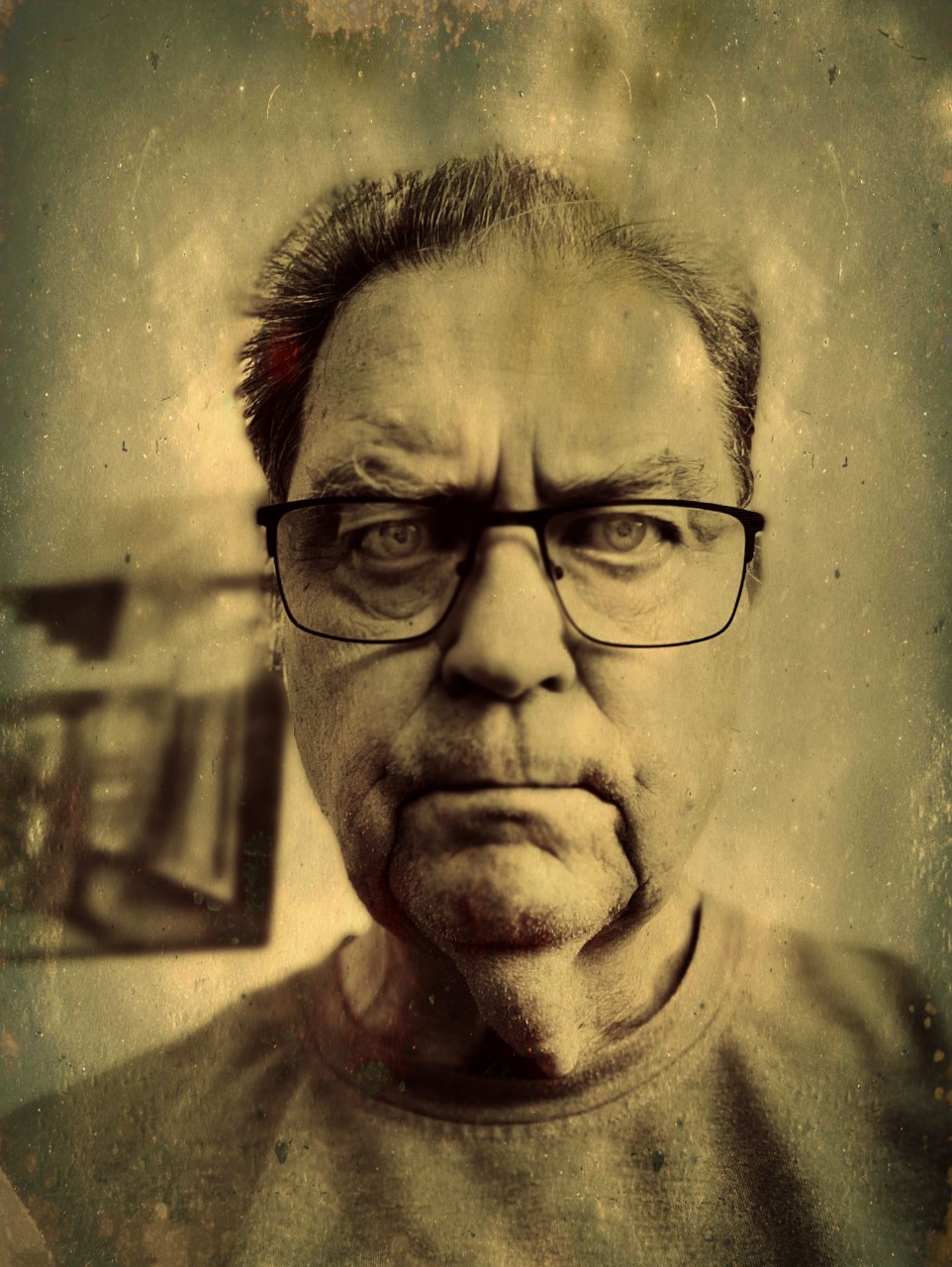
A faux tintype selfie, delivered via an app. The conception and the platform work hand-in-hand.
Fast-forward to the present, in which digital technology has completely liberated the photographer, opening up a broad swath of choices for the visual signature that you choose for a given picture. Want to render your subject in a way that reflects Victorian tech? Want to deliberately limit things like light sensitivity, texture, dynamic range? Pick a period, pick a look. It’s yours at the touch of a button or the flick of an app. What a spectacular arsenal is at our command, all in an instant.
I have absolutely no practical experience in the processing of film of any kind, but then, I have no need to learn it, unless I desire to master that tech for my own hobbyist amusement. With even modest equipment, I can absolutely simulate the various emulsions of a variety of film types, replicating how they were developed by those who grew up natively with those orientations. This is like being able to write both left and right handed. My eye is one personal signature for the pictures I hope to create, and the look of a given era or medium is a second signature. My choice of platform acts as a co-signer for my choice of approach.
The greatest blessing of the current age in photography is that we have developed gear that simplifies the mechanical process of capturing a frame to such a degree that more effort can now be directed to our vision, and less on how our machinery will execute it. When you conceive of a great idea, you are affixing your signature to the result, while the platform you choose to deliver that work signs off on it as well. Amazing.
SHARING A SUNSET WITH LOUIS AND LEON
By MICHAEL PERKINS
PHOTOGRAPHY HAS NEVER BEEN DEFINED BY A SINGLE TECHNICAL BREAKTHROUGH. It is, of course an invention, but one which is evolutionary, unlike a “eureka” moment in which a single inventor, an Edison, say, solves a problem and generates a product. The making of pictures unfolded in a much slower fashion, with many “little edisons” adding this technique or that method along a protracted timeline. Photography is never “finished”; it is always on the way to being finished.
This means that assigning authorship to a particular development or stage in photography is difficult. The art has so many co-creators that we find it hard to nail down who was the first to do or try a particular thing. The first days of the craft saw many different people all trying to portray very basic elements of the world, with very little documentation as to who was first across a given finish line. As we find in our own time, if you think up a great idea for a picture, chances are that a zillion other people have had the same “original” notion at the same time, given how universal some of our life experiences are.
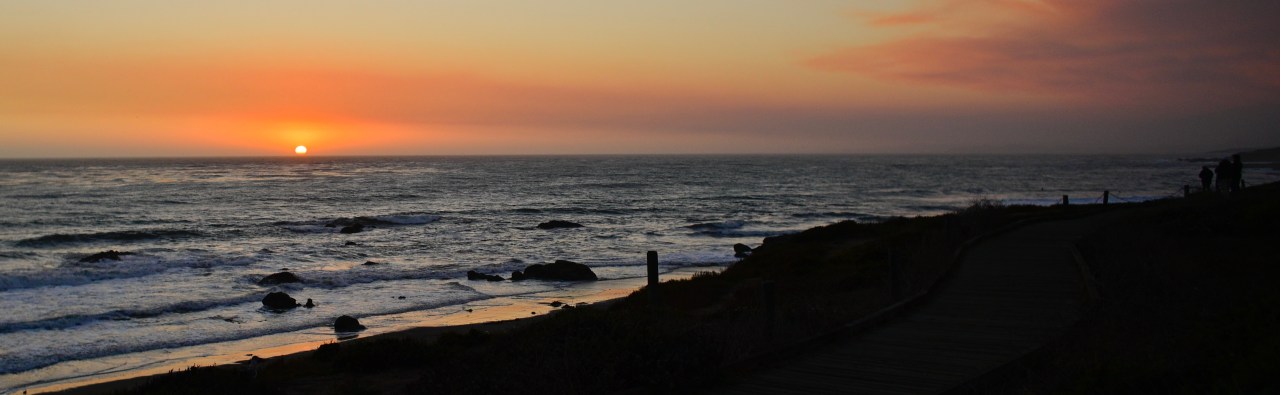
Moonstone Beach, Cambria, California, August 29, 2026, 7:40pm
By this time, for example, nearly everyone who has picked up a camera has made some kind of image of the sun. Our primal connection to nature was documented in photos almost as soon as the arrival of photos themselves. Ah, but who was the first to try such a picture? Some credit the first solar photograph to Louis Fizeau and Leon Foucault, a pair of French physicists who were experimenting in 1845 with the relatively new daguerreotype method, one of the first photographic systems to boast sharp resolution and fine detail. Their exposure was amazingly fast for the time (1/60sec.) and the resulting image was small, just 4.7 inches big, but it reportedly recorded spots on the sun’s surface and so was regarded as a scientific milestone. Okay, that’s the accepted version of history. But can we really attribute “firsties” in any photographic history with any certainty? It’s been argued that several people invented the telephone at about the same time as Alexander Graham Bell, but he was just the one who got to the patent office first. The same is likely true of most advances in photography. They have so many fathers that they are community property.
Which points to the fact that almost any subject has, by now, been photographed to death, or at least beyond the point of novelty, with the only crucial ingredient one’s own approach or experience. Even then, it’s hard to approach the hyper-familiar in a fresh way. Still, it’s the degree to which we refuse to accept that “there is nothing new under the sun” that makes us, well, photographers.
INDY’S INNER SHUTTERBUG
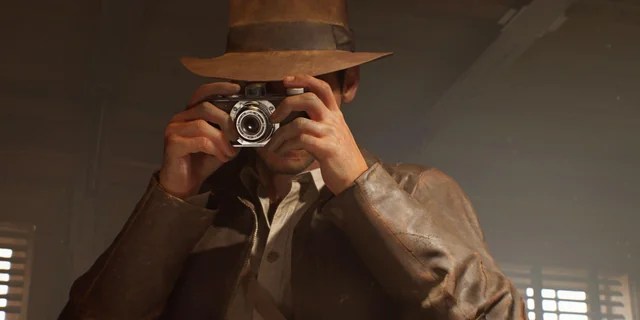
What does your favorite adventurer use to snap snappy snaps in tombs?
By MICHAEL PERKINS
THE HISTORY OF THE MOVIES IS LIBERALLY SPRINKLED with images of cameras used by its heroes on-screen, whether it’s a hard-boiled detective snapping spy photos of a suspect or proud parents posing the family for key moments. Many, if not most of the cameras shown in the films are composites of design cues from various devices cobbled together by the prop department, either for visual effect or to avoid copyright infringement or both. And then there are characters that you’d figure would be armed with a camera for certain occasions, but, oddly, never are.
Like Indiana Jones, for example.
Across the span of half a century and five theatrical films, Indy has concentrated on locating all the items on his archaeological bucket list, but shooting images of his finds? Not so much. Until now. The creators of the video game Indiana Jones & The Great Circle have finally put a camera in the legendary digger’s mitts, and, unlike everything else in the game, it’s something that actually existed. A very special something, in fact, that quietly revolutionized personal photography. Meet the Argus “A”, the camera that got the world hooked on compact 35mm photography.
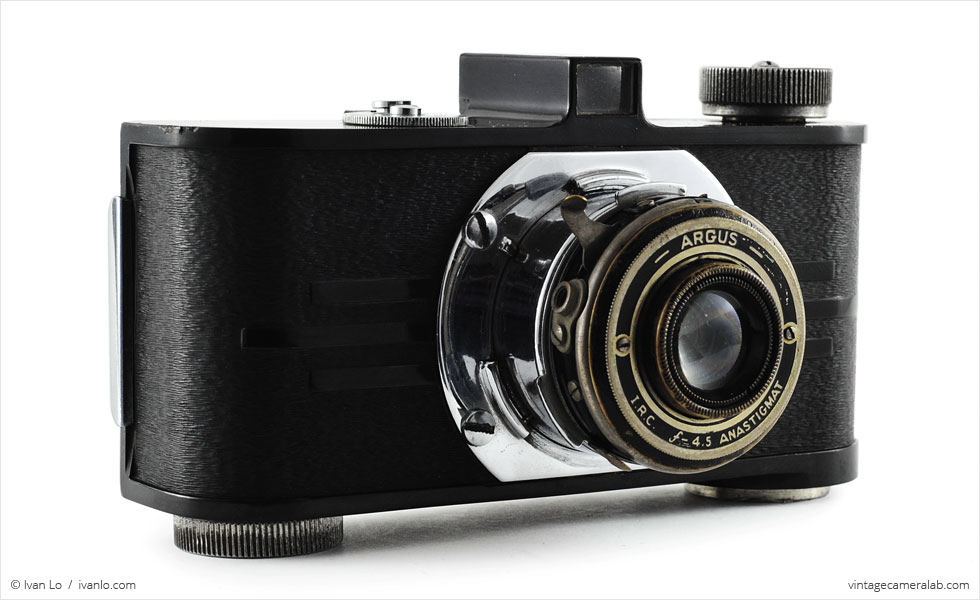
It’s true that many archaeological digs were documented in pictures, but most of said pictures were made on medium or large format rigs that were tripod-mounted for long exposures in dimly lit rooms. However, their sheer stationary bulk argues against their use by a guy who’s always leaping across craggy chasms or trying to outdistance giant boulders, and so the producers of Great Circle have given Jones one of the first successful compacts of the 1930’s, a dandy little number that actually outsold the main competition at Kodak. The “A”, launched in 1936, established Argus as a major player in the camera game, so much so that it sold off all its other holdings to concentrate totally on photographic products. The “A” came with a collapsible lens for a slim pocket profile, a light body of bakelite and chrome, a nifty 50mm prime lens, an aperture range from f/4.5 to f/11 and shutter speeds from 1/200th to 1/25 plus “Time” and “Bulb” settings. The viewfinder was small but serviceable, and, most importantly, the “A” accepted the new Kodak film “cassettes” for easy loading. Moreover, they delivered all this for just $12.50. The initial model reportedly sold 30,000 units in its very first year of release. More models, including one equipped with a flash shoe, would be introduced through 1941.
For Indiana Jones, a guy known to travel light, the “A” would have taken up very little real estate in even a modestly sized valise, leaving plenty of room for his signature Webley and Smith & Wesson revolvers, with which he did far more “shooting” in practical terms. It’s ironic that an iconic fictional character should finally get a camera that not only came from the real world, but, in photographic terms, changed it as well. And, in case of nuclear attack, it would fit neatly beside you as you huddled inside a refrigerator.
So there’s that.
RANDOM HARVEST
By MICHAEL PERKINS
HAVING LIVED IN BOTH FILM-AND-PIXEL-BASED UNIVERSES, I find myself leaning toward the advantages of both ways of making pictures, favoring one sensibility or the other, based on the situation. In my film days, I was trained to carefully approach my shooting based on the immutable reality of the frame count. If I purchased a 36-exposure roll, that number loomed before me like a neon road sign with every shot I framed up. With money a major determinant as to whether I could shoot at all, budgeting my shots as I went upped the ante on intentionality. Only pros whose work was underwritten either by deep-pocketed sponsors or their own flush bank accounts could snap away with complete abandon.
In the digital era, anyone can “run and gun”, that is, crank out a virtually infinite number of frames, either because they want to try various approaches or because they figure that they can select some salvageable images from the flurry of shots they take…a kind of random harvest idea, that is, “one of these must be good.” And, being human, and therefore on mental auto pilot (or just plain sloth), I have, many times, decided to just shoot a whole lotta stuff real fast without a lot of forethought, figuring either God or me will sort out a masterpiece further on down the road to Editville.
But I still occasionally go back to my old “budgeting” habits, because with that heightened feeling that “I only have so many tries as this” comes a return of the intentionality, the deliberation, and, almost always, a slowing. Slowing myself down to ask what should be Question One, or “what am I trying to actually do here?” invites planning, and planning, in the moment, is always better than editing in the aftermath. Sure, sometimes I want to shoot instinctively, as if I have a gun or a deadline to my head. Sometimes, however, I just have to go back into analog mind. What if I only had five frames to nail this shot? Or three frames? Or one? Yes, that’s it. What if I were shooting film and this was the last frame on the roll? What’s my “make or break”, Hail Mary move here?
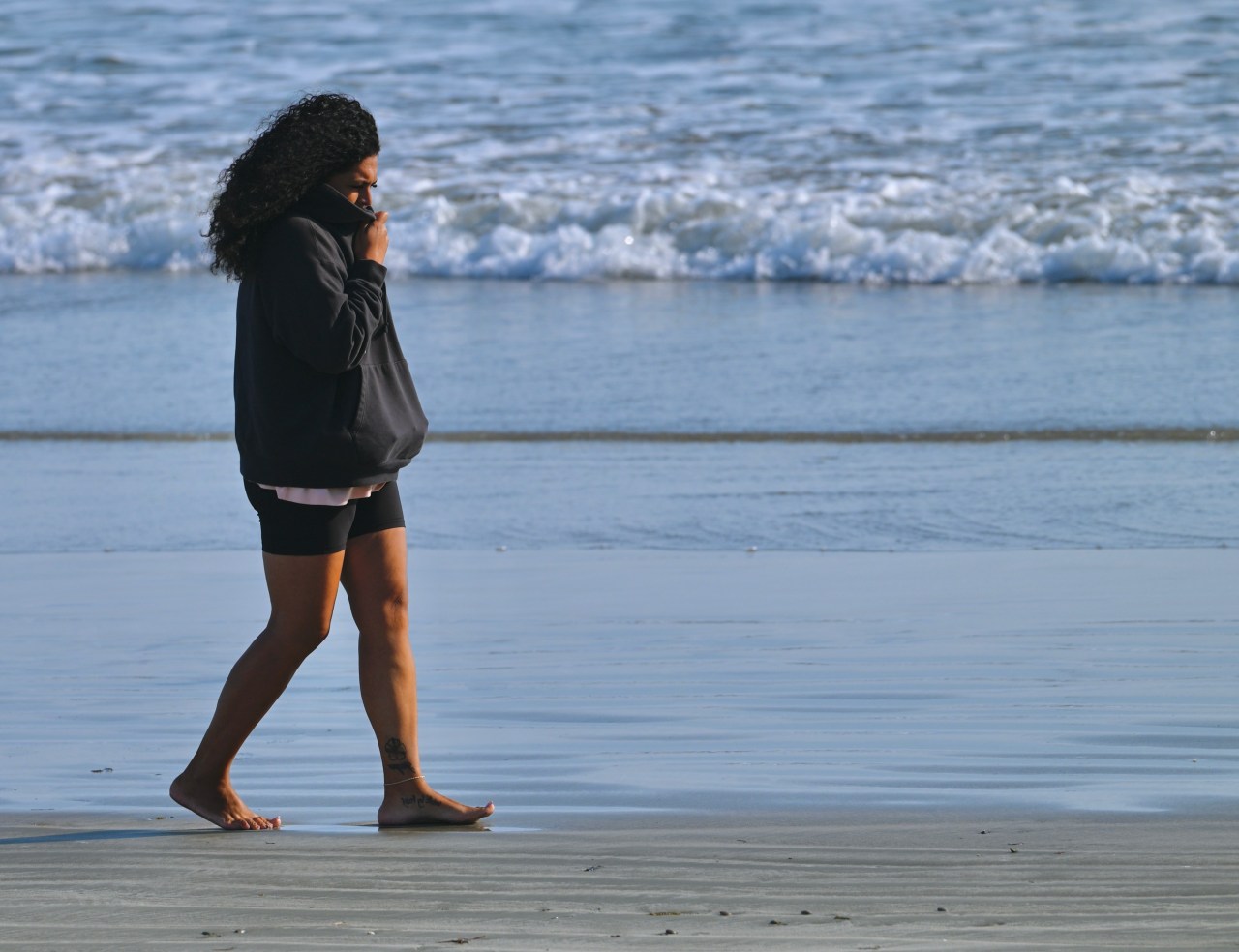
The young lady you see here is illustrative of both analog and digital mindsets. She first got my attention walking by herself, but I could see she was approaching a group of friends, and so, if I wanted only her in the frame, I would have to shoot lots of “maybes” and shoot them fast before she caught up with them. Then, moments later, she said goodbye to the friends and was walking alone once again, over a fairly long stretch of beach, allowing me to pick my moment in just a frame or two, one of which you see here. Instinct and deliberation.
Putting yourself on notice, or arbitrarily putting obstacles in your own path, is a good way to check your thinking, to be sure whether you are, in fact, trying to create something, or whether the use of your trigger finger is merely a nervous tic. Convenience is wonderful, but not all great things come easy. Be suspicious of shortcuts and “time-savers”. You’re trying, after all, to save something far more important than just time.
SPILLING OUT
By MICHAEL PERKINS
I CAN NOT PROVIDE A SATISFACTORY DEFINITION FOR THE WORD SURREAL, anymore than I could define the “reality” that it’s supposedly a departure from. It’s one of those terms that gets volleyed back and forth across the net of popular discourse, but it strikes me as more of a label for a sensation than for any definable state. And as for what constitutes surreality in a work of art, I can tell you what I feel much better than I can explain what that is. So everyone put your pencils down.
I can identify those moments in the act of picture-making that seem to call for images that go beyond the parameters of the known world, photos that require some kind of departure from reality…..and, again, don’t ask me to explain it. One of the subjects which always strikes me as a bit extra-real is myself, since I have to admit that I may never have gotten a self-portrait really “right”. It’s crazy to think that, in viewing myself in a reverse lens image or a mirror reflection, that I could gain enough distance from myself to make an objective interpretation of my own face, which is just the front layer for a mind that may or may not be in evidence, visually, on any given day. And so, in any kind of selfie, I have to trust the instinct and emotion of the moment and hope something halfway true comes out of it all.
Still.
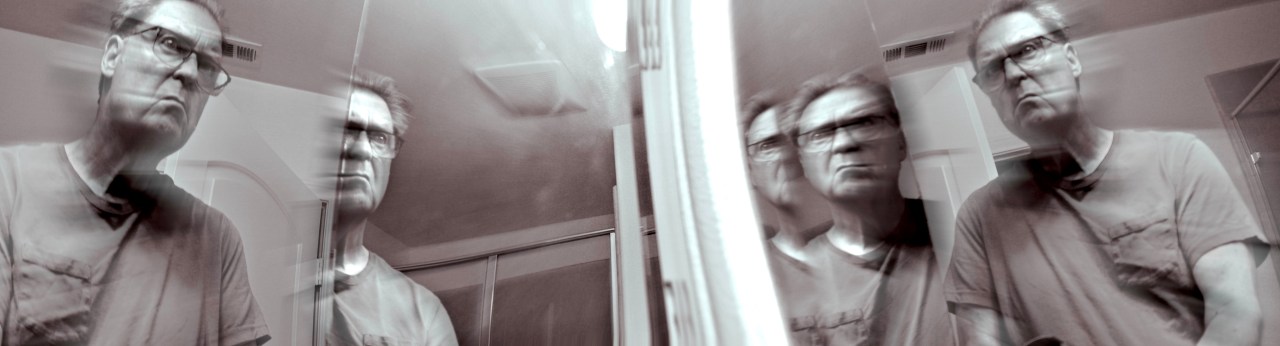
What you see here started out merely as an exercise in “can I really do this?” and began to take on a life all its own. The initial takes were all about trying to overcome the technical mine field between imagining the idea and shooting it. The further along the process went, however, the more I found myself trying to make some kind of statement in my chosen of facial expression. For who? To say what? Is this right? Are we still just playing? Far from coming up with any answers, I’m still trying to even agree with my various selves as to what the freaking questions are. That’s any art, really, and certain a testimony to the face that photography is an art and not merely a craft. The selfie dilemma remains constant; who do I want to appear to be? And, once I answer that, how do I even go about it? Selfies are not documents, not in the way we understand one. There is always something else spilling out, making mischief, clouding the issue.
And how did you spend your Sunday?
POINTING THE CAMERA SKYWARD
By MICHAEL PERKINS
MY TENDENCY, IN PHOTOGRAPHING THE HUMAN CONDITION, is to try, if I can, to mine hope from the full range of human experience. It’s my way of manifesting the belief that there is, after nearly everything, a way forward. A path for emerging from the ashes into the sunlight. Making lemonade, if you will. That means that I normally resist making pictures that display unalloyed sadness or despair. I can’t account for why I try to see the world in that way. It’s just in my wiring.
As I write this, the 25th anniversary of the 9/11 tragedy is being marked, with somber, heartbreaking images being wed to the spoken memories of one of the world’s most horrific acts of mass murder. In reviewing images I made in the first years that followed that horror, I realize that, had I wanted to, I was in New York frequently enough (my wife was born and raised there, and we maintain many ties) that I could have made some kind of photographic pilgrimage to Ground Zero to record my own impressions of the wreckage. But I didn’t. The first time I shot anything connected with 9/11 came later, with the opening of the memorial pools that had been built atop the Twin Towers’ original foundations. The first tribute. The first physical roster of the names of the lost. It was still a tremendously sad sight, even as the steel skeleton of the new World Trade Center One rose next door. But it was a symbol of resurrection. Of what The Morning After would look like.
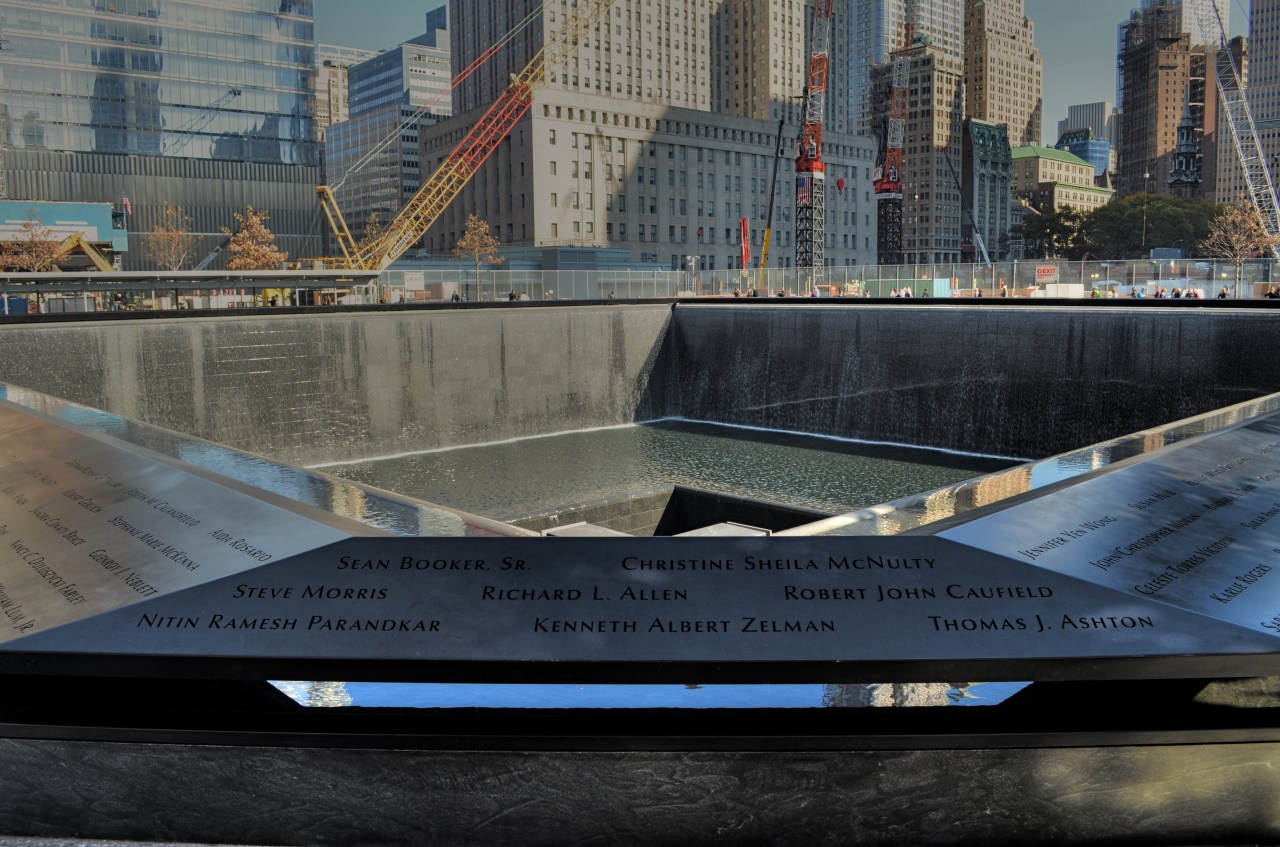
9/11 + 10: The Memorial pools open as cranes begin the work of rebuilding the World Trade Center, Lower Manhattan, 2011.
As Bruce Springsteen sang, “Come On Up For The Rising’, and we did. We transformed a gravesite into a tribute to survival, first with the pools, then with the Oculus, the complex that re-established the PATH to its rightful role as the transit terminal for Lower Manhattan, then as the 9/11 Memorial/Museum, and finally as a new garden of towers not designed to erase memory but to, in a very special way, sanctify it. My pictures could be increasingly about those deliberate acts of resiliency, those defiant, line-in-the-sand, very New York ways of saying to Cruel Fate, is that all you got? If you want to take us down, you’ll have to come bigger than that….
As a human, I feel the same pangs of horror, sorrow and loss as everyone else walking the planet. But once I pick up a camera, I feel charged with something very different from a mere manifestation of anguish. It’s not an attempt to whitewash or deny the sadness. It’s a recognition that the only way out of the dark is to walk toward the light. Or as Ginger Rogers sang so eloquently,
Nothing’s impossible, I have found / for when my chin is on the ground/ I pick myself up/ dust myself off/ start all over again
FINAL ANSWER ( FOR NOW, ANYWAY…)
By MICHAEL PERKINS
IF YOU LIVE LONG ENOUGH, YOU’LL QUESTION DAMN NEAR EVERYTHING that you once regarded as either undeniable or settled. I am old enough to remember when many of the shoppes that offered film processing would advertise the service as “photo finishing“, as if images actually had a defined beginning, middle and end point to their lives. “A photograph is never finished”, said Ansel Adams, “only released.” Certainly, for him, a man who often reinterpreted the same negatives half a dozen times over decades, photography was a process, not a product; an organic, evolving, breathing thing rather than a set series of steps from inception to completion. That’s both the frustration and the hope involved in making pictures.
Take a serious look at your own work over the years. Consider which images, regardless of age, that you would willingly take another crack at. We’re not talking about re-doing the initial capture, unless you truly want to return to the scene of your crimes and approach a given subject from scratch, as if the version of it that you shot is essentially unsalvageable. No, we’re speaking here of a shot that was fundamentally sound, but in need of an editorial…. re-imagining. Could be a simple crop, or just the rescue of detail from darker portions of the frame. really anything that, processing-wise, you’d undertake to take a basically adequate picture and squeeze just a bit of extra precision or narrative power from it. How big a list would you come up with?
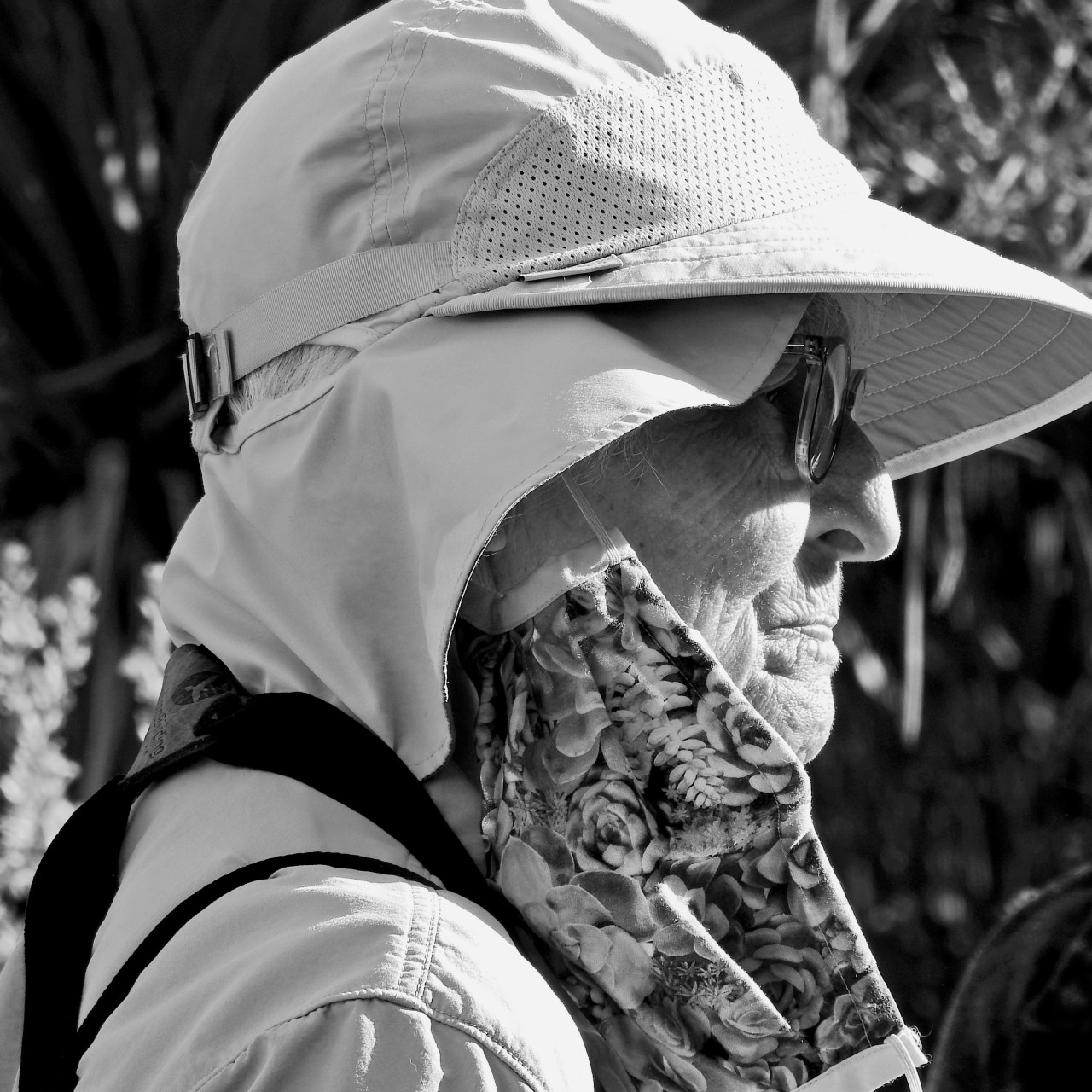
Bird Lady Rampant, 2022
Of course, you may also start with a shot that you previously believed was too flawed, too off the mark, only to find that a very small adjustment changed how it spoke (as in the case of the portrait shown here, now in its fifth rethink since being taken four years ago). Think of these images as the pictorial equivalent of a homeless guy, who after a shave, a shower, a hot meal and a decent suit turns out to be quite the Dapper Dan. The point (Ansel’s) is that a photograph will always be re-evaluated over time anyway, either through a change in social context or a shift in fashion, or people just regarding the subject matter in ever-new terms, so that we are forever adjusting how we judge a picture, whether we are thinking about doing it or not. Thus it’s not weak or silly or self-indulgent to look upon one’s creation from time period “A” and see how, in time period “B”, its power can be re-interpreted. It’s all right to release a photo, like a trained bird, then call it back at will. In fact, it’s better than all right. It’s the key to the growth of our work overall.
DO YOU TAKE THIS WOMAN……
By MICHAEL PERKINS
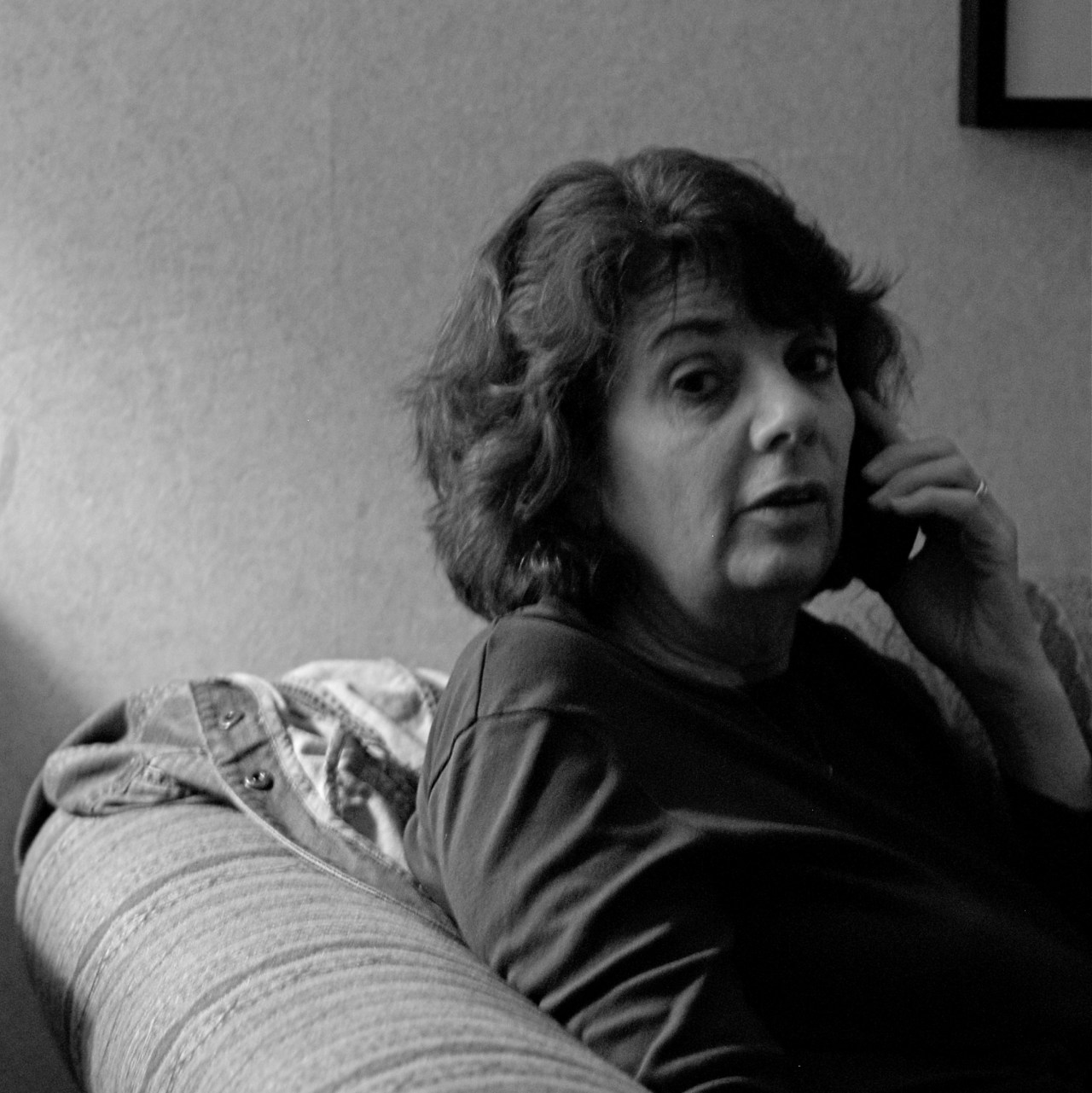
AS I WRITE THIS, I am marking my twentieth anniversary with my wife Marian. Over the years I have written much in these pages about her role as the central muse for my photography. I may not always have delivered on my intention to glorify her in photos, or try to convey her profound influence on how I make them, but I have had a helluva lotta fun trying.
She is, as a person who’s generally not keen on having her picture made, someone that I can seldom pose. The very things that static, formal stagings do for some others are not where her comfort zone lies, and I can only compromise the results by barking out any instruction more complicated than “look over here”. My best strategy is to get in and get out, and quickly. Candids all the way. No “say cheese” or standing her up with a travel destination as a backdrop. I have to make images of her that, before the invention of the camera, would only have existed in my own eye, rooted in our private universe of shared memories. If I can squeeze even a drop or two of that formula from my Nikon, I have more than beaten the game.
One those rare occasions when she approves of the results, usually with only a “that one’s not too bad”, I feel like Ansel, Eisenstadt and Leibovitz all rolled into one. But, to be honest, as with much of my photography, I learn a lot more from the ones that got away, the near-misses. It’s like the old joke about carving an elephant by trimming away anything that doesn’t, you know, look like an elephant. Marian is about fifteen different women to me at various times, and on any given day I can’t predict which one will show up for work. Thankfully, they are all worth pursuing, and all have their own secrets to potentially reveal themselves to a lens. I take pot luck and sometimes take home a miracle.
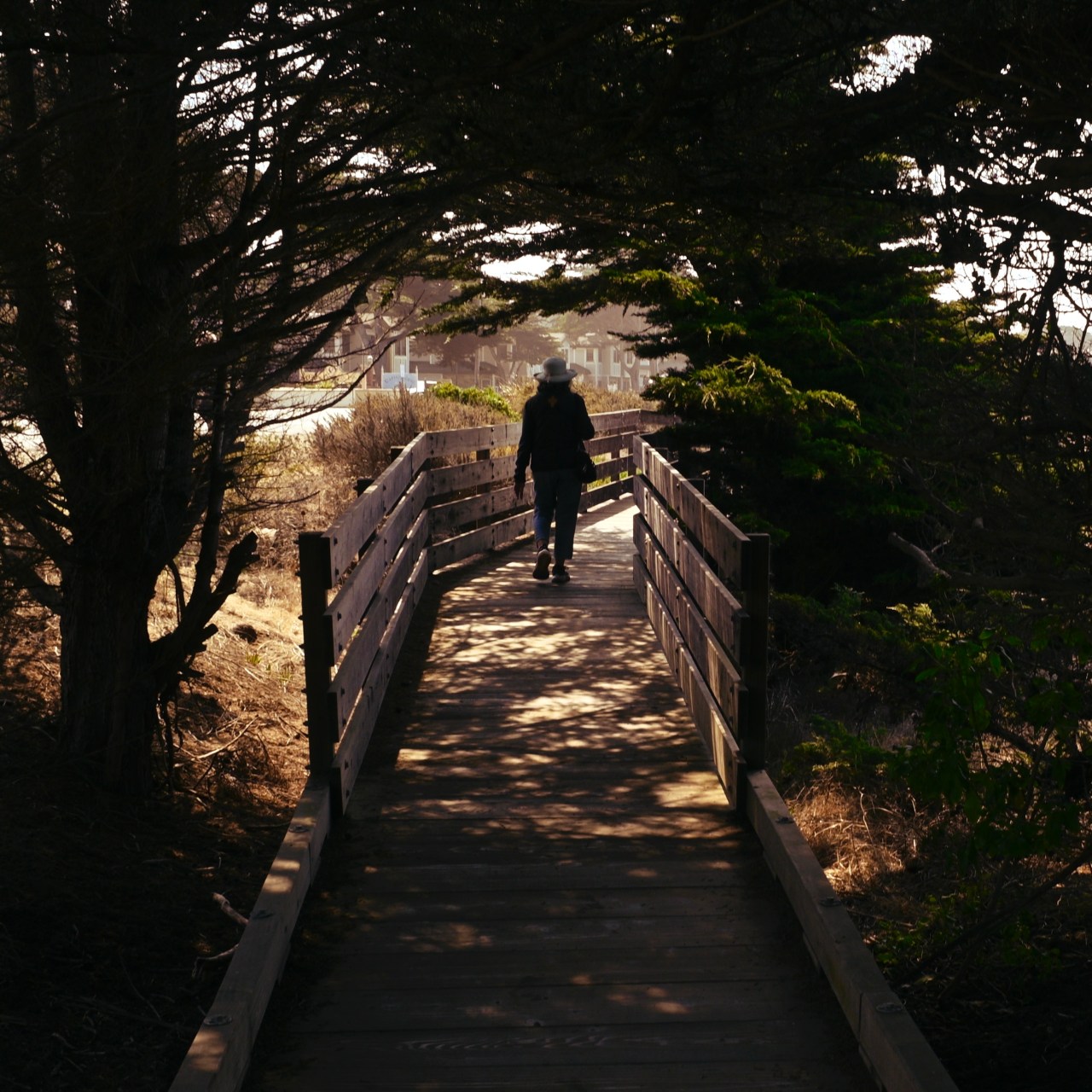
Like all passionate pursuits, photographing my wife is its own reward, regardless of what actually gets captured in the box. It was great fun chasing her all those years ago, and, armed with a camera, I get to take up the chase all over again, whenever I want. I cannot imagine having her as both subject and audience, just as I cannot imagine my life without her on my arm.
The other arm I’ll keep free.
You know, just in case I need to snap the shutter……
JIM MORRISON IS NOT READY FOR HIS CLOSE-UP
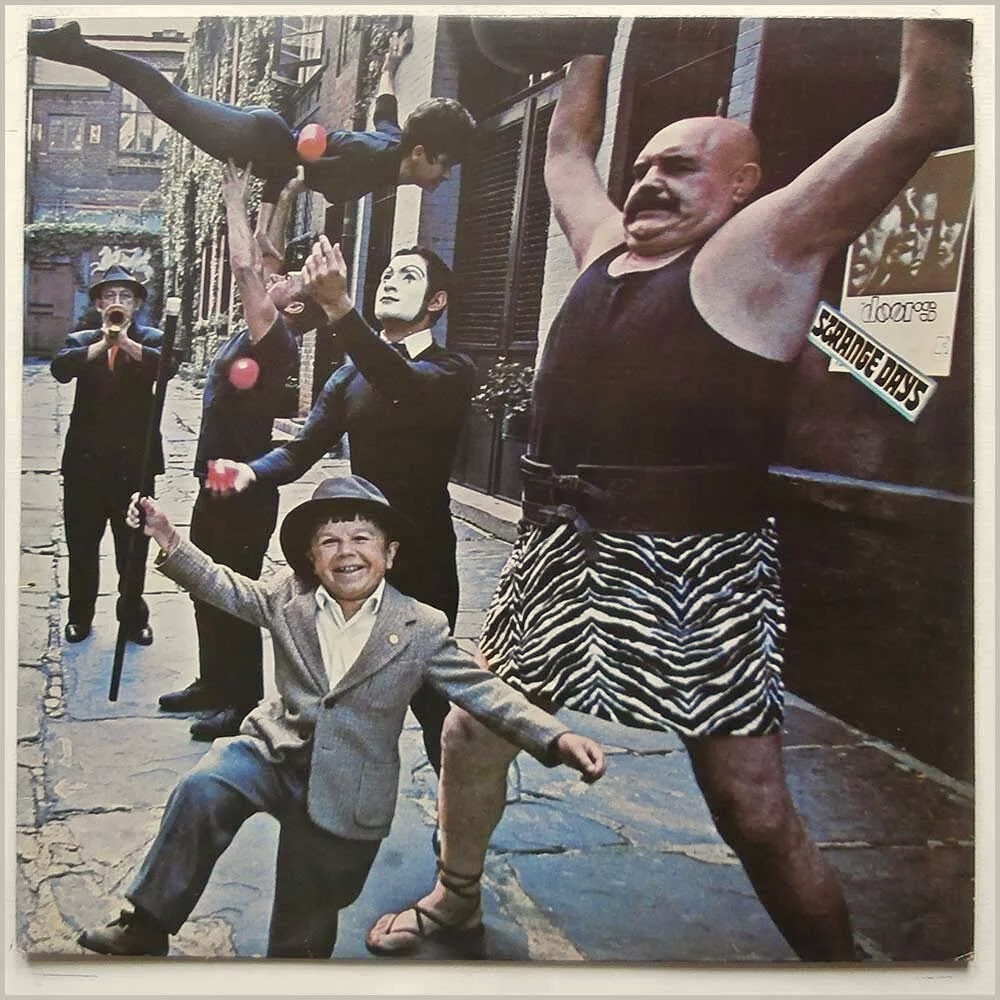
The 1967 cover for the Doors’ album Strange Days, shot by Joel Brodsky.
By MICHAEL PERKINS
WHEN LIFE SLAMS FOUR DOORS IN YOUR FACE, open a fifth one, as a “Plan B”.
A dilemma faced the folks at Elektra Records in the fall of 1967, a year in which the entire concept of album marketing was being turned on its head. The label was issuing a strike-while-the-iron-is-hot follow-up to the debut album by the band the Doors, a record that, half a year after its release, was still atop the charts. The music for the group’s sophomore effort was strong, with advance singles already garnering national radio airplay. There was only one problem: Jim Morrison and the other members were refusing to pose for a conventional photo for the cover.
The long-time practice of designing album covers with attractive images of the artists and a few words about the content inside, a system which had been the norm just a few years prior, was suddenly out the window following the cover of Sgt. Pepper’s in summer of ’67. Suddenly, album covers were no longer just billboards; they were statements, original concepts, a bit of performance art that was, yes, done in support of the record inside, but also created to have a life of its own. The shift across music of the “counter-culture” was immediate. You didn’t just shoot a cover; you designed it.
Faced with a Doors-less Doors album cover, Elektra’s art director William Harvey decided to capitalize on the record’s title, Strange Days, by staging a tableau of bizarre street performers as living proof that, indeed, these days were strange, and getting stranger. He decided to create the cover outdoors, with veteran photographer Joel Brodsky along for the ride, at an old carriage house storage alley between East 36th Street, between Lexington and Third Avenues in Manhattan called Sniffen Court. Unable to round up enough authentic street performers, he had Brodsky’s assistant play the part of the juggler and paid a cab driver in the area five dollars to pretend to be playing the trumpet. Identical twin dwarves were hired (one for the front cover, one for the back), and a bouncer at the Friar’s Club was pressed into service as a circus strongman.
In what would be referred to by contemporary movie fans as an “Easter Egg”, Brodsky managed to sneak one of his group portraits of the Doors onto a wall as a kind of poster. In those days, he was frequently shooting with Ektachrome slide film, which may account for the blue-green color rendering, but no notes survive the shooting, so there is no way of confirming that, or of reconstructing the mix of natural and bounce light in the shot or identifying the lenses used. The shot is fairly sharp from front to back, and it looks deep, suggesting a wide-angle at maybe f/5.6 or somewhere in that ballpark, but it’s all guesswork. The image stands out a bit in Brodsky’s work, which includes dozens of the most iconic covers shot in the rock era, most of them prominently featuring a portrait of the billed artist (as in every other one of his Doors, btw). But Harvey and Brodsky’s quirky “plan B”for Strange Days turned out to be a classic on its own terms, a lemons-to-lemonade “save” for the ages.
“STREETER”-THAN-THOU
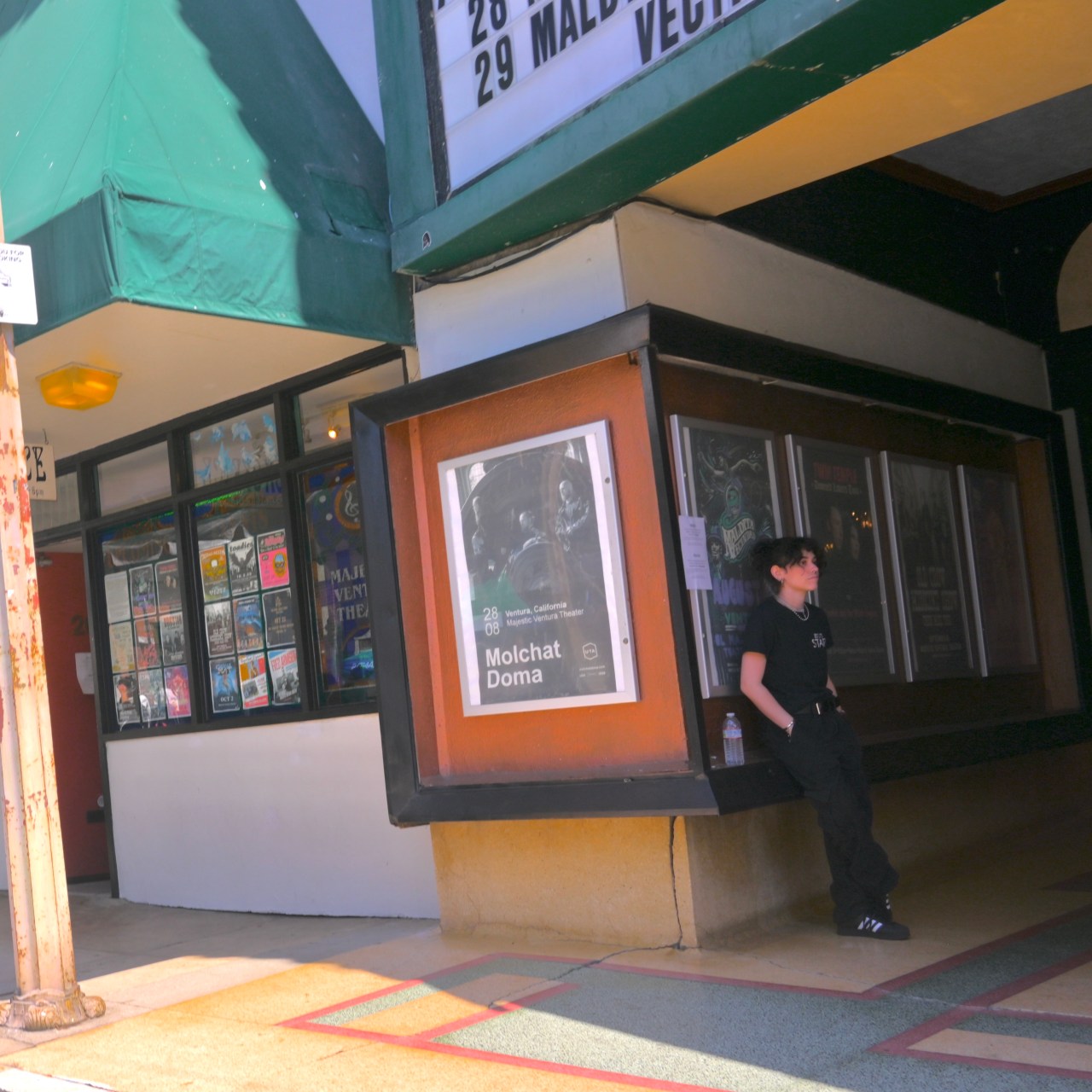
Matinee Iol, August 2026
By MICHAEL PERKINS
I KNEW THAT IF I WERE TO LIFT MY CAMERA TO MY EYE, I’d lose her.
Everyone shooting on the street has received that look, that “don’t even try to take my picture” look. You size up a subject based on some kind of instinct, i.e., “oh, this one is telling a real story“, and you get into a mad rush to frame and snap before, well, before you get caught at it. And then comes the look.
I get it. Street photography, and whether it’s reportage or invasion, is a hotbed of controversy in the present day. What a paradox. We invite cameras into our private lives more than at any other time in history, posing for more candids and selfies than can ever be calculated. And yet. And yet we reserve the right to wall ourselves off from some, not all, but some, prying eyes. Hence you see the kind of solution I was forced into here, preventing myself from being detected by going for the dreaded from-the-hip shot, the ultimate “straight out of the camera” dice roll. All sugar or all sh—-…… well, the opposite of sugar, anyway.
And then there’s the whole discussion about whether I should leave the image, which is decidedly off-kilter, just the way it was shot, or if there’s some arbitrary rule of horizon-normalizing that dictate that I “straighten it out”, a decision accompanied by much soul-searching about “authenticity” and “realness”. Who is more “streeter”? Of such things are bar debates, and, occasionally, bar fights, fashioned. Here, for your consideration, is a “corrected” version of our young subject. Does this settle it? Can anything?
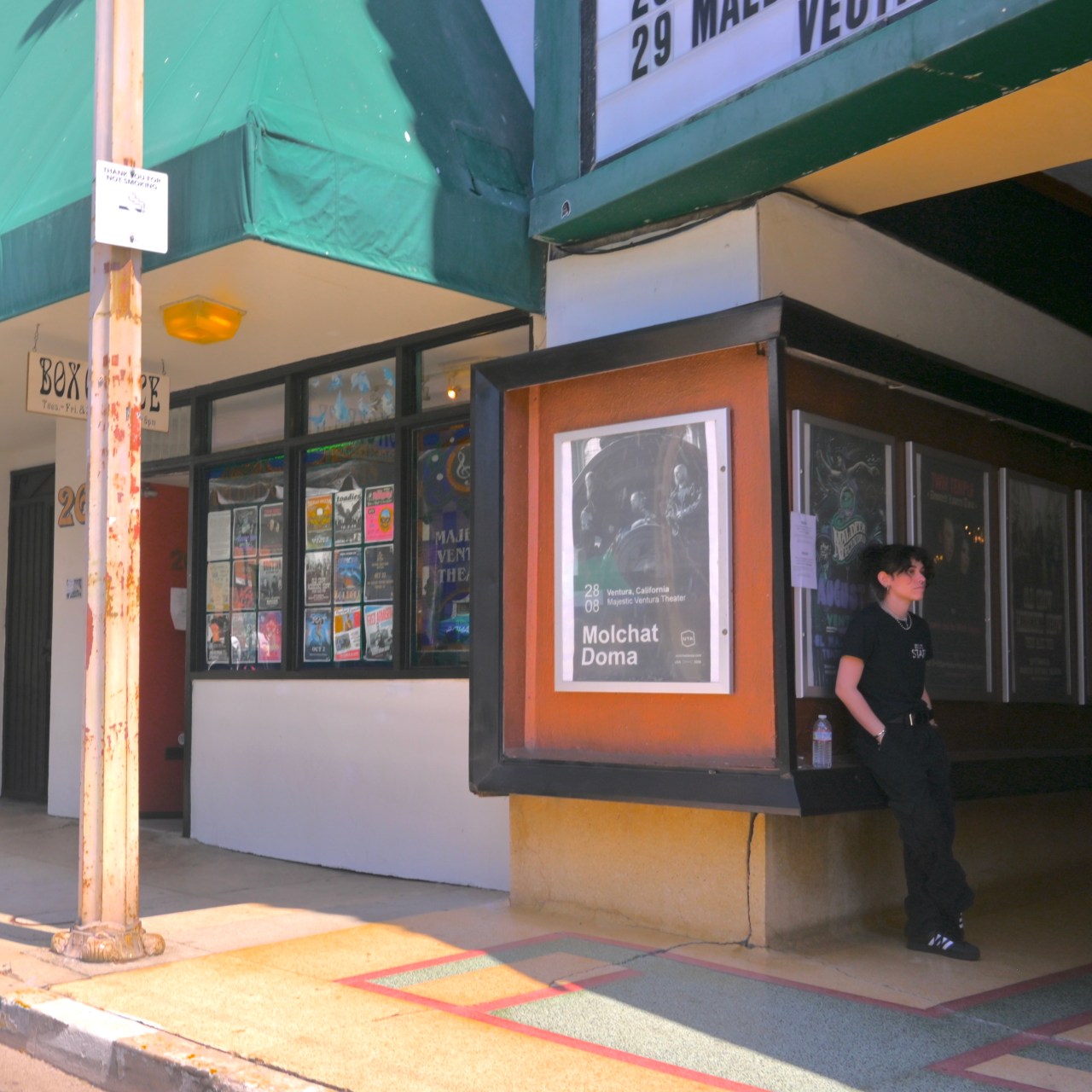
Does this strike you as more normal than the original? And stand up straight, willya?
At least Ansel Adams never had to wonder if he was violating the privacy of El Capitan by taking hours to get his exposure right. No complaints from fleeting sunsets that, “hey, I want to be alone”. And so it goes. Of course photography is an invasion, a theft. Every camera is a spy camera. Stealing a potato chip from your sweetie in the movies is still stealing. The issue comes down to who else in the society sanctions the snatching, of either chips or portraits. Life, at least as much as photography, is a negotiation.
ALL ELSE IS MERELY GEAR
By MICHAEL PERKINS
Master your light before you master your camera.
Ansel Adams
CONSIDER: A BLANK PHOTOGRAPH IS NOT WHITE, like a fresh sheet of paper.
It is black, like a starless night.
Photographic images all begin the same way, with a medium that is dark because it is absent all light. Supply light in enough areas, in the correct dosage, and color and detail and narrative emerge. Light is the reagent that starts the entire photographic process, the trigger. In that spirit, how can we ever know enough about it? How can we ever become adept in all its applications? And what bit of equipment, what device, what tech tweak can compete with merely making a passionate, all-consuming study of light? Light is the only upper-case word in photography. Everything else is merely gear and word salad.
Light presents. It stages. It defines. It caresses. It symbolizes everything from inspiration to hope to, in its absence, loneliness, despair, isolation. Light wraps around things. Leads the eye. Underscores the importance of whatever it falls upon. Changes the very character of what it comments on. Speaks loudly. Whispers softly.

Seattle, Washington, August 14, 2016, 8:08pm.
Light is Topic One for photographers. Do a Google search on the words “photography quotes about light” and you’ll see a cross-section of shooters from across several centuries, all saying what Uncle Ansel said so cleanly and perfectly. Know light, and a simple camera becomes an oracle. Know light, and you control everything about what an image is saying. Know light, and the rest will come.
There is a poetic brilliance to the Biblical account of creation, as God’s first command is literally “Let There Be Light”, as if the Big Guy were saying, “Good. Now I can see what the hell I’m doing…” The very word “photography” means to write with light. To illuminate and shape that which was undefined before, to confer meaning on what was merely the abyss. That’s an amazing power. Photography is an amazing power. And to the degree that you understand what makes the magic happen, it simply dazzles the soul.
BONES ON UP
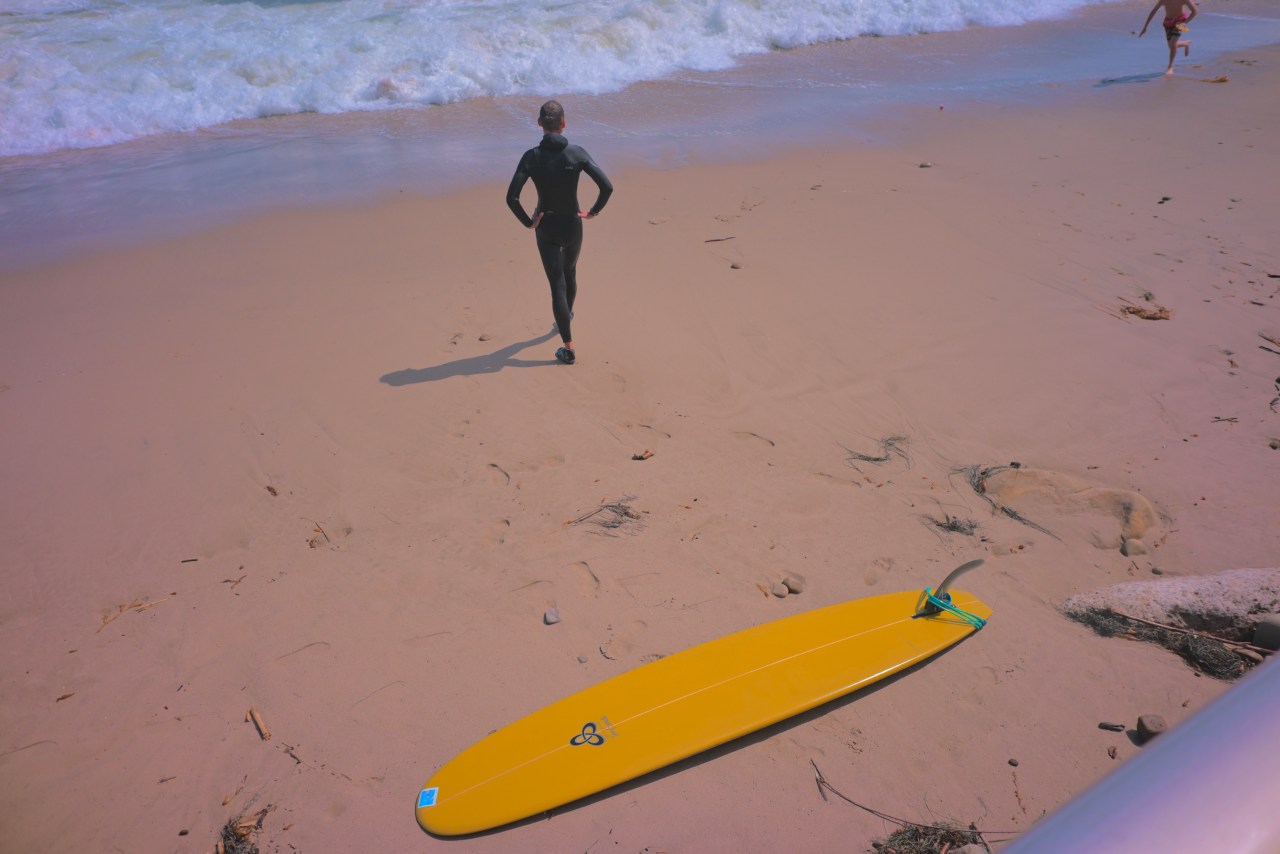
On the way to being a decent image, but some judicious use of the scissors is in order.
By MICHAEL PERKINS
THE ILLUSTRATOR HAL FOSTER, who authored and drew the legendary comic strip Prince Valiant, was often praised for the naturalistic appearance of his drawn figures, an effect he attributed to the practice of building them up in stages. Foster told interviewers that he began at the skeletal level for the people he was drawing, then added in layers of muscle and skin, and finally clothing to make the figures as structurally sound as possible. Photography, in which many pictures are not so much composed as re-composed, can benefit from the same “bones up” approach.
Many of the scenes we snap in the moment are fixed in post-processing, with cropping being the most common tool. We amplify what is needed to tell our visual story and shave away the surrounding distractions. So take this idea a step further, if you will, and imagine that, instead of slicing off unneeded data that “fights” our picture, we are actually beginning with a tabula rasa (blank page) and selectively building elements into it until we get just enough data to make the image effective.
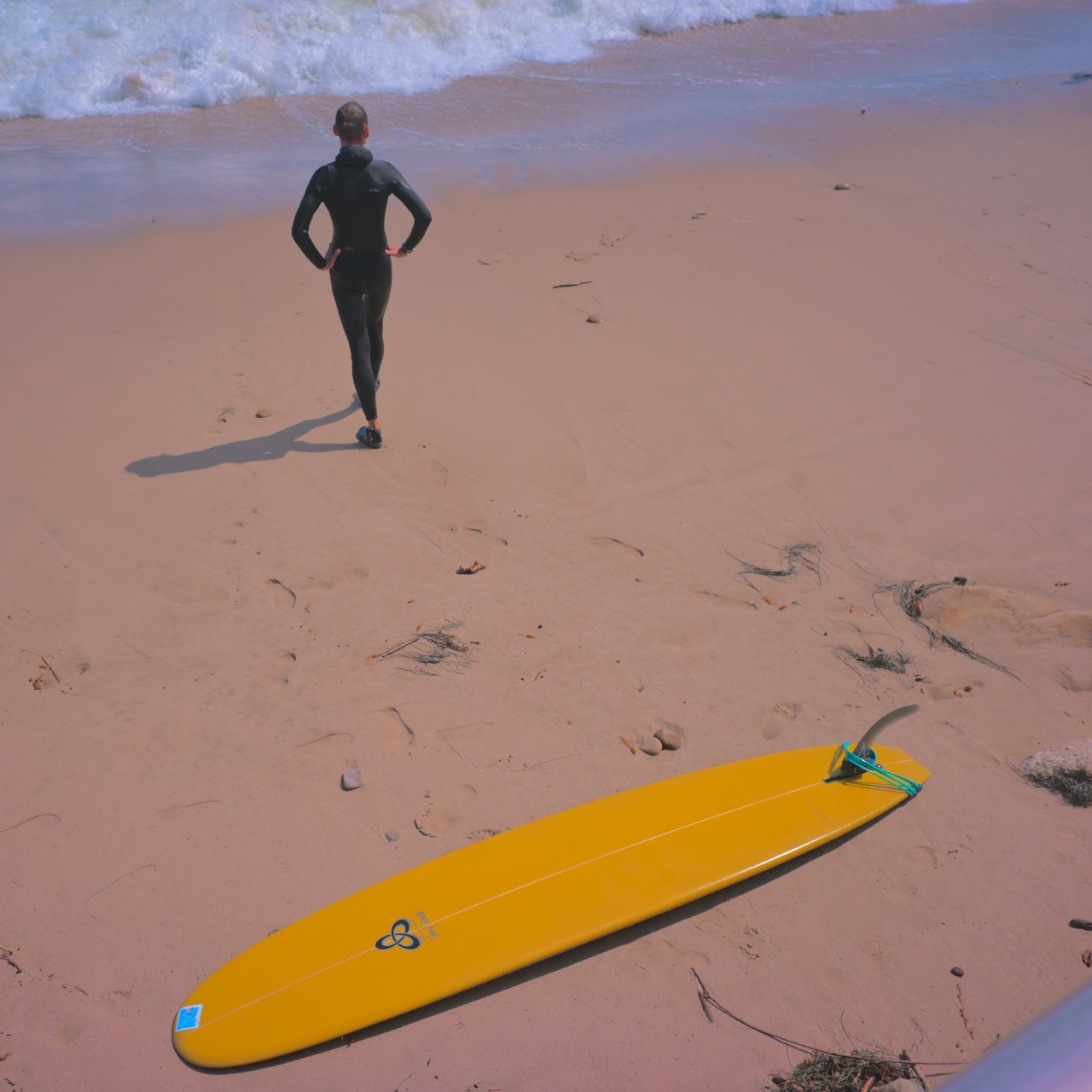
Two snips later; everything I need and nothing that I don’t need.
Take our friend on the beach here. Were I visualizing this scene as if I were building it up piece by piece, I would decide that I needed three main elements; the ocean, or at least a hint of it, explaining the surfer’s purpose; his stance on the sand, which indicates contemplation or intention; and the board, which is not in use, speaking to his unresolved thought process. Do I go now? What’s my approach?
That’s it. That’s the picture. Whether I have those elements in balance at the time I snap it, or crop it back to just those factors afterward, I have visualized the photo as I want the final version of it to be. Of course, in a real-life situation, my frame has also invited other elements that are either distractive or unneeded. For instance, I don’t need more of the waves to the surfer’s left, as they tell me nothing I can’t see with a closer crop, so out it goes. Mosto of the bit of seawall at lower right also conveys nothing important, nor does the other occupant on the beach to the upper right, so, snip, they’re out. And now comes the important question; is what I have left everything I need? Is there anything else that, by being removed, will actually boost the effectiveness of the resulting photograph? If the answer is “no”, then we’re done. I’ve done a Hal Foster, building the picture from the bones up and then stopping. Finis.
All of which goes to underscore that cropping is not merely a “fix” but an active tool. You’re not just cutting things away so much as you’re requiring them to earn their place in the valuable real estate in your images. You’re not losing “the big picture”; you’re inching closer to “the right picture.”
LIMITED, AND FREE
By MICHAEL PERKINS
IN TECHNICALLY PREPARING FOR A PHOTO SHOOT, I find myself, as you likely do, walking a tightwire between having enough choice and fairly drowning in options. What to carry? What might I find to shoot? Is one lens enough, and are six too many? How can I cover every possible eventuality? What if I don’t take the right kit? What if I pack too much, too little?
Not exactly a recipe for enjoyment or relaxation.
In fact, it’s like hardwiring anxiety into a creative project before you even begin it, a conundrum addressed by Barry Schwartz in his visionary book The Paradox of Choice: Why More is Less. There is, he explains, a real juggling act for most of us between variety and fatigue, a teeter-totter of indecision which leads to frustration and anxiety. I often imagine that the author of the phrase “fear of missing out” was a photographer, a guy who, no matter what he packed in his bag, is certain that he made the wrong call. Whatever he did, he should have done something else. Misery ensues.
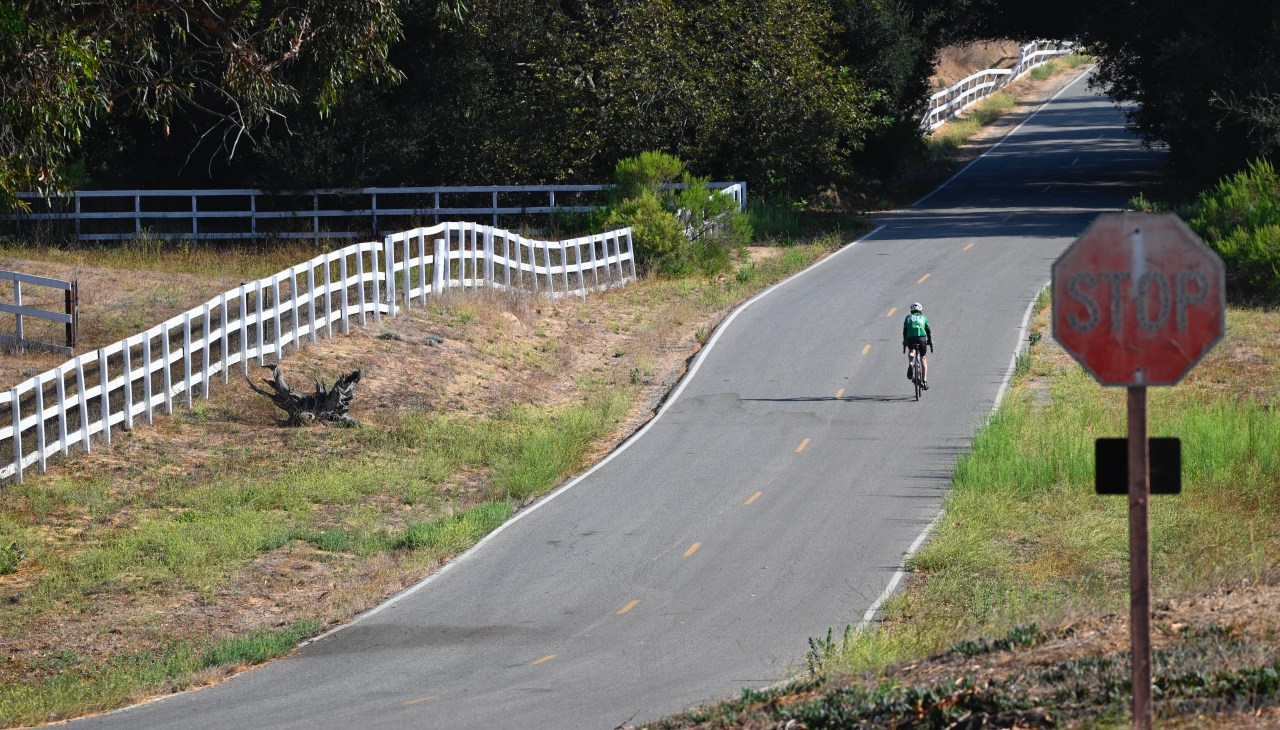
I have logged many miles lugging a lethal load of gear on any and all journeys, only to find that, not only could I easily have gotten by with fewer tools, but that I polluted my potential enjoyment by being paralyzed by the sheer array of choices. Instead of being liberated by all those options, I was actually impaired by them, as was my photography. I was sapping my work of any sense of joy or freedom, emphasizing what I was going to use rather than what I was going to do. It took me a long time to realize that I was sabotaging myself under the guise of being “ready for anything”. I call it the golf bag approach, in which I saw my bodies and lenses like the woods and irons in a standard golf bag. The driver can’t do what the putter and wedge can do, and so on. But a camera is not a golf club. I’ve had to get accustomed to feeling freer by being more limited. An example: the image here was taken on a day when I was out birding with a telephoto that zoomed to 600mm. Not much use for a wide-angle, or anything that delivered that look, until this fellow sped by. If I stepped back, I could open to 180mm and get the shot I needed. Not a true wide-angle, but if I could make the same effect happen without changing glass, why not, said my aching shoulders and neck?
In Paradox Of Choice, Schwartz explains the importance of choosing a course of action that is likely to deliver most of the result you want without expanding your options to such a degree that you simply can’t move. The best photography is reactive, nimble, improvisational. You can’t plan it or diagnose it the same way you can with purely mechanical operations. And, as we have all observed, it is those moments of imprecision, even loss of control, that can produce the most pleasing results. None of us started out equipped with kit bags bulging with choices; it was a learned habit, one that can be unlearned. All we have to do is trust to our own instincts to make pictures with damn near any kind of tool, to ride that tightwire between Too Much and Not Enough with more confidence.


NOW, THE REASON I ASKED YOU ALL HERE…..
By MICHAEL PERKINS
In the end, it’s really just a box. YOU are the actual camera.
ONCE OR TWICE A YEAR, since we started this little small-town gazette almost fifteen years ago, I stop to thank you all for walking this path with us, whether you’re a new subscriber or a wizened veteran. I also use the occasions to re-state how The Normal Eye happened in the first place. It may be instructive for some, and certainly serves as a mental reset for yours truly.
Photoblogs, at the time we launched, were, and remain, dominated by product reviews and technical tips, so much so that I knew that I myself had to go a different way, that is, if I were to keep the content relevant over time or maintain my own interest in the project. As it happened, I had, at about the same time, just compiled a kind of monograph of a year’s worth of images taken with a single lens, the prime glass known familiarly as the “nifty fifty” The other word for primes being “normal”, since they captured things in much the same way that we naturally see, I decided to title the book The Normal Eye. In spending a concentrated amount of time shooting with just one optic on full manual, I learned as much about my own limits, and options, as those of the lens, with the very word normal taking on an ever-more profound meaning for me.
We come into this world sensing everything on an instinctive level. Eventually, as we grow older and are socialized and hemmed in by the basic behaviors of just getting along in the world, we learn to stray from what was our original “normal”, relying on our own instincts less and measuring “reality” in much the same way that everyone else does. We learn that, to draw the sun, you always, always use a yellow crayon. We color inside the lines. We admire others’ view of basic things, often folding theirs into our own. We learn to mistrust the purity of our own vision, in music, in writing, in what we see. We “de-normal” our eyes. And our photography begins to fall into easily categorized, generalized technique. We shoot inside the lines, with a yellow crayon.
And so, re-learning the habit of seeing everything through the natural filter of our souls requires a deliberate, and dedicated exercise. We have to re-discover our normal eye. Learning to fully see is far more important than whatever gear we choose to help us record what we see. Intentionality becomes all. And so, in this forum, I wanted to be able to chronicle, as directly and simply as possible, what I encountered, daily, on that journey back to “normal”, to the natural. We try to use TNE to act like the kind of photographic diary you yourselves might keep, marking your daily progress and your evolving attitude toward the creative act of making pictures. Because Uncle Ansel was right; they are “made”, not “taken”, and that requires an ongoing sense of self-knowledge. It’s what we strive for at The Normal Eye, and it’s what I hope you and I share.
Thanks for being here.
Share this:
September 30, 2026 | Categories: Uncategorized | Tags: Commentary, Photoblog, Technique | Leave a comment