ALL TOGETHER NOW
By MICHAEL PERKINS
IT STARTED OUT WITH MY LIFELONG REGRET at not being able to interview the world’d greatest photographers. Beyond the fact that too few opportunities for actually meeting the greats would ever present themselves in a dozen lifetimes, there was the problem of what, in the name of all that’s holy, I would even ask. Which of them could define, for all the others, what constituted a good picture? Which single person’s work could speak to the full possibilities of the medium? I learned to be content with studying the piecemeal remarks some of them had made, words that often were as evanescent or mysterious as their visual work. And then I realized that they were all, equally, correct.
More precisely, they were all, in an infinite variety of viewpoints, all articulating the same quest, the same terms for their work. Technical mastery, yes, but also personal discovery, a constant struggle to better know one’s self, to hone one’s eye, to synch it with the soul more effectively. I decided to try to show how common this struggle was, across the words of so many shooters, by concocting a kind of “superquote”, a coherent general statement about photography that was actually a composite of the thoughts of many. I served one up in these pages about a year ago, and it was such fun that I offer what follows here as the sequel. As before, different sentences or thoughts originated with different photographers, the identities of which are given, in order of their appearance, in the key below. We are all different, and we are all the same.

Q: How would you (all of you) characterize your personal view of your work?
A: Photography is the simplest thing in the world, but it is incredibly complicated to make it really work. It’s not enough to just own a camera. Everyone owns a camera. To be a photographer, you must understand, appreciate, and harness the power you hold. Only photography has been able to divide human life into a series of moments, each of them with the value of a complete existence. In photography, there is a reality so subtle that it becomes more real than reality. It’s about finding out what can happen in the frame. When you put four edges around some facts, you change those facts. To me, photography is the simultaneous recognition, in a fraction of a second, of the significance of an event. The eye should learn to listen before it looks. Photography takes an instant out of time, altering life by holding it still.
Technology has eliminated the basement darkroom and the whole notion of photography as an intense labor of love for obsessives and replaced them with a sense of immediacy and instant gratification. But no matter how sophisticated the camera, the photographer is still the one that makes the picture. The two most engaging powers of a photograph are to make new things familiar and familiar things new. Of course, there will always be those who look only at technique, who ask ‘how’, while others of a more curious nature will ask ‘why’. Personally, I have always preferred inspiration to information.
So stare. It is the way to educate your eye, and more. Stare, pry, listen, eavesdrop. Die knowing something. You are not here long.
(1.Martin Parr 2. Mark Denman 3. Edward Muybridge 4. Alfred Stieglitz 5. Garry Winogrand 6. Henri Cartier-Bresson 7. Robert Frank 8. Dorothea Lange 9.Joe McNally 10. Doug Bartlow 11. William Thackeray 12. Man Ray 13. Walker Evans)
HERE I AM IN FRONT OF…..
By MICHAEL PERKINS
BY A WIDE MARGIN, THE MAJOR BY-PRODUCT OF THE EASE AND CONVENIENCE OF THE DIGITAL PHOTOGRAPHY ERA has been the boundless proliferation of the selfie. What was, just a generation ago, something of an experimental shot has now become the global baseline credential of personhood. “Today”, wrote Susan Sontag many years ago, “everything exists to end in a photograph”, which I would amend slightly to read “everything exists to end as a backdrop in a photograph of me.” The Eiffel Tower may have some innate impact, but nothing compared to the validation it receives if I am standing in front of it.
Of course, souvenir photography always functioned this way; people always shot Uncle Bob in front of the pyramids or Mom inside Notre Dame, as if to prove that they had made it to this place or that. What’s different now is the sheer volume of shots (and time) spent just in glorifying ourselves, usually in a tight head shot, reducing the attraction or destination in question to a distant prop or afterthought, as if our facial expressions comprised a kind of ego-driven series of trading cards, with the objective being to collect the entire set.

And so we rack up bigger and bigger totals of pictures of ourselves in front of….whatever, and we go from being shooting images of random activity to snapping pictures of people posing for pictures, getting ready to pose for pictures, or playing pictures back. Popular points of interest or tourist destinations roll with the trend and provide more opportunities for their patrons to pose in front of cool stuff. The street performers seen in the above shot do not work for a fair, a carnival, or a circus, but a botanical garden. Traditionally, taking in the seasonal shrubs and flowers does not seem to call for the services of eight-foot butterflies or zebras, but people will or must pose in front of something, and so these wandering backdrops spend all day smiling for “just one more, okay?”
The camera was created primarily as a way to take visual measure of the world beyond ourselves, and, of course, it still serves that purpose. But one of its main components, people-watching, is increasingly about people who are ready for their close-up, self-consciously eager to publish and be liked and be followed. Here I am in front of….hmm, you can’t really tell, but I like the way my hair looked that day….now, here’s…..
BACK TO BEING….A BEING
By MICHAEL PERKINS
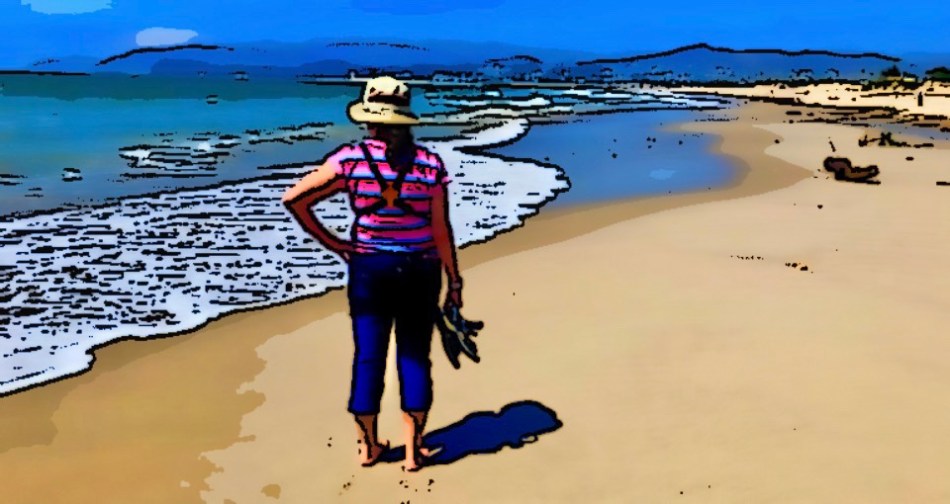
VACATIONS ARE HARD WORK.
Well, sure, lying next to the pool and trying to grab the waiter’s attention for uno mas of whatever’s in this drink is not the exact same thing as hard labor. It’s just that, for some of us, effectively getting our minds on a leisure footing requires as much focus as learning any other important life skill, leading many of us to feel that it’s only as we head back for home that we’ve finally started to get the hang of the whole “chilling” thing. And since I am always making some kind of picture wherever I go, the results of my vacay snapping reflect the same process of adjustment as well.
It’s not enough to merely say that the images get “simpler”, or that I shoot more instinctively in some way while on holiday, although both those things certainly happen. It’s more like my entire perception of what a picture is for is changed, along with a different concept of what is worthy of a picture. For one thing, when I am away, I shoot almost equally with a cellphone and my more sophisticated cameras, something I rarely do at home. This affects the choices I make in a variety of ways, as happens whenever we shift from one device’s strengths/limits to those of another.
To cite but one example, I use a much narrower, and sometimes more dramatic range of post-processing effects (of which the picture up top is a product) on my cell camera than on my Nikon mirrorless, on which I nearly always shoot straight-out-of-the-camera. The phone camera also serves as a kind of “sketch pad” or first-take record of subjects I will return to later with the Nikon, whose tools are far more nuanced and controllable. All of this and more goes on in my back brain while my forebrain is telling relax, you idiot.
If I’m lucky, I come home with at least a handful of images in which I somehow managed to do something different, moments in which I actually figured out how to be “on vacation”. In such cases, the expense and planning all seem worth it, and I re-experience at least a part of the electric thrill I felt the first time I put my eye up to a viewfinder.
Now that’s relaxing.
GOING STRAIGHT, WITH A DETOUR
By MICHAEL PERKINS
I DON’T PRECISELY KNOW WHAT THE TERM “STRAIGHT OUT OF THE CAMERA” MEANS, and I suspect that you don’t, either.
As a phrase, SOOC is now more the expression of an ideal than any accurate reflection of a process. In the years since on-line file sharing began to codify our photographic work into broad categories (the easier to keep track of things, my dear) this baffling abbreviation has began to crop up more and more. You know the stated intent; to create groupings that are defined by images in which no manipulation or processing was ever added, ever ever, pinky swear on a stack of Ansel Adams essays. But just as with terms like “natural” or “monochrome”, SOOC tends to obscure meaning rather than enhance it; that is, it refers to something that is supposed to be desirable without explaining why.

We are given role models to admire and emulate; legends like Cartier-Bresson are historically held up as paragons of SOOC. The stories are repeated for each new generation: He never spent any appreciable time framing a shot in advance….no editor ever cropped a single one of his shots….and so on, into the realm of holy myth. But so flaming what if all that were even true? What additional authenticity or impact is conferred on a picture just because its author never touched it again after the shutter click? Beyond the wonderful vanity that our first vision of something could be so profound that no further action or intervention is needed to render it complete, does that mean anything more than someone who solved a crossword in under twenty minutes, or managed to go three years without eating dairy? I mean, on one level, I get it. We would all love to claim the mantle of auteur, creating our own perfectly realized art without assistance or adjustment. This my creation, and mine alone. It’s a pleasing fantasy.
But that’s all that it is.
The image you seen here is, by my lights, as close to SOOC as I personally ever get. And yet: I cropped it, leveled it, raised the luminance on the reds and oranges. I did, in fact, mess with it, though not in a majorly transformative way. This is called a “tweak”. Granted, it took a lot less intervention since the master shot generally worked out as planned. The result was a collaboration, if you like, between Shooting Me and Editing Me, and I’m fine with that. Here’s the deal: in creating a “straight out of the camera” category, image sharing sites have, for good or ill, drawn a line between preferred and regrettable, between instinctive genius and “coping well”, and that bothers me. Art cannot be crammed into ill-fitting “worthy” or “less than” pigeonholes. When that happens, it becomes “less than”, well, art.
EX POST FACTO
By MICHAEL PERKINS
PHOTOGRAPHING THE BUILDINGS THAT ONCE COMPRISED THE VISUAL LANDSCAPE of a vanished time is always an entire “term paper” project for me. Finding antique structures that were designed for very specific uses, and trying to shoot them in as close to their original form as possible, always trips me into reams of research on how they survived their eras, what threatens their further survival, or what grand new uses await them in the future. And most of those stories begin with my quite accidentally strolling past them en route to somewhere else.
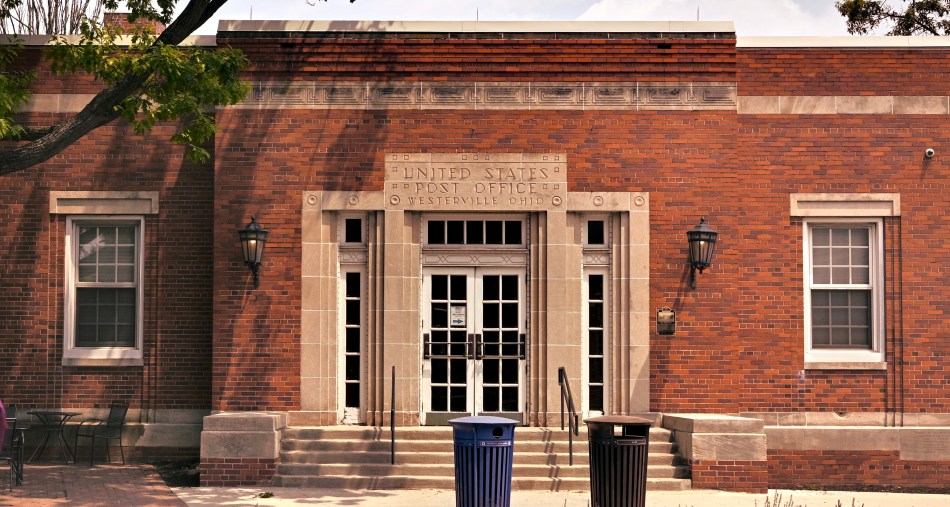
This post office from 1935 popped into view as Marian and I were taking a recent post-lunch stroll around the reborn town of Westerville, Ohio. Photos from its grand opening show it to be nearly identical in appearance to the first day of its service, decades before its namesake was even officially a city. It was one of dozens, perhaps hundreds of village post offices built during the Great Depression by the job-creating New Deal program known as the W.P.A., or Works Progress Administration. Most of the P.O.s erected in those austere years were, themselves, no-frills affairs, devoid of all but the simplest decorative detail and as structurally logical as a Vulcan with a slide rule. Straight, clean lines. Modest appointments. Simple tablatures over the entrance.
The Westerville P.O.’s most distinct feature was actually inside the building, where a “noble work of the common man” mural typical of the period (another federal make-work project to help sustain starving artists) once decorated one wall. Sadly, Olive Nuhfer’s “The Daily Mail” depicted a neighborhood that resembled the artists’ native Pittsburgh, a bone of contention for the Westerville locals who pronounced it out-of-step with the small-town ethos of the area. In time, the painting was removed and returned to a permanent place in the Steel City.
Photographing these kinds of buildings is an exercise in restraint, in that I seek to idealize the structure, to lift it back up out of the past if you life, but without over-processing or embellishing it. Seeing it as close to how it first was is enough for me; it is absolutely of its time, and, as such, it’s a gift.
Post Script (see what I did there?): It’s also encouraging that a regional restaurant chain will soon give the empty building new life as a brew pub. However, it’s more than a little ironic in a town that was once the national headquarters of the Anti-Saloon League, the bunch that forced Prohibition down America’s throat (without a chaser), meaning that Westerville was, for a time, the busiest small postal system in the country, simply by virtue of sending out millions of pieces of anti-hootch literature every year. John Barleycorn gets the last laugh.
OF CLEAN SHOTS AND DIRTY BIRDS
By MICHAEL PERKINS
“WELL, THAT’S A DAY I’LL NEVER GET BACK” goes the cliche about irretrievably wasted time, muttered after many a dud movie, inert concert or (say it with me), a particularly frustrating photo shoot. Many days we greet the dawn overflowing with hope at the day’s golden prospects, only to slink back home under cover of nightfall with nothing to show for our efforts but sore feet. Such is the camera life.
One of my own key wastes of picture-making time consists of the hours spent trying to do workarounds, that is, outsmarting a camera that is too limited to give me what I want without a ton of in-the-field cheats and fixes. My chief offender over the last five years is the compact super-zoom that I use for casual birdwatching. I lovingly call this camera “The Great Compromiser”, since it only makes acceptable images if the moon is in the right phase, the wind is coming from the northeast, and if I start the day by sacrificing small animals on a stone altar to appease the bloody thing. We’re talking balky.
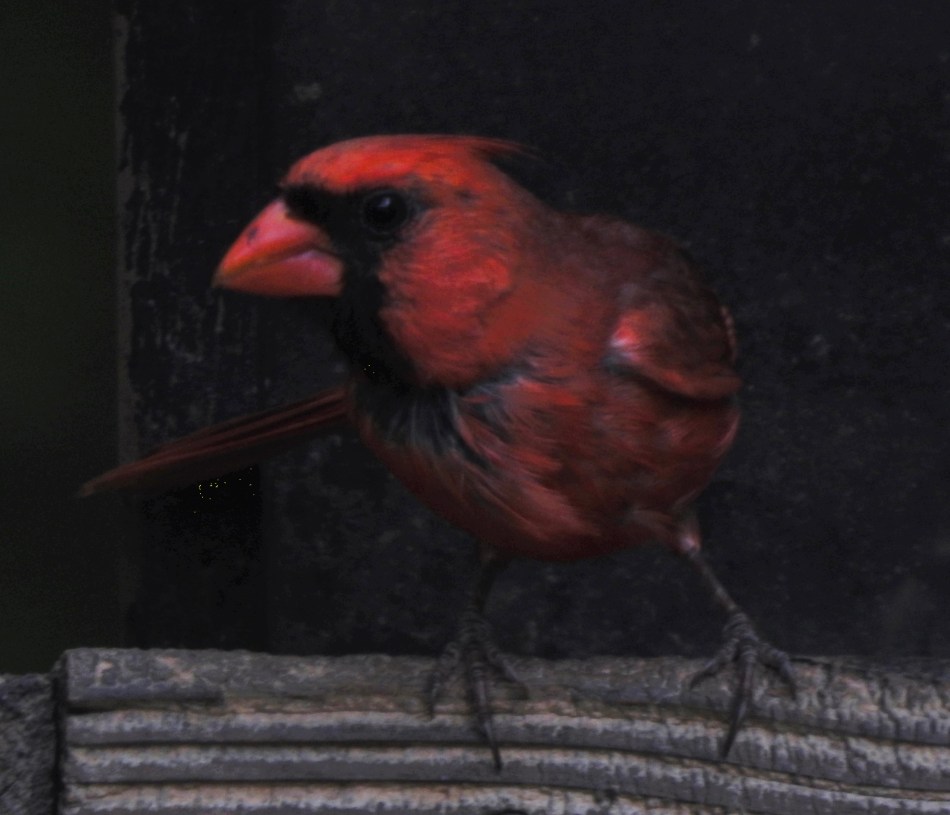
Out of the murk rises a small miracle. Or not.
The Compromiser achieved its convenient size and insane levels of magnification by writing all its images to a small, small sensor. That means that direct, plentiful sunlight is the only way to get acceptable results, proof of which can only be evaluated in playback, since the EVF is dim and utterly unreliable as a predictor of success. Add to that a maddeningly slow response rate after burst shoots, menus that only Satan himself could admire, and the surety that even a mild boost in ISO will generate more noise than a midnight Kid Rock show, and you begin to get the idea. I saved lots of money by not purchasing a dedicated prime zoom lens and I pay for it daily in the agony of using my “bargain” in the real world. Live and learn.
But just as any camera can deliver shots that are technically, well, caca, an occasionally “wrong” picture somehow works in spite of its shortcomings, and that’s where we find the above image, which gave me a dirty bird instead of a clean shot. The picture’s very imperfections gave me a look that I certainly would not have sought on purpose, but which is strangely endearing, even though nine out of ten other shooters might justifiably consign it to the Phantom Zone.
And so we soldier on, learning to love our red-headed (red-feathered?) stepchildren even as we see them as something that we never, ever want to do again. Love-hate is a term that seems to have been coined specifically to describe how the artist evaluates his art. Get away from me. Come here, I need you. I’ve never despised anyone like I despise you. Kiss me.
Repeat as necessary.
A RESETTING OF SETTINGS
By MICHAEL PERKINS
MY FIRST QUARTER-CRNTURY IN THE AMERICAN WEST has completely re-ordered my senses, and, in turn, my evolution as a photographer. My concepts of beauty, design, history, and ecology have all been filtered by those years through a visual grammar that is indigenous to deserts and the kind of scale of space that was purely abstract to me as a boy in Ohio. It only makes sense, then, that as I entered the back half of my life, a completely different approach to picture-making would become my mental default.
A recent return trip to my native Midwest, for a longer-than-usual stretch than has been typical for many years, allowed me to schedule more than the standard lunches and reunions with family and friends. That, in turn, let me literally stop and smell the roses, as well as re-awakening my inner tree talker.

This sounds a lot less important than it is, but, in the creation of nature images “back home”, part of me is not only around more green but re-acclimating my eye to the process in seeing it. It’s not as if the West is entirely composed of tumbleweeds and cow skulls; it’s that green takes a back seat of sorts, a reverse of the role it plays in other regions. In returning to the parks and creeks where I came of age, I find myself overwhelmed by the challenges to my work flow; it forces me to slow my shooting time by more than half, if only to re-calculate the regional shifts to the basics of exposure, composition, and so on. I have to find my way back to a sense of belonging here. It’s a fraught journey, made even stranger by memory and other tricks of the mind.
And so it goes. Photography begins as a simple mechanical process, the faithful transcription of experience. But all great pictures begin and end in the brain, and adjusting those settings is far trickier than merely clicking dials on a camera.
REDRAFTING THE RULES
By MICHAEL PERKINS
COMPOSITION IN PHOTOGRAPHY is an exercise in prioritization, a series of ranking decisions that inform the viewer what will be important in a picture. It is, if you like, a picture’s “ground rules”, the terms of engagement between shooter and audience. Look here. Notice this first. Regard these as important.
Most of the time, the assignment of space in an image depends merely on how naturally occurring elements in a photo are framed. The stuff that goes from left to right, top to bottom is thus determined by your shooting angle or distance from the subject. In some special cases, however, a composition is made by extracting select elements in a frame and creating a whole new composition through duplication of those elements; refracting, distorting or multiplying them until the way they occupy space and focus attention are radically re-assigned.
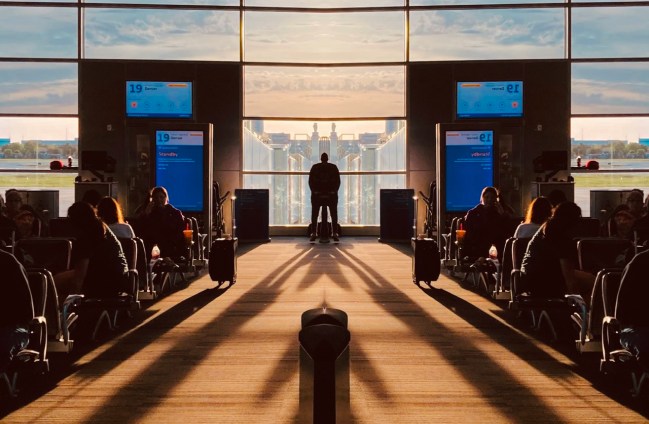
At this point, a standard object becomes purely a bit of design; it fails to be an actual thing and is repurposed as purely a collection of angles, shadows and patterns. As seen in the above image, which was crafted from a standard snap in an airport waiting area, so-called “real” things become components in a fantasy realm through duplication. What they signify or “mean” is completely recontextualized, suggesting worlds that can only exist within the newly re-drafted rules of that one picture.
Often, the unique arrangement of what is framed in a “real” image will supply all the story that photo needs. However, photographers must follow whatever paths lead to the best narrative. And sometimes those paths veer dramatically away from mere reality.
 thenormaleye