THE LOVELY, THE LONELY
By MICHAEL PERKINS
SHAKESPEARE’S CONTENTION THAT “THERE IS NOTHING EITHER GOOD OR BAND, but thinking makes it so” seems an awful lot like the philosophy of a good street photographer. The notion that all subject matter is but the starting line for a race toward meaning, and that creativity dictates that we all take our own paths to the finish line, rings as true today as it did in the reign of Elizabeth I. Like the bard, shooters come upon things or places whose contexts are incomplete, requiring that we tag them with “good” or “bad” stickers as we see fit. Cities and people shot at the speed of active life can yield results that are either lovely, or lonely, or both. The miracle is that, even though we are using a machine as our interpretative tool, the soul is clearly in the driver’s seat.
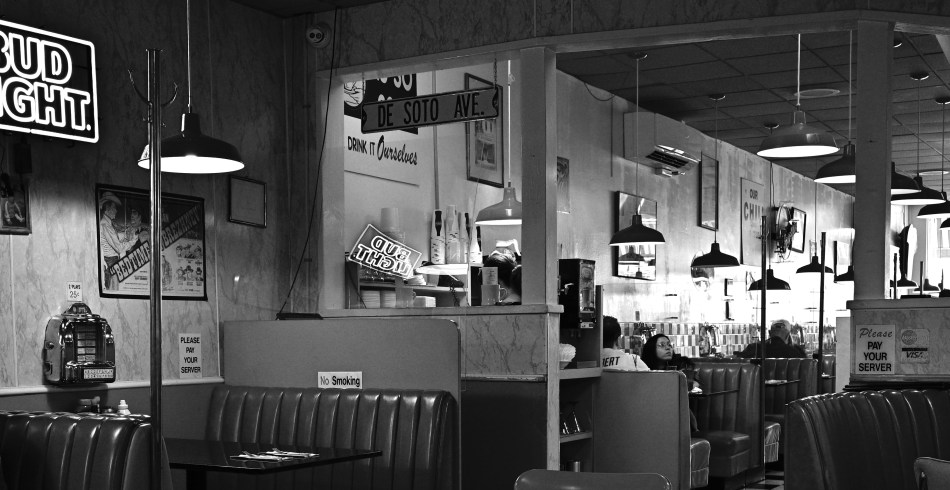
Public places like the diner shown here are like wipeboards of experience. Assemble a given set of things on that board, and the message is merriment, the enjoyment of a gathering. Then wipe down the board and arrange a few shadowy shapes. In an instant, the same board is a portal to introspection, isolation, sadness. This creative “optioning” goes across artistic lines. For example, songs mirror the plasticity of photography when it comes to interpreting spaces. One composer looks at a neighborhood joint and writes Roll Out The Barrel, We’ll Have A Barrel Of Fun, while another views that same hangout and pens It’s A Lonesome Old Town When You’re Not Around. Like the photographer, the songwriter sees what is and asks whether it would be better off being something else.
The burger palace seen here, built to recall the simpler times of the Happy Days era, is, in its natural state, fairly exploding with color, most of it Coca-Cola Red. It’s impossible to make the place look moody or poignant with the distraction of all that splendor, and so I did the master shot in mono, since converting a color shot didn’t render the same contrasts. In reality, the place bears the jolly name of the Busy Bee Diner, but, in my view, it works better as the Last Chance Cafe, and so there you are. Shakespeare, had he been born after about 1800, might have delighted in the camera’s ability to shape perception, much as Lord Hamlet loved to cast his Danish gloom over everything in his path. Of such things are plays and pictures made.
 thenormaleye
Leave a comment