GETTING INTO IN
By MICHAEL PERKINS
AS MORE AND MORE PHOTOGRAPHERS DIP THEIR TOE into full-frame sensors for the first time, a slight re-learning curve seems inevitable. The smaller sensors that were typical on the first DSLRs taught us all to do a strange math when sizing up shots, since a cropped image was smaller by one-and-a-half times or even more than those taken on a traditional 35mm frame. This meant that some lenses shot tighter on our cameras, with, for example, a 35mm delivering a frame more like a 50 in terms of the area covered. In moving to full-frame, the process is reversed, with a 35 shooting just as wide as a 35 should, forcing us to re-think how much info we want in wide shots that suddenly seem like wiiiiide shots.
Glad as I am to have a lot more breathing room in my images, I am still being reminded that, on a really wide shot, I seem now to be very far from the center of action. Shooting mostly with primes rather than zooms, I have to take several trial shots until I hit the right balance, and, in many cases, move a lot closer to my subject. I’ve got to get further into in.
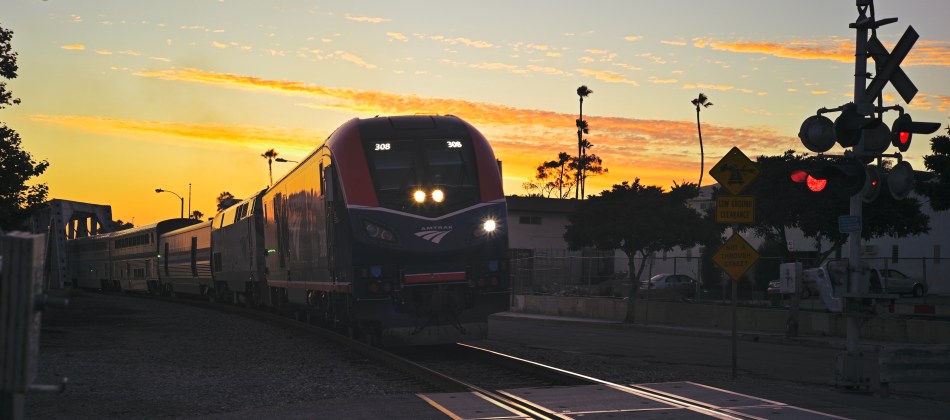
This shot of a freight train rolling through Ventura, California was shot on a 28mm lens on a full-frame Nikon Z5. I began sizing up the composition when the engine was quite far off, taking trial shots as it first emerged from under the trestle bridge seen at far left and just ahead of a local gate crossing. I was certain that my first shots would be just about perfect, but again and again I saw the train appear distant and small. I was still framing based on my old experience of seeing a 28 on a cropped-sensor, which would read roughly like a 42mm. In the end, I had to move nearer the crossing and stand so close to the tracks that my wife became alarmed, if the phrase “you’re going to get yourself killed!!” is any indication of her mood. Even so, the train seems like it’s still approaching me, not about to run over me.
Bottom line: my brain was/is still re-learning just how much a wide-angle can exaggerate the distances from front-to-back in a shot. I could, of course, have shot the scene with a zoom, but for the fact that the zoom I had with me was nowhere near as efficient in the rapidly fading sunset light, and that the bridge camera it was designed for had a significantly smaller sensor, which would become extremely noisy with even a modest boost in ISO. Far easier in the long run to adjust where I’d stand than fussing with all those other variables. I shot wide-open at f/2.8, kept the ISO to around 100, and snagged an acceptable shot. Wide-angles are a glorious tool, but in switching to full-frame, there is a break-in period as your brain resets on the rules of engagement.
 thenormaleye
Leave a comment