CANYON-ADJACENT
By MICHAEL PERKINS
MANY LARGE CITIES BOAST ENORMOUS STRETCHES OF ULTRA-TALL GLASS AND STEEL TOWERS arranged in a kind of urban forest that is both broad and long. Think Manhattan, where the dense bigness of the skyline seems to stretch outward to all points of the compass at once, a town of big shoulders where all the short shoulders seem to have been crowded out, and where the amazingly new seems to nearly eclipse the old.
That idea of a solid, omni-directional bigness is not as universally true on the opposite coast, where, in many parts of Los Angeles, for example, the town’s bigness is often confined to buildings right along the main drags, with shorter, older residential neighborhoods intact, almost invisible, just a few blocks either side of that, as if the skyline went dramatically from dominoes to sugar cubes within a very brief distance. This is quite pronounced in the “museum row” or “miracle mile” section of Wilshire Boulevard, which begins in Santa Monica near the coast and makes its way northeast to the heart of downtown L.A.
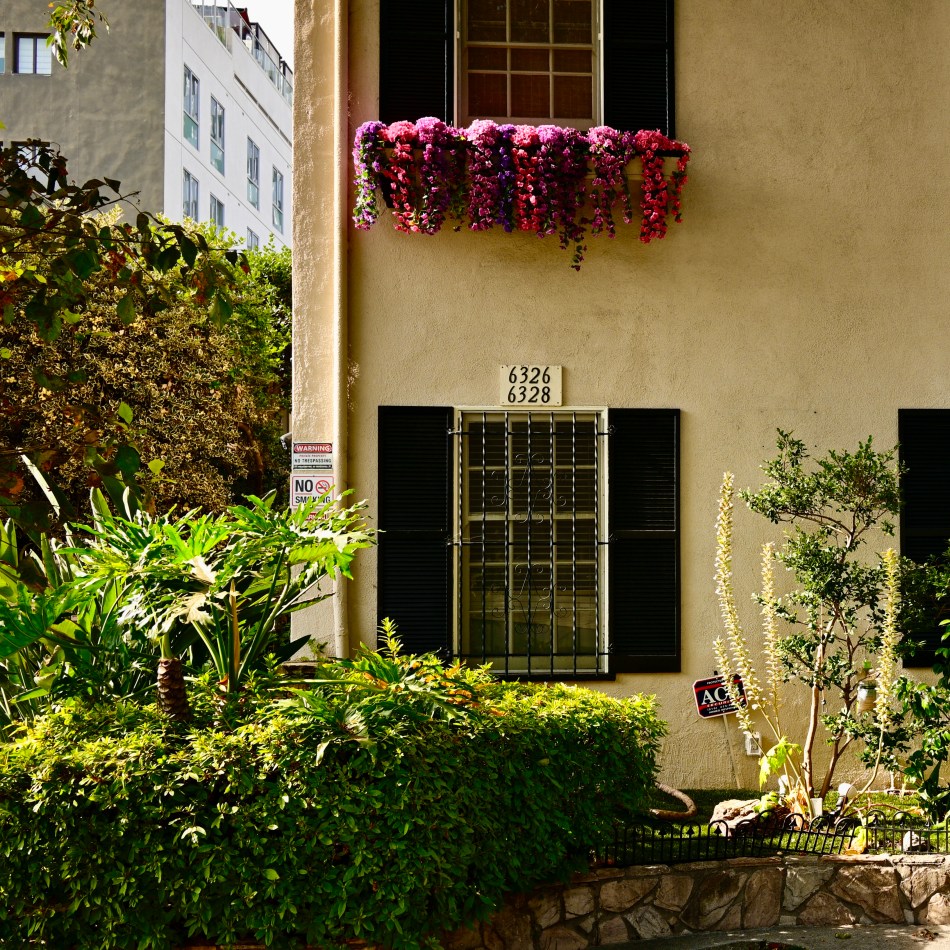
Hidden from view in the busier parts of Wilshire, and yet scarcely a hundred yards north or south of it, dozens of older districts can be found, boasting huge homes that, in some cases, date clear back to the 1920’s, largely unchanged by all the monstrous stacks of stories that line the main avenue. They are not part of the “concrete canyon”, but are indeed “canyon adjacent”. In this frame, a vintage house can stand in stark contrast to the skyward reach of its taller neighbor, almost as if the skyscrapers provide a buffer or protective wall that acts as a barrier against the encroachment of time. The average height of a structure can thus drop from dozens of floors to two, or even one, within the space of a city block.
Neighborhoods are delicate things, and it’s always a delight to see how well some of them manage to defy change, or, more precisely, to survive it, living on to assert their own identity. Los Angeles is not unique in its array of canyon-adjacent jewels, but it is one of my favorite photographic hunting grounds because of the phenomenon.
 thenormaleye
Leave a comment