THE MOMENT WHEN THE MASK SLIPS
By MICHAEL PERKINS
Lord, what fools these morals be!
William Shakespeare, A Midsummer Night’s Dream
ELLIOTT ERWITT, the world’s most widely published freelance photographer, who passed just days ago at the age of ninety-five, served up, in over a half century of work, many proofs of mankind’s folly, but never with Puck’s snooty disdain. For decades, his work displayed our most unguarded moments, the brief instants when the mask of control slips a bit and reveals the vulnerability within. We laughed at his images because they were true; it was easy to identify with the ironic, or strange, or hilarious behavior in the people he snapped because they were us, in all our sloppy and divine imperfection. His was a great eye, and his work was a great gift.
Born Elio Romano Erwitz in France in 1928, Erwitt emigrated to the U.S. while still a child, and was formally educated in picture-making in Los Angeles before moving to New York in 1948, where he chanced to meet the photographic superstars of the day, including Edward Steichen and Robert Capa. By the time he was drafted into the Army in 1951, where he worked as a photographer’s assistant, he already had several published commissions under his belt, and, upon returning stateside, he became a full-time freelancer, taking assignments from the prominent print magazines of the day, from Life to Look to Colliers and well beyond.
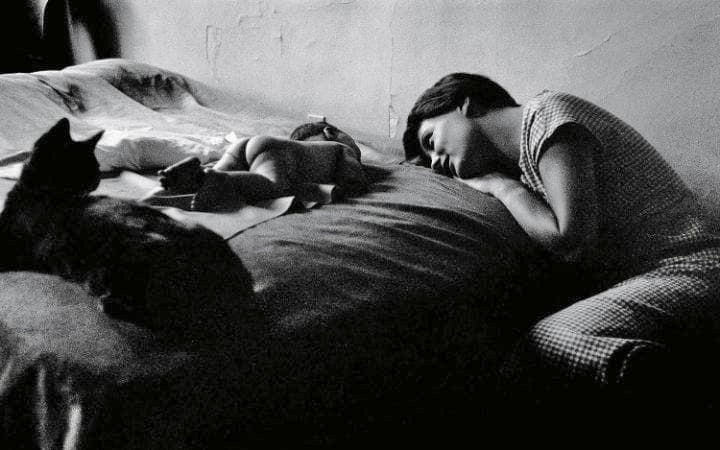
Erwitt’s work became mostly associated with whimsy, eliciting dry chuckles from the candid realities he extracted from his random street work. However, his output was always leavened with more conventional journalism and portraiture, ranging from his moving shot of Jaqueline Kennedy receiving the folded flag from her husband’s coffin to cover images for The Rolling Stones’ Get Your Ya-Yas Out album. One of his most widely circulated pictures, seen above, was a shot of his young wife and his infant daughter staring at each other while a cat looks on disinterestedly. It wasn’t Erwitt-funny, or wry, but it became a permanent part of Edward Steichen’s global curation of images from everyday life, The Family Of Man, which made its debut as both an exhibition and a book in 1955. When I heard of Erwitt’s passing the other day, it was this picture, not his “what fools these mortals be” images, that immediately sprang to mind. It’s eternal, universal, quiet in the way a Mozart adagio is quiet, and true, the kind of legacy any photographer would give his right arm to leave behind: the moment the mask slips, revealing a tender humanity underneath.
 thenormaleye
Leave a comment