PROMETHEUS IN TERRA-COTTA
By MICHAEL PERKINS
FOR PHOTOGRAPHERS, THE EARLIEST AMERICAN SKYSCRAPERS are treasure troves of the kind of cultural lore that seems, increasingly, to be an exclusive artifact of the early 20th century. Not only did we design the basic shells of these supertowers in a vastly different way from how we might conceive one today, but we also had a different agenda for how they should be adorned. As public buildings evolved from the hyper-gothic scrollwork and busy exteriors of the Gilded Age to the streamlined decor of the Art Deco period, so too did our idea of what statements should be featured to create wonder or inspiration for passersby. Today, reading the outside of these aging headstones for the industrialists and bankers of the ’20’s and ’30’s (which is largely what they are) is to get a true peek into what they thought of as essential in the telling of their individual sagas.
Buildings from this period frequently featured repeating geometric patterns or other abstract lines, but in the first globally industrial century, there were also specific depictions of mankind mastering the very elemental forces of nature. Reflecting an new era of machines, innovation, and the birth of the first mass media, the symbols on skyscrapers began to celebrate our ability to harness Nature itself, with terra cotta, steel, tile, and mural art showing our newfound dominion over electricity, motion, speed….all tamed in the service of profit and progress.
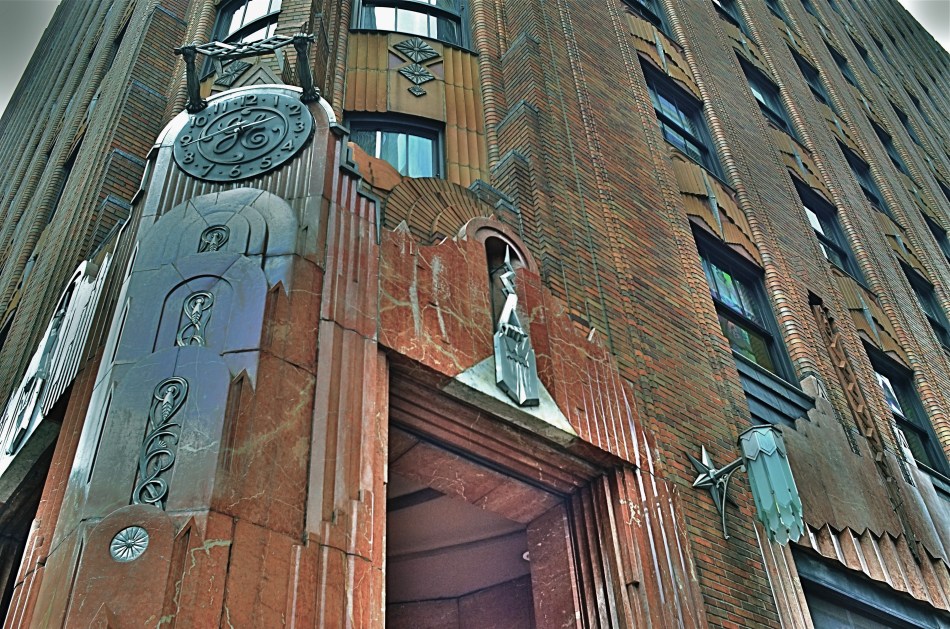
1931’s General Electric headquarters in NYC, complete with disembodied arms holding lightning bolts, as one does….
Like Prometheus stealing fire from the gods, we celebrated our harvesting of raw energies in the universe and their re-purposing to make the world over in our own image. Buildings like this one at 570 Lexington Avenue in New York were especially illustrative of the modern world and the power of symbols as integrated features of the new breed of mega-structures. Originally proposed in 1929 as the first national headquarters of the Radio Corporation Of America, the building wasn’t completed until 1931, by which time RCA decided to house its corporate digs in the brand-new Rockefeller Plaza instead. As a subsidiary of General Electric, the broadcast giant decided to cede 570 Lex to GE, which proceeded to mount its cursive logo at the center of an enormous clock above the northeast entrance to the building, directly below two disembodied arms holding bolts of lighting. Additional abstract zigzag patterns suggestive of electrical power were added all the way up the building and in accents within the lobby.
Today, photographers can play the “hidden picture” game on structures that show the speed and sweep of automobiles and trains, the power of hydroelectric dams, the towering scale of ocean liners and dirigibles, the reach of radio and telegraphy….any and all manifestations of Mankind’s new role as landlord of the earth and sky. Many of the buildings created in this golden age are gone; others have been repurposed, but the clues to the dreams of its creators live on, the heiroglyphic record of what we claimed and what we dared.
 thenormaleye
Leave a comment