TO SEE THE SEA IN FULL
By MICHAEL PERKINS
I AM VERY NEW TO DAILY LIFE in California. After decades of longing to convert my occasional doses of this marvelous state into the stuff of everyday experience, to go layers beyond mere vacation sensation, Marian and I have actually done it, making a new home in Ventura, a mid-size city along the Pacific coast about fifty miles north of Los Angeles. This means that the ocean is something we don’t just perceive as a getaway or a holiday destination. It’s something we see nearly every single day.
And once you’re a local, especially a photographer local, you see things that go far beyond the gorgeous sunsets and the lapping waves, including several things you wish you could un-see.
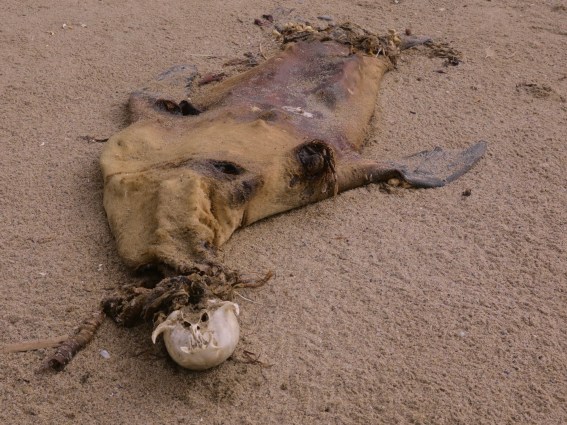
This dessicated pelt, a lunch opportunity for shorebirds and scavengers along the Hollywood Beach, was once a young sea lion. Its bones now picked clean down to the very contours of its skull, it is, sadly, also a more frequent sight for those of us walking the area coastline. Hundreds of sea lions have been washed ashore to suffer and die this year along the California coast, poisoned by an invisible scourge happening silently out to sea. A compound called demoic acid, a species of plankton, is in a state of high surge at present. That is to say that chemical changes which typically convert very small amounts of it to a deadly neurotoxin are currently churning it out like crazy. Fish eat the algae that contains it, apparently without harm to themselves, but sea lions eat the contaminated fish, and the result is an epidemic of sea lion death in San Luis Obismo, Santa Barbara, Ventura, and other coastal towns.
The process by which these toxins are produced in bulk is called upwelling, which occurs when the right combination of colder water meets the right amount of nutrients. Upwelling seasons are a part of oceanic life, occurring randomly since the beginning of time. But what’s puzzling to science, and deadly for mammals like the sea lion, is the increased frequency and intensity of such toxic “blooms”, which may very well prove to be yet another sinister side effect of climate change.
California has so much of its life anchored to the seasons and cycles of the sea that such threats are front and center for policy and abatement, meaning that the state is already seeing things the rest of us have not seen, making match-point decisions that will eventually echo across the great middle of the nation. But to know a thing is happening, we first need to see it happening. Cameras are great for vacations. But we are also obligated, now and going forward, to also use them to bear witness, if not to head off destruction for ourselves, then to chronicle, for our wiser children, what fools their forebears once were.
 thenormaleye
Leave a comment