FROM THE VAULTS: “Framing Memory”
( All twelve years of THE NORMAL EYE are archived, and you can easily search any month or year by clicking on “Post Timeline” at the very bottom of any page. Here, from December 2018, is a look at the history of the Kodak “Colorama” and its huge role in holiday traditions. )
THE IDEA OF AMATEUR PHOTOGRAPHY, the once-revolutionary notion that virtually anyone could own a camera and produce good results with it, came about at the exact point in history as the birth of mass-market advertising. Inventors made it possible for the average man to operate the magic machine, and wily promotion made him want to own one, and, by owning, adopt the habit of documenting his entire life with it. Some companies in the early days of photography excelled in the technical innovations that ushered in the amateur era, while others specialized in engineering desire for the amazing new toy. And no company on earth combined both these skills as effectively as the Eastman Kodak Company.

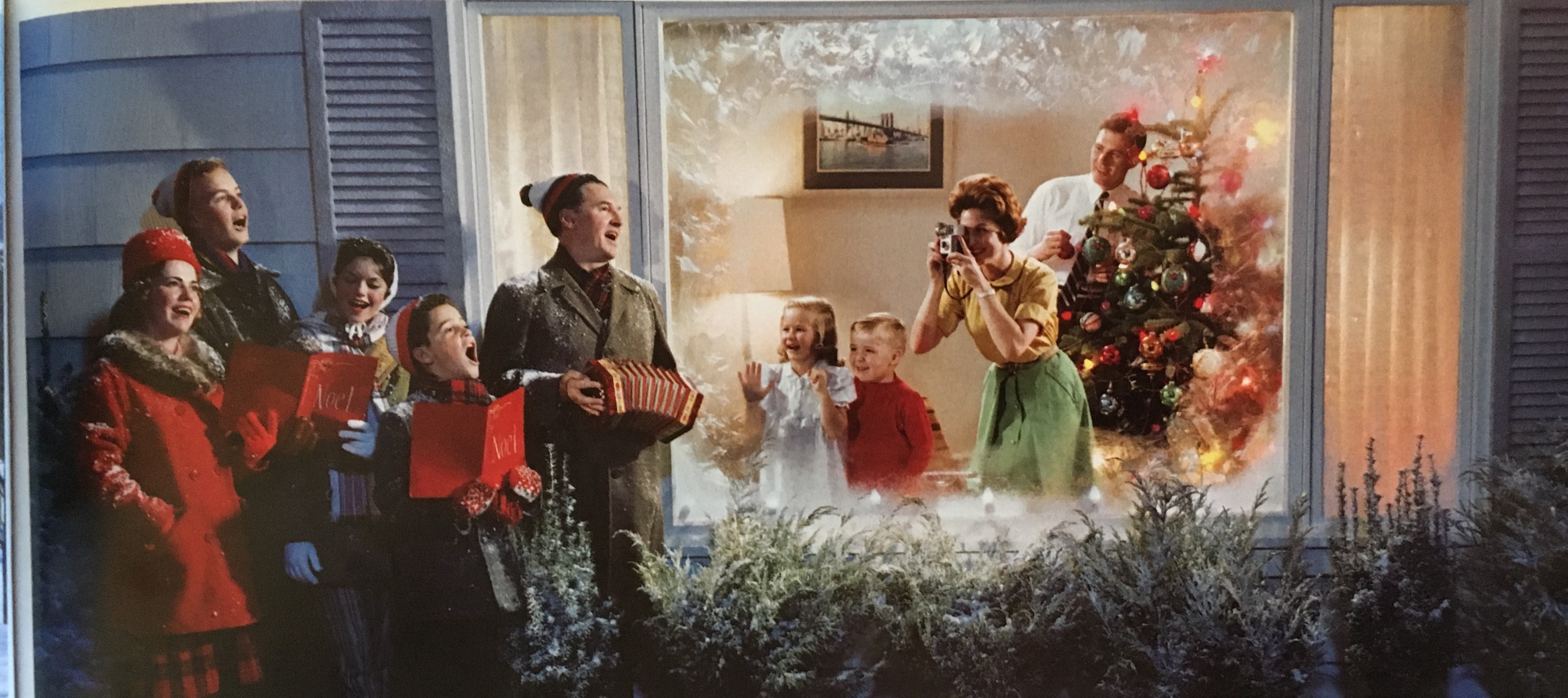
A super-sized Kodak “Colorama” transparency from the 1950’s.
From the beginning of the 20th century, Kodak’s print ads used key words like “capture”, “keep”, “treasure”, “preserve”, and, most importantly, “remember”, teaching generations that mere memories were somehow insufficient for recalling good times, or somehow less “real” without photographs to document them. The ads didn’t just depict ideal seasonal tableaux: they made sure the scene included someone recording it all with a Kodak. Technically, as is the case with today’s cel phones, the company’s aim was to make it progressively easier to take pictures; unlike today, the long-term goal was to make the lifelong purchasing of film irresistible.
Kodak’s greatest pitch for traveling the world (and clicking off tons of film while doing so) came from 1950 to 1990, with the creation of its massive “Colorama” transparencies, the biggest and most technically advanced enlargements of their time. Imagine a backlit 18 foot high, 60 foot wide color slide mounted along the east balcony of Grand Central Terminal. Talk about “exposure”(sorry).
Sporting the earliest and often best color work by Ansel Adams and other world-class pros, Coloramas were hardly “candids”. They were, in fact, masterfully staged idealizations of the lives of the new, post-war American middle class. The giant images showed groups of friends, young couples and family members trekking through (and photographing) dream destinations from the American West to snow-sculpted ski resorts in Vermont, creating perfectly exposed panoramas of boat rides, county fairs, beach parties, and, without fail, Christmas traditions that were so rich in wholesome warmth that they made Hallmark seem jaded and cynical. It was a kind of emotional propaganda, a suggestion that, if you only took more pictures, you’d have memories like these, too.
More than half a century on, consumers no longer need to be nudged to make them crank out endless snaps of every life event. But when personal photography was still a novelty, they did indeed need to be taught the snapping habit, and advertisers were happy to create one dreamy demonstration after another on how we were to capture, preserve, and remember. The company that put a Brownie in everyone’s hand has largely passed from the world stage, but the concept of that elusive, perfect photo, once coined “the Kodak Moment”, yet persists.
 thenormaleye
Leave a comment