SUPER STAND-INS
By MICHAEL PERKINS
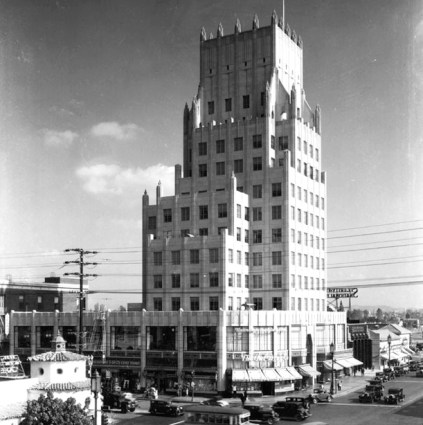
Los Angeles’ E.Clem Wilson building, the first structure to portray the Daily Planet on film.
SINCE ITS VERY BEGINNINGS, THE MOTION PICTURE INDUSTRY has made bank by creating and marketing alternative realities, visions of what they hope we’ll believe, at least until the last frame of film clears the projector gate. So lasting are some of these illusions that they become more authentic than the actual in-life objects or locations that were used to generate them.
In my own case, one of the first and most influential times a thing from the “real” world was re-purposed to stand for something else was in my daily viewing of reruns of The Adventures Of Superman, in which exteriors of various Los Angeles landmarks were substituted for key locations in the Man Of Steel’s fictional world. Of course, at the age of seven, I tended to take everything Hollywood presented to me at absolute face value; if the storytellers told me a thing was so, that was it, as far as I was concerned. So of course, when I saw a shot of the E. Clem Wilson building (in the earliest episodes of the show) or the Los Angeles City Hall (for the later stories), I knew that actually, they were the headquarters of the Daily Planet, the hallowed shrine of journalism in which Clark and Lois and Jimmy clacked away at Royal typewriters in pursuit of The Next Big Scoop.
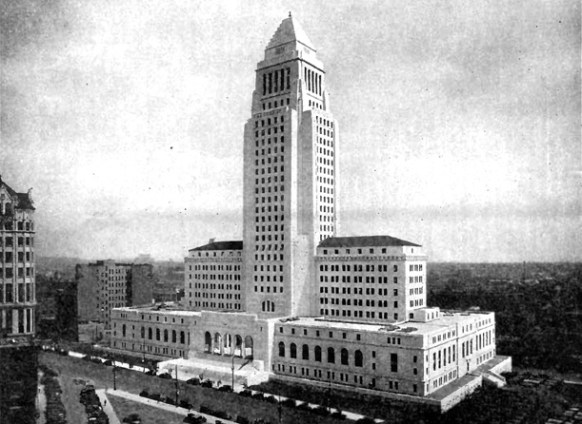
Los Angeles City Hall, which followed the Wilson building as the second version of the Planet on the Adventures Of Superman TV series.
Of course, as a lad, I I knew nothing of the film industry’s century-long habit of saving a buck by using stock shots to stand in for something that they didn’t want to build from scratch. I saw exactly what they wanted me to see, and thought about it exactly how they wanted me to think. At that age, I certainly didn’t have any sense that film-makers, just like propagandists or documentarians, could make me look at an image and draw associations from it that had no root in fact. A few years later, as I stumbled into photography, I developed my own ideas on how to idealize the things I shot. Being a total noob, I thought everything I pointed my camera at was important, or beautiful, because that’s what the process of making a picture felt like to me. Years later, when I looked at my earliest “good” pictures, I was amazed at how truly horrible many of them were, and how, in my my mind’s eye, I had wildly over-inflated their value. Eye of the beholder and all that.
At this writing, in early 2025, yet another cinematic reboot of the Superman myth is being readied for the screen, and yet another visual symbol of the Planet building will be needed for the present generation. However, unlike the producers of Adventures Of Superman, who were bringing in every episode of the show at a rock-bottom budget of about $15,000, the new crew won’t have to settle for just shooting some random place and merely renaming it. CGI and other tools will make literally anything possible. And yet I still find myself going back to the L.A. City Hall, where, somewhere in one of the Planet’s vast corridors, there is that miraculous storage room into which Clark Kent disappears to become The World’s Mightiest Mortal. For my inner seven-year-old, you can’t get any more “real” than that. And that’s the superpower of photography. Superman may be able to bend steel in his bare hands, but a picture can twist reality to any purpose.
 thenormaleye
Fun read Michael. I can relate to pretty much everything you said.
I’m not sure where AI will take us all…..but I’m pretty certain I’m going to be slow to accept it. Unless I go back to college and need help on a paper:)
January 22, 2025 at 2:31 PM