TWO-WAY MIRROR
By MICHAEL PERKINS
GLASS IS BOTH A REVEALER AND CONCEALER in photography, acting in equal amounts as truth-teller and liar. Light neither bounces perfectly off a glass surface nor permits 100% transparency, and so individual shooters have to strike an arbitrary and individual balance between seeing into and seeing onto. This artistic see-saw is one of the most intriguing calculations anyone can make with a camera.
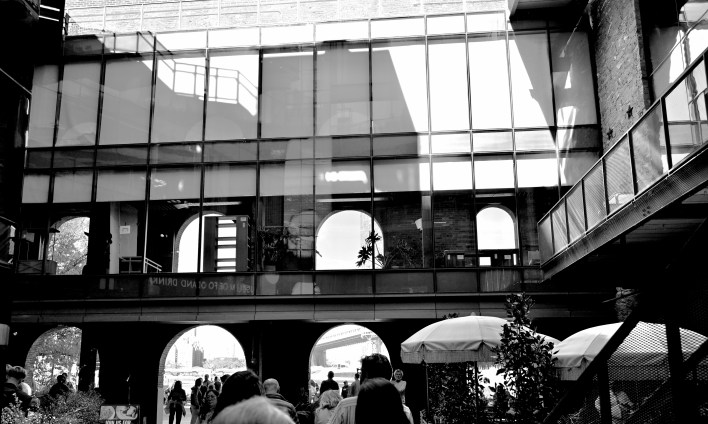
Even if it were possible, optically, say, for a window on a building to allow us to only see in or only see reflections of what is behind the camera, the mixture of see-in/see-on would still be very seductive. The pioneering French photographer Eugene Atget, in documenting shop windows around Paris in the 1800’s, was also documenting the texture of street life in the city as it was reflected in those windows. And over the subsequent centuries, what a certain type of viewer might see as an error went on to become a standard form of commentary by succeeding generations of photographers, from Garry Winogrand to Robert Frank to Walker Evans and beyond. Certainly, this idea that a window is both portal and mirror caught on so universally that it has become something of an urban cliche. But, of course, things become cliches at first because they are undeniably true.
Just as Jerry Seinfeld once said that “men aren’t interesting in what’s on TV; they’re interested in what else is on TV”, I’m never interested in just looking in or out of a window. Noticing, and exposing for, and composing for, what else is impacting that window keeps me interested. If nothing else, showing the world beyond the glass plane, even when reversed and distorted, contextualizes the story that a peek through a window only begins. For me, it’s like imagining a really strong beginning sentence, and then realizing that, based on where I place punctuation or accent marks, I can steer that sentence to deeper meaning. Clear as glass.
 thenormaleye
Leave a comment