OFF THE SHELF
By MICHAEL PERKINS
JERRY SEINFELD ONCE REMARKED. OF GUYS OBSESSED WITH OVERUSE OF THE REMOTE CLICKER, that they “aren’t interested in what’s on tv; they’re interested in what else is on tv.” Funny and true, and also indicative of some photographers, in that, while we love what our basic gear does, we’re really excited at the prospect of hybridizing equipment from any and all sources. We’re interested in what else our cameras can do.
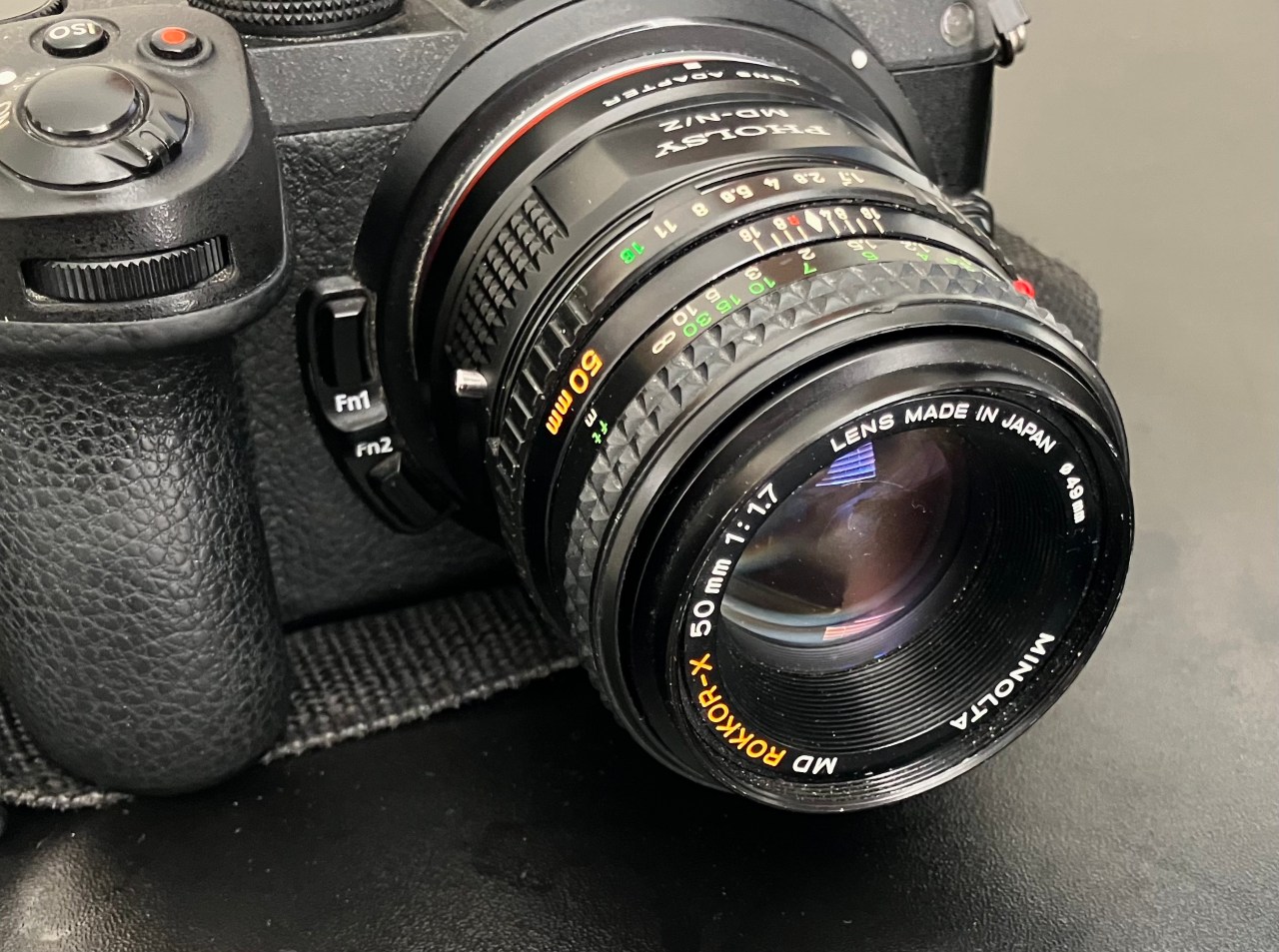
My 1977 Minolta 50mm, dormant in my closet for over twenty years, now fronting my Nikon mirrorless.
Many of us at least stray slightly from the only-original-manufacturers mindset (that is, only Canon lenses for my Canon camera, etc.), yielding to some degree of lens bi-curiosity, leading us to adapt glass from other makers to find the perfect marriage between body and optic. It’s not always a win for our work, but the journey is far more fun than the destination anyway. And the old hybridizing romance of the DSLR period has easily found a contemporary equivalent with the move to mirrorless cameras, as dozens of third-party equipment houses have rushed modestly-priced adapters to market for converting older glass, including many manual-only lenses, to use on mirrorless platforms. Photographers tend to be tinkerers; they are fascinated by what happens when you do this to this. And now it’s easier than ever to get answers for that tantalizing question.
Like many reading this, I spent my DSLR years adapting old manual primes from the film era, treating myself to optics with all-metal construction, smoother aperture and focus adjustment, superior sharpness, and a huge cost savings. These tended, for the most part, to be Nikkor lenses for my Nikon cameras, and so no adapter was required, since I was going from an F-mount lens to an F-mount body. Then, after making the leap to mirrorless, I adapted the same lenses to continue their use on a Z-body (using so-called “dumb” adapters that don’t communicate with the camera body, another cost-savings for someone who’s shooting without the need for AF). And finally, I’m enjoying going completely off-brand to give new life to optics that have been gathering dust since my first days behind a viewfinder.

Moonstone Beach near Cambria California, 9/6/25, seen through the eye of a 1977 Minolta 50mm prime.
The lens shown here came from a Minolta SRT200, a ’70’s-era SLR that I grabbed for $100 in the ’90’s when my daughter decided to enroll in a high school camera class. The class came and went, but I kept the camera, fitted out with a Rokkor-X MD 50mm f/1.7 prime lens. I spent a lot of time, just before and just after 2000, shooting mostly slide film with it, sticking it in the closet only after the purchase of my first digital point-and-shoot. Learning that, decades later, it could be restored to service as a sharp and clear prime for the mere cost of a $30 adapter put a huge grin on my face, and, at this writing, we have been renewing our old love affair for several weeks. Scores of articles are now online as to the efficacy of this or that bit of “legacy” glass on mirrorless bodies, most written with a flavor of delight, or adventure, or both. Some even claim that such vintage optics perform even better on digital cameras than they ever could on film. Your mileage may vary. As for me, I’m just beginning to explore what else is on my camera.
Oh, and hand me that clicker, willya?
 thenormaleye
Leave a comment