THE LAND OF NO EXCUSES
By MICHAEL PERKINS
THE TIME IS FAST APPROACHING where most of the photographers in the world will have no personal memory of just how much technical skill once needed to be applied just to obtain a usable photograph. We are already a full generation removed from a world in which film had to be purchased, loaded, exposed, unloaded and processed before the results could be viewed. Also gone for most people is the careful budgeting of shots that had to be plotted so that snaps of a vacation could be captured within the span of 24 or 36 exposures, rather than the endless barrage of shots made typical in the digital age. And beyond all that lies an additional plethora of calculations, tools, aides, and attachments once enlisted in the great effort expended in making pictures look, well, effortless. These all speak not to the art but to the craft of photography, and, as they fade away for good, all we are left with is endless possibilities and greatly increased responsibility. Simply put, there is almost no excuse for making a bad image.
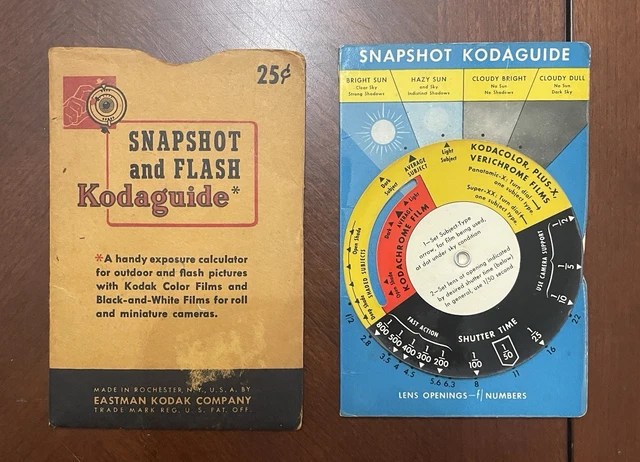
The little wonder you see here was produced by Eastman Kodak Company for generations, and was always tucked into my father’s shirt pocket for quick consultation before triggering the shutter. For shooters of his generation, taking a shot meant first solving a math problem. Composition and inspiration came in second or third after just being able to hack the science of it all. Many cameras had basic instructions for use or loading inscribed inside their covers, and every roll of film was accompanied by a flier on how to correctly expose that particular emulsion. The aforementioned Kodak also kept HOW TO MAKE GOOD PICTURES, its basic primer on photo techniques, in print for nearly sixty years. And then you also factor in the efforts of the true purists, those who chose to process their own film. The point is, the apparatus involved in being able to take the uncertainty out of photography is largely gone, with more responsive “serious” cameras and mobiles virtually guaranteeing a workable result every single time.
So why are there still so many awful, bland, uninteresting, insanely misconceived photos? Well, it could be because there is still a real limit to what cameras can do. Granted, they are better than ever at anticipating what we need in a given situation and trying to supply it. They are also incredible at protecting us against our own limited skills. But they cannot think. Or feel. Or, to be very hippy-dippy, dream. The best photographers are, in fact, dreamers, and it was not so long ago that our dreams were thwarted, or at least compromised, by our need to “master” the camera, to tame it as one might a wild stallion. Now, we no longer have to fight our gear to a draw. The craft aspect is largely gone. The art part remains. And that’s on us.
 thenormaleye
Food written words. And i think that before this complex guide should be achieved, one needs to detect the moment, the scenery, the interesting subject for the whole process. And this can’t be written in any guidance. And today the marketing people easily deny the need of the proper cameraman on their events and projects and just use their smartphones for this action. And the problem is that also their consumers easily eat this fast food.
December 10, 2025 at 11:22 PM