CLICKING WITH THE LADIES
By MICHAEL PERKINS
By MICHAEL PERKINS
NO ONE ALIVE TODAY CAN RECALL A WORLD in which a camera of some kind was not considered an essential personal accessory, especially after the recent iPhone revolution has absolutely completed the “democratization” of photography. That concept, the idea that everyone should own a camera and take it everywhere, was, at one time, a novel idea, a behavior that had to be taught. And, as in so many cases with early amateur photography, the teacher for that habit was the Eastman Kodak Company.
Having already made cameras cheap and simple to operate by the end of the 19th century, the company next tackled the task of making people want to use them, and use them all the time. Kodak was certainly a “hardware” company, in that they made a wide line of cameras, but their bread and butter was as a “software” company, as it was the sale of Kodak film that created its biggest profit. And so, having provided the means for taking a lot of pictures, they turned to engineering the desire to do so, especially as regarded female consumers, where they saw their biggest potential growth.
Enter the Kodak Girl.
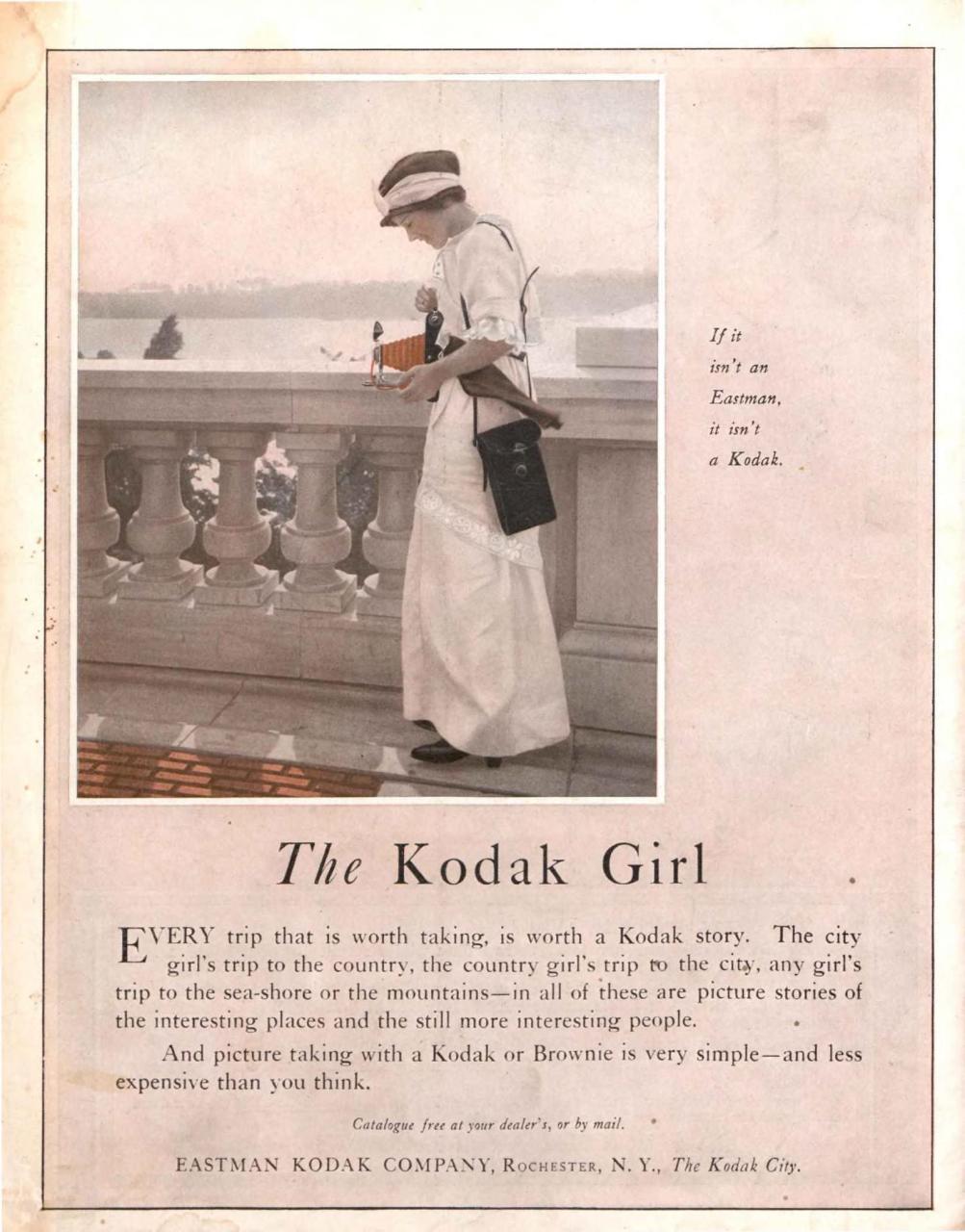
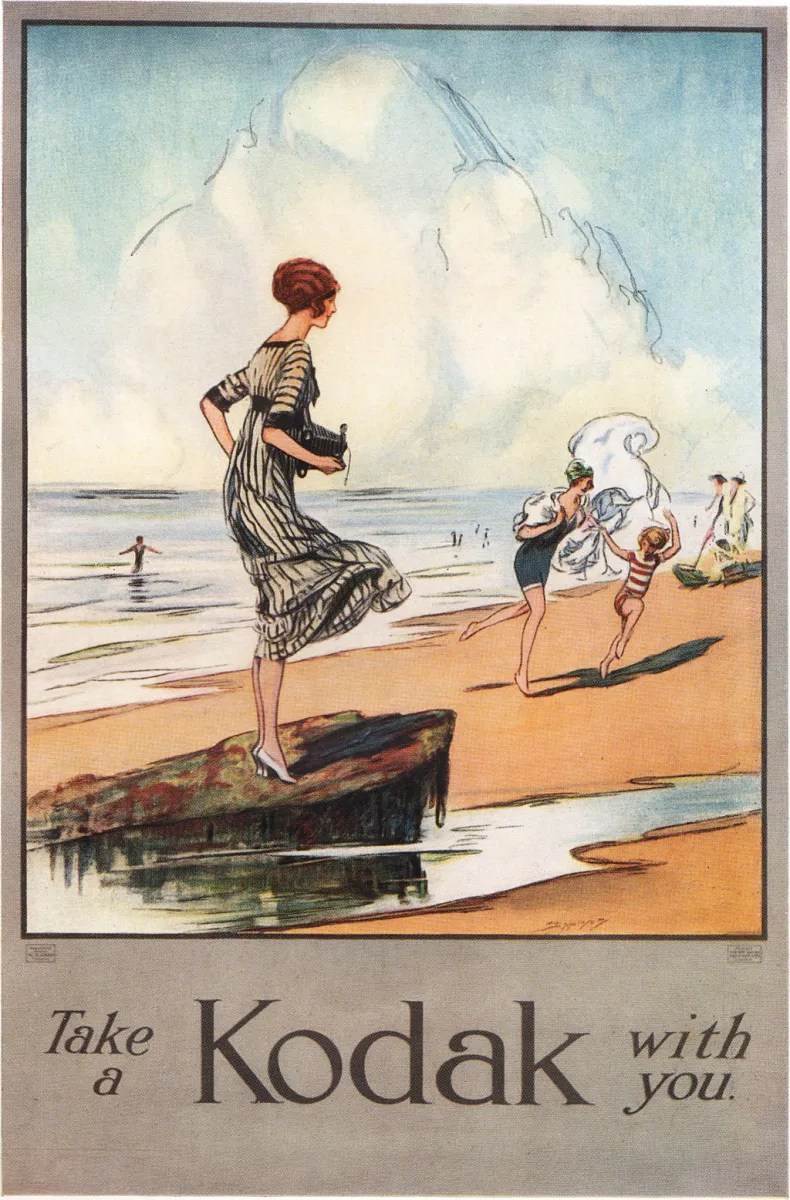
Young, adventurous, jaunty, and constantly pictured with a Kodak at the ready, The Kodak Girl was first featured in prominent women’s magazines in the late 1800’s, ready to preserve key moments at parks, the beach, and the mountains, as well as capturing key moments around the home. She was shown in a variety of poses and styles so as to appeal to both the stay-at-home mother and the active seeker, but her greatest role was as The Closer, a character with which consumers could easily identify, sparking their own decisions to buy their first personal camera and make its constant use a regular activity. Kodak kept evolving the Girl’s physical look as the 20th-century saw women gain in spending power as well as personal empowerment, modeling some ads in the ’20’s after silent screen actress Edith Johnson. Decades later, they would refresh the old campaign yet again, dubbing a young bathing beauty named Cybil Shepherd as a Kodak Girl for the age of Aquarius.
Thus, Kodak pioneered the idea of putting a camera in everyone’s hand a century before Steve Jobs added his own variation to the campaign, his iPhone removing the last real barrier to universal camera use. Introducing a truly useful thing into the world is a great talent, but the ability to convince people they need something they’ve never even thought to wish for is an equally remarkable skill.
 thenormaleye
Leave a comment