MEANS AND ENDS
By MICHAEL PERKINS
And if you don’t know where you’re goin’, any road’ll take you there—-George Harrison
THE PERSON WHO COINED THE PHRASE, “there’s more than one way to skin a cat” may not have been a photographer, but he/she certainly summed up a key truth about picture-making. Ever since we first started freezing images in boxes, we’ve been trying to craft shortcuts to the creation of our favorite effects, generally adopting the idea that results are about just that, results, and who really sweats what tool or technique you used to get them? Some of the earliest problems in photography, like engineering media sensitive enough to make immediate exposures, took decades to solve, as did the puzzle of providing supplementary flash without, you know, setting fire to the drapes. But we are now at a stage when the tinkerer’s first version of how to pull off something is followed up by simpler shortcuts in less and less time.
More and more, we initially discover how to do things by fairly laborious means, only to turn around seconds later and see a digital or A.I. shortcut that performs the same magic trick at the flick of a button or swipe of a screen. This convenience, wonderful as it is, is sometimes met with suspicion, as if a thing can’t be worthy or good if it comes too easy. This view, that only shooters who bravely grapple with unwieldy processes are making “real” pictures, is a snotty country-cousin to the belief that only those who shoot all-manual are “true” photographers. Me, I’m fine with painting a big wall with a paint brush, but, if I can do it just as well in half the time with a roller, then, yes, please, hook me up.
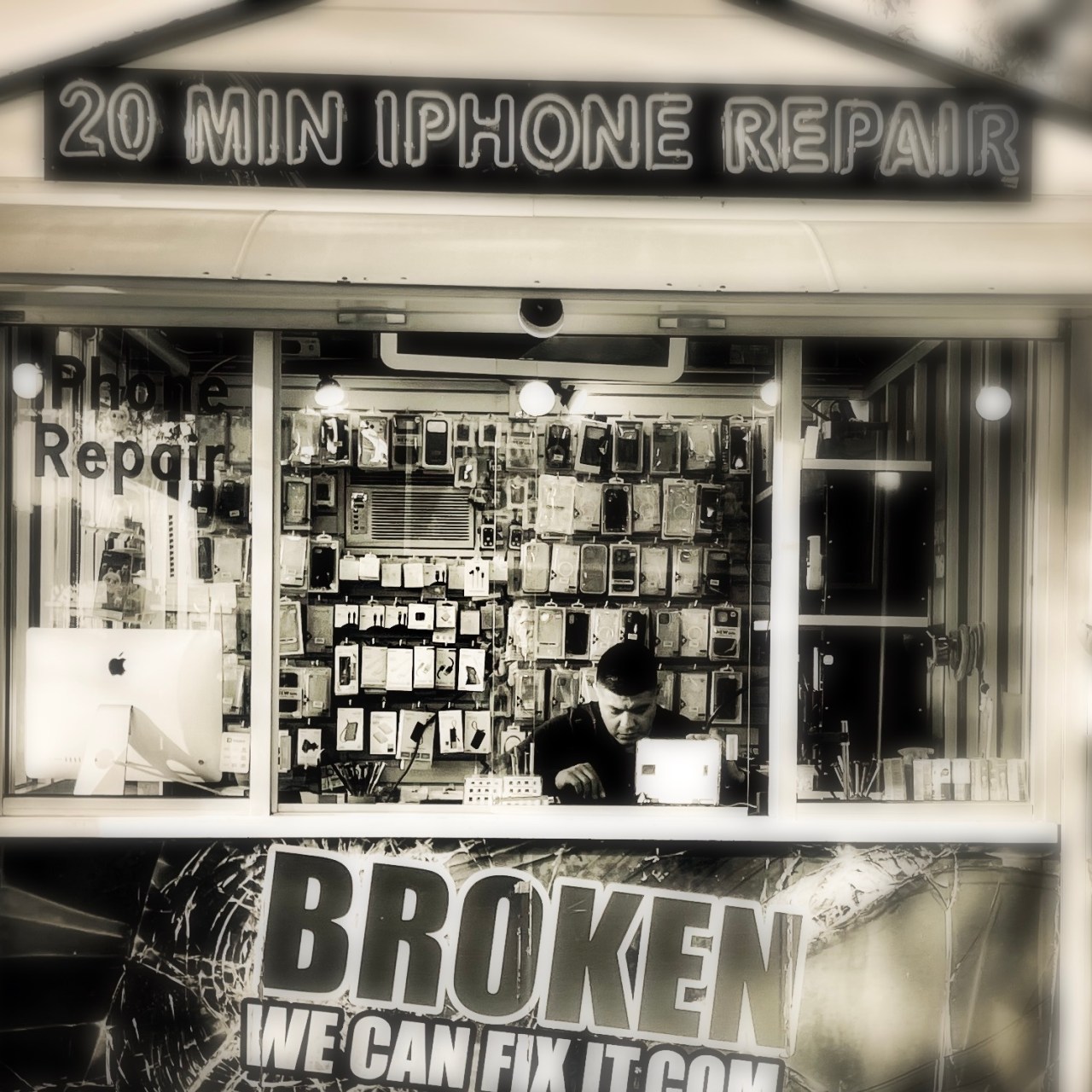
Selective “Lensbaby” focus, achieved in post-processing with a quick pinch and swipe via the Hipstamatic phone app.
Take, as an example, the recent love affair many have struck with the manual lenses that allow for selective focus to be achieved in-camera, as marketed wonderfully well by Lensbaby and other optics houses. With such specialized glass, a floating “sweet spot” of sharpness is preselected by the user, placed wherever he/she may desire it, surrounded by a soft haze that serves to call extra attention to the subject matter within the selected focus area…all of it done in-camera. These specialized lenses are fairly costly and tend to be one-trick ponies, in that their optics may not be optimum for all the uses found on standard glass. And then there is the time spent in climbing the lens’ learning curve, since uniform results are far from guaranteed.
Now, contrast that to a single trick among dozens of offered post-processing effects within a single phone app, which, in the case of our illustration, is called Hipstamatic. Selecting “depth of field” among the choices, and applying a little stretch-and-pinch of the fingers, renders the Lensbaby effect immediately, and with even greater flexibility, since, with the ability for endless re-dos of the effect before locking in the final version, there is no standard trial-and-error. Also, since you are basically working on a copy of your original, it remains pristine and ready to be taken in other directions on another day, based on your whim. All for the one-time cost of the app, which, in this case, was zero.
Having once invested in the speciality lenses required to make such a shot, must I regard the app-rendered version “less than”? Certainly not in the quality or effectiveness of the final result, and certainly not when it comes to any yardstick of economy or efficiency. The app does what I ask of all photographic processes; places as few barriers as possible between my vision of an image and my ability to hold the result in my hand. Sometimes, as G.Harrison implies, you want to calmly saunter down the old dirt road. And sometimes you want to take the expressway.
 thenormaleye
Leave a comment