SMILE! OR NOT.
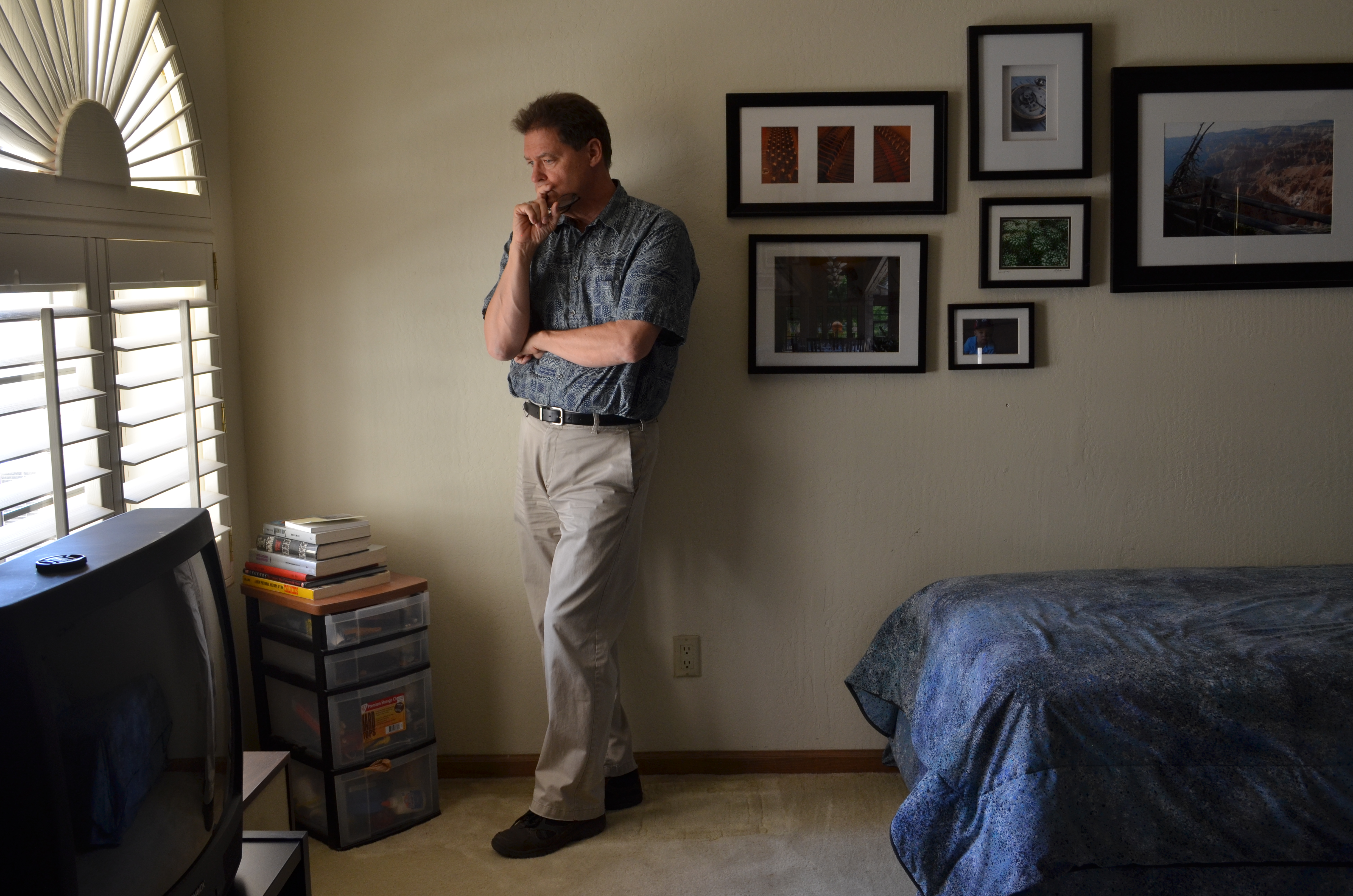
Since we’re usually unhappy with the way others capture us, we have nothing to lose by a making a deliberate effort to come closer to the mark ourselves. Self-portraits are more than mere vanity; they can become as legitimate a record of our identities as our most intimate journals. 1/15 sec., f/7.1, ISO 250, 24mm.
By MICHAEL PERKINS
A COMMONLY HELD VIEW OF SELF-PORTRAITURE is that it epitomizes some kind of runaway egotism, an artless symbol of a culture saturated in narcissistic navel-gazing. I mean, how can “us-taking-a-picture-of-us” qualify as anything aesthetically valid or “pure”? Indeed, if you look at the raw volume of quickie arm’s length shots that comprise the bulk of self-portrait work, i.e., here’s me at the mountains, here’s me at the beach, etc., it’s hard to argue that anything of our essence is revealed by the process of simply cramming our features onto a view screen and clicking away…..not to mention the banality of sharing each and every one of these captures ad nauseum on any public forum available. If this is egotism, it’s a damned poor brand of it. If you’re going to glorify yourself, why not choose the deluxe treatment over the economy class?
I would argue that self-portraits can be some of the most compelling images created in photography, but they must go beyond merely recording that we were here or there, or had lunch with this one or that one. Just as nearly everyone has one remarkable book inside them, all of us privately harbor a version of ourselves that all conventional methods of capture fail to detect, a visual story only we ourselves can tell. However, we typically carry ourselves through the world shielded by a carapace of our own construction, a social armor which is designed to keep invaders out, not invite viewers in. This causes cameras to actually aid in our camouflage, since they are so easy to lie to, and we have become so self-consciously expert at providing the lies.
The portraits of the famous by Annie Liebovitz, Richard Avedon, Herb Ritts and other all-seeing eyes (see links to articles below) have struck us because they have managed to penetrate the carapace, to change the context of their subjects in such dramatic ways that they convince us that we are seeing them, truly seeing them, for the first time. They may only be doing their own “take” on a notable face, but this only makes us hunger after more interpretations on the theme, not fewer. Key to many of the best portraits is the location of their subjects within specific spaces to see how they and the spaces feed off each other. Sometimes the addition of a specific object or prop creates a jumping off point to a new view. Often a simple reassignment of expression (the clown as tragedian, the adult as child, etc) forces a fresh perspective.
As for the self-portrait, an artistic assignment that I feel everyone should perform at least once (as an intentional design, not a candid snap), there is a wealth of new information gleaned from even an indifferent result. Shooters can act as lab rats for all the ways of seeing people that we can think of to play at, serving as free training modules for light, exposure, composition, form. I am always reluctant to enter into these projects, because like everyone else, I balk at the idea of centering my expression on myself. Who, says my Catholic upbringing, do I think I am, that I might be a fit subject for a photograph? And what do I do with all the social conditioning that compels me to sit up straight, suck in my gut, and smile in a friendly manner?
One can only wonder what the great figures of earlier centuries might have chosen to pass along about themselves if the self-portrait has existed for them as it does for us. What could the souls of a Lincoln, a Jefferson, a Spinoza, an Aquinas, have said to us across the gulf of time? Would this kind of introspection been seen by them as a legacy or an exercise in vanity? And would it matter?
In the above shot, taken in a flurry of attempts a few days ago, I am seemingly not “present” at the proceedings, apparently lost in thought instead of engaging the camera. Actually, given the recent events in my life, this was the one take where I felt I was free of the constraints of smiling, posing, going for the shot, etc. I look like I can’t focus, but in catching me in the attempt to focus, this image might be the only real one in the batch. Or not. I may be acting the part of the tortured soul because I like the look of it. The point is, at this moment, I have chosen what to depict about myself. Accept or reject it, it’s my statement, and my attempt to use this platform to say something, on purpose. You and I can argue about whether I succeeded, but maybe that’s all art is, anyway.
Thoughts?
Related articles
- Avedon For Breakfast (fabsugar.com)
- Getty Center Exhibits Herb Ritts and Celebrity Portraits (ginagenis.wordpress.com)
- Annie Leibovitz: ‘Creativity is like a big baby that needs to be nourished’ (guardian.co.uk)
WHEN ART SELF-CENSORS
IN ITS FIRST DAYS, photography took on the inward, personal aspect of painting, both in its selection of pictorial subjects and in its method of presentation, which was designed to legitimize the new science by aping the look of the canvas. Only by actively engaging the world and invading every corner of it in an outward search for truth or beauty did picture-making break free of the painter’s constraints. Once Matthew Brady’s stark images of the Civil War froze that conflict’s horror on glass, at least one leg of the photographer’s stool rested on a confrontation of reality.
In the 20th century, as shooters toggled between deliberate, arranged images and pure documentation, the “face” of the public became an unwitting tool in the artist’s toolbox. Human manifestations of delight, horror, revelation and ruin told the story of the new era even more graphically than the correspondent’s pen, creating some of the most indelible images of modern times. Indeed, there seemed to be an unspoken pact between the artist and his “prey” to the effect that their lives, like ours, could be endlessly recorded, interpreted, interrupted and enshrined for the sake of our “art”.
But is that era coming to an end? And, for photography, what lies beyond?
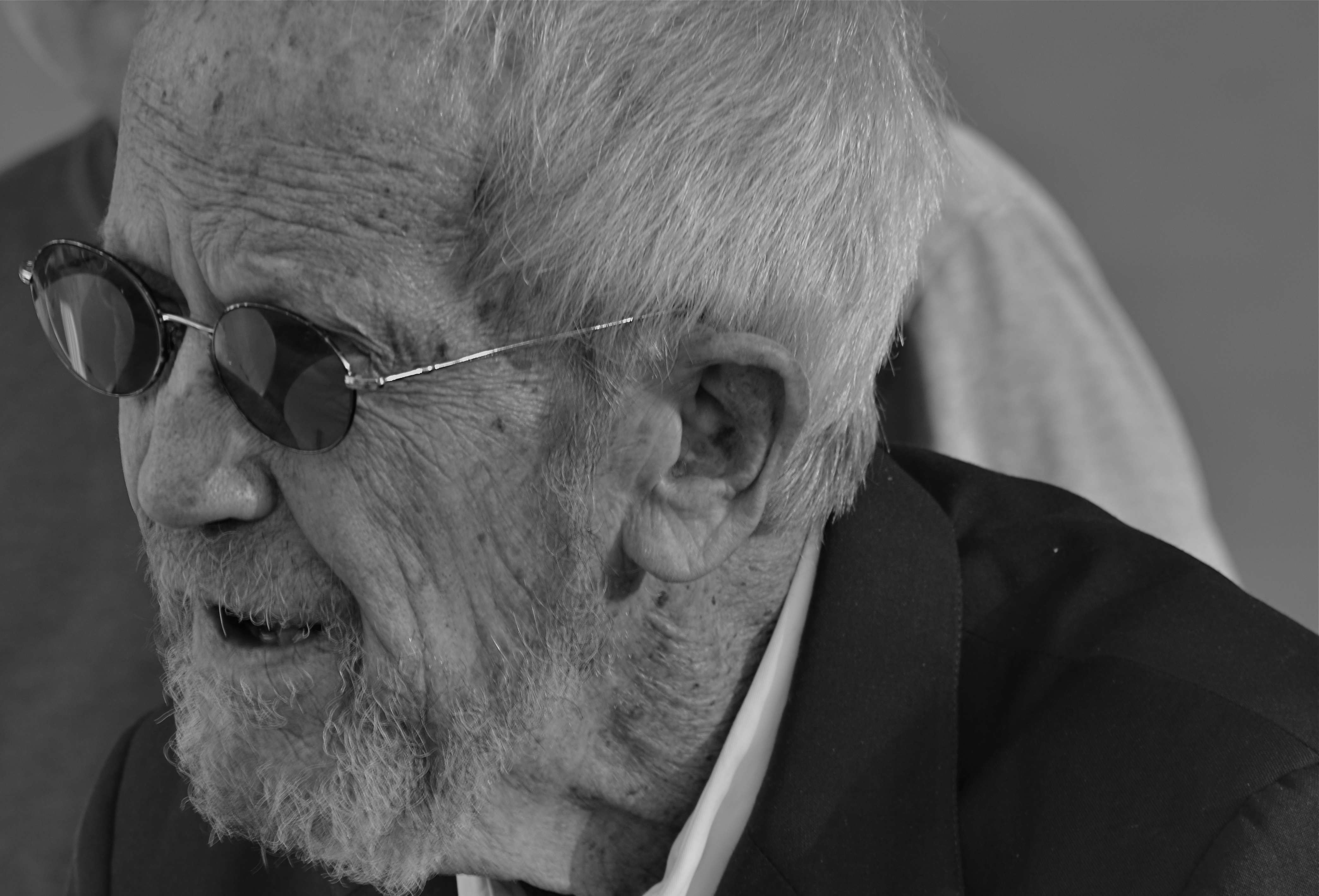
By agreeing to appear at a book fair and signing, public figures like Elmore James (author of Get Shorty and, 3:10 to Yuma, and consultant on the TV series Justified) more or less agree to allow their images to be recorded as part of the celebrity they have willfully undertaken. But what of everyone else? 1/40 sec., F/11, ISO 160, 300mm.
In recent years, both public and private institutions have begun to disallow photography in some venues that had historically been open to it, including retail stores, parks, malls and other previously “free” spaces. Some of this is the inevitable aftermath of our recent obsession with security, a kind of whoa-slow-down against the pervasive replication of all aspects of one’s identity. Perhaps, several gazillion camera phone snaps and gotcha YouTubes later, we have reached a tipping point of sorts, a world in which people desperately seek a firewall around their secret selves.
Even as certain nondescript individuals shamelessly seek the spotlight of reality shows and paparazzi-fed ego gratification, many more are feeling an unfamiliar new yen for shelter from the ubiquitous flash of fame. In such a time, the concept of commentary or “street” photography faces one of its most daunting challenges. What is permissible in an image, now? Are what were once the eloquently revealing truths of spontaneous snaps now a kind of voyeurism, a “reality porn” peek into peoples’ lives to which we have no right?
Without the harrowing chronicle of Dorothea Lange’s dust-bowl refugees, would we understand less of the horrific impact of the Great Depression? Was she underscoring an important message or exploiting her subjects’ suffering? Absent Larry Burrows’ grunt’s-eye-view of Vietnam for Life magazine, would we have missed a valuable insight into a war our government might just have gladly kept under wraps? We may have already reached the point where some of us, embarrassed for the intrusive nature of our craft, have begun to self-censor, to mentally de-select some images before we even shoot them. Such prior restraint may be the height of sensitivity, but it spells paralysis for art.
 thenormaleye