lower case G’s
By MICHAEL PERKINS
THE HUMAN VANITY WITH WHICH ALL PHOTOGRAPHERS, much like disposable cameras, come “pre-loaded” would have our audiences believe that all our work is the product of meticulous, deliberate planning, a “vision” that flows, fully formed, from our marvelous minds through the lens. Of course, anyone who’s taken the requisite number of rotten pictures needed to attain any skill whatever knows that this is a fantasy.
The raw fact is that many, many of our most wonderful photographic notions die a-borning. Either they come up short because we don’t possess enough skill to execute them or they fall prey to a thousand random factors that occur in the instant an exposure is made. And while we are more than willing to parade our successes as if they are de rigueur, something that happens effortlessly everytime we trip a shutter, we don’t tout the many happy accidents that sometimes work out better than what we started out to achieve. We aim at upper-case “Greatness” and, instead, get lower-case “gifts” from the Gods Of Camera Randomness.
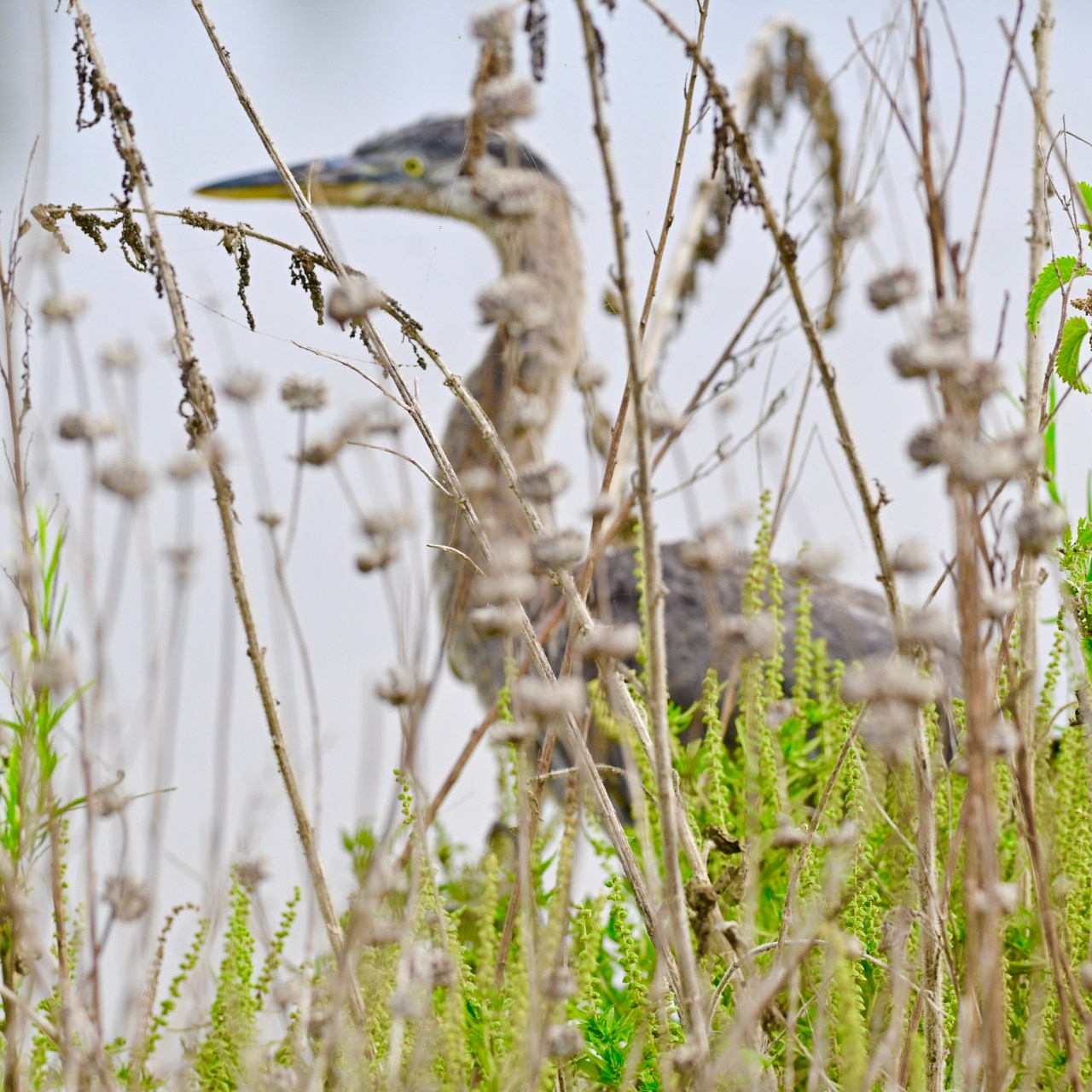
This image began as a gift, then had the brief potential for Great, then receded back down to a lesser gift. The juvenile heron you see here was pausing in a tall pond bank of reeds and flowers just twenty feet from where I and a group of birders were standing. Our binocular and telephoto gazes had been fixed on other birds, farther out in the water, when we suddenly realized this gorgeous creature was practically standing next to us, young enough to be unspooked by a cluster of aging hobbyists. The race was then on to grab some kind of image before he realized that he would be far better off putting some distance between us and him.
The foliage in front of him made autofocus useless, in that my lens would try to render the closest thing to it in sharpest relief, blurring out the bird. Switching to manual, I was racing against the clock to lock in the heron’s face before he could move even an inch and go back out of focus. I got five frames cranked off before he took wing, none of which had been in perfect register. Had I failed? Was I left with a generally bad batch, or could at least one image be said to deliver something more than a perfectly sharp frame might have? I had failed to capture “Greatness”, but had I truly been given a “gift”?
I know what you’re thinking. Photographers are all too eager to excuse their failures and try to see them as strengths, like an indulgent parent who sees a budding Picasso in his child’s incomprehensible crayon scrawl. I’m certainly not immune to my own ego, nor my bias toward whatever wretched messes emerge from my camera.
Still….
 thenormaleye