DAYCARE CASUAL
By MICHAEL PERKINS
ONE OF THE THINGS THAT DISTINGUISHES THE VIBE in small towns is the variable definition of what constitutes “public space”. Where do people actually gather? Where are social interactions transacted? What is the familiar hang, the “everyone goes there?” Photographers who find themselves even temporarily out of their own neighborhood elements are constantly searching for the answer to the “where it’s at” question in the places they’re cruising through.
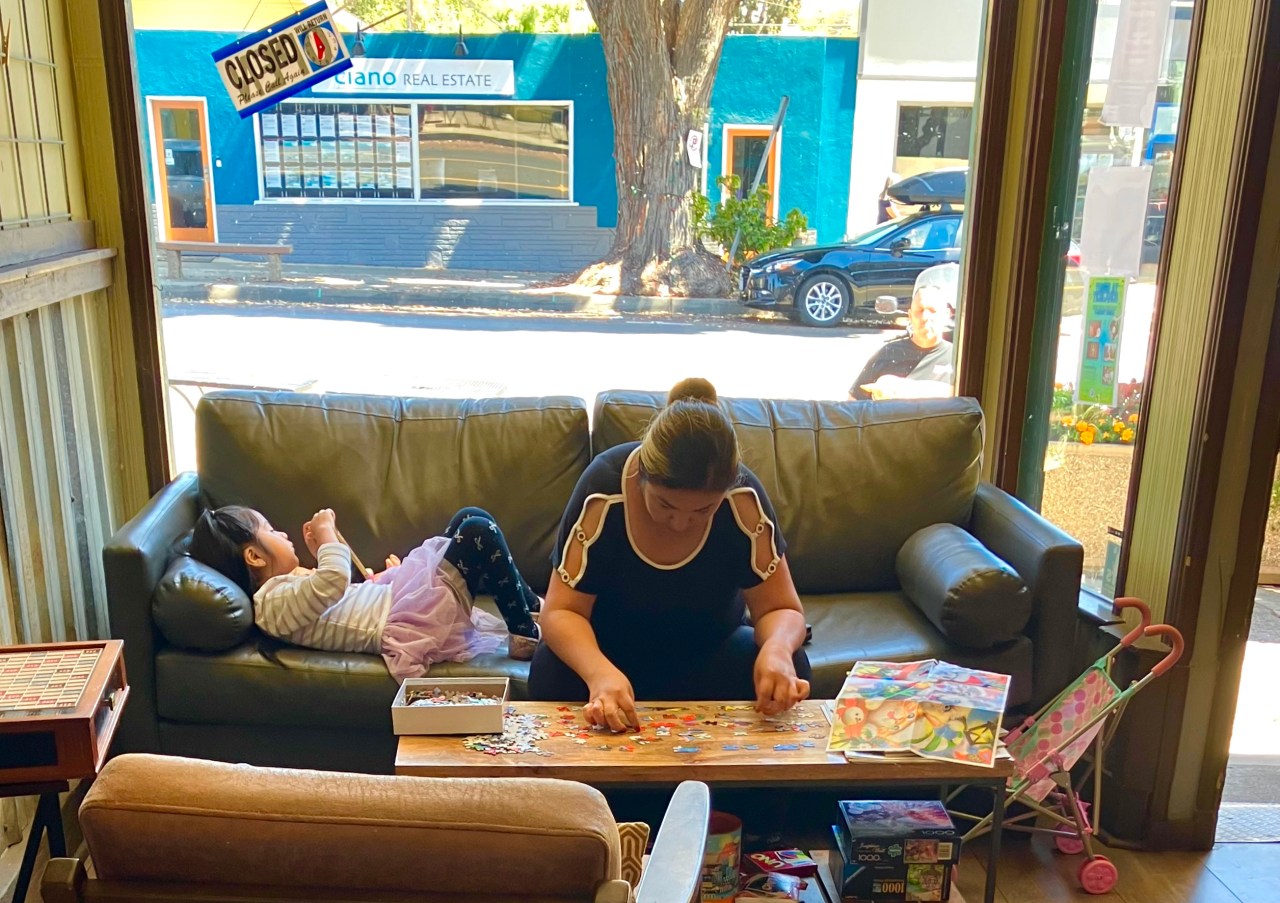
I’ve never seen a puzzle and game play space inside a Starbucks, or, for that matter, inside the average courthouse, city hall or bar. But inside a coffee house in the small coastal town of Morro Bay, California, it’s obvious that whole families, kids and dads and moms, are frequent players, stopping by for a cappuccino or espresso, a bun or croissant, and….a few chill moments with a jigsaw puzzle. The coolest part about encountering this mother-and-child team in the joint was how unremarkable they seemed. The local feel for this cafe was more than “everyone is welcome”. It was all the way to “whatever you need”. And then some.
No other customers in the shoppe seemed to acknowledge this micro daycare center activity; it was obviously just part of the daily rhythm, what made the town the town. I was only about eight feet away from the pair when I snapped this, a single-frame go-for-broke frame. I was so afraid of either making them feel as if they had to pose, or, worse, feel violated by my presence. But there was just so much life, real life, in the scene. I’m glad I had my shot.
FAKE IT ‘TIL YOU TAKE IT (OR EVEN LATER)
By MICHAEL PERKINS
THERE ARE SO MANY VARIABLES IN STREET PHOTOGRAPHY, from composition to exposure and everything in between, that it’s a minor miracle that any useful pictures ever get made, by anyone, anywhere. Being that street work is even more subject to hazard or random accident than any other kind of shot, the shooter must negotiate dozens of factors before squeezing off a frame. Contrary to popular terminology, this process produces the very opposite of a “snap shot”, in that nothing is completely controlled, and most everything is unanticipated.
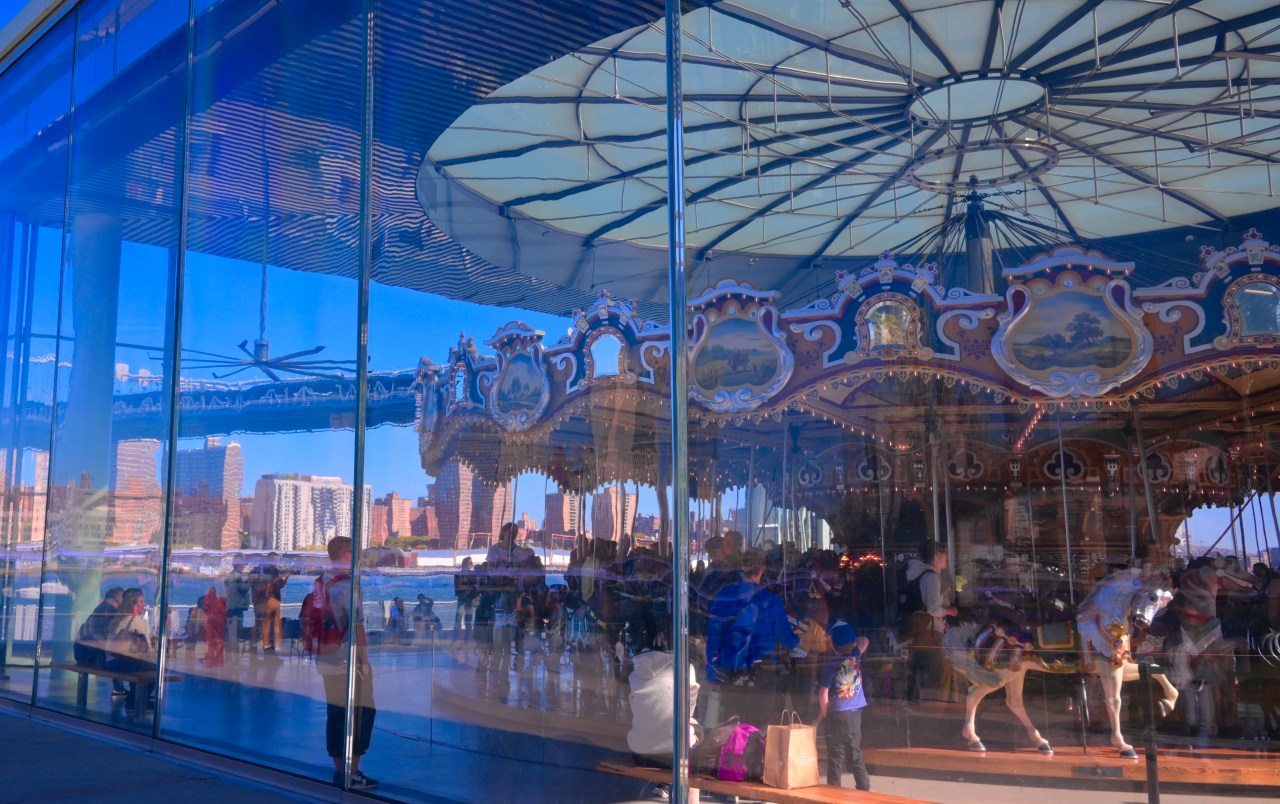
Frequently, when I first sort through images back home, I discover that Nature or Chance gave me a bit of a boost in making a picture work slightly better. On the day I took this shot of Jane’s Carousel) in Brooklyn Bridge Park opposite lower Manhattan, I was mostly concentrating on the interactions of parents and kids as they queued up for the ride, and occasionally trying to frame to include the bridge, which is very close by. I typically don’t try to convey motion in such shots, snapping at a quicker shutter speed to keep everything frozen for the sake of faces. In the case of this carousel, exposure was also a bit tricky, since it sits inside a glass enclosure topped by an overhanging roof which also includes atrium-like cutouts. That’s a lot to handle at one time.
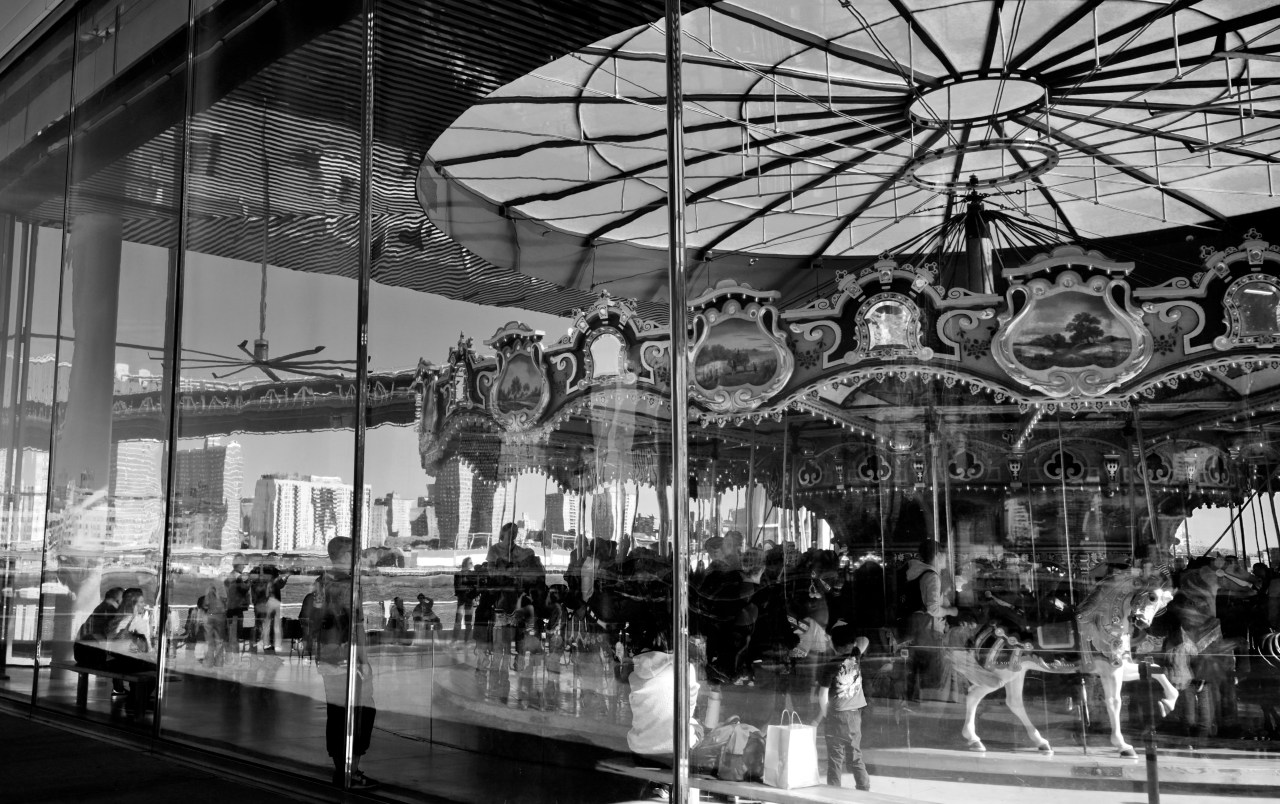
So much, in fact, that it wasn’t until days later that I realized that shooting through a closed side of the carousel’s glass box would, in effect, filter the carousel through a wiggly warp of sorts, creating the sensation of whirling or spinning. In fact, close examination reveals that most of the details are, in, fact, in fairly sharp, normal focus, but the slight distortion lent a dreamy quality to both the original shot at the mono conversion, both of which I submit here.
Whatever “plan” you try to make in advance, street work places you at the mercy of prevailing conditions, and so it’s better to be gracious/grateful for the odd bits of luck that are thrown your way. As soon as you become cool with the knowledge that you’re not actually in charge, you can just get out of the way of the entire process and chalk up an occasional win.
SEEK THE UNIVERSAL
By MICHAEL PERKINS
To see a world in a grain of sand / and a heaven in a wild flower / hold infinity in the palm of your hand / and eternity in an hour. ——–William Blake, Auguries of Innocence
ONE OF THE MOST MIRACULOUS GIFTS OF PHOTOGRAPHY is the same gift that all great arts, from painting to music, produce; the ability to take a small sample of life and make obvious its universal connection to existence in general. To see a local sunrise is to see the same sun that every person on the planet can see; to show Blake’s “grain of sand” is to glimpse every shoreline and beach; and to show emotion on a single human face is to experience the joys and sorrows of all faces everywhere.
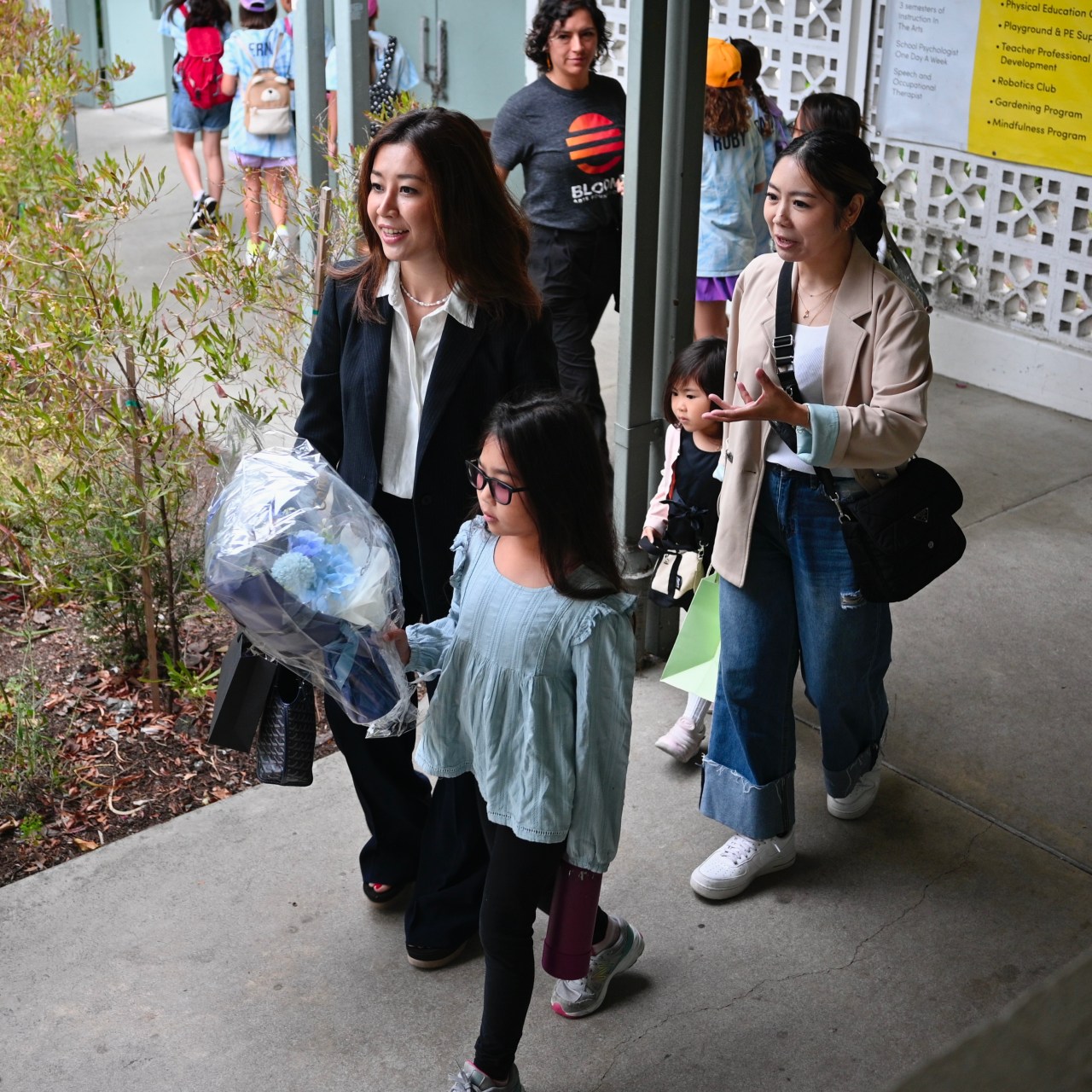
Seeking the universal in the particular is, of course, beyond instinctual to anyone who spends any appreciable time as a photographer. We learn from our first photo shoots how to recognize patterns and their replication across peoples and generations. We know that everything we show has all been shown before. So why restate the obvious? I guess because some instances of “all of us are everybody” strike us as particularly poignant. It reinforces the truth that all experience is shared experience.
I recently attended an elementary school graduation at a school in Los Angeles, an elegant, sweet-hearted recognition of our general humanity that, on that particular day, contrasted strongly with angry energy elsewhere in the city that underscored our divisions rather than our commonality. This particular school is a wondrous mixture of ethnic pride, a school in which no fewer than eleven languages are spoken across the student body. There were any number of opportunities to record the celebrations of various families as they arrived to celebrate the miracle of their young people, but for some reason I was particularly happy with this one, a small parade of three generations gathering to mark success, to certify our common humanity, to beam with pride. I love this picture, for reasons that go far beyond any technical skill on my part. Photography succeeds when it seeks, and preserves, evidence of the universal. We are all the same child, happy to pick up our diplomas and go to the next level. We are all cameras striving to freeze that happiness for posterity.
************************************************************
Want to review past articles? The Normal Eye is fully archived. Just click on POST TIMELINE at the bottom of any page on the site to scroll through our entire first dozen years. Thanks and happy hunting!
 thenormaleye