OPEN WIDE AND SAY AHHHH
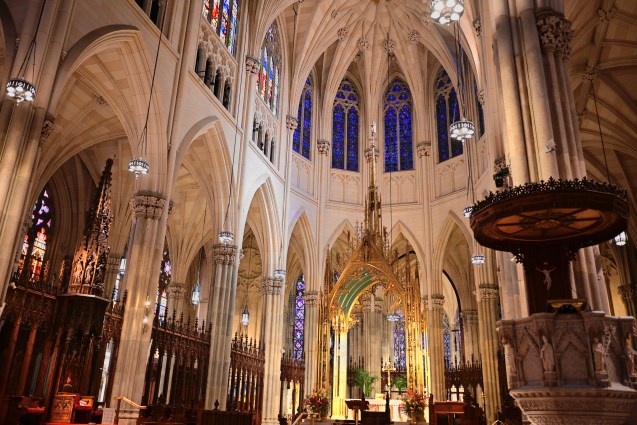
Handheld inside St. Patrick’s Cathedral, NYC. f/2.8, 28mm, ISO 1000, 1/50 sec.
By MICHAEL PERKINS
1960’s COMMERCIALS FOR THE SWINGER, Polaroid’s first entry-level instant camera, marketed mostly to teens, showed how easy it was to achieve good exposures, simply by twisting the knob that supported the shutter button. Too dark, and the word “NO” would appear in the viewfinder. Twist to tweak, and the display turned to “YES”. Many flubbed fotos later, we all learned (at substantial expense) that it really ain’t that simple. And in the years that followed, with better and better cameras, we still seemed to be getting a “YES” from our gear, only to find that the resulting image was definitely a “NO”.
The reason for all this reminiscing is the completely different experiences I’ve had in recent years taking shots that, just a while ago, were almost guaranteed to fail, but which now succeed, and amazingly well. You know the kind I mean; those extreme pockets of darkness and gloom where light goes to hide and pictures go to die. In my early DLSR days I did my best to harvest a higher percentage of them, working with that format’s smaller sensors, the fastest prime lenses I could afford, and higher ISO settings. Working on a tripod made even more of such shots possible, but those were always in the minority of overall frames. Let’s face it; unlike Ansel Adams, who could work all day waiting for the right shadow to hit the side of El Capitan, we largely live in a hand-held world. I got a lot of “NOs”.
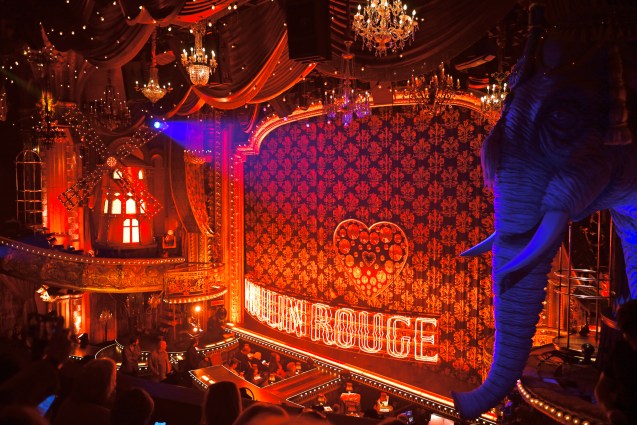
Just before curtain at Broadway’s Herschfeld Theatre. Hand-held at f/2.8, 28mm, ISO 2000, 1/100 sec.
After switching to a full-frame sensor and allowing for the tech to catch up in terms of more evenly rendering high-contrast subjects, even straight out of the camera, I find that the list of “undoables” is a lot shorter than it used to be, as witness the two shots in this article. Both are done with a 28mm lens wide open to f/2.8; both are handheld; both are taken inside locales (a cathedral and a Broadway theatre) known for harboring deep, deep pockets of shadow, often leading to dark patches that swallow detail or light areas that tend to blow out. Amazingly, minus a few minor color corrections, neither shot has been corrected in post.
In the days of our first cameras, we largely shot on an “if come” basis. If we did everything right to second-guess every technical tiger trap that was part of the process of calculating the shot, the picture might “come”. Maybe. And now, the carefree joy of picture-making which Polaroid promised back in the days of mini-skirts and paisley, a real closing of the gap between the imagining and the realizing of an image, might finally be imminent.
It’s enough to make you feel like a Swinger.
 thenormaleye