IT’S NOT THE SHOES
By MICHAEL PERKINS
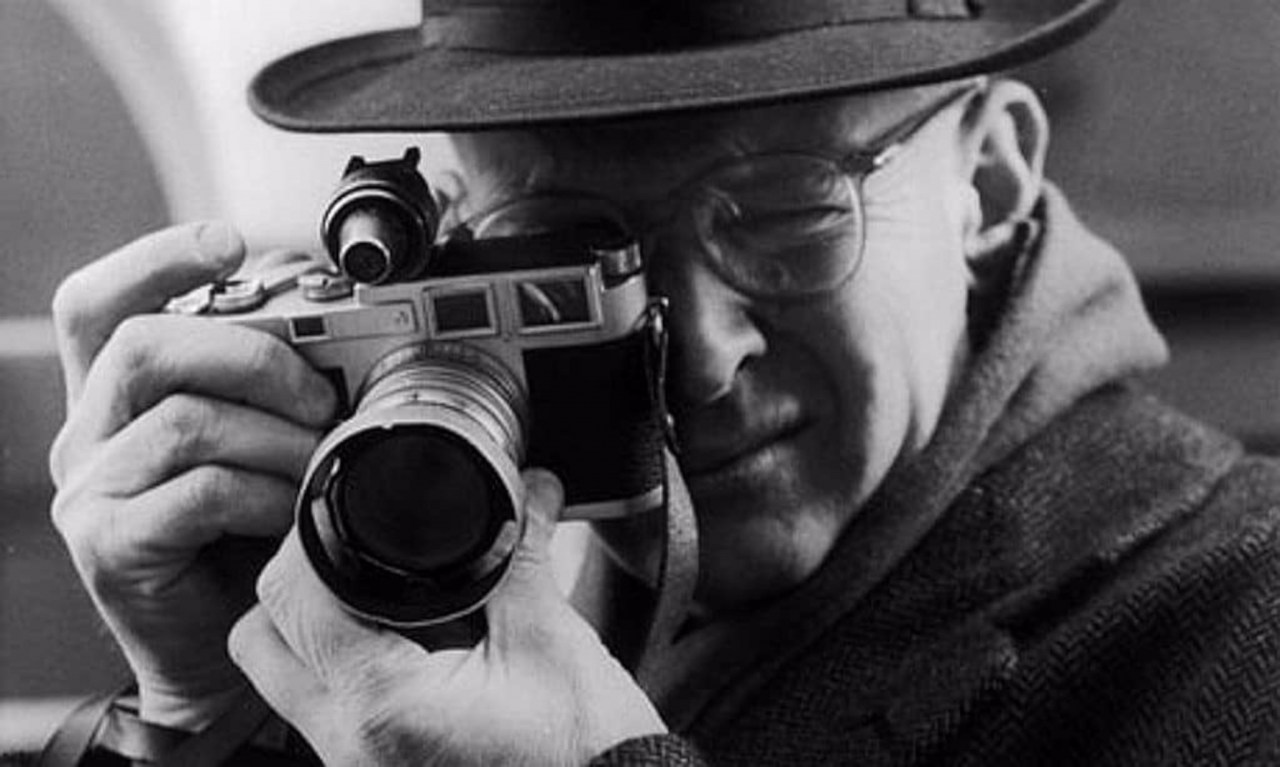
I WAS RECENTLY READING AN ARTICLE that centered not so much on the unique talent of legendary photographer Henri Cartier-Bresson as on the succession of early 35mm Leica’s that were his go-to tools. In the writer’s defense, I believe he was at least trying to make the case that HCB’s kit merely facilitated his own wonderful vision, assisting but not making his greatest images. However, a reader that already regards certain cameras with the zeal of a cult worshiper could easily come away with the opposite view, that those Leicas were, themselves, a determinative force in how his pictures came out. And that’s unfortunate.
People who sell consumer goods tap into the human habit of crediting things for what might be achieved by intelligent use of those things. Eat this breakfast cereal and break the four-minute mile. Ride around your neighborhood on the tires that won the Indy 500. The pitch even works in reverse psychology, as in Spike Lee’s brilliant ’80’s ads for Nike, in which he kept asking various basketball superstars, “it’s the shoes, isn’t it?” The payoff was, of course, a knowing wink to the consumer, i.e., “well, no, it’s not really the shoes, hee hee, but, P.S., Jordan wears ’em, so…” And, for shooters, the equivalent pitch: buy this camera/lens/attachment/app and become a great photographer. It’s an easy approach for advertisers, because it appeals to our own bias about what creates excellence, which, in many cases, the advertisers have “taught” us to believe in the first place.
Cartier-Bresson, whose sense of composition was said to be so keen that he was known to merely raise the camera to his eye and click in one unbroken motion, developed that economical sense of execution on his own, irrespective of what gear he was using. He employed the simplest, most streamlined approach to making pictures that he could, and, as a matter of historic accident, the early Leica’s, themselves very no-frills affairs, gave him all the machine he needed to get the job done, and nothing more. Other manufacturers could likely have served the same elemental function for him, but, as fate would have it, Leica got there first, and so became an inextricable part of his legend, a lazy kind of “oh, that’s how he did it” explanation for a genius that simply cannot be explained.
One wonders how long the camera industry could thrive if manufacturers could not (a) make us discontented with what we already have, and (b) convince us that the next toy we buy will make us a Cartier-Bresson. But the real “camera” in photography is the one positioned behind our eyes. Knowing where to hit the nail-head is more important than merely buying a premium hammer. It really, honestly, swear to God, is not the shoes.
COLOUR MY WORLD (OR NOT)
By MICHAEL PERKINS
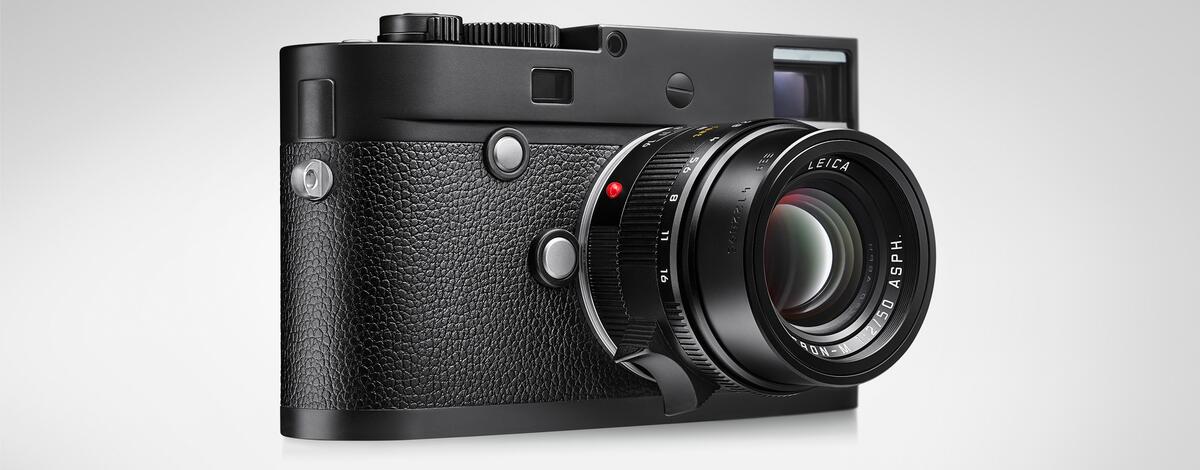
This camera costs $8,995 and cannot, will not ever, take a color image. How many would you like?
EVERY PHOTOGRAPH EVER CREATED BY A DIGITAL CAMERA, regardless of subject, technique or approach, begins as the very same thing: a black-and-white image. Even in an era of saturated and custom-manipulated color, our cameras originally create everything in tones of grey. Aesthetically speaking, that’s about as hard-wired a bias toward monochrome as you can imagine. And this means exactly what, and to who?
The science of how this happens is all rather basic, at least in the horrendously oversimplified way I’m going to explain it. In addition to the camera’s pixel-covered sensor, that assigns tonal value for a photo file in black and white, there is, in most cameras, a second sandwich layer, called a Bayer filter array, that combines with the sensor to assign color to those tones. This all happens without many of us giving it much thought, since black and white, at least mentally, is no longer the default mode for most of us, merely an effect that we achieve either by changing a setting on the camera’s shooting menu or converting color shots to b/w in post-production after the fact.
Where this gets interesting is when an affection for both mono and technical perfection meets the niche camera market, resulting in the creation of cameras that shoot nothing but black-and-white, inciting some wags to intone, “at last!” while many others query, “what are you, nuts?” Those who vote with the skeptics point to the fact that the pro-sumers who opt for such a machine, such as Leica’s M10 Monochrom, will part with nearly nine thousand clams for the privilege of enjoying one less feature than even the cheapest camera delivers. Wait, they say. You took something away from the camera and you’re charging more for it? Well, I gotta bridge I wanna sell ya…
On the pro-sumer’s side of the argument is the trickier, tech-ier underbelly of the issue. Turns out that the Bayer array actually degrades your images, reducing the amount of light that gets to the final file, compromising both sharpness and ISO performance in low-light situations. That in turn means that removing the Bayer array from the camera boosts its fidelity in a significant way, resulting in less loss in both cropped images and enlargements. Do these benefits register as must-haves for the average shooter? Does the romance of shooting in black-and-white only, which, as we’ve pointed out, used to be the default status of all cameras way back when, still have the allure that it once did, and for how many consumers? This is the part of the program where you do your own math and makes your own choice.
Now, let’s be honest. I love me some elite toys, especially the ones I would never, in a million years, actually purchase. I love $3,000 direct-drive analog turntables mounted in virgin-forest koa. I love $500 counter-top appliances that only de-vein and parboil jumbo shrimp. But the turntable can’t make my old Black Sabbath albums any better musically (nothing can, sadly), not can the shrimp gadget confer Wolfgang Puck status on my random kitchen meanderings. Could I take better pictures (whatever that phrase means) with the most technically advanced camera on the planet? Only if I can take good pictures with anything, from a cigar box pinhole to a NASA telescope. And, if you spend years failing to develop the eye for making pictures that connect with people, it takes more than a $9,000 bandaid to make that not be so.
IF YOU LEICA ME LIKE I LEICA YOU….
By MICHAEL PERKINS
EVEN FOR PHOTOGRAPHERS WHO WILL NEVER OWN A LEICA, the brand has always been synonymous with pristine quality, innovation, and a mystique that is as durable as gold and as elusive as vapor. In fact, the company which began its life in Germany 1907 as Ernst Leitz Optische Werke (or simply “Leitz”) has inspired imitation, envy, and a definite bloodlust of desire that separates Those Who Would Have Nothing Else from Those Who Can Only Dream. In short, all Leicas are good children and all good children go to heaven. They are an impeccable species sufficient unto themselves, making no concessions to lesser species. History, right?
Except of course, that such “history” is mostly folklore. In point of fact, Leica has experienced the same ups and downs, the same botched launches and bitter failures, as other manufacturers, creating its own mutant wing of weird hybrids and downright flops, occasionally going so far afield as to come dangerously close to winking out of existence. One of those errant wanderings is traceable to the 1970’s, which was, overall, a marvelous time to own a camera, unless that camera was… a Leica.
Beginning in the ’60’s, the single-lens reflex camera revolutionized the world of both pro and amateur shooting, with Nikon, Canon, Pentax and other lean young barbarians adding amazing features at a reasonable cost in a way that was rendering the venerable Leica rangefinder system obsolete. The late-breaking line of Leicaflex SLRs, introduced years behind the competition, offered a mealy-mouthed feature set and insane price tags. They also brought the company nearly to its knees, as its makers found themselves unable to control runaway production costs, actually losing money on every unit sold.
And then something historic happened. Around 1973, Leica (whose parent company was still officially named Leitz) looked down from its perch atop photography’s Mt. Olympus (no camera joke intended) and asked for help, entering into a partnership with Minolta, which, at the time, was one of the big dogs in the SLR kennel. The two companies agreed to share designs while the actual manufacture of selected components would be moved from Wetzlar, Germany to Japan. Their first product collaboration was a revised rangefinder called the CL, which sold well, but chiefly at the expense of the equivalent “pure” Leica product line, a fact which succeeded in ticking off the company’s purist fan base (bless ’em). Right on schedule, the ever-present Leica snob machine began to put an asterisk after all such Leitz-Minolta products, marking them as less than genuine than “real Leicas”, even though the partnership actually helped improve the sleekness of the company’s SLR design and pioneered many new features, such as aperture and shutter priority, that would become standard in the following decades.
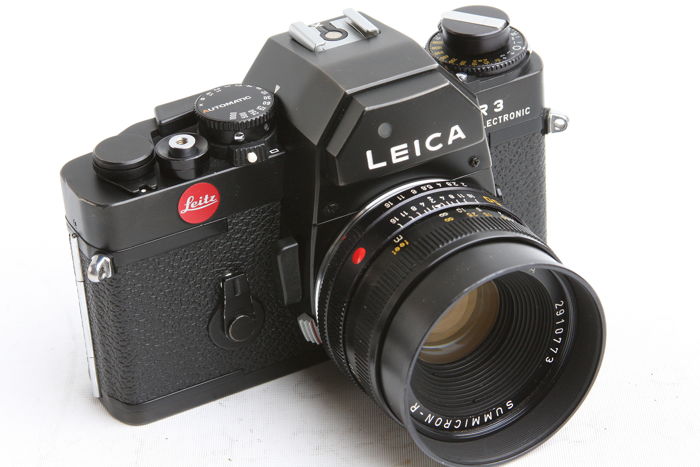
Over the next decade, the Leitz-Minolta marriage refined the weight, ergonomics and acuity of its mutual “children”, producing some of the world’s favorite cameras before differences in philosophy forced a divorce in the early ’80’s. Notable among their successes was the magnificent Leica R3 (1976, seen above), which boasted center-weighted metering, an improved mount to better accommodate a variety of lenses, and a more responsive shutter, all making for a full-on comeback for the folks in Wetzlar.
After the breakup, Minolta entered into a later arrangement with Sony, as eventually would Leica, which also went on to share technology with Panasonic. Neither company would ever again fly completely solo, and their original collaboration would demonstrate that even the companies with the highest pedigrees could enhance their survival in a fiercely competitive global market by thinking outside their own branded boxes.
RECOMMENDED READING: Josh Solomon, The Sweetest Taboo: The Unlikely Story Of Leitz-Minolta.
 thenormaleye