RISE OF THE UPSTARTS
By MICHAEL PERKINS
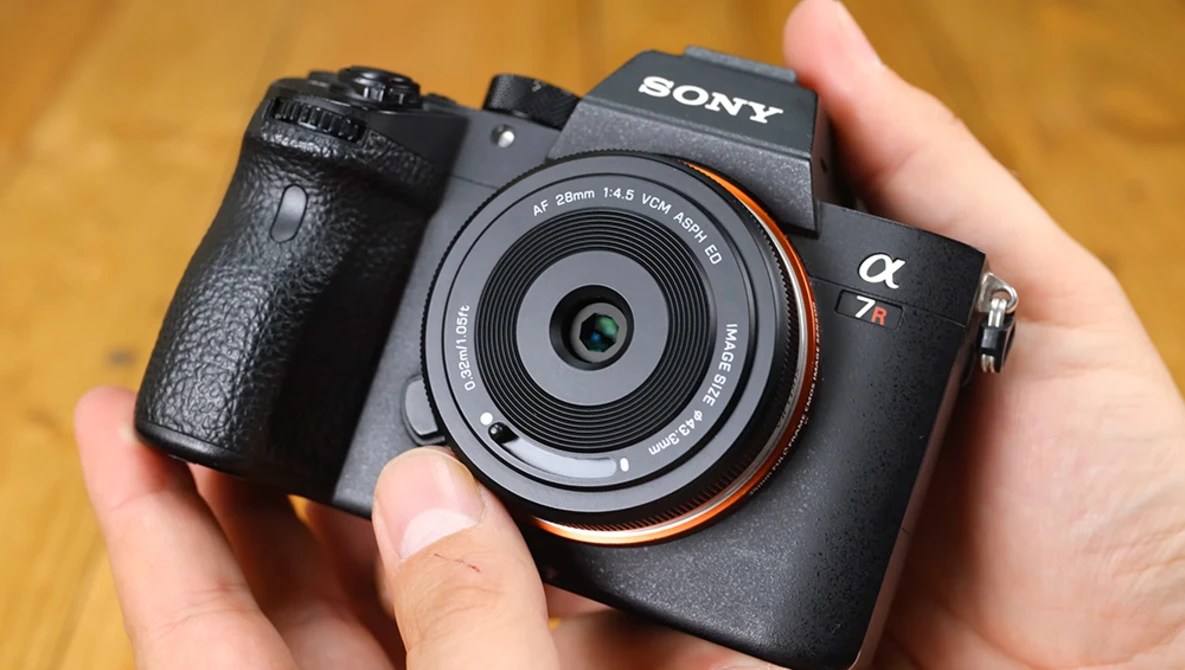
Pancake with a punch: newcomer Viltrox’. body-cap-sized 28mm f/4.5 for full-frame cameras (various mounts) with AF.
THE MARKET FOR CAMERA LENSES HAS ALWAYS EXPANDED in all directions at once, affording photographers an embarrassment of riches when it comes to selecting their best optical options.
There is always the most traditional route, in which various makes of cameras promote their own proprietary lines of brand-new products from macro to telephoto and everything in between…what one might call the “brand-loyal” route, a path which can lead to a substantial investment in cutting-edge tech. Then there is the “lest we forget” wing, in which new cameras are paired with older model optics long vanished from their parent company’s active product line, often adapted from one format to another, such as the refit from DSLR-era glass to new uses on full-frame cameras. Lately, there has also been a kind of retro retrenchment, as lo-fi (but not always lo-cost, lol) lenses are marketed to “serious shooters” for a rebirth of randomness, error or “authenticity”, as unpredictability is re-introduced to a process that’s grown, for some, a bit sterile.
And now, as we near the one-third mark on the 21st century, a tremendous wave of fresh product is coming from a new crop of third-party optics houses entering the market at the low end of the investment scale, providing amazing features that traditionally were found only in costlier major-brand lenses. Established third-party players like Tamron and Sigma have been joined by new players that include Laowa, Rokinon, TTArtisan, 7Artisan, and Viltrox, with more players entering the game each year. And while the new kids had mostly been sporting models with manual focus only, that barrier is falling as well. The small-as-a-body-cap Viltrox 28mm f/4.5 pancake lens shown here delivers quick, responsive auto-focus for just $99, with other brands rushing their own wafer-thin, fixed-focal-length versions to market as we speak. Reviewers whose critical default is a down-the-nose dismissiveness toward upstarts have had to rethink their biases, and the “rules” of who can be competitive in the optical field are likewise being radically rethunk. Long gone are the days when one country, tradition or brand had a lock on what constituted a “good” lens, a leveling of the playing field which can only benefit the consumer.
GO-TO / COME-BACK-TO
By MICHAEL PERKINS

THE URGE TO DO MORE WITH LESS, to make better and images with a smaller central amount of kit to carry around (or invest in), probably hits every photographer at least once in his/her life. It’s great fun to add to one’s arsenal of weapons/toys in the pursuit of being able to shoot anything under any circumstances, but it’s also very freeing once you decide on the absolute minimal amount of gear that it takes to do nearly the same thing. I’ve gone through any number of “return to basics” phases over a lifetime, always looking for that one set-up that’ll keep me from over-complicating the elemental principles for making decent pictures, which are, let’s face it, pretty simple.
This all leads to the search for the so-called “go-to” lens, an ongoing vision quest for me, and, I suspect, for many of you. But there is another, slightly different comfort category, which I call the “come-back-to” lens, a piece of glass that may, at one time, have served as a go-to, and now has earned the right to occasionally return to the front of the pack, like a one-off date with an old flame. A true come-back-to may not be a universal solution to all shooting situations, but it likely will have been proven in battle in some manner at an earlier time, and thus deserves to be deployed again in a similar situation. This goes a lot to the issue of familiarity, of ease of operation, of not having to think too excessively about how to get the pictures you want. The come-back-to is, in essence, a return to comfort. It’s not a box of chocolates: you know what you’re going to get.

So, an example: when I want to set up my camera to handle the shifting mix of light, exposure challenges and color rendition in the tricky environment of, say, a museum, I go digging for one of the oldest optics I have, a 1970’s-era Nikon 24mm f/2.8 manual lens that I’ve used, off-and-on, for about fifteen years. I set my Nikon Z5 on full manual, pre-selecting a medium focal length like f/4, and tell the camera to allow auto ISO to make any necessary tweaks on my sensor up to 3200. At that point, I’m working almost literally with a point-and-shoot, a level of ease that allows me to react to a rapidly changing series of environments without slowing down to fiddle. It’s not strictly logical, but then the advantage of a come-back-to is mostly emotional. I feel as if I’m going to get good results, which is half the battle. A ” go-to” is a lens that can be counted on to do damn well nearly everywhere; a come-back-to is like going home again. Or so it feels to me.
 thenormaleye