LAND OF SCROOGE AND CRATCHIT
By MICHAEL PERKINS
AMERICA HAS NO MONOPOLY on the stark contrast between the haves and have-nots, but we certainly stage that ongoing drama in our own uniquely dramatic fashion. The worlds of comfort and privation in America are often separated by physical walls of membership and exclusion, but the eye of the photographer can often see the two realms parked uneasily side-by-side. Nowhere is this more demonstrable than in our major cities, where one man’s the sky’s the limit life is another’s pretty much everything’s a limit existence. And one of the cities where this existential play is staged to greatest effect is Los Angeles.

Hollywood, specifically, is a Petri dish for the collision between aspiration and desperation, being the world’s foremost fantasy factory. As long as nightmares are the reverse side of the dream coin, the yin and yang of want it and need it will be displayed in Tinseltown, and, to a lesser degree, across all of L.A. The image seen here advertises the up and down sides of daily life, or. if you like, the Scrooges versus the Cratchits. One camps has it and wants to keep it. The other peers over the golden fence and wonders what it’s like to walk in the sun.
Around the world, the chasm between privilege and privation fuels discontent, envy, revolution. It also sparks art, adventurism, enterprise, exploration. And always, in Hollywood and beyond, the symbolism, the visual way of keeping score, the belief that, with a little extra hustle, any Cratchit can put on the golden raiment of a Scrooge. Maybe that’s the pull-push that’s needed to make a society. Whichever way the contest shakes out, there are stories to tell, and pictures to help sell those narratives.
I KNOW WHY THE (UN)CAGED BIRD SINGS
By MICHAEL PERKINS
JOHN JAMES AUDUBON NEVER EMBRACED THE NASCENT ART OF PHOTOGRAPHY, which was only just out of its crib when the naturalist and artist passed in 1851. More’s the pity: his studies, and the magnificent paintings which resulted from them, were only accomplished by the killing of nearly all of the four hundred species he depicted, a technique well in line with practices of the 1800’s but regarded with horror by today’s birders. Photographs, in his lifetime, were a curiosity, certainly no competition for the observation and focus required to capture nature on canvas. And so it goes.
I have repeatedly credited my wife in these pages for retraining my eye regarding birds, which I certainly noticed over the courts of my life but didn’t really see. As someone who has always had a camera hanging around his neck, I have, since her miraculous intervention, experienced successive waves of “where the hell I have I been?” when naively delighting in creatures that she has been keenly aware of for decades. Fortunately, unlike Audubon, I don’t have to catch, shoot or poison them just to get a good look at their habits or habitats, as it’s rewarding enough just to be able to linger over the details of their design and grace in pictures. Sadly, I should have begun this journey as a much younger man.
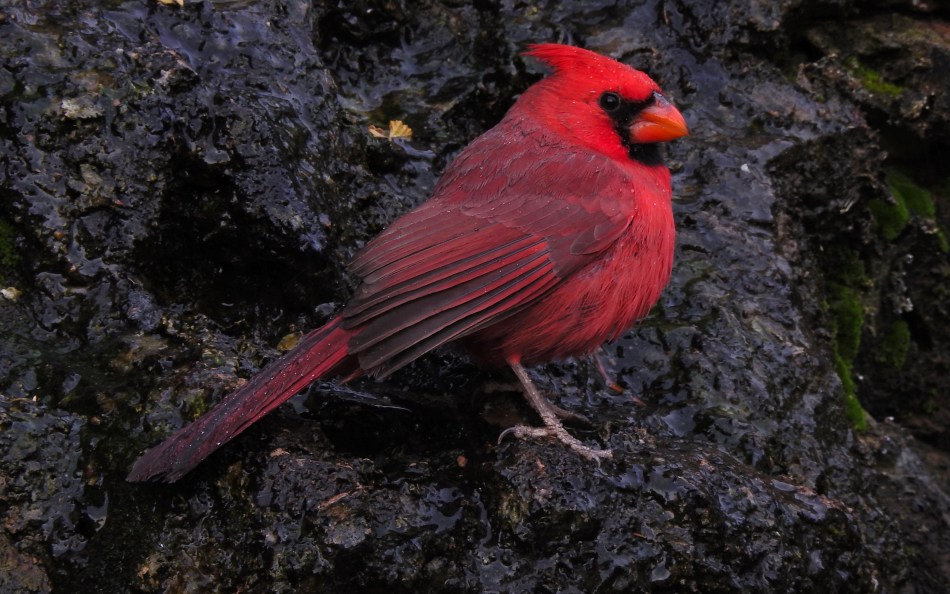
Making a photograph of a bird is a privilege.
Hang with birders for even a short while, and you will be stunned by how very much you do not, but should, know about creatures whose life is impacted, impoverished and just plain crowded out by our very existence, by our selfish gluttony and plunder of all things natural. It’s not just that we are just the loud, rude neighbors down the block: it’s as if we decided to throw empty beer bottles and cigarette butts from our parties over the back fence and into the yard next door. Birds are both a reminder of the infinite beauty built into the world and a rebuke to the unwitting war we wage against it. To measure what is either threatened or vanishing, you need a reliable recording tool….faster, more accurate, and less deadly than Audubon’s slay-’em-and-then-salute-’em method. For millions, including myself, that’s a camera.
The Audubon Society is currently undertaking the sizable task of changing the names of all birds who were identified by the names of humans. Not merely the more notoriously racist or rapaciously heedless of them, Audubon and John Muir among them, but any humans. The names will now merely be descriptive of the individual bird’s identifying characteristics, making their labels more purely scientific and perhaps sending at least a small signal that the earth is ours to inhabit, not conquer; to cherish, not dominate; to curate, not capture. And to learn, as the makers of all too many cages, why the uncaged bird sings so clearly and so beautifully.
OF GOLDFISH AND MEMORY
By MICHAEL PERKINS
AS WE ADVANCE IN AGE, OUR LIFELONG HABIT OF PHOTOGRAPHING EACH OTHER takes on a kind of mildly desperate urgency. Suddenly we realize that everything we see might be the last of something: the last birthday with Grandma: the last Christmas before the children move away: the last time we were all together “like this”. A wasted opportunity for a picture becomes a more egregious error. Oh, I missed it. We become acutely attuned to the fleeting nature of things than we ever could have as young people.
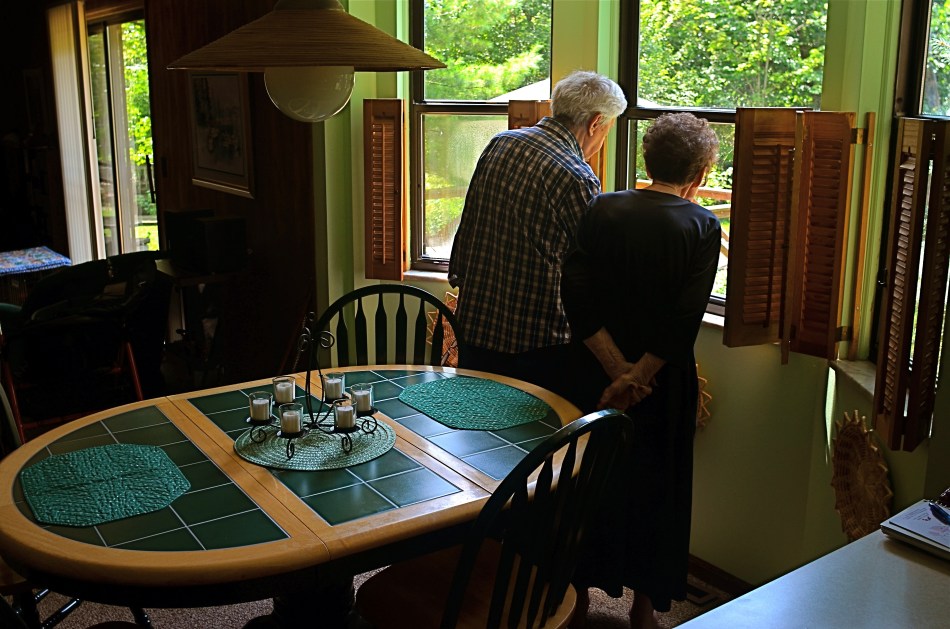
2023 mark my first holiday season without my mother. She lasted nearly ninety-one years, and her marriage to my father, who remains, marks its seventy-third anniversary as of this Thanksgiving Day. The image shown here, taken in 2017, is not the final picture I have of them together, but, over time, it has become my favorite. Over the space of two thirds of a century, literally thousands of pictures have been made of the two of them, almost all of them forward-facing, every one of them radiating the love and joy that made their lives a perennial miracle. But this one, with their backs turned to me, can make me cry as well as smile. And I cherish both reactions.
The composition is a pure accident, absolutely a thing of the moment. For years, they maintained the tiny fish pond just outside the back window of their dining area, struggling to keep it clean and safe from the elements as well as the predations of the occasional greedy heron. This meant that the simple act, especially in the winter months, of their looking out to see how “the babies” were doing, was a regular part of their daily routine. And so this is a snapshot of something very ordinary.
Or at least it began that way.
Now, it’s something deeper. Now, it’s the two of them, the Team Supreme, the Two Against The World, side-by-side, looking outward, looking, as one, for the Next Big Dream. I can’t see their faces, but I can clearly visualize their souls. The photograph taketh away and the photograph giveth.
In this cold Ohio November, my father, the last man standing, walks the halls of a home that is now merely a house, looking for his pal, his best girl, and finding only shadows and echoes. Amazingly, he learned enough about hope from her, over a lifetime, to keep going, keep looking for more fish that need caring for. And I go “fishing” for this picture for the solace I seek.
I know they are actually not separated at all, not really.
But, occasionally, I can sure use a reminder.
BLANK CANVASES
By MICHAEL PERKINS
I GENERALLY STEER CLEAR OF THE WORD “ABSTRACT“, since, like many other terms of art, it has been bludgeoned, by misuse and repetition, into a blunt instrument, rather than the surgical tool it might have been. If the word means, as one dictionary has it, something “disassociated from any specific instance” or, in another, as “expressing a quality apart from an object“, then it actually becomes a fairly accurate way of defining what happens when one art beholds another. We take the object away from its original context, or redefine it in our own terms. We begin to personally possess it, using words or pictures to say, “I know what this was ‘supposed’ to be . This is what this is to me.”
In this way, a person with a camera can approach any subject, regardless of its “actual” history, as if it were a blank canvas.
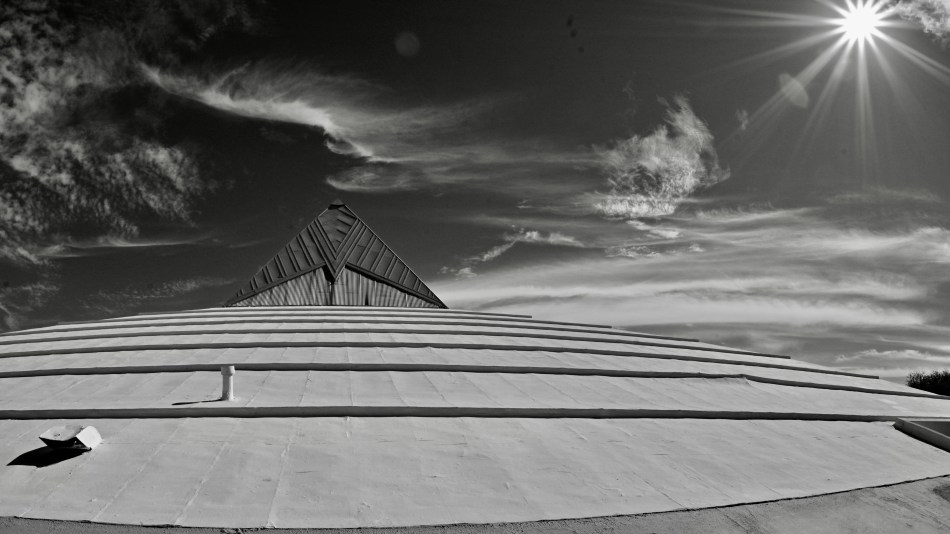
I approach the building seen here in exactly that way. Originally, it was a church of some kind, and by “some kind” I mean of the ooky-spooky, not-of-this-world variety. Hey, no judgement. The pyramid cap up top was deemed significant in some way in the overall design, but, as the place had long since been de-sanctified and put to other purposes by the time I first encountered it, the intent of the creator(s) has been lost to me….hence the “blank canvas”. The structure has no history at all, at least as far as my eye is concerned, freeing me to assign any meaning (or no meaning) to it pretty much at will.
Strategy-wise, part of the making of this image is an attempt to tie the building to something ethereal or mystical, leading me to shoot in monochrome for mood and using an f/16 aperture to convert the midday sun from a blinding glob to a multi-pointed starburst. I also decided to jack the contrast to extreme levels and darkened the insanely bright Arizona sky into something foreboding, imbuing the passing clouds with a bit of menace. The result? A temple? An alien mother ship? A gateway to another dimension? Your rules and your choice. The structure, as I came upon it, meant nothing to me, and so I got to determine its meaning. Or “a” meaning. And that, to me at least, is abstraction. Or maybe it was just a way to kill fifteen minutes while waiting on my wife. Or maybe I live in a world in which both things are true.
HELLO GOODBYE
By MICHAEL PERKINS
THERE IS AN AUTOMATIC AND NATURAL EMOTIONAL CONNECTION between our memories and the images we create as those memories are being generated. The whole “remember that?” appeal of a photograph, after all, is why many of them get made in the first place. Pictures both record and recall in the same instant. We steal time now so we can steal it back later. But there is another heart tug that we feel over a lifetime of making photos, the special one connected to the specific devices we use to do the deed, and what those devices say about who were were at different phases of our lives.
In recently trying to winnow down the Everest of clutter Marian and I will be taking to our next home, I’ve been, as the archeologists say, opening a lot of tombs lately, mountains of accumulated junque which is decidedly less precious than the loot of the Pharaohs. In said tombs I stumbled on a mint-condition Nikon D60, my camera of choice when this blog began more than eleven years ago. It was the brand’s entry-level DSLR at the time, and I was certainly an entry-level shooter with it. Accordingly, once I learned how to do better and desire a more whizbang-y toy, it was shelved and forgotten, along with the memory of just how much dang fun the thing was to shoot with. A full tech check seemed in order before I could decide if it deserved adoption or de-activation, and so, for the first time in almost a decade, I spent a morning pointing it at just about anything.
One more lazy morning with an old friend. In this case, my old Nikon D60, newly emerged from retirement.
It wasn’t quite like taking your ex to dinner years after your breakup, but it definitely created some of the same type sensations. Suddenly, I wasn’t just taking pictures: I was recalling pictures, thousands of them, along with the backstories on how me and the D60 had willed them into existence. I remembered learning specific things for the first time, and recognized how my eye melded with what the camera could and could not deliver…..a lot of, “oh, yeah, it does that” and a warm regard for a kind of picture-making that now seems sweetly innocent. Oh, and, in the bargain, the thing still takes pretty good photos.
The tricky part now becomes where the dingus will wind up. I can’t bear to merely drop it off at a thrift shop or kick it to the curb, and so I now have a whole side project trying to find someone who wants what it does at this precise moment in their lives, a mission which has me annoying friends and relatives alike in search of a grandchild, a buddying hobbyist, somebody to love it like I did. Anything less would dishonor the great times we had together before we sadly concluded, “we need to see other people”. So, sorry, old sweetheart, we won’t be ending the evening back at my apartment, but take care of yourself and keep in touch.
“It was great fun, but it was just one of those things…”
UNANCHORED
By MICHAEL PERKINS
THE MOST ENDURING PHOTOGRAPHS TRANSCEND TIME, connecting with succeeding generations in ways that both celebrate the eras in which they were originally made and yet keep them unanchored from time somehow, as if what they have to say is completely irrelevant to the date of their actual creation. Even as each succeeding level of photo tech has produced a “look” specific to its place in time, the photographic art has evolved to the point where we can easily invoke the cues or features of any one photographic age, mixing and matching them in new photographs that also seem free of the constraints of time.
That, to me, is the selling point on apps, and their power as real tools rather than playthings. Our inherited legacy of the meaning of pictorial quality, as well as our sense of how physical images tend to age, is now simulated in endless combinations of color manipulation, textures, and image modification, even in our most casual snaps, meaning that there is no part of our shared photo history that cannot be summoned forth and replicated virtually at will.

Like many, I’ve tried to find a unique combination of app settings that begin to look like a signature style for my manipulated images, rather than just generate novelty effects, like sticking bunny ears on someone’s head. And like many others, I’ve had to radically revise my idea of a “genuine” photo, just as the cel forced me to revise my concept of a “real” camera. That, in turn, has made me looser with both phone pics and the pictures I make with my conventional gear. As to apps, where I’ve finally landed is a crazy quilt of looks that suggest everything from daguerreotypes to hand-colored tones to painterly patches to hyper-focused ultra-detail to textures that suggest either water damage or wear. I don’t know what to label the end result, but I seem, upon rifling through oh-so-many files, to have settled on it as my set point.
Which brings me to today’s launching of my latest gallery, Etchings & Agings, listed in the tabs menu at the top of this page or linkable here. It’s the first full page of phone images that I feel consistently happy about since I started this forum some eleven years ago. I may have come late to the dance with cel images, but they now loom larger in my workflow with every succeeding year. It can sometimes make me feel like I was the last kid in the neighborhood to get a color TV, but then, photography is as much about self-discovery as it is technical mastery. Without one you can’t get the other, and vice versa.
TATTOO REMOVAL
By MICHAEL PERKINS
THE INDUSTRIAL DESIGNER RAYMOND LOEWY, the genius behind some of the most imaginative products of the twentieth century, from the streamlined Greyhound bus to JFK’s version of Air Force One, often remarked how much more beloved an object could become if its outer shell was rendered more appealing. He proved it with everything from cigarette packages to locomotives, improving the public perception of everyday brands just by affecting how they were presented. Some might call such transformations superficial, mere makeovers, but they seriously matter when it comes to the visual impact of the everyday.
Photographing cities of a certain age means photographing the infrastructure that is part of their history, that intersection between how a thing performs and whether that performance is beautiful or ugly. There are good signs that our public places are finally taking Loewy’s lead and paying attention to how infrastructures impact our senses, that is, whether they are a delight, or whether, as H.L. Mencken put it, they “lacerate the eye.” For an example, consider San Francisco, a town of many rebirths and resurrections. The present day version of the place is often built upon the scar tissue of one or other of its prior eras. Things burn down. Thing crumble in quakes. Thing fall to the changing priorities and passions.
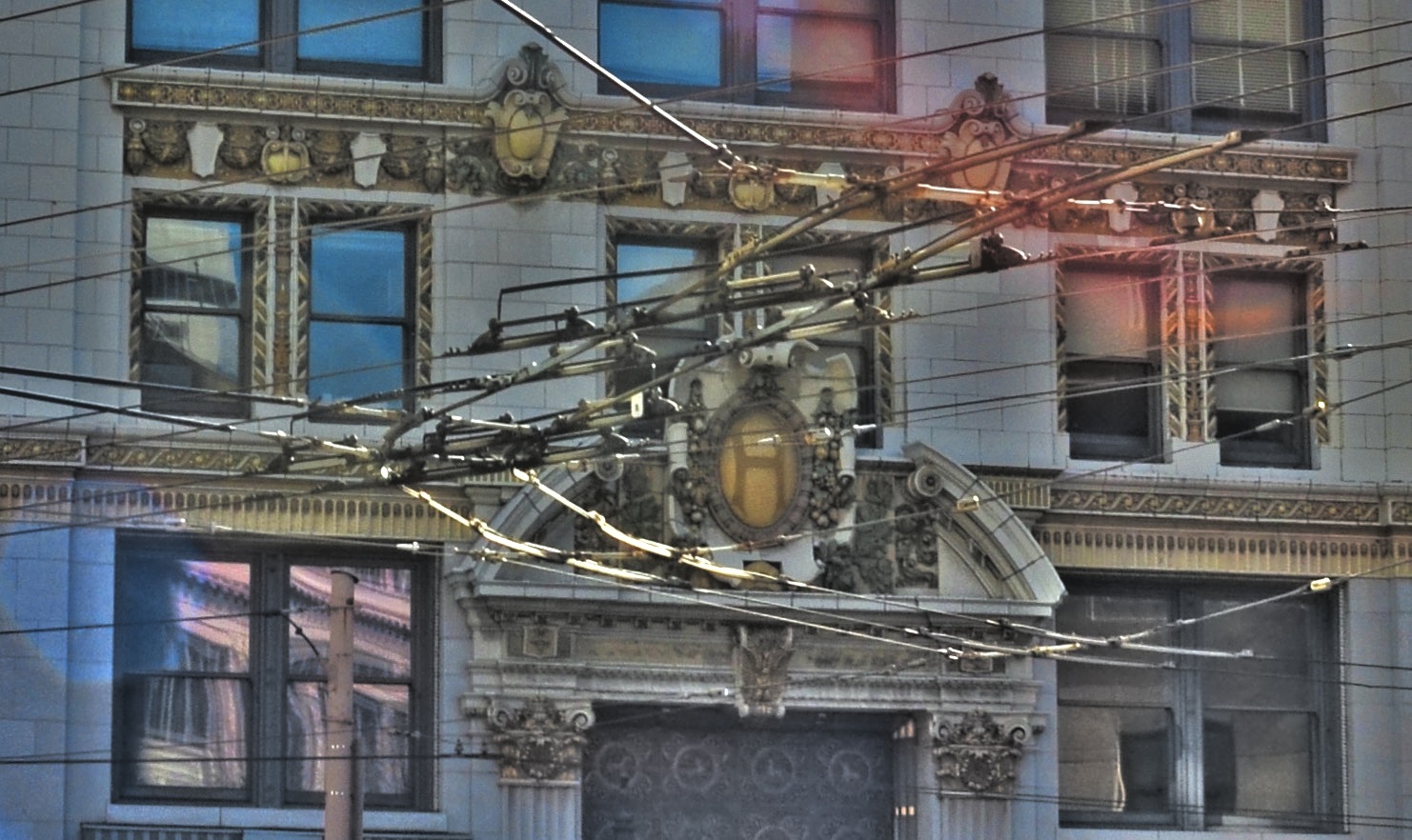
Even making pictures in a location as lovely as the Bay City can mean being force to focus through something hideous, like the mad tangle of electrical and cable car lines blocking the grandeur of the venerable building seen here. Above-ground telephone wires are vanishing from many places, and being designed out of the visual layout of newer towns, as are other remnants of bygone periods in American growth, but much remains to be done, a kind of cultural tattoo removal that shows we can, indeed, get out of our own way, that the beautiful signature of one kind of energy is not cancelled by the bad thinking of another kind.
In the meantime, the transition itself is photo-worthy, even important. Like Loewy often remarked, “good design keeps the user happy, the manufacturer in the black, and the aesthete unoffended”. In the interim, pictures can help us mark both our progress and our regressions, and both kinds of images serve to make us knowable to ourselves.
DANCING WITH GHOSTS
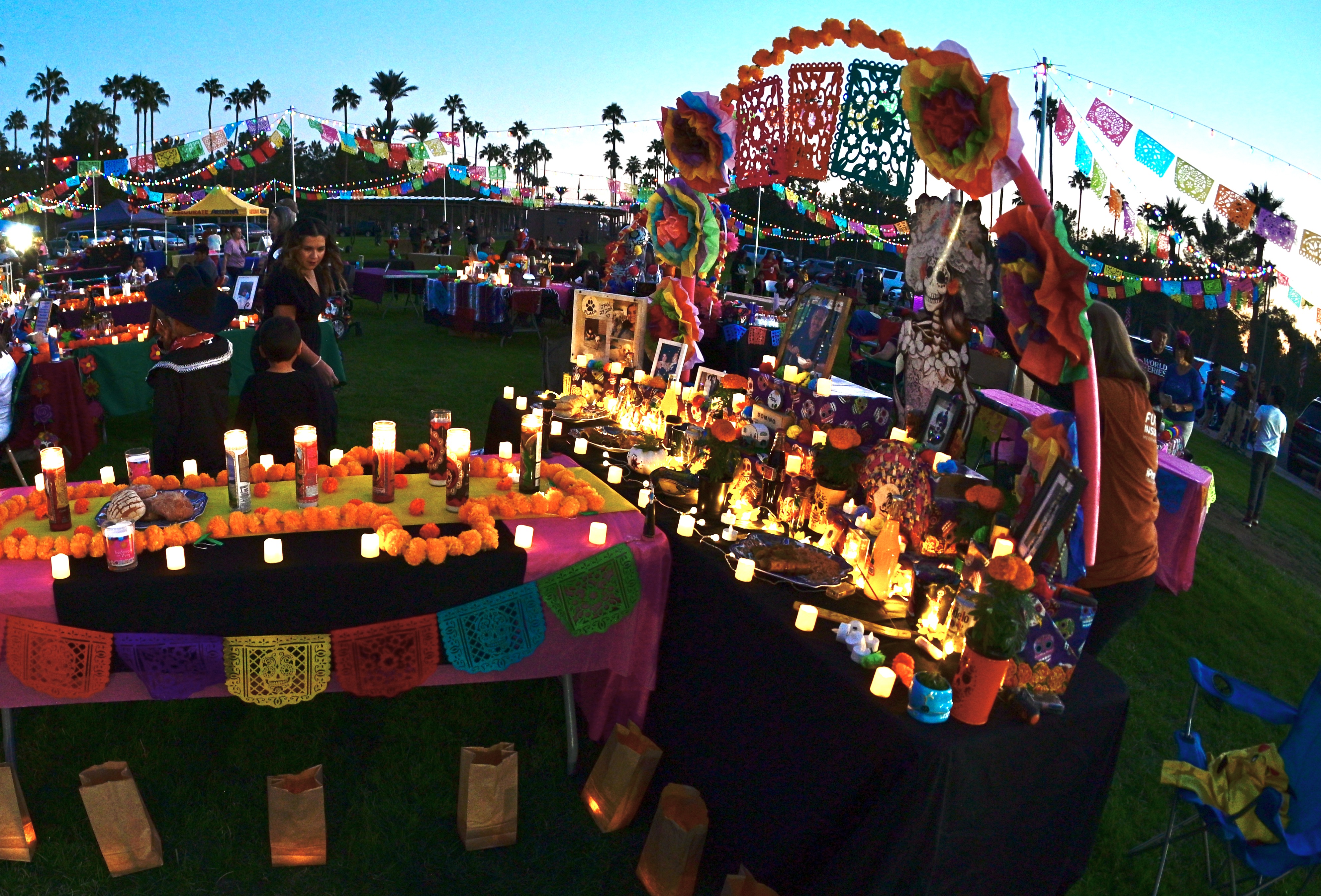
An ofrenda, or family altar shrine, at a Day Of The Dead celebration in Phoenix, Nov. 2, 2023.
By MICHAEL PERKINS
THERE ARE STILL SIZABLE STRETCHES OF AMERICA for which Dia De Los Meuertos, or the Day Of The Dead, remains a cultural asterisk, in contrast with those regions where it is sacred, mournful and celebratory, all at once. For a quarter century, I have lived in such a region, as the Valley of the Sun, or metro Phoenix, Arizona, is pretty much ground zero for the beautiful commemoration of family and spirituality that occurs in Hispanic neighborhoods each November 1st and 2nd. Catholics can specifically relate to the same calendar dates, as they coincide with the historic holidays of All Saints and All Souls Days. Also, scholars will remind us that Halloween, or the Eve Of All Hallows, which directly precedes November, was originally a time for dressing up as one’s patron saint. And therein lies the best connection to Dia De Los Muertos.
This year, I was invited to a DDLM festival held, where else?…in a cemetery, hosting a spectacular array of ofrendas, or the miniature altar-like shrines dedicated to departed members of one’s family. Precious photographs and votive candles are the main features, which are quickly expanded to include personal mementos of the dear ones, as well as endless sprays of bright pastel paper flowers, radiantly patterned hanging pennants, and, at this particular gathering, lots and lots of food. The dead are summoned by the endless skeletal figurines and sugar skulls that festoon every inch of every offrenda, and many of the celebrants themselves sport skull faces created with both mask and makeup. The atmosphere is never one of grief alone, but sadness alloyed with joy, as well as gratitude for the memories left us by our most beloved.
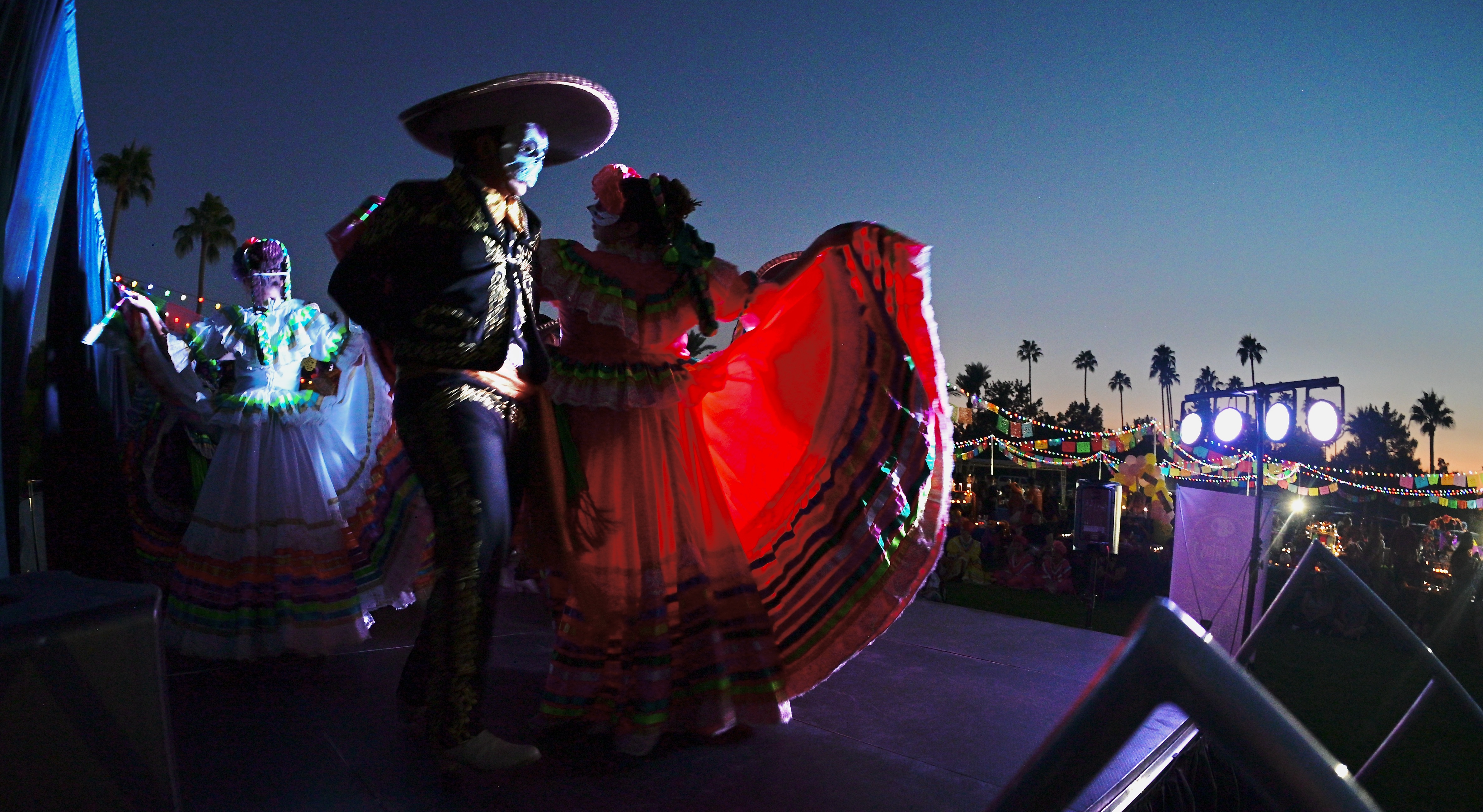
Dance and song narrow the gap between the “realities” of life and death.
Obviously the supernaturally tinged flavor of DDLM is paradise for a photographer, and I find myself trying to do justice to the sweetly spooky vibe by making images that are beyond mere documentation. It’s challenging to try to optically suggest a feeling, but it’s also rewarding when something unexpected makes it into the camera. This year, in using a lateral fisheye to twist the concept of space and thus suggest a kind of dream state, I also had to get comfortable with a bit of blur or distortion, as if I were able to capture ghosts in mid-dance, rendering the vanished visible, if even for a moment.
As Shakespeare said, there are more things in heaven and earth than are dreamt of in our philosophy, and seeing so many people in one place taking so much solace in re-connecting to those who have gone before creates a tremendous, electrical release of energy. Trying to make images of something that floats tantalizingly between life and death is an adventure I can’t resist.
RE-FOCUS, AD INFINITUM
BY MICHAEL PERKINS
PHOTOGRAPHS NOT ONLY RECORD HISTORY: they also function as history itself, used both in the context of their first creation, and later as illustrations for purposes beyond their original context. We cannot look at breadline images from the Great Depression without seeing all want or hunger in all ages: we can’t help but see the faces of our own dead in Matthew Brady’s jarring scenes from the American Civil War. Photos are given one identity by their makers, and then are asked to play other roles as they move forward in time.
As one example, lately, I have seen increased use of this image from Buster Keaton’s legendary silent feature The General in articles about dysfunction in both nations and governments, as a fairly on-the-nose example of a “train wreck”, or a situation gone horribly wrong. Ironically, the picture began as proof that one of the most challenging productions of the period had gone amazingly right.

Forever a depiction of “best laid plans”: the spectacular crash from Buster Keaton’s The General (1926)
The film tells the story of an engineer whose devotion to his beloved locomotive, dubbed “The General”, and his crucial role in conveying supplies and troops for the Confederacy. After many an adventure both above and below North/South battle lines, the train meets its doom attempting to cross a trestle that has been set ablaze, the whole works collapsing into the river below.
Shooting the overall film in Oregon, a rarity in the days when most movies were shot almost exclusively on studio “back lots”, Keaton selected a crash location near a town named Cottage Grove, which declared a holiday on the morning of the big scene so all the locals (nearly 4,000 of them) could see the one-take spectacle, cheering on their own state National Guard, who crossed the river below the trestle costumed as federal and confederate troops. Making sure that the actual, full-size “Texas” locomotive would make it nearly across the bridge before its collapse was one of the things that made the sequence, at a cost of $42,000 in 1926 money, the single most expensive shot of the entire silent era. Keaton captured the scene with six cameras as extra insurance, and the crash entered popular history even as the film, although later considered a classic, initially failed at the box office.
There are many photographs whose lives far outlast the original periods in which they were created, whether they become symbols of celebration, or, in the case of the General, failure and devastation. Either way, what we shoot today could well serve other uses in other times, for intentons beyond our wildest speculation.
 thenormaleye