ONE-ARMED PHOTOGRAPHY
By MICHAEL PERKINS
COLOR HAS NOW BEEN THE DEFAULT PLATFORM FOR NEARLY EVERY PHOTOGRAPHER FOR SO LONG that many (not all) of us tend to think of monochrome as some kind of deficit, that “real” pictures must, reasonably, be in color. It’s as if, having once put sugar on our corn flakes, we can’t imagine downing a bowl without that sweetness hit, or that trying to tell an effective story in a mono image is like tying one arm behind our backs. MONSTROUSLY HUGE DISCLAIMER: this is NOT the belief of millions of us who still shoot in black and white. I am grading a BIG cultural curve here….
To me, the two mediums are like recipes. One uses a sumptuously wide variety of spices, accents and seasonings to create a rich, full-bodied dish. The other uses a small list of ingredients, but can also result in intense flavor. Neither has a culinary edge or skillbragging rights over the other. In the use of monochrome, it’s all down to approach, which, for me, at the advanced age of 768, means calling on memories from when shooting that way was simply the only feasible choice.
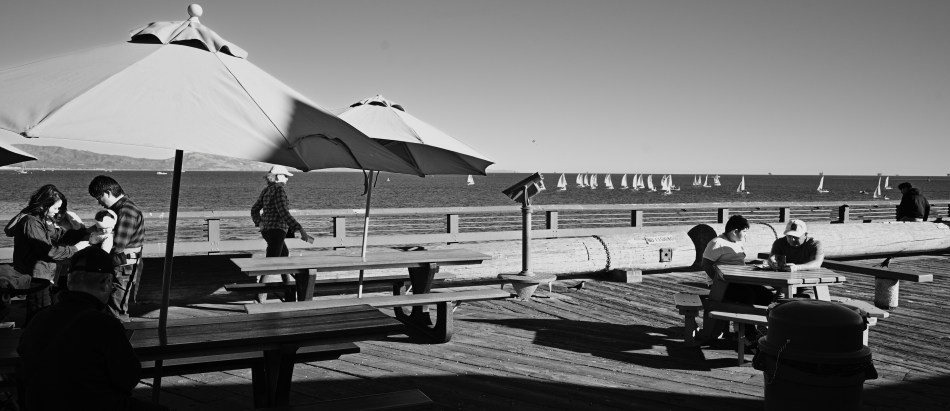
That Wednesday At The Wharf, November 2024
Color was already in rapidly increasing use when I first crawled out of the photographic womb, but the default usage, globally, was still too mono. It was cheaper, for one thing. Also, there were many more people walking around who had trained when there was no other way to go, and their habits informed those of people like me, who were newbies at the time. So, now, when I deliberately conceive a b&w shot, I ask myself what, in that shot, I can achieve without color, or, more precisely, what impact mono will deliver for me that color would needlessly complicate or distract from. I find that if I ask myself, if I were forced to shoot this in mono, how would I make the picture work? Or, more pointedly for fossils of my vintage, how did I use to approach this?
There is nothing more counter-intuitive than a subject like the seaside. There is just so much that scrams at you to “capture it all”, or, in other words, grab every shade and hue of color. But, the fact is, once upon a time, I went to beaches with a basic Kodak and Verichrome film and somehow made at least some pictures that I was happy with. Can I still do that? Photography is a wonderful creative experience because of its blend of scientific surety (if you press this, the camera will do this), and the uncertainty involved in making anything aspiring to art (is this the right approach? Are my instincts correct?). What keeps the whole thing exciting is in trying to get the confidence/anxiety mix just right.
Or understanding that not everything’s black and white.
Unless you want it that way.
 thenormaleye
Leave a comment