THE GREAT DEMOCRATIZER
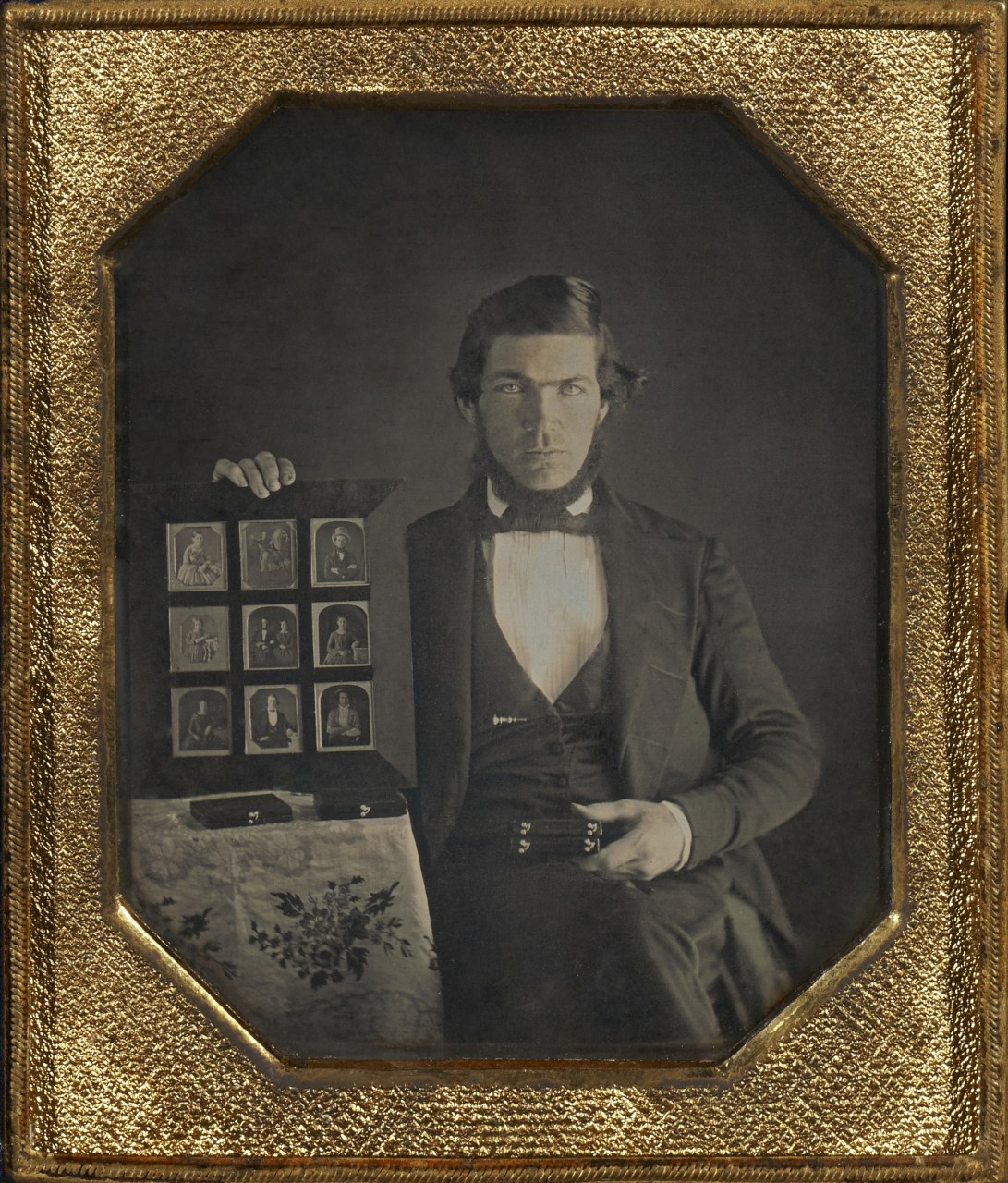
A daguerreotype of a maker of daguerreotypes, and several of his daguerreotypes.
By MICHAEL PERKINS
IN PHOTOGRAPHY’S FIRST DECADES, THE DAGUERREOTYPE was, for a time, considered the ultimate streamlined process in the making of an image. This direct-positive (that is, no negative) system generated a highly defined image on a sheet of copper with a detail that, centuries later, still impresses…..and so simple to do! Just clean a silver-plated copper sheet and polish it until the surface looks like a mirror. Next, sensitize the plate in a closed box over iodine until it takes on a yellow-rose appearance. Then transfer the plate to a lightproof holder, and transfer the holder into the camera. After exposure to light, the plate is developed over hot mercury until an image appears. The picture is then “fixed” by immersing the plate in a solution of sodium thiosulfate or salt (whichever you have around the house at the time) and then toned with gold chloride. What could be simpler?

A true “snap shot”, taken in haste (out of necessity) but still with some intention.
Small wonder that, by the end of the nineteenth century, when the laborious and hobbynerd-driven practice of photography was suddenly simplified by the introduction of the personal snapshot camera, what had been the domain of artists and tinkerers became the world’s birthright, creating a truly democratized art. Suddenly, photographs were not single or “official” chronicles of things generated by the few, but infinite variants of interpretation wielded by any and everyone. The phrase snap shot, which dates back to the early 1800’s, was originally a term for a hunter who fired from the hip, quickly, and without a lot of deliberate aim or intention. By 1897, the immediacy and ease of making personal pictures saw the first published reference to the taking of a photographic “snap shot”, and the name stuck.
We still use the term to describe the informal or the instinctual, impulse photography that, in the digital age, is easier to indulge than ever. Making images used to be a deliberate, intentional act that required preparation and tortuous practices that could break down or fail at any stage in the process. Now, more than ever, “taking” a picture is as natural as breathing, and yet, the option to slow down, to plan, to sculpt the outcome, to, in effect, intentionally “make” a picture, remains, as photography is an act of both spontaneity and purpose.
 thenormaleye
Leave a comment