TWO SIGNATURES REQUIRED
By MICHAEL PERKINS
PRIOR TO THE 21st CENTURY, THE AVERAGE PHOTOGRAPHER produced his/her/their work on one platform at a time. For many whose creative energy was rooted in analog, film was the tablet on which the work was “written”. That meant that, for the most part, the look of that medium was the underlying visual “signature” of whatever was recorded on it. Go back even farther, and mediums like tintypes or daguerreotypes, with their respective looks and limits, defined what we now regard as an “old time” image. Each process conferred a certain look upon whatever the photographer captured. When you were born, the recording medium you worked in dictated, to a degree, what your pictures would look like.
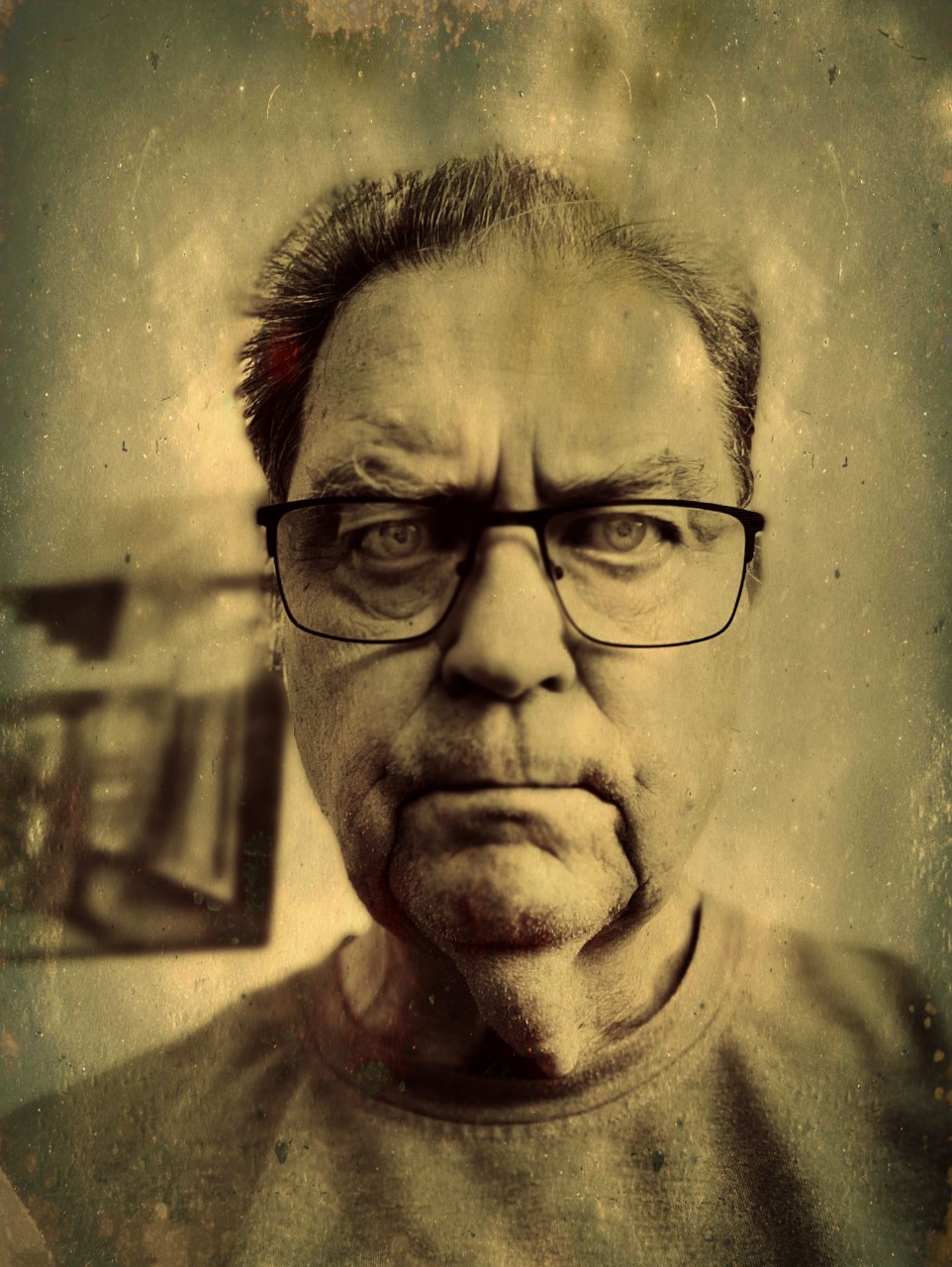
A faux tintype selfie, delivered via an app. The conception and the platform work hand-in-hand.
Fast-forward to the present, in which digital technology has completely liberated the photographer, opening up a broad swath of choices for the visual signature that you choose for a given picture. Want to render your subject in a way that reflects Victorian tech? Want to deliberately limit things like light sensitivity, texture, dynamic range? Pick a period, pick a look. It’s yours at the touch of a button or the flick of an app. What a spectacular arsenal is at our command, all in an instant.
I have absolutely no practical experience in the processing of film of any kind, but then, I have no need to learn it, unless I desire to master that tech for my own hobbyist amusement. With even modest equipment, I can absolutely simulate the various emulsions of a variety of film types, replicating how they were developed by those who grew up natively with those orientations. This is like being able to write both left and right handed. My eye is one personal signature for the pictures I hope to create, and the look of a given era or medium is a second signature. My choice of platform acts as a co-signer for my choice of approach.
The greatest blessing of the current age in photography is that we have developed gear that simplifies the mechanical process of capturing a frame to such a degree that more effort can now be directed to our vision, and less on how our machinery will execute it. When you conceive of a great idea, you are affixing your signature to the result, while the platform you choose to deliver that work signs off on it as well. Amazing.
SHARING A SUNSET WITH LOUIS AND LEON
By MICHAEL PERKINS
PHOTOGRAPHY HAS NEVER BEEN DEFINED BY A SINGLE TECHNICAL BREAKTHROUGH. It is, of course an invention, but one which is evolutionary, unlike a “eureka” moment in which a single inventor, an Edison, say, solves a problem and generates a product. The making of pictures unfolded in a much slower fashion, with many “little edisons” adding this technique or that method along a protracted timeline. Photography is never “finished”; it is always on the way to being finished.
This means that assigning authorship to a particular development or stage in photography is difficult. The art has so many co-creators that we find it hard to nail down who was the first to do or try a particular thing. The first days of the craft saw many different people all trying to portray very basic elements of the world, with very little documentation as to who was first across a given finish line. As we find in our own time, if you think up a great idea for a picture, chances are that a zillion other people have had the same “original” notion at the same time, given how universal some of our life experiences are.
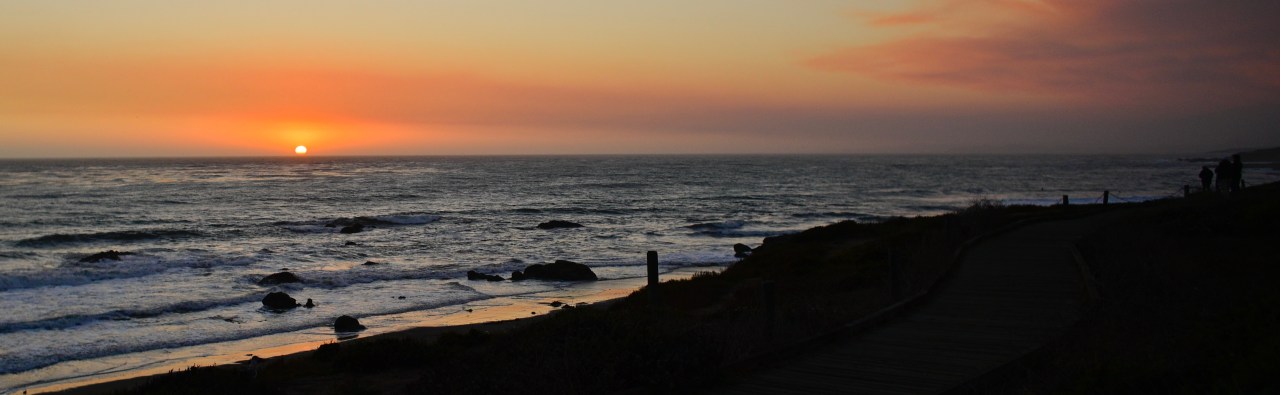
Moonstone Beach, Cambria, California, August 29, 2026, 7:40pm
By this time, for example, nearly everyone who has picked up a camera has made some kind of image of the sun. Our primal connection to nature was documented in photos almost as soon as the arrival of photos themselves. Ah, but who was the first to try such a picture? Some credit the first solar photograph to Louis Fizeau and Leon Foucault, a pair of French physicists who were experimenting in 1845 with the relatively new daguerreotype method, one of the first photographic systems to boast sharp resolution and fine detail. Their exposure was amazingly fast for the time (1/60sec.) and the resulting image was small, just 4.7 inches big, but it reportedly recorded spots on the sun’s surface and so was regarded as a scientific milestone. Okay, that’s the accepted version of history. But can we really attribute “firsties” in any photographic history with any certainty? It’s been argued that several people invented the telephone at about the same time as Alexander Graham Bell, but he was just the one who got to the patent office first. The same is likely true of most advances in photography. They have so many fathers that they are community property.
Which points to the fact that almost any subject has, by now, been photographed to death, or at least beyond the point of novelty, with the only crucial ingredient one’s own approach or experience. Even then, it’s hard to approach the hyper-familiar in a fresh way. Still, it’s the degree to which we refuse to accept that “there is nothing new under the sun” that makes us, well, photographers.
THE GREAT DEMOCRATIZER
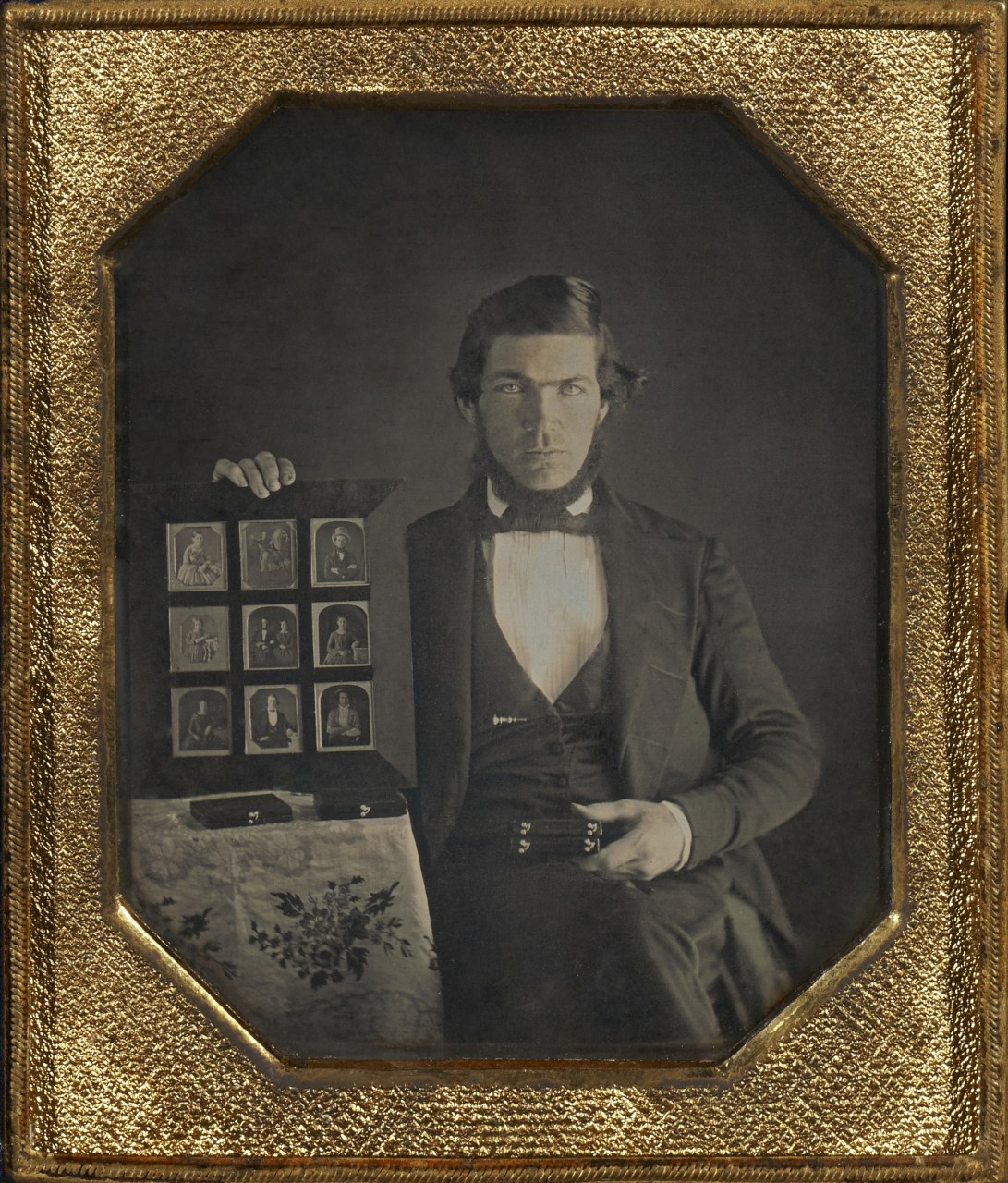
A daguerreotype of a maker of daguerreotypes, and several of his daguerreotypes.
By MICHAEL PERKINS
IN PHOTOGRAPHY’S FIRST DECADES, THE DAGUERREOTYPE was, for a time, considered the ultimate streamlined process in the making of an image. This direct-positive (that is, no negative) system generated a highly defined image on a sheet of copper with a detail that, centuries later, still impresses…..and so simple to do! Just clean a silver-plated copper sheet and polish it until the surface looks like a mirror. Next, sensitize the plate in a closed box over iodine until it takes on a yellow-rose appearance. Then transfer the plate to a lightproof holder, and transfer the holder into the camera. After exposure to light, the plate is developed over hot mercury until an image appears. The picture is then “fixed” by immersing the plate in a solution of sodium thiosulfate or salt (whichever you have around the house at the time) and then toned with gold chloride. What could be simpler?

A true “snap shot”, taken in haste (out of necessity) but still with some intention.
Small wonder that, by the end of the nineteenth century, when the laborious and hobbynerd-driven practice of photography was suddenly simplified by the introduction of the personal snapshot camera, what had been the domain of artists and tinkerers became the world’s birthright, creating a truly democratized art. Suddenly, photographs were not single or “official” chronicles of things generated by the few, but infinite variants of interpretation wielded by any and everyone. The phrase snap shot, which dates back to the early 1800’s, was originally a term for a hunter who fired from the hip, quickly, and without a lot of deliberate aim or intention. By 1897, the immediacy and ease of making personal pictures saw the first published reference to the taking of a photographic “snap shot”, and the name stuck.
We still use the term to describe the informal or the instinctual, impulse photography that, in the digital age, is easier to indulge than ever. Making images used to be a deliberate, intentional act that required preparation and tortuous practices that could break down or fail at any stage in the process. Now, more than ever, “taking” a picture is as natural as breathing, and yet, the option to slow down, to plan, to sculpt the outcome, to, in effect, intentionally “make” a picture, remains, as photography is an act of both spontaneity and purpose.
POWER ON THE PLATE
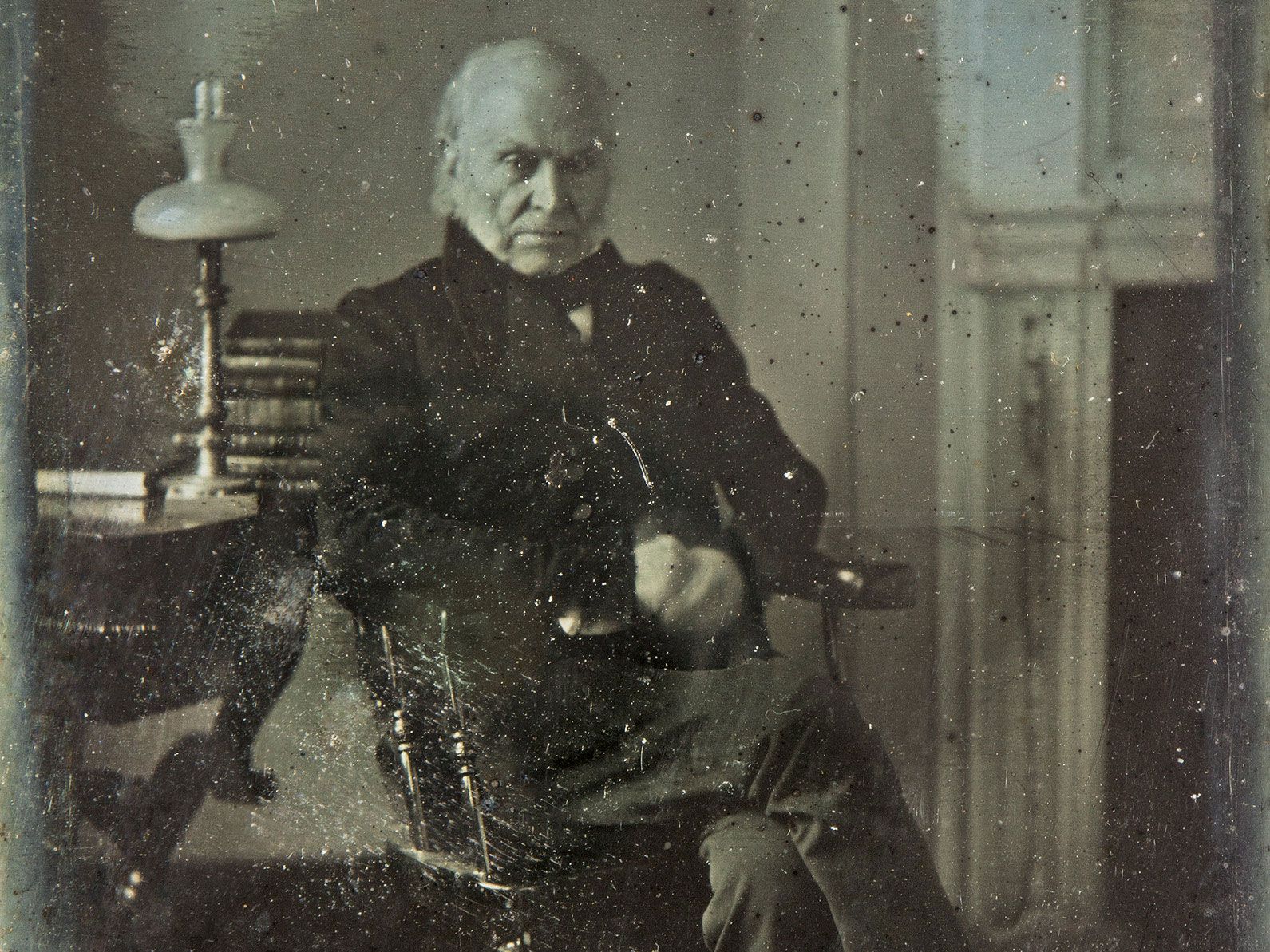
John Quincy Adams is ready for his close-up, 1843.
By MICHAEL PERKINS
ON JANUARY 13, 2009, BARACK OBAMA, a man of many firsts both personal and political, created a benchmark in the history of photography as well, becoming the first President of the United States to have his official portrait created with a digital camera. Data nerds will note that the exposure was made with Pete Souza’s Canon EOS 5D Mark II camera without flash and settings of 1/125 sec., f/10, ISO 100, and 105mm. In the interval between that time and this, the break with analog film-based photography seems both natural and inevitable, and so the shot has one key thing in common with the very first presidential portrait, in that it was taken using the most advanced technology of its time, changing forever the way we thought of “official” records of the Chief Executive.
One hundred and sixty-six years prior, in 1843, John Quincy Adams, some fifteen years after the end of his presidency, sat for what, today, is the oldest surviving original photographic portrait of an American president. The term original, when speaking of early photographs, must be given a bit of additional context. The process known as daguerreotype was, at the time of Adams’ sitting at Philip Haas’ Washington studio, only four years old. Each photograph was printed directly on glass plates, and were therefore one-of-a-kind images in the truest sense, as no means for printing copies of photos would exist until the creation of negative film by George Eastman nearly half a century later. The fragility of daguerrotypes added to the special quality afforded them as keepsakes in the nineteenth century, as they were quite literally irreplaceable. And then there was the arduous process of getting a usable exposure made in the first place. In President Adams’ diary of the day, he remarked that, upon arriving for his appointment, he found
“...Horace Everett [U.S. Congressman from Vermont’s third district] there for the same purpose of being facsimiled. Haas took him once, and then with his consent took me three times, the second of which he said was very good—for the operation is delicate: subject to many imperceptible accidents, and fails at least twice out of three times.”
Full disclosure: In fact, the very first presidential portrait was taken of the spectacularly unlucky William Henry Harrison, the first president to die in office just one month after taking the oath, likely due to complications of pneumonia brought on by failing to dress warmly enough during inclement Inauguration Day ceremonies. Indeed, a photographic portrait was made of Harrison on March 4, 1841, mere days before he fell ill. However, the original of the image is said to be lost, surviving only in copies, while the Adams image, now on display at the National Portrait Gallery, is the very same glass-plate photo taken two years later by Haas. Adams probably deserves the distinction of hanging in the NPG for an additional reason, in that he was one of the primary forces behind the creation of the Smithsonian Institution, of which the Portrait Galley is a subsidiary.
Like Barack Obama, Adams had additional historical mileposts attached to his fame as a photographic subject. Serving in the House of Representatives for many years following his presidency, he was the last living tie to the Founding Fathers, one of the men who, as they sing in Hamilton, was “in the room where it happened”. Photography was lauded, at its birth, as one of the proudest achievements of the Industrial Revolution, but many feared that it might be a merely mechanical medium, devoid of the soul of painted portraiture. And yet, since its very beginnings, it has not only performed a purely reportorial function, but has also anchored us to all ages in a most un-machinelike fashion, preserving the essences of our humanity and allowing us to sing Hail to many a Chief.
APP(T) PUPIL
By MICHAEL PERKINS
IT WAS PRETTY COMMON, just a few years ago, to find a county fair or amusement park that boasted its own “old-timey” photo booth, a space where families could don historic costumes and pose for a simulated sepia daguerreotype. It was the start of a trend that continues to the digital age, in which the bulky, balky technology of Photography Eras Past becomes romanticized as an effect to be applied to contemporary images. Or, to put it in practical terms, everything old is new again….in an app.
Faking the past via digital doctoring can provide a unique aspect to a newly-taken snap, or it can just produce what I call the “that’s cool” effect, which masks the general purpose of the original and drowns it in gimmicky goop. But the temptation to tweak is strong: apps are cheap (or free) and it takes mere minutes to determine if a given one will add anything to your work beyond mere novelty. One such example is the wide selection of faux tintype emulators available at a click.
The tintype (which was actually exposed on iron plates coated with dried collodion) was never as sharp as its predecessor, the glass-plate daguerreotype, but it was so simple to take and process by comparison that it effectively liberated the camera from the studio, sending field photographers in tented wagons out across the country to shoot every aspect of American life, including, notably, the battles of the Civil War. Eventually paper positives and celluloid film spelled the technology’s doom, but it’s uneven textures and tones continue to evoke a vanished world.
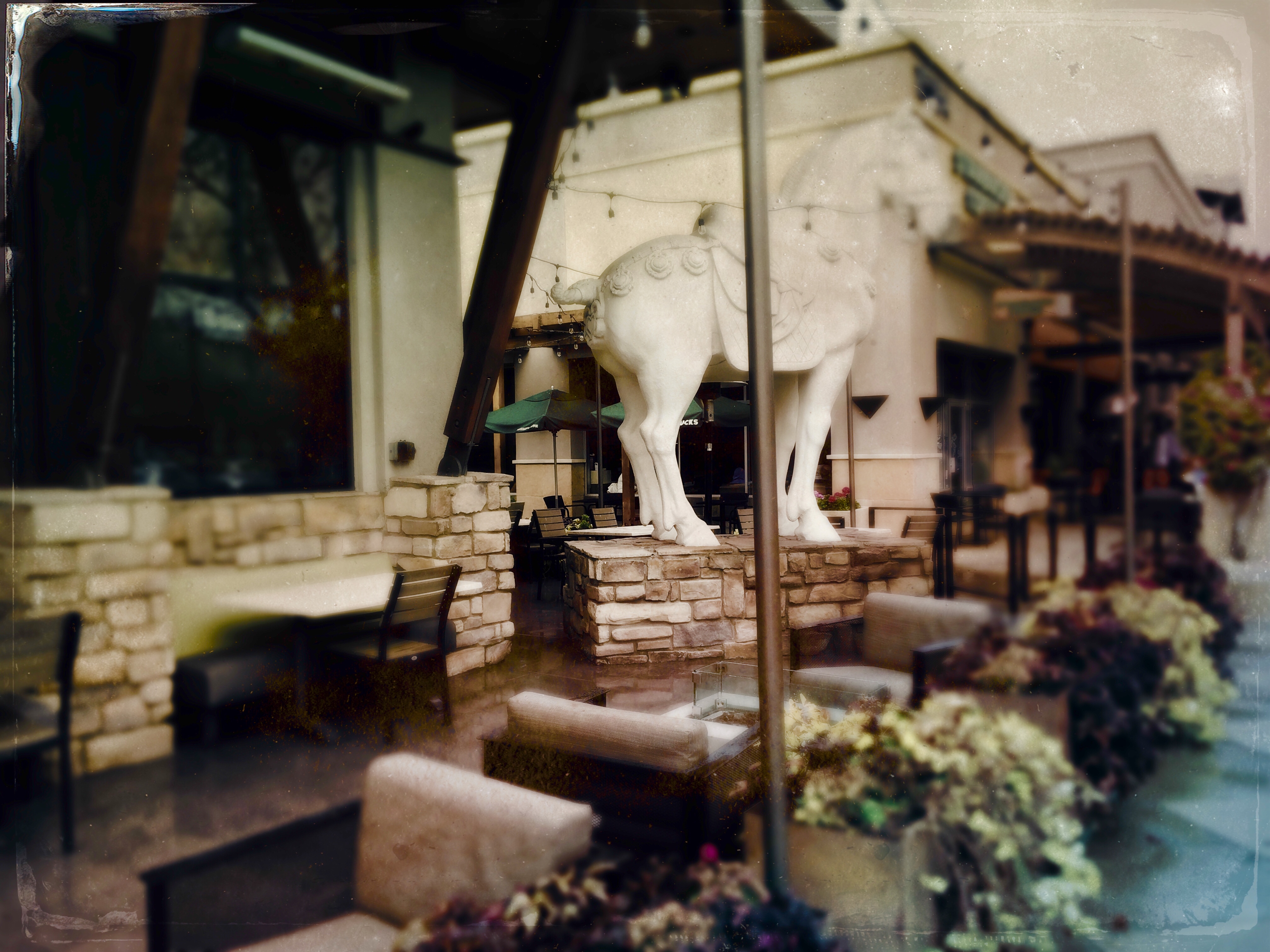
Allowing a tintype app to use your mobile’s camera increases your creative control.
I very seldom use tintype apps after I’ve taken a shot. It seems as if I’m admitting that the image somehow wasn’t enough, that it needed “help” of some kind. I prefer to take pictures from within the app itself, allowing it to use my phone’s camera. The idea is to conceive of the picture beforehand as benefitting from the tintype effect, to pair its “look” with its intention. The tonal range and uneven detail of the tintype can be thought of as another kind of abstraction, and your choice of narrative need not be limited to picturing Uncle Fred as Buffalo Bill. As with so many apps, actual practice can make the difference between a tool and a toy.

