NO, REALLY, GOOD BYE. I MEAN IT.
By MICHAEL PERKINS
MY FATHER USED TO DEFINE “OLD SCHOOL” ENTERTAINERS by how many bows or encores they took at the end of a given performance. The vaudeville-era concept of a “curtain call” was illustrative both of the showman’s natural inclination to stick around, drinking in a little more applause, and the audience’s reluctance to let those wonderful pied pipers get away, abandoning us to our regular humdrum lives. There’s something in those feelings that speaks to a need for photographs, and photographers.
A year ago this month, Marian and I closed the book on over twenty years in the same house, as well as its accumulated baggage and bloat. Estate sales were staged. Decades of memories were sifted, often jettisoned at a speed that astounded both of us. And most importantly, some key objects were committed to photos. Children’s art projects; historic front pages; and, in a kind of “Rosebud” moment, one more “curtain call” for a life I left half a century ago, symbolized by a curio that had been dragged with me from house to house since my salad days; an inoperable radio from the 1930’s.
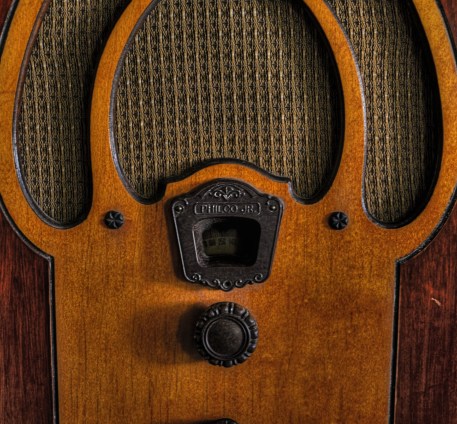
The Philco Junior cathedral model shown here was already an antique in 1972, when my best friend at the time toiled at great length to refurbish it as a wedding present for me. The vacuum-tube guts of the thing had proven beyond repair, and so he had replaced the workings with a transistor-based tuner of his own design, then provided power to the front-mounted tuning “spook light” with alligator clips and a Ray-O-Vac lantern battery. Fortunately, the cloth speaker grille was intact, as was the tortoise shell trim and two-tone face plate. And so, to the naked eye, the Philco was still in good working order, occupying an honored place in the first apartment I and my young bride moved into after our budget nuptials.
ntiquesBy the time I snapped one more image of the front of the radio, just ahead of our leaving for California, the back had rotted away, the sides were splintered, and it hadn’t received a broadcast in over a generation. Moreover, that first marriage had long since vanished beneath the waves, as, sadly, had the friendship that sparked the initial radio project. In the spirit of Bogie’s “we’ll always have Paris”, I guess I can say that, in this image at least, I’ll always have the Philco. One more curtain call before we sign off for the evening, ladies and gentlemen, and be sure to tune in again tomorrow for…..
Of Hauntings Great And Small
By MICHAEL PERKINS
AS A PHOTGRAPHER, I TEND TO DIVIDE MUSEUMS into two general classes. The first includes the grand halls that act largely as warehouses for collections of disparate items from across history. The second consists of the more personal spaces that were actually once someone’s private dwelling, such as a presidential home or an historic manor. In the first class, the emphasis, at least for me, is on the visual appeal of individual objects, i.e., the mummy cases, caveman tools, etc. In the second class, the narrative lies in the physical space that surrounds the relics, that is, the feel of the house or structure itself.
When I am being conducted through a home where a great family raised its children, where its dreams and schemes were birthed, I of course am fascinated by their quilts, kerosene lamps, butter churns and such. But, since this was a place designed not as a housing for curiosities but as a place where actual people lived, I am interested in trying to show what it might have been like to personally occupy that space. What it was like to wake up with morning light streaming through a bedroom window. What the anticipation of callers felt like, viewing the back of the front door from the second-floor landing. What solitude a certain room might have afforded. Where glad and sad things happened.
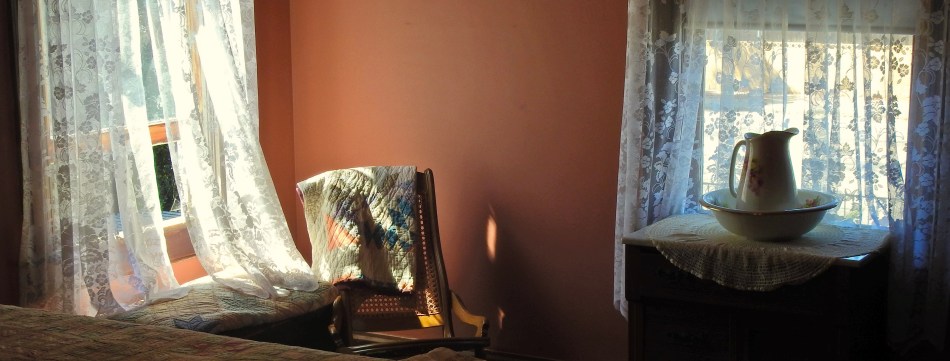
Take me to the Met and I will want to see certain things. Take me to an old family home and I will try to depict certain feelings. In the frame seen here, I was lucky enough to be in a bedroom where the delicate lace curtains at left were bending slightly inward from the window, courtesy of a cooling breeze. I began to wonder what it might be like to wake in such a room. What you would see first. How the basics of the room could create a feeling of solidity or safety. My only visual prop was the washstand at right, but that was enough. The suggestion of a life lived was present in just those basics, uncluttered by the mash of curios and collectibles that filled many of the home’s other rooms. Museums sort of represent a variety of hauntings, and their spirits can often speak more clearly in sparse, open settings. It’s like a whisper that you have to teach yourself to listen for. And then the pictures come…..
 thenormaleye