LUMIERE’S PHOTGRAPHIC HAT TRICK
By MICHAEL PERKINS
ALL HISTORIES OF THE EARLIEST DAYS OF MOTION PICTURES rightfully credit brothers August and Louis Lumiere as twin titans in the creation of some of the medium’s most important technical advancements. Their first breakthrough came when they refined Thomas Edison’s earliest motion picture cameras and devised a more uniform method of moving film through them, with the simple but elegant invention of sprockets. Their second, and substantially bigger win involved the creation of the cinematograph, which combined photography, developing, and projection within a single device. Both innovations helped the Lumieres become the first true producers of motion picture content and the very concept of “movies”, years ahead of Edison and the rest of the field. Ironically, they believed that the cinema was a dead-end fad, a novelty that would play itself out in time. That mistake would eventually lead them back to their beginnings in still photography, and their third fundamental miracle: color.
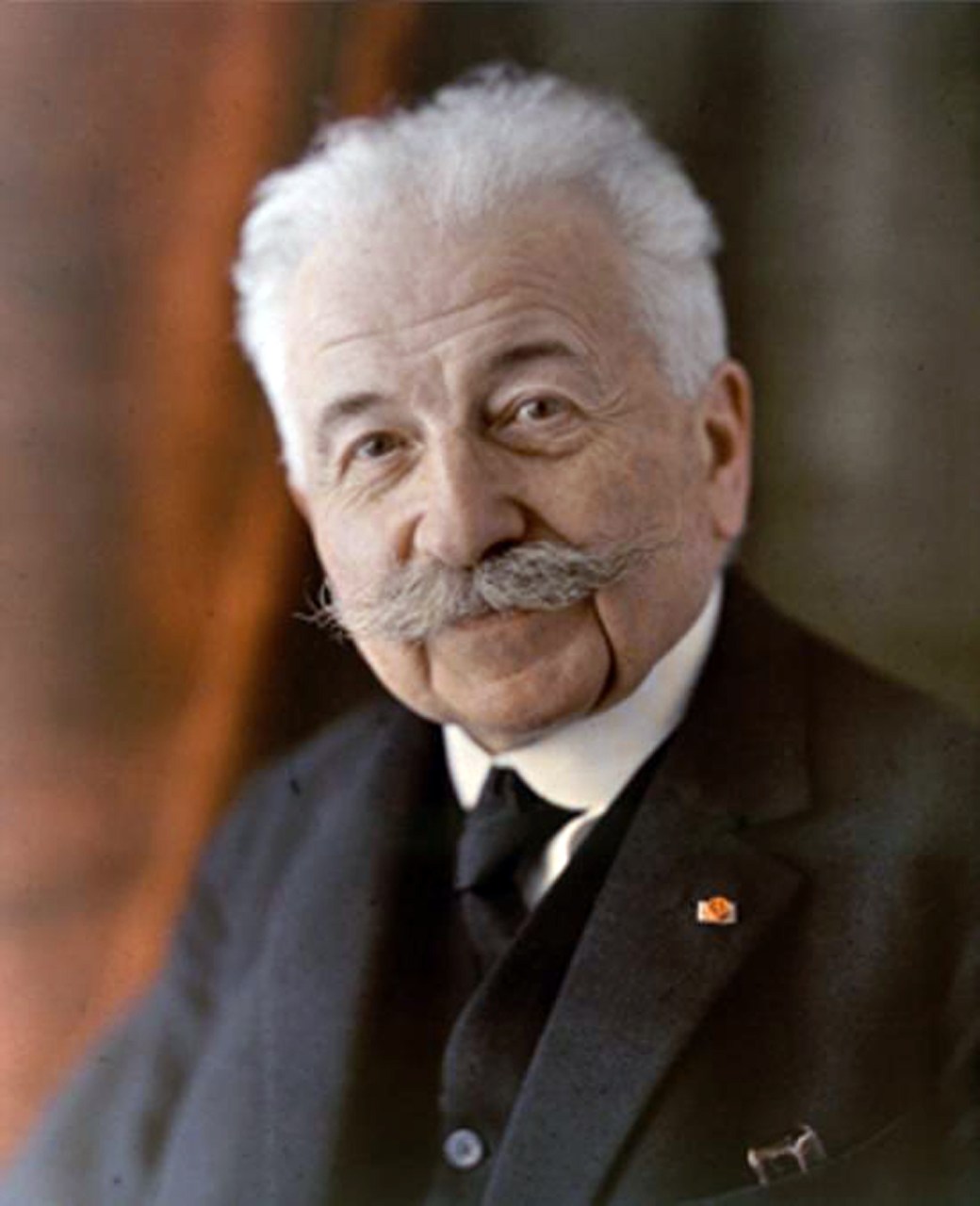
Auguste Lumiere, captured by the Autochrome process he developed with his brother Louis, just after 1900.
Attempts at a natural, stable color process had begun very nearly at the start of the photographic era, but nearly all were what we’d now called coloration processes, with either special filtration or hand-drawn hues added after a positive monochrome print was achieved. The Lumieres built color into the very act of making a photograph with their chemically complex Autochrome system, an “additive” process, versus the “subtractive” methods which would later characterize the first true color films such as Kodachrome.
Near the turn of the 20th century, just a few years after roll film was popularized by George Eastman, the Lumieres built Autochrome on existing glass plate technology. coating a plate with a random mosaic of microscopic grains of potato starch, dyed red-orange, green, and blue-violet, with each grain hue acting as a color filter. Lampblack was mixed in with the colored grains and an over-layer of silver halide emulsion was applied over that. The exposed plate would produce a color negative, which was then re-exposed after the removal of most of the plate’s silver content to result in a positive transparency. The result was extremely natural in its reproduction of the existing color spectrum but dark in tone, so that a backlight of some sort would have to be shone through it for sufficient illumination. Special carrying cases were produced to make this process easier and more consistent.
Autochrome became the first complete process for in-camera recording of a colored image, but, due to its required longer exposure times, it became a medium for mostly portraiture and still-life work. Accordingly, many historic figures “sat” for Autochromes, including President William Howard Taft, the first president to be photographed in natural color. The Lumiere’s system, short-lived though it was, kicked open the door to color photography, taking it from an afterthought craft to a living art. Every one of us are standing on their shoulders.
 thenormaleye