OPEN WIDE AND SAY AHHHH
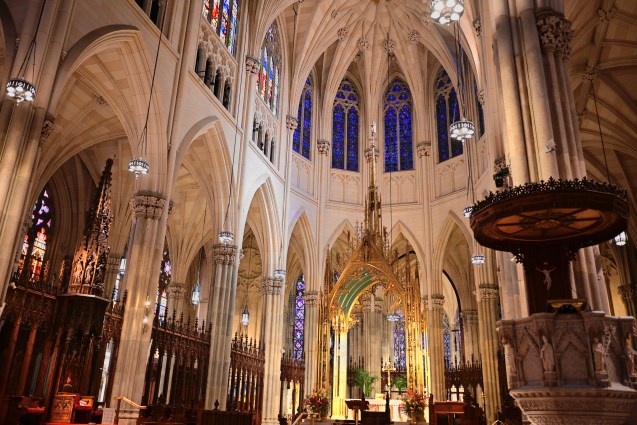
Handheld inside St. Patrick’s Cathedral, NYC. f/2.8, 28mm, ISO 1000, 1/50 sec.
By MICHAEL PERKINS
1960’s COMMERCIALS FOR THE SWINGER, Polaroid’s first entry-level instant camera, marketed mostly to teens, showed how easy it was to achieve good exposures, simply by twisting the knob that supported the shutter button. Too dark, and the word “NO” would appear in the viewfinder. Twist to tweak, and the display turned to “YES”. Many flubbed fotos later, we all learned (at substantial expense) that it really ain’t that simple. And in the years that followed, with better and better cameras, we still seemed to be getting a “YES” from our gear, only to find that the resulting image was definitely a “NO”.
The reason for all this reminiscing is the completely different experiences I’ve had in recent years taking shots that, just a while ago, were almost guaranteed to fail, but which now succeed, and amazingly well. You know the kind I mean; those extreme pockets of darkness and gloom where light goes to hide and pictures go to die. In my early DLSR days I did my best to harvest a higher percentage of them, working with that format’s smaller sensors, the fastest prime lenses I could afford, and higher ISO settings. Working on a tripod made even more of such shots possible, but those were always in the minority of overall frames. Let’s face it; unlike Ansel Adams, who could work all day waiting for the right shadow to hit the side of El Capitan, we largely live in a hand-held world. I got a lot of “NOs”.
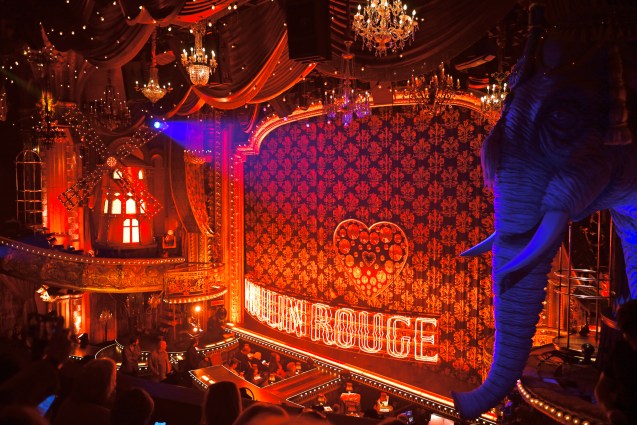
Just before curtain at Broadway’s Herschfeld Theatre. Hand-held at f/2.8, 28mm, ISO 2000, 1/100 sec.
After switching to a full-frame sensor and allowing for the tech to catch up in terms of more evenly rendering high-contrast subjects, even straight out of the camera, I find that the list of “undoables” is a lot shorter than it used to be, as witness the two shots in this article. Both are done with a 28mm lens wide open to f/2.8; both are handheld; both are taken inside locales (a cathedral and a Broadway theatre) known for harboring deep, deep pockets of shadow, often leading to dark patches that swallow detail or light areas that tend to blow out. Amazingly, minus a few minor color corrections, neither shot has been corrected in post.
In the days of our first cameras, we largely shot on an “if come” basis. If we did everything right to second-guess every technical tiger trap that was part of the process of calculating the shot, the picture might “come”. Maybe. And now, the carefree joy of picture-making which Polaroid promised back in the days of mini-skirts and paisley, a real closing of the gap between the imagining and the realizing of an image, might finally be imminent.
It’s enough to make you feel like a Swinger.
THE NOTHING-TO-LOSE CLUB
By MICHAEL PERKINS
TAKE ENOUGH PHOTOGRAPHS AND YOU WILL FIND YOURSELF acting more deliberately, and thus less reflexively. Your snapshot mind, the scatter-shot, try-anything part of your brain that acts purely on impulse, is never completely eradicated, but is suppressed, tamed if you like, by a more careful and selective way of seeing things, a habit of taking additional time to size up a situation before you shoot. This evolution in style is to be expected, as you learn, over the years, that a few extra moments of mental prep can yield consistently better results than merely shooting from the hip.
And yet.
It’s not really healthy to let the prudent half of our brains win every argument. Likewise, we should never completely renounce our membership in the “Nothing To Lose” club, that proud aggregation of people who will always, always go for the shot, despite the realizations that I Brought The Wrong Lens, The Light’s Not Exactly Right, or It Probably Won’t Come Out. Don’t get me wrong: I love, love, love to think that my extra seconds of calculation and forethought will consistently give me better results. And, often, I am proven right. But shooting on instinct, in fact being comfortable with both randomness and uncertainty, can sometimes bring home the bacon as well. The only uniformly wise option is: always shoot something, or, as they say in politics, don’t let the perfect be the enemy of the good.
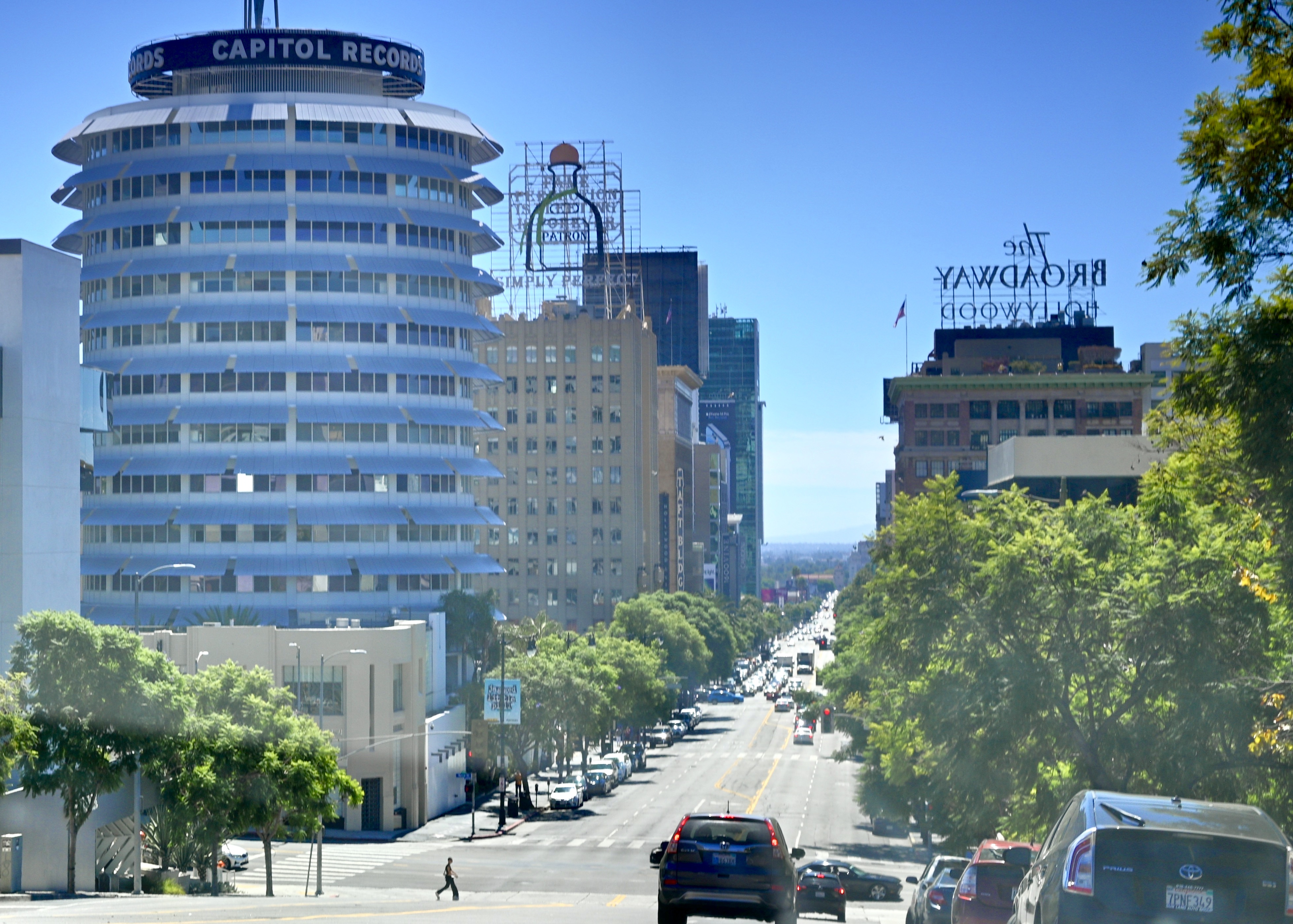
The Vibe On Vine, Los Angeles, September 2022
This windshield shot, taken on the fly during a recent ride down Vine Street in Hollywood, represents such a case. The car was not going to stop: it was not in our plans to get out, set up a formal composition of these iconic buildings, or take a walking tour through the neighborhood. And so I found myself, once again, a member in good standing of the Nothing-To-Lose club, and I got, well, what I got. And of course there are technical flaws galore in the shot, not the least of which is severe color imbalance caused by shooting through glare and factory window tinting, resulting in the loss of nearly a stop of light.
But I can live with the bruises on the peach because, generally speaking, I got to eat the peach. I may or may not be able to return to the scene in future to try for a four-star job, but, in the meantime, I can chalk this one up to what you might call a workable preliminary sketch, and stop stressing about it. Because, in the final analysis, by failing to at least try, I did have something to lose.
The fun of making a picture.
 thenormaleye