SLOW YOUR (CAMERA) ROLL
By MICHAEL PERKINS
WE’VE MUSED OFTEN, IN THESE PAGES, on the difference between what I call snapshot mentality and photographic mentality. The first occurs when our minds are in “the moment of the moment”; quick, instinctual reaction. The second speaks to a more contemplative approach to making pictures, something that requires intention, planning, and a number of creative choices. The omnipresent tsunami of gazillions of images generated by the convenience of the mobile camera favors snapshot mentality, while older tech, film for example, bends toward photographic mentality. One approach urges that we do things in a hurry, sorting out the chaff later (if ever), while the other dictates that we slow down and focus.
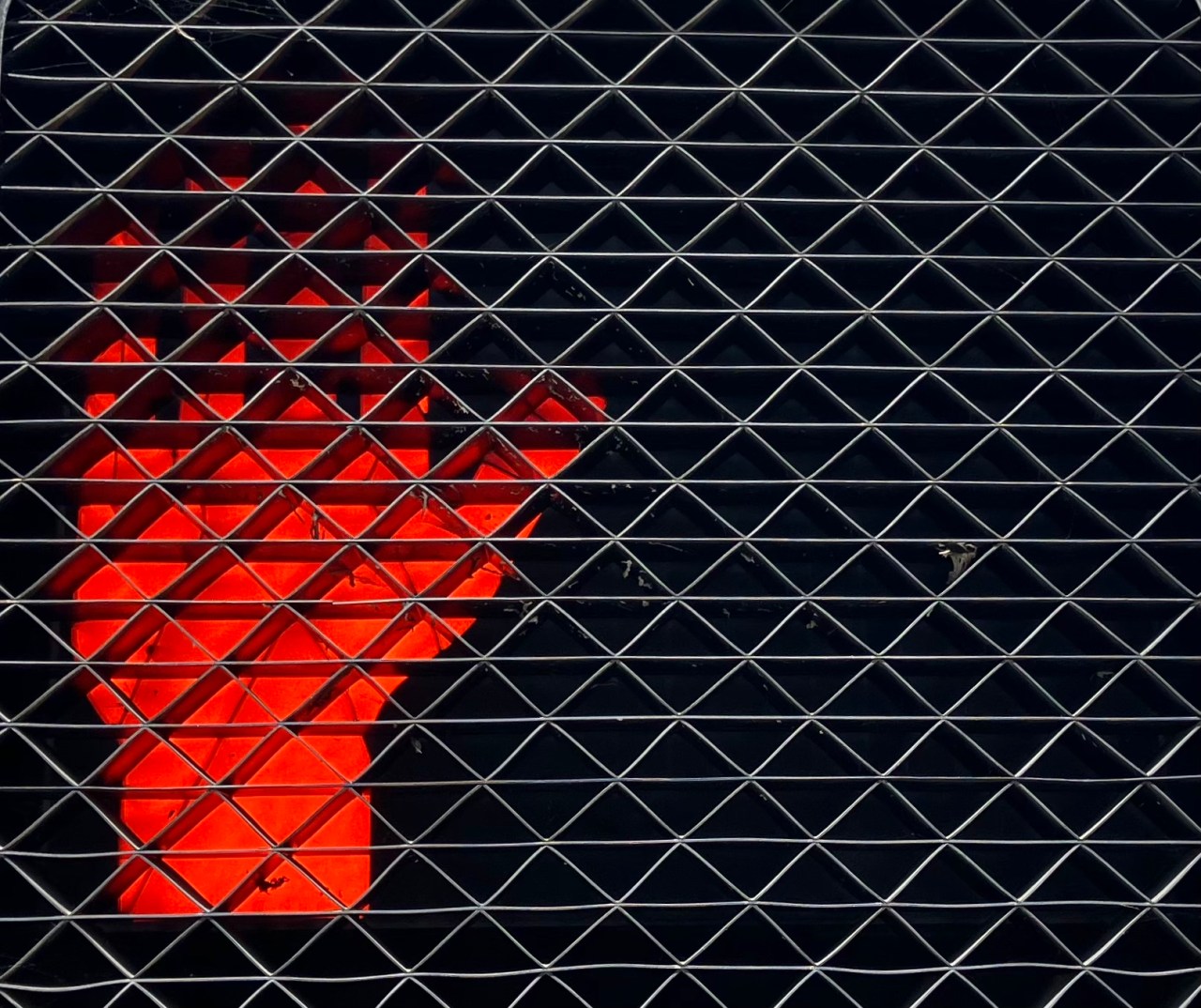
Several disciplines within photography actually seem to be trying to make photographic mentality a priority. The recent explosion of new medium format cameras, for example, emphasizes careful design of an image rather than quick takes. The retro fascination with film, especially with technically limited toy cameras that are prone to error and failure, also forces the user to stop and think before shooting, if for no other reason than sheer economy (mistakes that don’t matter in digital are costly and time-consuming in analog). Another key demarcation is the decision to shoot on either manual or full auto. which also imposes its own unique methods. And then there are the spiritual or mystical approaches that enter into every creative process, demanding that all shooting decisions promote patience and deliberation, a kind of zen hive mind. It’s like the old predictive primer Megatrends, in which the author argued that, like a pendulum, mankind swings between the poles of high tech and high touch. Once high tech begins to overload our senses with speed or convenience for their own sake, the human need for high tech…..a direct, tactile, and yes, slower engagement with the world, becomes needful as a corrective.
We all do a percentage of our work in both snapshot and photographic mentalities. Neither approach is sufficient for every situation. But there is a lot to be said for stopping, waiting, and evaluating what we are doing on the most complete terms possible in the moment. Photographs never suffer from too much advance planning, after all. And while we all admire the sentiment that we must “stop and smell the roses”, the very first step is to notice that there are roses in the first place.
OFF THE SHELF
By MICHAEL PERKINS
JERRY SEINFELD ONCE REMARKED. OF GUYS OBSESSED WITH OVERUSE OF THE REMOTE CLICKER, that they “aren’t interested in what’s on tv; they’re interested in what else is on tv.” Funny and true, and also indicative of some photographers, in that, while we love what our basic gear does, we’re really excited at the prospect of hybridizing equipment from any and all sources. We’re interested in what else our cameras can do.
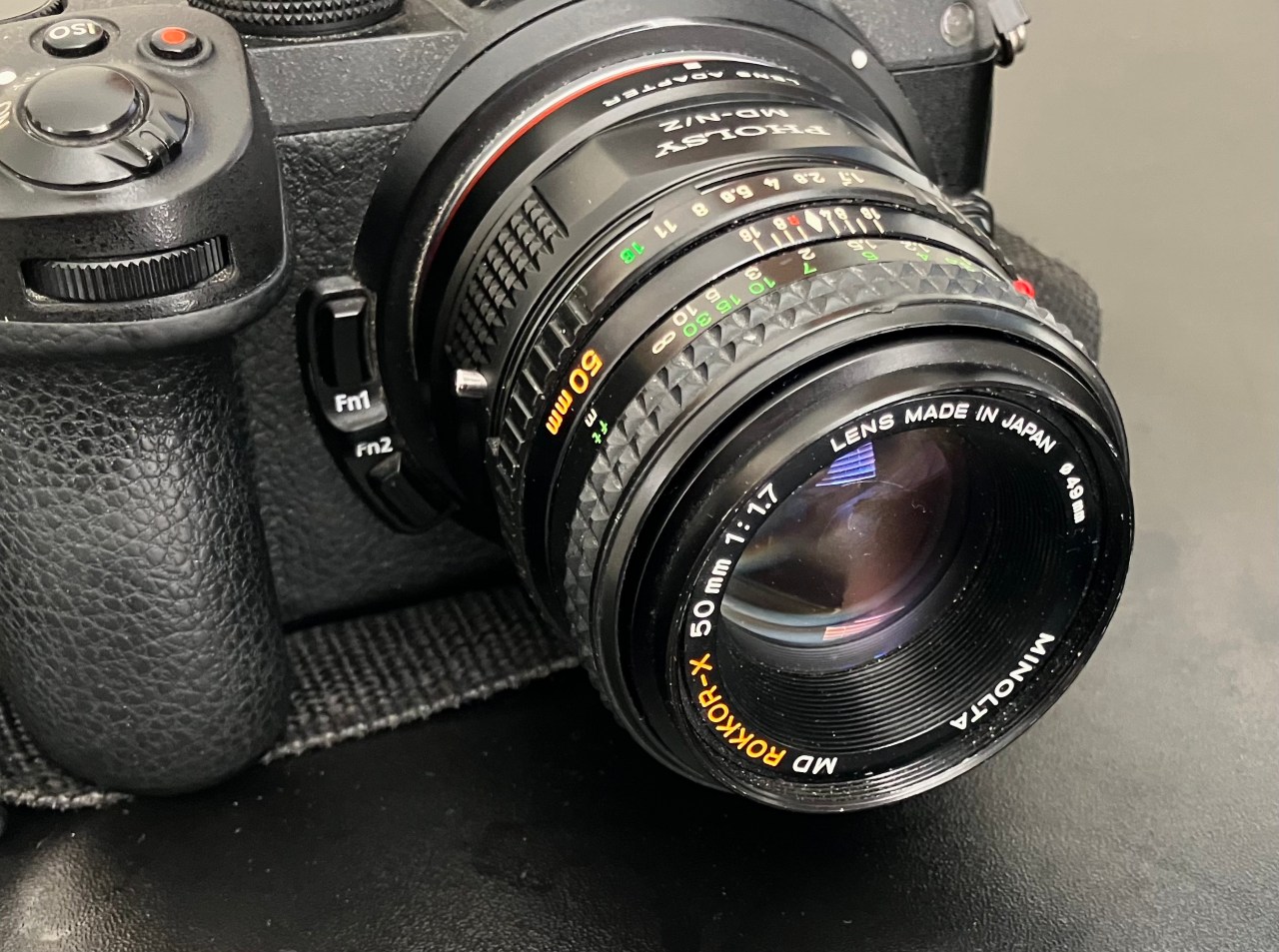
My 1977 Minolta 50mm, dormant in my closet for over twenty years, now fronting my Nikon mirrorless.
Many of us at least stray slightly from the only-original-manufacturers mindset (that is, only Canon lenses for my Canon camera, etc.), yielding to some degree of lens bi-curiosity, leading us to adapt glass from other makers to find the perfect marriage between body and optic. It’s not always a win for our work, but the journey is far more fun than the destination anyway. And the old hybridizing romance of the DSLR period has easily found a contemporary equivalent with the move to mirrorless cameras, as dozens of third-party equipment houses have rushed modestly-priced adapters to market for converting older glass, including many manual-only lenses, to use on mirrorless platforms. Photographers tend to be tinkerers; they are fascinated by what happens when you do this to this. And now it’s easier than ever to get answers for that tantalizing question.
Like many reading this, I spent my DSLR years adapting old manual primes from the film era, treating myself to optics with all-metal construction, smoother aperture and focus adjustment, superior sharpness, and a huge cost savings. These tended, for the most part, to be Nikkor lenses for my Nikon cameras, and so no adapter was required, since I was going from an F-mount lens to an F-mount body. Then, after making the leap to mirrorless, I adapted the same lenses to continue their use on a Z-body (using so-called “dumb” adapters that don’t communicate with the camera body, another cost-savings for someone who’s shooting without the need for AF). And finally, I’m enjoying going completely off-brand to give new life to optics that have been gathering dust since my first days behind a viewfinder.

Moonstone Beach near Cambria California, 9/6/25, seen through the eye of a 1977 Minolta 50mm prime.
The lens shown here came from a Minolta SRT200, a ’70’s-era SLR that I grabbed for $100 in the ’90’s when my daughter decided to enroll in a high school camera class. The class came and went, but I kept the camera, fitted out with a Rokkor-X MD 50mm f/1.7 prime lens. I spent a lot of time, just before and just after 2000, shooting mostly slide film with it, sticking it in the closet only after the purchase of my first digital point-and-shoot. Learning that, decades later, it could be restored to service as a sharp and clear prime for the mere cost of a $30 adapter put a huge grin on my face, and, at this writing, we have been renewing our old love affair for several weeks. Scores of articles are now online as to the efficacy of this or that bit of “legacy” glass on mirrorless bodies, most written with a flavor of delight, or adventure, or both. Some even claim that such vintage optics perform even better on digital cameras than they ever could on film. Your mileage may vary. As for me, I’m just beginning to explore what else is on my camera.
Oh, and hand me that clicker, willya?
“SAME DAY” BLUES
By MICHAEL PERKINS
IT WAS JUST A HEARTBEAT AGO that I posted an appreciation of the current generation’s crop of camera sensors, trumpeting proudly how much easier it has become to capture high-resolution images, hand-held and on the fly, in greatly compromised lighting situations. I went on at some length (as I do) about how noise reduction, coupled with greatly expanded ISO ranges, had made it possible to salvage images that, just a generation ago, would have been lost, and I posted a shot taken within an extremely dark museum gallery that demonstrated my point.
Then I remembered this picture:

Same day, same inky black museum interior, nearly the same technical specs. To refresh, I was shooting that day on a Nikon Z5 full-frame mirrorless (so, a pretty recent camera) with a fully-manual, 24mm F-mount Nikon lens from the 1970’s. It’s attached to the body via a generic F to Z adaptor, so no information flows between the glass and the rest of the camera. The picture was taken wide open at f/2.8, just like most of my other shots for the day, and just like the humble-brag shot I posted several weeks ago from the same museum tour, which was remarkably noise-free and fairly sharp. Similarly, both shots were taken at 5,000 ISO.
So why is this take so much softer and…I dunno, smudgier? Well, that’s the kind of “what happened?” question that keeps one up at night. Lessee, there may actually have been less light to work with than in the first shot that I was so happy with. I could have mis-dialed the manual focus. Have I mentioned the possibility of gremlins or unclean spirits, i.e., a ghost in the machine? Meh. I can excuse the shot due to its general feel and composition, and perhaps pass it off as “painterly” which is a voguish catch-all alibi that loosely translates to “I screwed up but perhaps I can make you believe I did it with some higher purpose in mind”. Ah, well, as they say at Bowlero, set ’em up again in the next alley. Maybe next time I can make the 7-10 split….
MITIGATING FACTORS
By MICHAEL PERKINS
IN LEARNING HOW TO MAKE PICTURES, we progress from the general to the particular, in that we initially learn formalized rules that apply in many or most situations, and then develop our own, shorter list of more rubbery regulations that most precisely fit our own approach to creativity. We learn from rigid do’s and don’ts, “always” and “nevers” that gradually bend or dissolve in deference to our fully realized style.
That means that, in photography, all standards are negotiable, even disposable. Think what freedom that sentence implies. In architecture, such a thing is not possible, since a building either has support or doesn’t. In math, such leeway is nigh unto unthinkable, because the specs in a space vehicle are either in tolerance (people survive) or out (people don’t survive). However, in a visual art, things work when they work, whether they adhere to a formal technique or not.
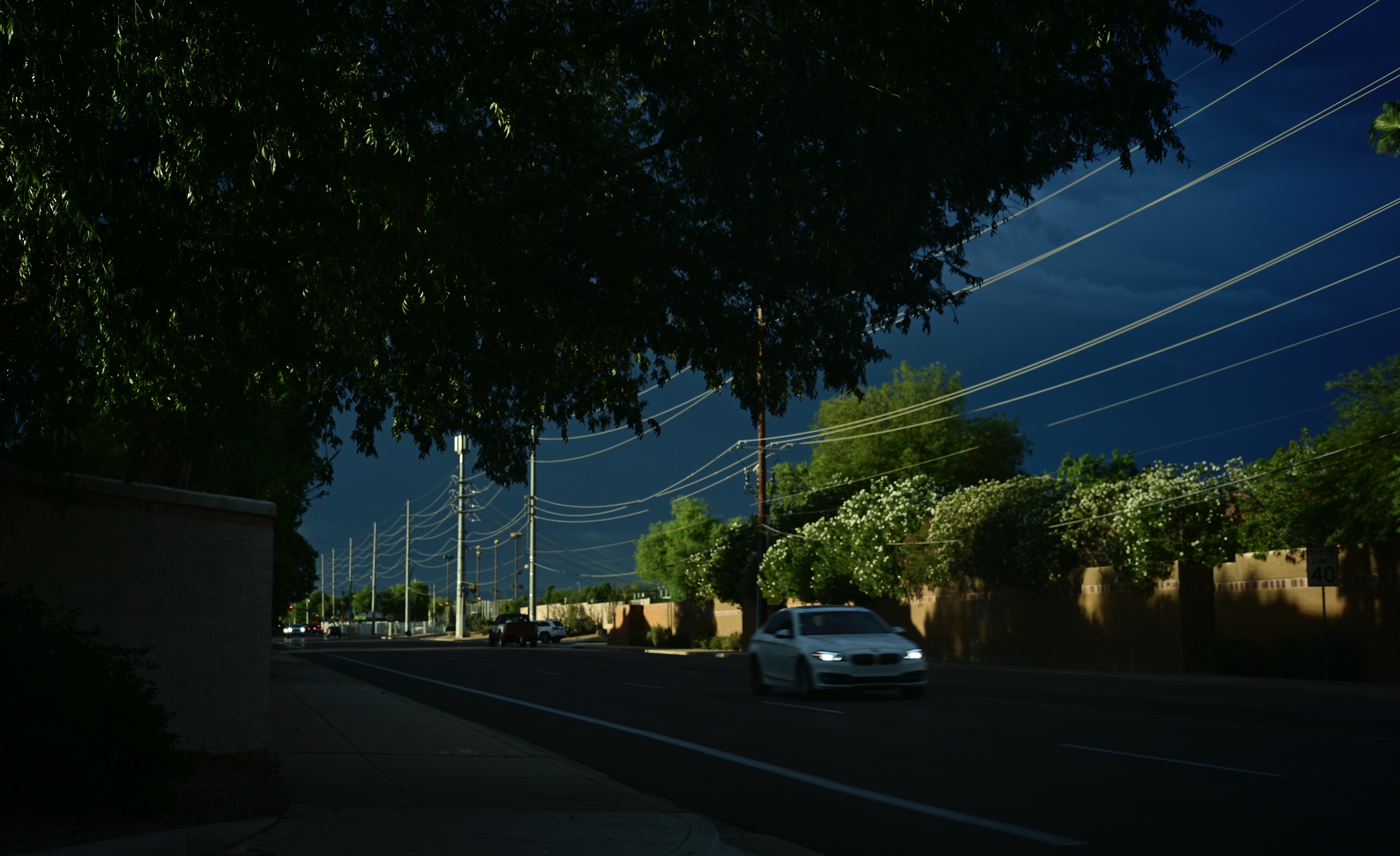
Because of its fairly soft focus, this picture, according to some who may view it, is imperfect, flawed, or what might term a bad photograph. It had to be grabbed in a second of impulse because everything in it was perishable. Things like the approaching auto, because it was needed for scale, composition, and a sense of urgency: the storm, which was refracting the dying sunlight of a late afternoon in amazing, but fleeting contrast: even my car, since I was shooting out my driver’s side window and would soon have to move on to avoid snarling traffic. It is not a precise picture, but instead it is an image of an opportunity. I might, with an additional second or two, have guaranteed the sharpness that, for some, disqualifies this shot, but I was shooting one-handed, and on full manual, and the oh-what-the-hell rule trumped everything else.
But for me, everything else except the lack of sharpness works powerfully enough to “sell” the picture, to convey what I felt when snapping it. Crispness might have been an additional plus for the final image, but I will never know. I do know how rotten I would have felt if I hadn’t had a go at it. Emotions can often carry a photograph where mere technical precision can never reach, and you’ll know when the time is right to choose one or the other.
 thenormaleye