HURT TIL IT SMILES
By MICHAEL PERKINS
WILDLIFE HAS BEEN SUCH A SMALL SUBSET of my overall photographic work over a lifetime that it holds a very special challenge for me. In shooting nearly everything else, I have landed at what might be termed a plateau of competence, an ability, through repetition and practice, to predictably deliver a decent result in a variety of disciplines. However, immersing myself in nature subjects places me so far outside my comfort zone, so far from any smug illusions of mastery, that it involves real risk. Ironically, more than ever before, that is where I am deliberately placing myself. Art doesn’t always thrive in the danger zone, but, on the other hand, doing what you’ve always done means you’ll always get what you’ve always gotten.
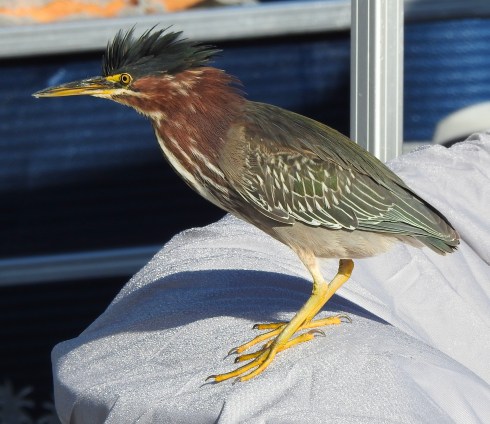
Green heron perched on a boat. Best to take the freebie and relax, but….(see next)
Bird work is a subset inside a subset, occupying a larger portion of my nature output in recent years, and offering equal portions of satisfaction and frustration. Birds are unlike other subjects for portrait work because they don’t care what I want and aren’t here to make me a success at it. They exist in their own sphere and under their own impulses and needs, and whether I can focus fast enough to catch them on the wing, or compose well enough to properly showcase them is of no importance to them. I am, by habit, caught up in what I want to achieve or capture, or, technically, succeed at. To properly photograph a bird, you have to shift every normal emphasis of style and approach. You can’t go out with a given quota or “yield” in mind, as conditions shift so quickly, so consistently that, on many days, you’re fortunate to have even a single usable shot to show for your effort. But that’s not really a negative. In fact, quite the opposite.
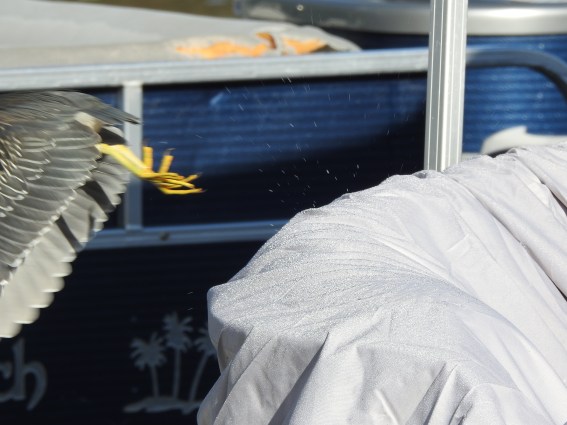
…Mr. Heron decides he’s out of here, and you’re too slow, boyo. In otherwords, a typical day.
To, as portrait photographers used to term it, “watch the birdie”, you have to develop a different kind of watching than for any other form of photography. You have to slow down. You have to listen as well as see. And you need to silence the part of your ego that instinctively thinks of the photograph as a trophy, as one more scalp on your belt. It sounds very New Age-y to say that you need to “let the picture take you”, but that is, at least, an approximation of what you’re aspiring to. Finally, given the sheer number of blown shots you must walk past on the way to the keepers, you need to be all right with failure, or at least be able to find a new definition of “success”. Art is not something that’s logged on a scorecard; it’s peeling away all the wrong versions of something until the right version is revealed. You hurt ’til you smile. Nature work is its own separate discipline, in that it’s defined by how well you manage yourself, rather than whether you tame the subject.
TWIN-AXIS ACCESS
By MICHAEL PERKINS
EVERY TIME I PHOTOGRAPH BIRDS, I lament the fact that I started in at it so late in life. Indeed, if I had not married a birdwatcher, I might never have strayed into wildlife work to any degree. Just being in the moment as I peer into the very special domains of living creatures has enriched my life. Being able to enrich the lives of others with what I capture from that experience has proven a much more random thing. That is to say, since I started year after others did, I may not live long enough to get really good at the whole thing. Sigh.
Bird shooting is really a double quest, a twin-axis access. Finding the bird, the first axis, is one thing. Finding a reliable way to record them is the second axis, and getting the two tracks to intersect perfectly is not a project for the faint of heart.
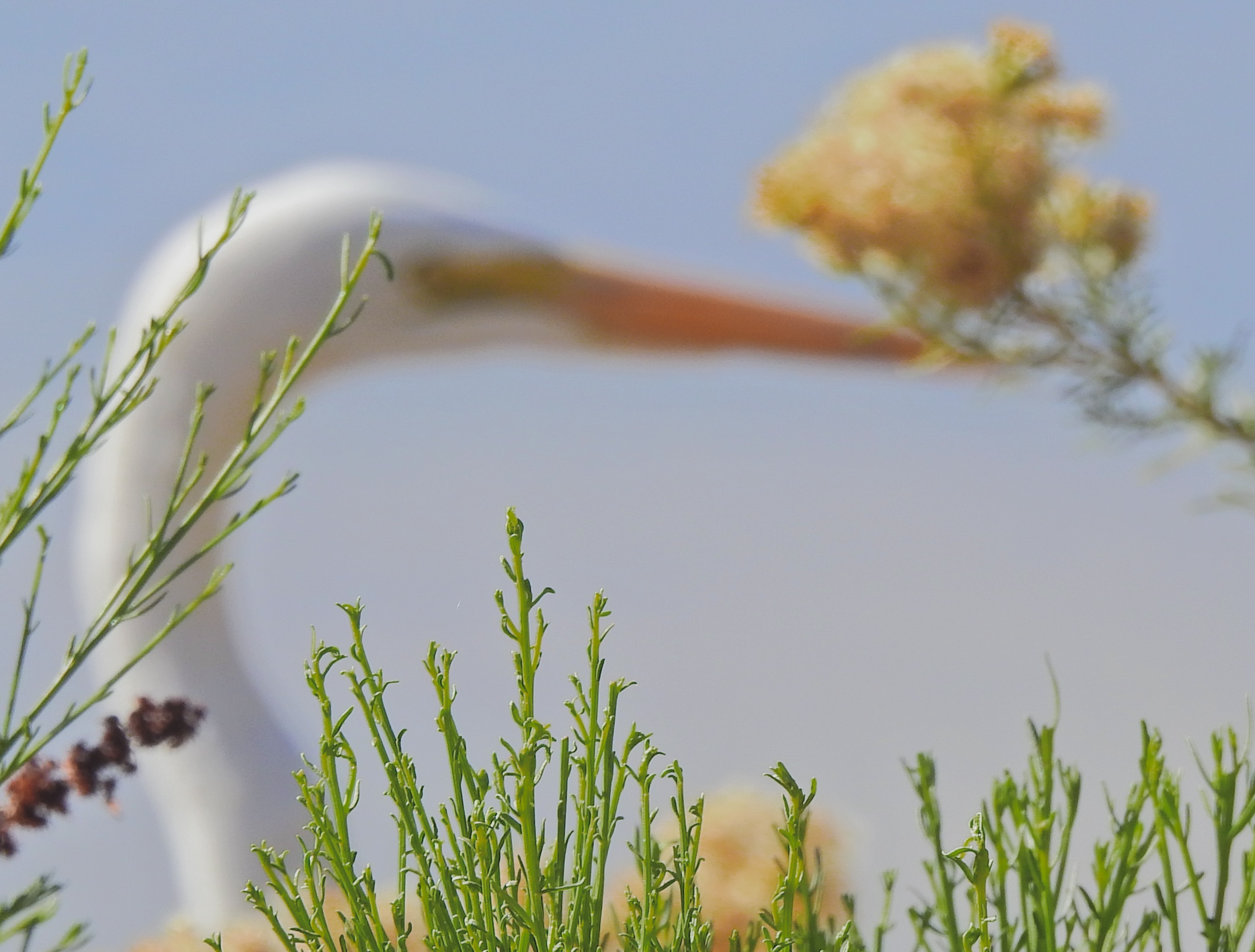
My aim was to render a sharp close-up of a heron behind some decorative pond clutter. Auto-focus, however, had other ideas.
With me, focus is a bigger issue than any other shooting consideration. Entering the world of birds as I did with a modestly priced “superzoom” rather than a dedicated (and far pricier) telephoto, I was exhilarated that, with the ridiculous reach of such cameras, I could suddenly get at least some pictures that had historically been the stuff of fantasy. However, just bringing the birds closer was only the first part of the challenge. Many superzooms (and some upscale telephotos) struggle to nail autofocus quickly enough to register bird shots sharply, and much of this problem is exacerbated by the subject’s surroundings. A single blade of grass interposed between your target and your lens can mean a tack-sharp picture of that blade of grass, backed up by a completely blurred bird (see embarrassing example above). Thus, shooting birds in a dense thicket or tree can make it nearly impossible to isolate your subject, resulting in more spoiled shots than my Irish temperament can comfortably endure. I’d like to say that images like the one shown here are rare in my portfolio, but I’d be lying through my tightly gritted teeth.
Of course, some bird photogs are expert in going the other way, and opting for completely manual focus. This, over the span of the unavoidable learning curve, will mean even more missed shots, given the little darlings’ tendency to dart about suddenly. Even when using a tripod to help minimize camera shake at longer focal lengths, nailing focus manually takes a lot of practice, the result being that most shooters would rather swallow bleach than rely on it, but, hey, different strokes and all that. As is the case in almost all types of camera optics, lenses which have the fastest and most responsive rates of precision in auto-focus modes can only be had by laying out serious dollars. This is one of the last barriers to a truly inclusive world for all photographers, and needs to be addressed. It shouldn’t cost thousands to make a beautiful picture, and more and more of photographic tech is all about addressing that issue. Alas, long-range, autofocus-dependent wildlife work is one area where the playing field sorely needs to be leveled. We ought to be able to easily show what we see.
 thenormaleye