BLANK CANVASES
By MICHAEL PERKINS
I GENERALLY STEER CLEAR OF THE WORD “ABSTRACT“, since, like many other terms of art, it has been bludgeoned, by misuse and repetition, into a blunt instrument, rather than the surgical tool it might have been. If the word means, as one dictionary has it, something “disassociated from any specific instance” or, in another, as “expressing a quality apart from an object“, then it actually becomes a fairly accurate way of defining what happens when one art beholds another. We take the object away from its original context, or redefine it in our own terms. We begin to personally possess it, using words or pictures to say, “I know what this was ‘supposed’ to be . This is what this is to me.”
In this way, a person with a camera can approach any subject, regardless of its “actual” history, as if it were a blank canvas.
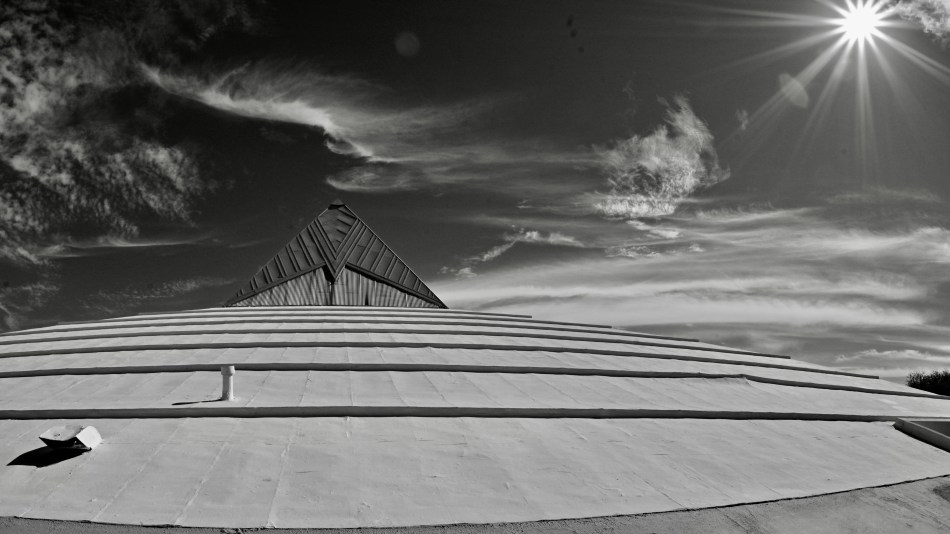
I approach the building seen here in exactly that way. Originally, it was a church of some kind, and by “some kind” I mean of the ooky-spooky, not-of-this-world variety. Hey, no judgement. The pyramid cap up top was deemed significant in some way in the overall design, but, as the place had long since been de-sanctified and put to other purposes by the time I first encountered it, the intent of the creator(s) has been lost to me….hence the “blank canvas”. The structure has no history at all, at least as far as my eye is concerned, freeing me to assign any meaning (or no meaning) to it pretty much at will.
Strategy-wise, part of the making of this image is an attempt to tie the building to something ethereal or mystical, leading me to shoot in monochrome for mood and using an f/16 aperture to convert the midday sun from a blinding glob to a multi-pointed starburst. I also decided to jack the contrast to extreme levels and darkened the insanely bright Arizona sky into something foreboding, imbuing the passing clouds with a bit of menace. The result? A temple? An alien mother ship? A gateway to another dimension? Your rules and your choice. The structure, as I came upon it, meant nothing to me, and so I got to determine its meaning. Or “a” meaning. And that, to me at least, is abstraction. Or maybe it was just a way to kill fifteen minutes while waiting on my wife. Or maybe I live in a world in which both things are true.
HELLO GOODBYE
By MICHAEL PERKINS
THERE IS AN AUTOMATIC AND NATURAL EMOTIONAL CONNECTION between our memories and the images we create as those memories are being generated. The whole “remember that?” appeal of a photograph, after all, is why many of them get made in the first place. Pictures both record and recall in the same instant. We steal time now so we can steal it back later. But there is another heart tug that we feel over a lifetime of making photos, the special one connected to the specific devices we use to do the deed, and what those devices say about who were were at different phases of our lives.
In recently trying to winnow down the Everest of clutter Marian and I will be taking to our next home, I’ve been, as the archeologists say, opening a lot of tombs lately, mountains of accumulated junque which is decidedly less precious than the loot of the Pharaohs. In said tombs I stumbled on a mint-condition Nikon D60, my camera of choice when this blog began more than eleven years ago. It was the brand’s entry-level DSLR at the time, and I was certainly an entry-level shooter with it. Accordingly, once I learned how to do better and desire a more whizbang-y toy, it was shelved and forgotten, along with the memory of just how much dang fun the thing was to shoot with. A full tech check seemed in order before I could decide if it deserved adoption or de-activation, and so, for the first time in almost a decade, I spent a morning pointing it at just about anything.
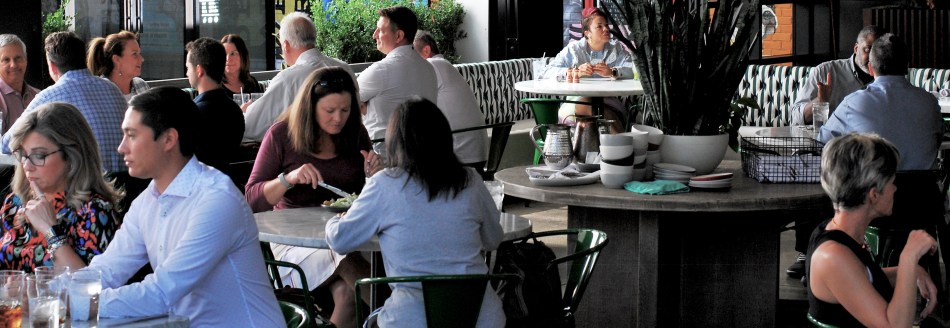
One more lazy morning with an old friend. In this case, my old Nikon D60, newly emerged from retirement.
It wasn’t quite like taking your ex to dinner years after your breakup, but it definitely created some of the same type sensations. Suddenly, I wasn’t just taking pictures: I was recalling pictures, thousands of them, along with the backstories on how me and the D60 had willed them into existence. I remembered learning specific things for the first time, and recognized how my eye melded with what the camera could and could not deliver…..a lot of, “oh, yeah, it does that” and a warm regard for a kind of picture-making that now seems sweetly innocent. Oh, and, in the bargain, the thing still takes pretty good photos.
The tricky part now becomes where the dingus will wind up. I can’t bear to merely drop it off at a thrift shop or kick it to the curb, and so I now have a whole side project trying to find someone who wants what it does at this precise moment in their lives, a mission which has me annoying friends and relatives alike in search of a grandchild, a buddying hobbyist, somebody to love it like I did. Anything less would dishonor the great times we had together before we sadly concluded, “we need to see other people”. So, sorry, old sweetheart, we won’t be ending the evening back at my apartment, but take care of yourself and keep in touch.
“It was great fun, but it was just one of those things…”
UNANCHORED
By MICHAEL PERKINS
THE MOST ENDURING PHOTOGRAPHS TRANSCEND TIME, connecting with succeeding generations in ways that both celebrate the eras in which they were originally made and yet keep them unanchored from time somehow, as if what they have to say is completely irrelevant to the date of their actual creation. Even as each succeeding level of photo tech has produced a “look” specific to its place in time, the photographic art has evolved to the point where we can easily invoke the cues or features of any one photographic age, mixing and matching them in new photographs that also seem free of the constraints of time.
That, to me, is the selling point on apps, and their power as real tools rather than playthings. Our inherited legacy of the meaning of pictorial quality, as well as our sense of how physical images tend to age, is now simulated in endless combinations of color manipulation, textures, and image modification, even in our most casual snaps, meaning that there is no part of our shared photo history that cannot be summoned forth and replicated virtually at will.

Like many, I’ve tried to find a unique combination of app settings that begin to look like a signature style for my manipulated images, rather than just generate novelty effects, like sticking bunny ears on someone’s head. And like many others, I’ve had to radically revise my idea of a “genuine” photo, just as the cel forced me to revise my concept of a “real” camera. That, in turn, has made me looser with both phone pics and the pictures I make with my conventional gear. As to apps, where I’ve finally landed is a crazy quilt of looks that suggest everything from daguerreotypes to hand-colored tones to painterly patches to hyper-focused ultra-detail to textures that suggest either water damage or wear. I don’t know what to label the end result, but I seem, upon rifling through oh-so-many files, to have settled on it as my set point.
Which brings me to today’s launching of my latest gallery, Etchings & Agings, listed in the tabs menu at the top of this page or linkable here. It’s the first full page of phone images that I feel consistently happy about since I started this forum some eleven years ago. I may have come late to the dance with cel images, but they now loom larger in my workflow with every succeeding year. It can sometimes make me feel like I was the last kid in the neighborhood to get a color TV, but then, photography is as much about self-discovery as it is technical mastery. Without one you can’t get the other, and vice versa.
TATTOO REMOVAL
By MICHAEL PERKINS
THE INDUSTRIAL DESIGNER RAYMOND LOEWY, the genius behind some of the most imaginative products of the twentieth century, from the streamlined Greyhound bus to JFK’s version of Air Force One, often remarked how much more beloved an object could become if its outer shell was rendered more appealing. He proved it with everything from cigarette packages to locomotives, improving the public perception of everyday brands just by affecting how they were presented. Some might call such transformations superficial, mere makeovers, but they seriously matter when it comes to the visual impact of the everyday.
Photographing cities of a certain age means photographing the infrastructure that is part of their history, that intersection between how a thing performs and whether that performance is beautiful or ugly. There are good signs that our public places are finally taking Loewy’s lead and paying attention to how infrastructures impact our senses, that is, whether they are a delight, or whether, as H.L. Mencken put it, they “lacerate the eye.” For an example, consider San Francisco, a town of many rebirths and resurrections. The present day version of the place is often built upon the scar tissue of one or other of its prior eras. Things burn down. Thing crumble in quakes. Thing fall to the changing priorities and passions.
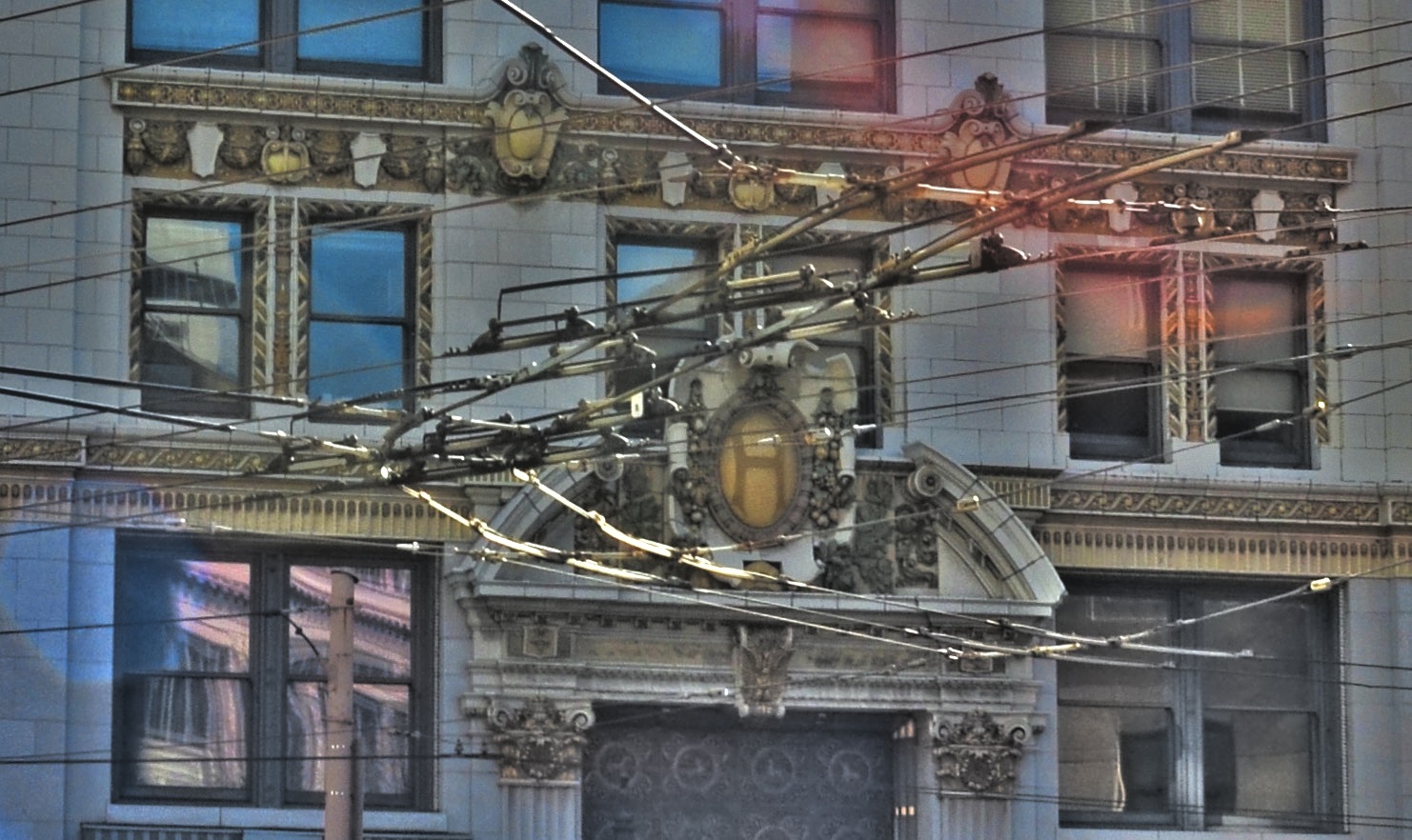
Even making pictures in a location as lovely as the Bay City can mean being force to focus through something hideous, like the mad tangle of electrical and cable car lines blocking the grandeur of the venerable building seen here. Above-ground telephone wires are vanishing from many places, and being designed out of the visual layout of newer towns, as are other remnants of bygone periods in American growth, but much remains to be done, a kind of cultural tattoo removal that shows we can, indeed, get out of our own way, that the beautiful signature of one kind of energy is not cancelled by the bad thinking of another kind.
In the meantime, the transition itself is photo-worthy, even important. Like Loewy often remarked, “good design keeps the user happy, the manufacturer in the black, and the aesthete unoffended”. In the interim, pictures can help us mark both our progress and our regressions, and both kinds of images serve to make us knowable to ourselves.
DANCING WITH GHOSTS
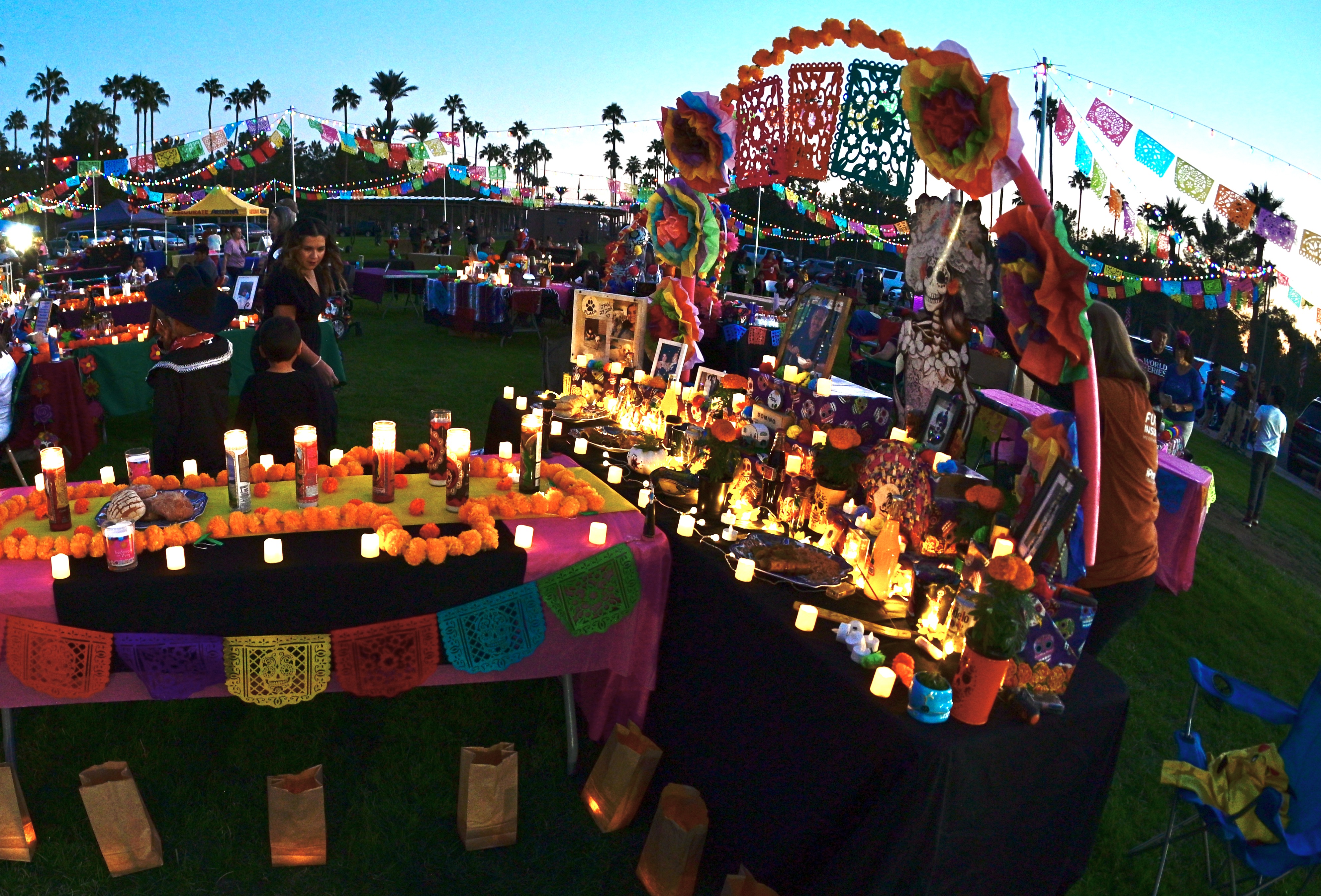
An ofrenda, or family altar shrine, at a Day Of The Dead celebration in Phoenix, Nov. 2, 2023.
By MICHAEL PERKINS
THERE ARE STILL SIZABLE STRETCHES OF AMERICA for which Dia De Los Meuertos, or the Day Of The Dead, remains a cultural asterisk, in contrast with those regions where it is sacred, mournful and celebratory, all at once. For a quarter century, I have lived in such a region, as the Valley of the Sun, or metro Phoenix, Arizona, is pretty much ground zero for the beautiful commemoration of family and spirituality that occurs in Hispanic neighborhoods each November 1st and 2nd. Catholics can specifically relate to the same calendar dates, as they coincide with the historic holidays of All Saints and All Souls Days. Also, scholars will remind us that Halloween, or the Eve Of All Hallows, which directly precedes November, was originally a time for dressing up as one’s patron saint. And therein lies the best connection to Dia De Los Muertos.
This year, I was invited to a DDLM festival held, where else?…in a cemetery, hosting a spectacular array of ofrendas, or the miniature altar-like shrines dedicated to departed members of one’s family. Precious photographs and votive candles are the main features, which are quickly expanded to include personal mementos of the dear ones, as well as endless sprays of bright pastel paper flowers, radiantly patterned hanging pennants, and, at this particular gathering, lots and lots of food. The dead are summoned by the endless skeletal figurines and sugar skulls that festoon every inch of every offrenda, and many of the celebrants themselves sport skull faces created with both mask and makeup. The atmosphere is never one of grief alone, but sadness alloyed with joy, as well as gratitude for the memories left us by our most beloved.
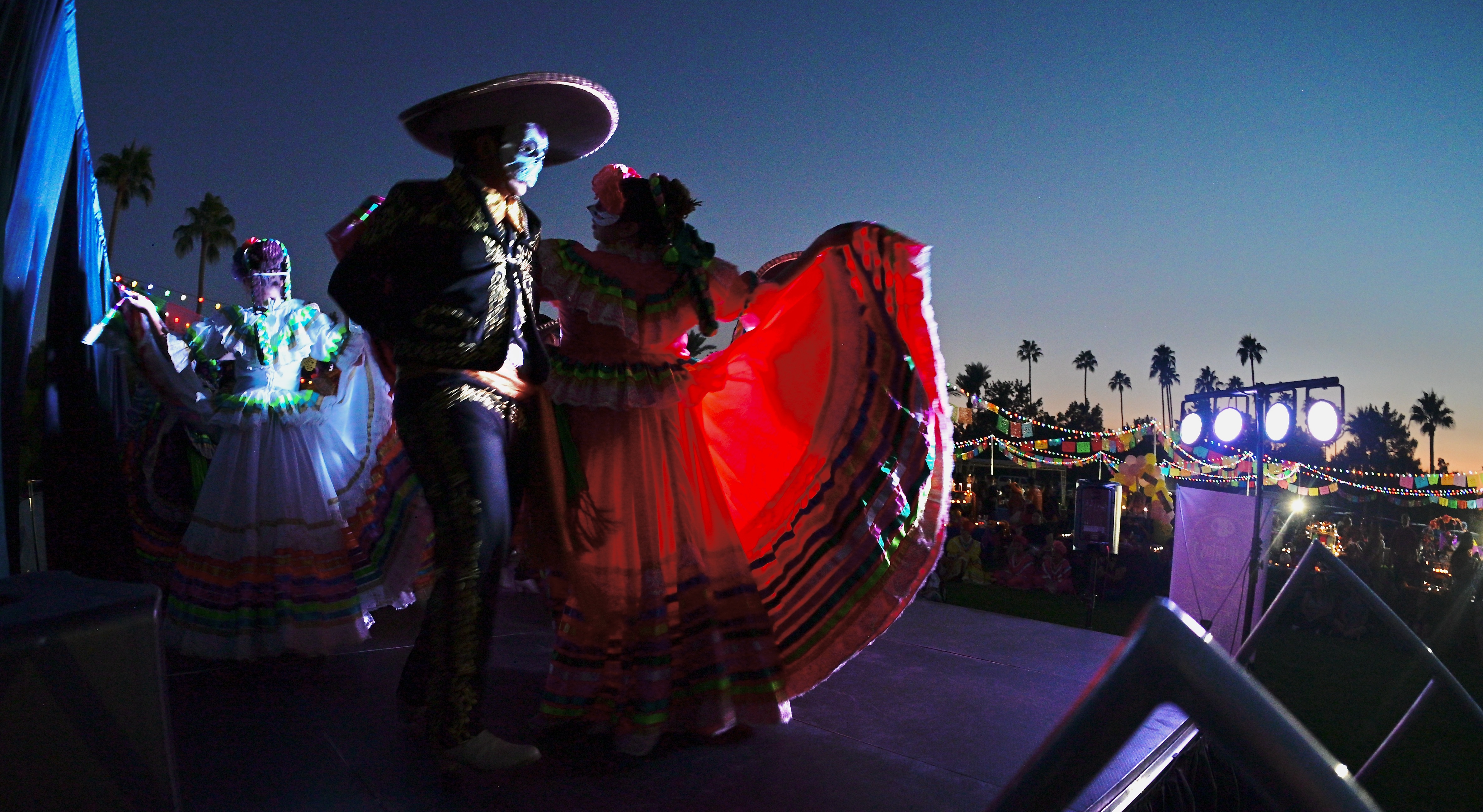
Dance and song narrow the gap between the “realities” of life and death.
Obviously the supernaturally tinged flavor of DDLM is paradise for a photographer, and I find myself trying to do justice to the sweetly spooky vibe by making images that are beyond mere documentation. It’s challenging to try to optically suggest a feeling, but it’s also rewarding when something unexpected makes it into the camera. This year, in using a lateral fisheye to twist the concept of space and thus suggest a kind of dream state, I also had to get comfortable with a bit of blur or distortion, as if I were able to capture ghosts in mid-dance, rendering the vanished visible, if even for a moment.
As Shakespeare said, there are more things in heaven and earth than are dreamt of in our philosophy, and seeing so many people in one place taking so much solace in re-connecting to those who have gone before creates a tremendous, electrical release of energy. Trying to make images of something that floats tantalizingly between life and death is an adventure I can’t resist.
RE-FOCUS, AD INFINITUM
BY MICHAEL PERKINS
PHOTOGRAPHS NOT ONLY RECORD HISTORY: they also function as history itself, used both in the context of their first creation, and later as illustrations for purposes beyond their original context. We cannot look at breadline images from the Great Depression without seeing all want or hunger in all ages: we can’t help but see the faces of our own dead in Matthew Brady’s jarring scenes from the American Civil War. Photos are given one identity by their makers, and then are asked to play other roles as they move forward in time.
As one example, lately, I have seen increased use of this image from Buster Keaton’s legendary silent feature The General in articles about dysfunction in both nations and governments, as a fairly on-the-nose example of a “train wreck”, or a situation gone horribly wrong. Ironically, the picture began as proof that one of the most challenging productions of the period had gone amazingly right.

Forever a depiction of “best laid plans”: the spectacular crash from Buster Keaton’s The General (1926)
The film tells the story of an engineer whose devotion to his beloved locomotive, dubbed “The General”, and his crucial role in conveying supplies and troops for the Confederacy. After many an adventure both above and below North/South battle lines, the train meets its doom attempting to cross a trestle that has been set ablaze, the whole works collapsing into the river below.
Shooting the overall film in Oregon, a rarity in the days when most movies were shot almost exclusively on studio “back lots”, Keaton selected a crash location near a town named Cottage Grove, which declared a holiday on the morning of the big scene so all the locals (nearly 4,000 of them) could see the one-take spectacle, cheering on their own state National Guard, who crossed the river below the trestle costumed as federal and confederate troops. Making sure that the actual, full-size “Texas” locomotive would make it nearly across the bridge before its collapse was one of the things that made the sequence, at a cost of $42,000 in 1926 money, the single most expensive shot of the entire silent era. Keaton captured the scene with six cameras as extra insurance, and the crash entered popular history even as the film, although later considered a classic, initially failed at the box office.
There are many photographs whose lives far outlast the original periods in which they were created, whether they become symbols of celebration, or, in the case of the General, failure and devastation. Either way, what we shoot today could well serve other uses in other times, for intentons beyond our wildest speculation.
WE’LL TAKE A CUP OF KINDNESS YET
By MICHAEL PERKINS
IT’S A TIME OF LIFE FOR DECIDING WHAT TO KEEP, and what to leave behind. Photographers, as well as people in general, reach an age when lists must be made. The essentials versus the disposable. The legacies versus the litter. We know we can’t take it with us when we go, but now things are getting serious, and so we can’t even take everything with us as we, say, move across town. Boxes are searched: offers are made. Do you want this? If so, take it. If not…
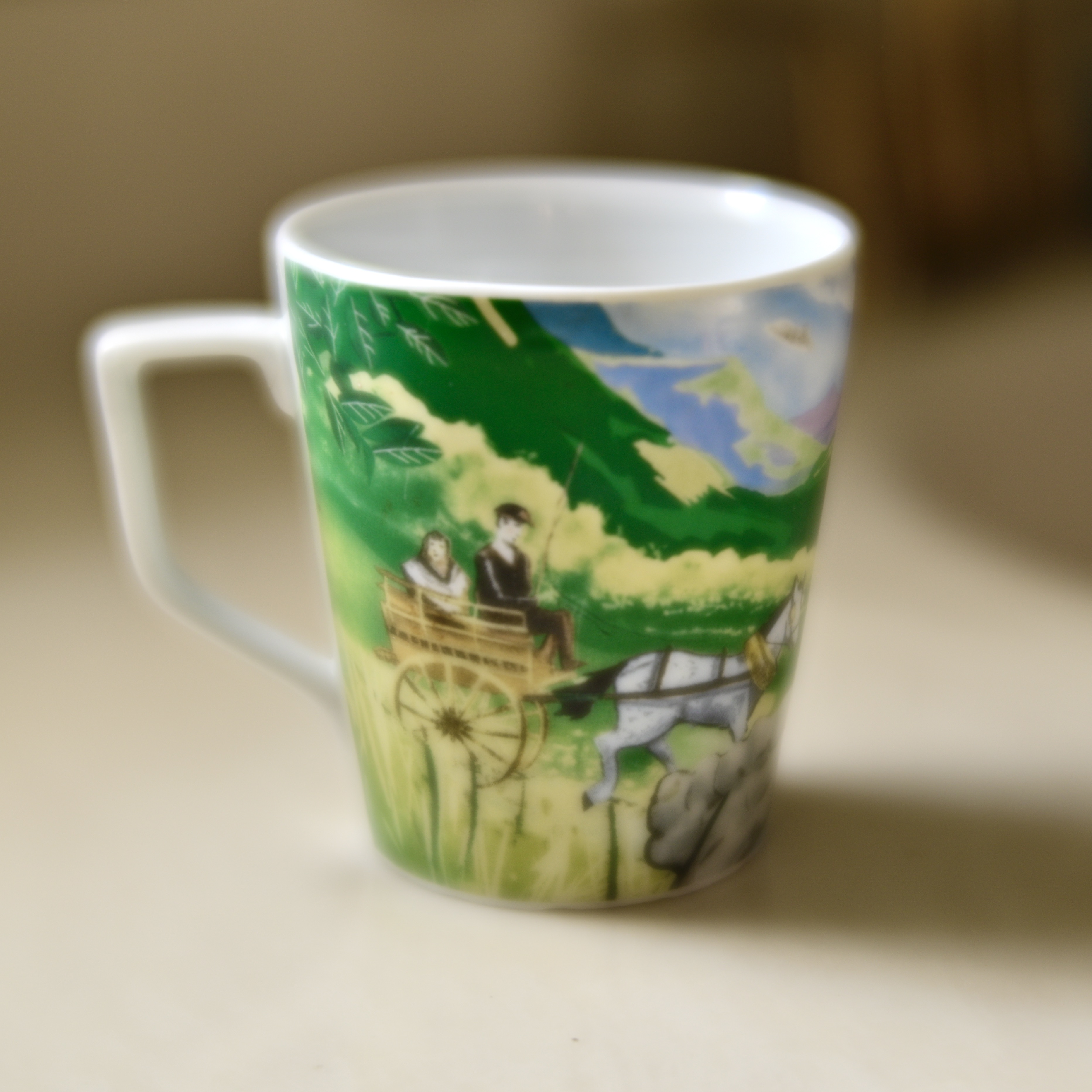
A year ago, this mug would never have made it into the keeper pile. I have often forgotten, over the years, that I even owned it, as it was one of those awkward gifts that an adult child gets from his aging mother simply because she has already bought him everything he actually wanted over a lifetime, and, oh, hell, here comes another Occasion. It’s kitschy and not my taste and was never on my radar as an object of desire. But a year ago, my mother was still alive, and so, now, it’s something quite different.
Now, the mug is bound up in things bigger than itself, having become a reminder that she loved that I loved that we were Irish. I was the one in my generation who “got it”, who thought that remembering our family’s journey from the Great Famine of the 1840’s to the present day was important, even an obsession, and so she wished up a token of that pride and sent it to me. I thought of you when I saw this.
And so, at this point, I make pictures of the mug, in an attempt to show a bit of the feelings that shape it in my mind beyond its mere physical reality. To interpret it as an aspiration, a remembrance, a ghostly vapor. Because my mother’s passing has not rendered the actual object any more valuable or artistic of and by itself. I am really taking pictures of myself from the inside out and draping that photographic veil onto the mug. In future, as the lists of keep/toss candidates pile higher and higher, the actual cup might well be left behind, but now that’s all right. In a photograph, I can continue to have something after I no longer possess it. That’s the miracle of a camera, and the best way to remember a woman who believed in, and often brought about, miracles of her own.
ONE LAYER AWAY

For now we see through a glass, darkly; but then, face to face. Now, I know in part; but then shall I know even as also I am known. 1 Corinthians 13:12
By MICHAEL PERKINS
LONG BEFORE MOST OF US EVER SCREWED A FILTER ONTO A LENS, we were shooting images that achieved kinda the same result. For as long as there have been windshields on cars (windscreens to you Brits), there have been through-the-windshield pictures, since, as we all know, photos are where you find them, when you can get them. Of course, we stipulate that some things that look amazing to your eye come out substantially less so when shot from inside a car, but that’s a lament for another day. Main point is, our first filtered images are often shot through a layer of smashed bug guts, dust, rain smears and wet leaves. And we have mostly been cool with that.
I have more than enough personal history to persuade me that windshield shots seldom truly deliver, and yet the twelve-year-old inside of me still believes that whatever I point a camera at, that’s what I’ll get (a fantasy seldom borne out by reality), and so I can still be convinced to take the shot anyway, especially in the digital age, in which, once you buy the equipment, you’re basically shooting for free. This temptation is made more urgent by the evanescent nature of auto travel itself, conditions in which waiting even a second too long means a vanished opportunity. But let’s face it, we’re truly up against it, on average. If the curvature of the glass doesn’t louse up your sharpness, or if the flare at one end of the glass doesn’t send a rainbow streak across the other, then you can still eighty-six the entire process through camera shake, or just trying to anticipate the precise moment to snap the shutter on subjects that are constantly in motion. It’s kind of a perfect storm of, well, storms. Despite it all, you do occasionally capture a keeper, hence the above illustration, which is less in the “personal best” category than it is in the “doesn’t totally suck” division. But hey.
And so we soldier on, lured by the sheer what-the-hell nature of shooting largely by instinct, in an arena in which we’re more or less expected to fail. Maybe it’s the last vestige of our amateur status, those days of carefree shooting before we even earned our brown belt. Or, just maybe, it’s an attempt to inject both uncertainty and fun into a pursuit that we typically approach, sadly, as a job rather than a joy.
CANYON-ADJACENT
By MICHAEL PERKINS
MANY LARGE CITIES BOAST ENORMOUS STRETCHES OF ULTRA-TALL GLASS AND STEEL TOWERS arranged in a kind of urban forest that is both broad and long. Think Manhattan, where the dense bigness of the skyline seems to stretch outward to all points of the compass at once, a town of big shoulders where all the short shoulders seem to have been crowded out, and where the amazingly new seems to nearly eclipse the old.
That idea of a solid, omni-directional bigness is not as universally true on the opposite coast, where, in many parts of Los Angeles, for example, the town’s bigness is often confined to buildings right along the main drags, with shorter, older residential neighborhoods intact, almost invisible, just a few blocks either side of that, as if the skyline went dramatically from dominoes to sugar cubes within a very brief distance. This is quite pronounced in the “museum row” or “miracle mile” section of Wilshire Boulevard, which begins in Santa Monica near the coast and makes its way northeast to the heart of downtown L.A.
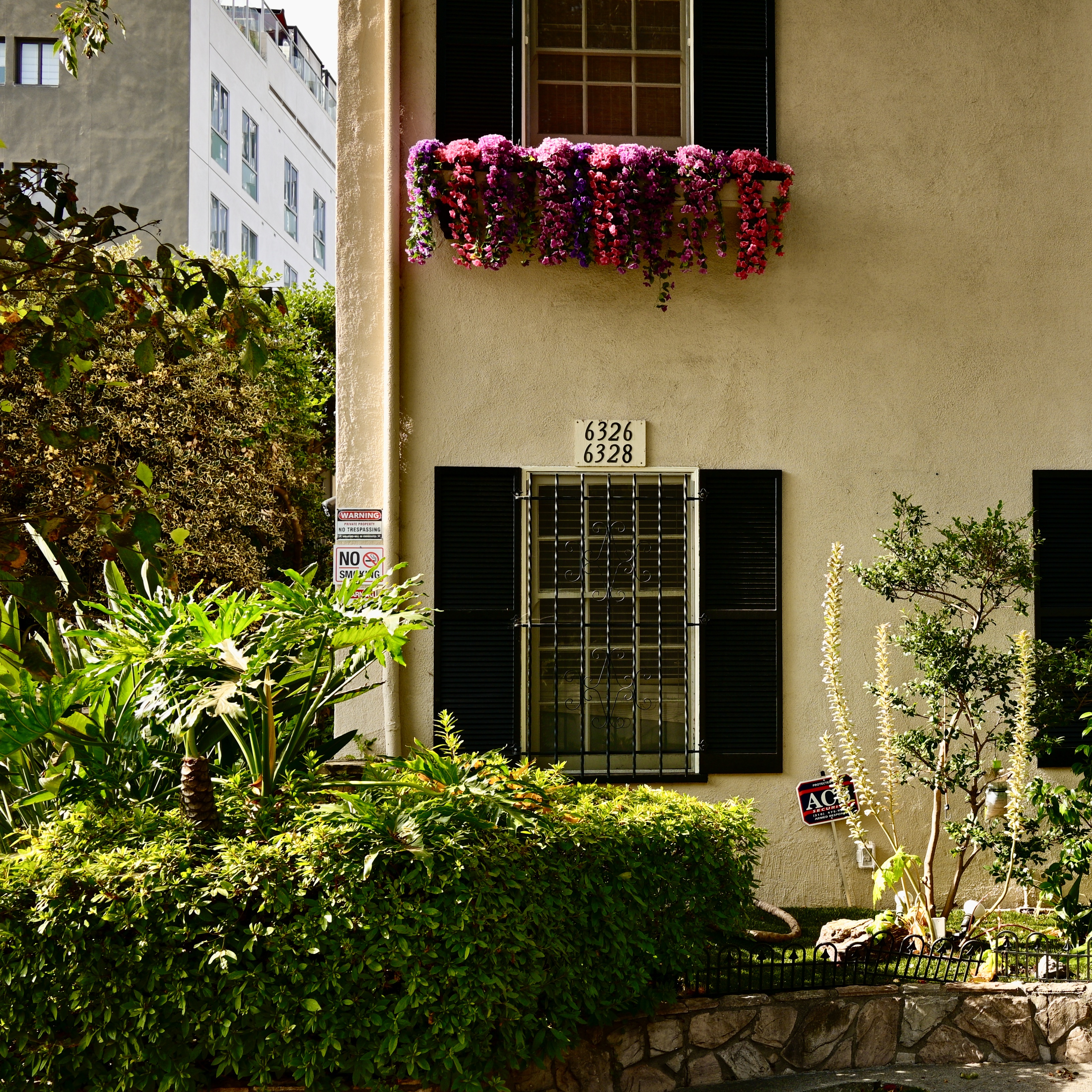
Hidden from view in the busier parts of Wilshire, and yet scarcely a hundred yards north or south of it, dozens of older districts can be found, boasting huge homes that, in some cases, date clear back to the 1920’s, largely unchanged by all the monstrous stacks of stories that line the main avenue. They are not part of the “concrete canyon”, but are indeed “canyon adjacent”. In this frame, a vintage house can stand in stark contrast to the skyward reach of its taller neighbor, almost as if the skyscrapers provide a buffer or protective wall that acts as a barrier against the encroachment of time. The average height of a structure can thus drop from dozens of floors to two, or even one, within the space of a city block.
Neighborhoods are delicate things, and it’s always a delight to see how well some of them manage to defy change, or, more precisely, to survive it, living on to assert their own identity. Los Angeles is not unique in its array of canyon-adjacent jewels, but it is one of my favorite photographic hunting grounds because of the phenomenon.
EITHER/ OR / EITHER

Inniswood Gardens, Westerville, Ohio, color original, 2023
By MICHAEL PERKINS
I GREW UP DURING THE MASSIVE CONSUMER SHIFT that saw most photographers, both amateur and pro, fully embrace color film, giving it real market dominance over black and white. The wind-up to the change took most of the first half of the twentieth century, given the substantial barriers that blocked quality reproduction of color in both processing and printing, problems that kept giants like Ansel Adams openly disdaining brightly saturated hues in favor of a range of tones that either seemed more objective and documentary, or at least more manageable. Color remained, until the 1950’s, the devil you don’t know, and mono was so dominant until after WWII that several boomer kids seriously asked their parents if the world was actually in black and white until well after they were born.
I was not unique at the time in that the first rolls of film I shot were Kodak Verichrome Pan. It was plentiful, everyone processed it cheaply, and newspapers and magazines still defaulted to it to a great degree. I only made the leap to Ektachrome reversal film after my father graduated prints to slides and I came to regard color as more “realistic” while gradually demoting mono to inferior status. It wasn’t until well after my teenage daughter began using Ilford roll film in a 70’s-vintage Minolta that I truly began to value the accumulated legacy of b&w, adopting Edward Steichen, Walker Evans, Margaret Bourke-White and others as honorary godparents and re-learning how less could actually be more.
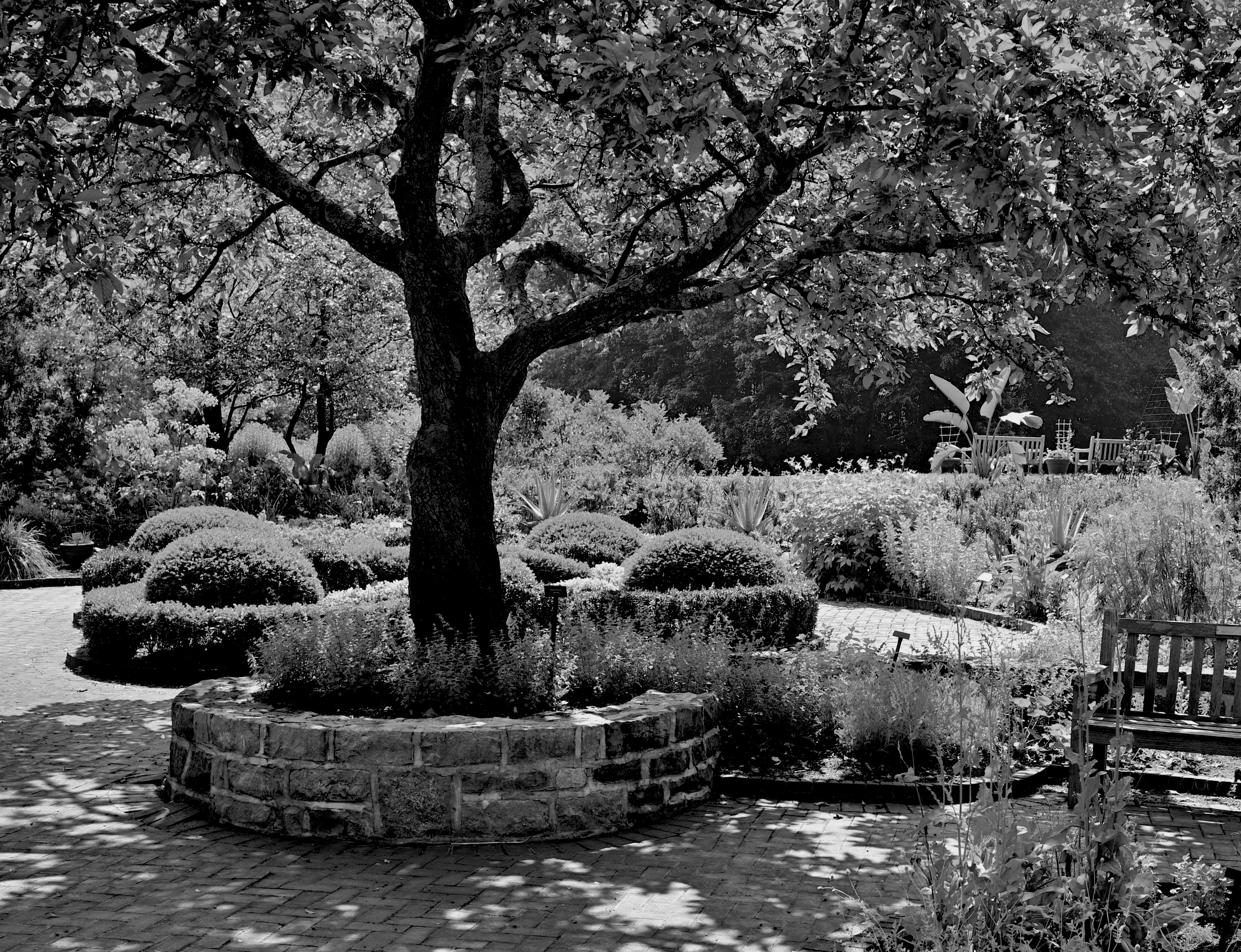
Mono conversion of above image.
Today, I create about 20% of my shots as mono originals, although I am strongly drawn to convert most b&ws from color masters, giving myself the most options possible. The shots that begin as mono are more numerous now because in-camera pre-sets are increasingly able to simulate the tonal range and contrast of mono films, and are therefore nuanced enough that nothing seems “lost” in the absence of color. However, I still have a few hundred mental debates per year on instances where either version might be considered satisfactory, depending on your intent and mood. Some of those debates I settle: the rest are slapped back and forth like a lazy tennis volley on slow, rainy afternoons. At the very least, the ambivalence reminds me not to get complacent about when a picture’s “finished” or “good enough”, and that may actually bode well for what I’ll shoot tomorrow.
GETTING INTO IN
By MICHAEL PERKINS
AS MORE AND MORE PHOTOGRAPHERS DIP THEIR TOE into full-frame sensors for the first time, a slight re-learning curve seems inevitable. The smaller sensors that were typical on the first DSLRs taught us all to do a strange math when sizing up shots, since a cropped image was smaller by one-and-a-half times or even more than those taken on a traditional 35mm frame. This meant that some lenses shot tighter on our cameras, with, for example, a 35mm delivering a frame more like a 50 in terms of the area covered. In moving to full-frame, the process is reversed, with a 35 shooting just as wide as a 35 should, forcing us to re-think how much info we want in wide shots that suddenly seem like wiiiiide shots.
Glad as I am to have a lot more breathing room in my images, I am still being reminded that, on a really wide shot, I seem now to be very far from the center of action. Shooting mostly with primes rather than zooms, I have to take several trial shots until I hit the right balance, and, in many cases, move a lot closer to my subject. I’ve got to get further into in.

This shot of a freight train rolling through Ventura, California was shot on a 28mm lens on a full-frame Nikon Z5. I began sizing up the composition when the engine was quite far off, taking trial shots as it first emerged from under the trestle bridge seen at far left and just ahead of a local gate crossing. I was certain that my first shots would be just about perfect, but again and again I saw the train appear distant and small. I was still framing based on my old experience of seeing a 28 on a cropped-sensor, which would read roughly like a 42mm. In the end, I had to move nearer the crossing and stand so close to the tracks that my wife became alarmed, if the phrase “you’re going to get yourself killed!!” is any indication of her mood. Even so, the train seems like it’s still approaching me, not about to run over me.
Bottom line: my brain was/is still re-learning just how much a wide-angle can exaggerate the distances from front-to-back in a shot. I could, of course, have shot the scene with a zoom, but for the fact that the zoom I had with me was nowhere near as efficient in the rapidly fading sunset light, and that the bridge camera it was designed for had a significantly smaller sensor, which would become extremely noisy with even a modest boost in ISO. Far easier in the long run to adjust where I’d stand than fussing with all those other variables. I shot wide-open at f/2.8, kept the ISO to around 100, and snagged an acceptable shot. Wide-angles are a glorious tool, but in switching to full-frame, there is a break-in period as your brain resets on the rules of engagement.
MEET ME AT OUR USUAL

Joint redux: Ventura, California’s favorite “joint”, the Star Lounge.
By MICHAEL PERKINS
I RECENTLY READ WHAT MIGHT BE, in tavern terms, public notice of a wake of sorts, advertising the partial return of a favorite local hangout that winked out during the darker days of The Plague, capping twenty years of a generally fine stretch as an Irish pub in the main streets of Tempe, Arizona. I say “partial return” because said hangout will not be returning to its original address, but will be merely a seasonal “pop-up” within the nearby Arizona State arena district, with a small commemorative bar and fixtures from the old site on display, pulled out of storage for some strange museum effect, or, to my mind, a kind of open casket viewing. Think relics of the Titanic with a liquor license. Not exactly warm and cozy.
I have, over a lifetime, availed myself plentifully of bars, but I am nearly religious in my zealotry for what are often called “joints”. The word is elusive in its precise meaning, and we can have many a beery dispute about what qualifies this or that place for the title. Suffice it to say, however, that most joints are also bars, but many bars fail utterly at being joints. It’s a term of endearment, one which must almost always be earned.

Right this way…
The fine establishment you see here, the Star Lounge in downtown Ventura, California, meets my very subjective criteria for a joint, and indeed is specifically known as one to the locals. As a photographic subject, you can see that it offers tons in what could loosely be called “atmosphere”. It is weathered without being seedy, unpretentious without being subtle. It’s comfy as an old bedroom slipper but still slick and busy and boisterous around the edges. Chain restaurants break their necks trying to make their mass-produced watering holes pass the joint test, and most of them come no closer than a TGIF or a Chili’s. Bars they may be; joints they most certainly are not.
I love taking images of places that have earned their slot in permanent cities, as opposed to strip malls. Joints are community assets, gathering places where great ideas are argued, great songs are sung (mostly loudly) and great reunions and occasions are arranged. In short, they are more than the sum of the accumulated furniture, which is why they can’t be replicated by merely showing off a few fixtures. Joints, in a way that a photographer can truly love, aren’t pop-ups.
They’re stick-arounds.
TURN AWAY THE STONE
By MICHAEL PERKINS
THINGS BEGIN TO OSSIFY AS WE AGE. Bones. Veins. Memory.
Curiosity.
Over time, photographers, no less than anyone else, can see their once-fluid sense of technique solidify, then freeze utterly into stone, as approaches that began as innovation descend into mere habit or repetition. Worse, such slowing of the creative muscles can be mistaken for a “style” or a “signature look” or anything that sounds better than, say, “stagnation”.
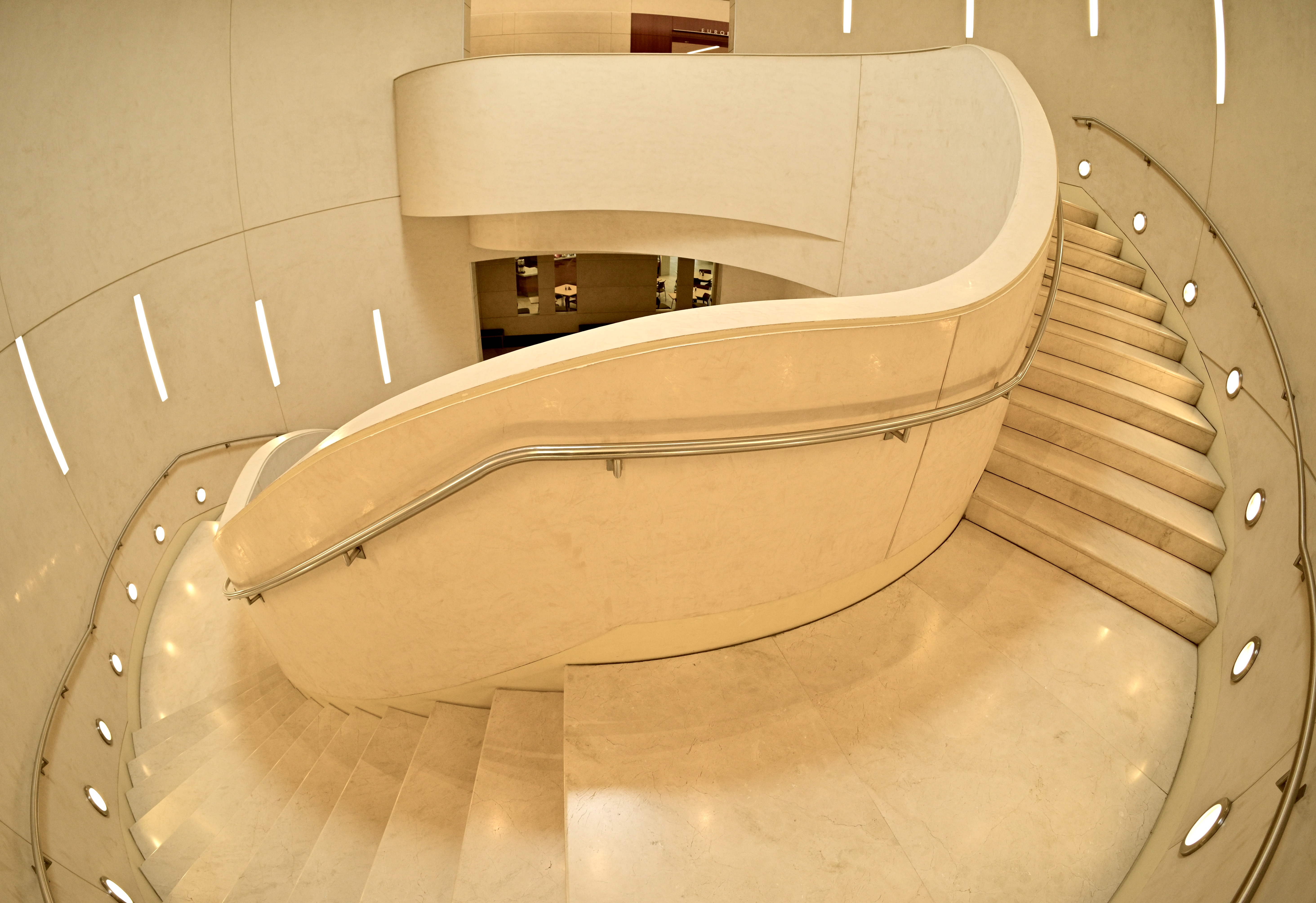
Every stylistic innovation holds the seeds for future paralysis.
As we teach ourselves how to achieve a particular visual result, we pass, year after year, through four distinct phases in how we view our results. These phases determine how we regard the act of creation itself going forward, and they can be generally described thus:
- I have done it this way once before.
2. I have usually done it this way before.
3. I always do it this way.
4. Obviously, that’s the only way to do it.
The first phase is tinged with a bit of amazement: hey, it worked. The second speaks of comfort, the kind of casual ease that comes with relying on something that worked once, and hey, why mess with success? The third phase sees the beginning of a slow-down, a reliance on something that will be predictably safe, and, besides, it’s now a trademark of sorts, expected of me. The fourth and final phase involves the silencing of any further discussion. The old technique in question is now “classic”, the yardstick, beyond debate. Tradition. At this point, creativity becomes nothing more than replication, ensuring more and more of the same kind of pictures, veering us away from art and into the sameness of craft.
Everyday we see articles that defend artistic paralysis as some kind of grounded science. I found the way. I know the truth. We need to turn away from stone and toward an every expanding elasticity in how we see. Otherwise we are no longer photographers, but mere on-demand printers. And for that, no one needs a camera.
HUMBLE BEGINNINGS
By MICHAEL PERKINS
PHOTOGRAPHY DOESN’T NEED ANY ASSISTANCE when it comes to teaching its practitioners humility, constantly reminding the shooter that, boy, you got a lot to learn. The feedback from one’s total output, which is, let’s face it, largely composed of either near or total misses, is immediate and occasionally crushing. How can something that seems so simple be so hard to be good at? So let’s agree that the constant baseline of all picture-making enterprises is a severe whack to the ego.
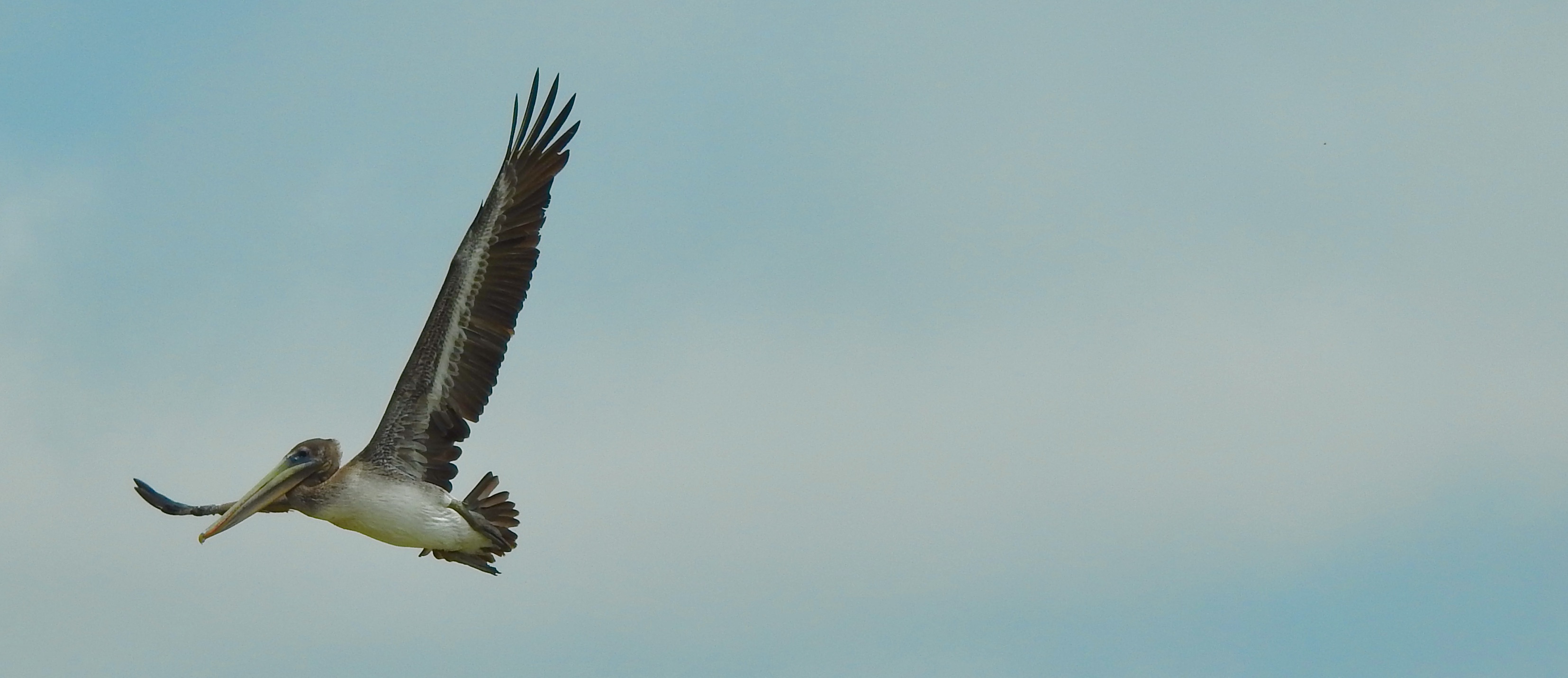
To make matters worse, piled onto that baseline are any number of additional layers of failure, as the novitiate makes his/her way up the ladder to some semblance of competency. One of the toughest such layers for me is nature work, and within that, the specially punishing hell of trying to bring off bird images. Many failures in this category are due to the shortcomings of one’s gear, as it takes at least a modest outlay of funds to get the equipment needed to capture birds under a variety of constantly changing conditions. Then there is the sheer, maddening patience that is required before you can even try to take a picture of one. Beyond the fact that, on a given day, no birds of any kind may even show up or reveal themselves, you have the golden roster of excuses: weather, foliage, distance, “the sun was in my eyes”,etc., etc. The alibis are legion, at least when I am trolling for pity as regards my own blown shots.
And even if you solve both the gear challenge (the right lens, your ability to work it well) and the search for the golden moment (are you sure the nightwings are coming tonight?), there is the problem of whether you even know how to make a picture of anything in a compelling fashion. Did you just “register” the bird’s body within your frame or did you tell a small story? Showcase something of its character? Compose for effect? Some days, you drop one more desperate nickel in the cosmic slot machine and you go home with a hat full of silver dollars, as happened in the above shot, the one salvageable image from over fifty frames taken that afternoon. Will I be back? Well, sometimes one usable pelican is enough to bait the hook and keep you on the line. Other days, you lick your wounds and curse your luck. I don’t know if that’s the same as actual humility.
But it smarts just as much.
A.L.s and E.L.s
By MICHAEL PERKINS
THE FIRST TIME I HEARD ANOTHER PHOTOGRAPHER REFER TO “art glass” I thought he was referring to a Hollywood talent agent. I guess I thought that using the modifier “art” to any reference to a lens was, at the very least, kind of a “duh” redundancy, since lenses serve no other purpose but to abet art. From wide-angles to superzooms, we program the way we choose to record the world based on the particular optic we choose. And within those choices are two very different additional paths to the pictures we are trying to create.
These paths begin with the selection of either an affect lens or an effect lens. If an optic helps shape an idea by enhancing its successful execution, it affects the outcome, but may not completely shape it. For example, faster lenses, or ones with a very deep focal length, help determine how a shot will come out, but the shot is not about that look per se. The opposite is true with an effect lens, where the special properties of enhancement or distortion inherent in the optic (fisheyes, macros, selective focus) can have a truly active role in shaping the final product, even going so far as to having that product be about the unique look created by the lens. Affect lenses are aides: effect lenses can do that, too, but also be the leading voice in an image, becoming, in fact, its content.
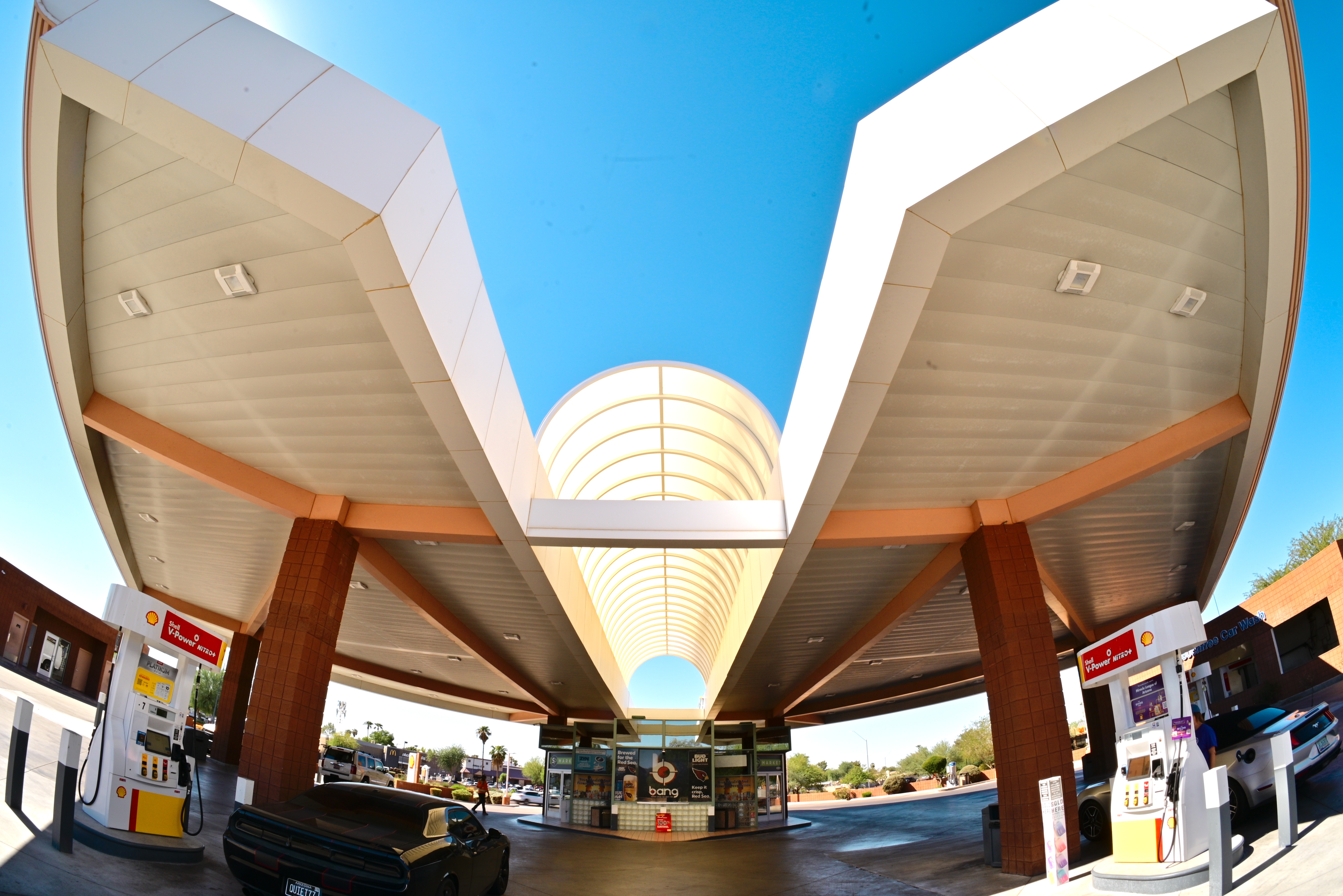
The image seen here was taken with an extreme wide-angle, a f/2.8 TTArtisan 10mm fisheye, and the hardest part of working with such a lens is not letting it run away with you, and having the picture be all about, “wow, that really looks weird, man”, which is the rabbit hole that you can easily go down with an “effect” lens. For the record, there was an actual objective in shooting a gas station with this lens, which was to emphasize the wing-like contours of its architecture, something that is lost in a conventional street view of the structure, but which can be brought out through dramatic distortion at a particular vantage point. Of course, whether the fisheye helps me show what I’m seeking to show, or eclipses it with its extreme strangeness, is for others to judge. Part of me, for example, says that if I have to write a paragraph explaining what I was going for, I’ve already lost the argument. Up to you.
We often use glass as both “AFs” and “EFs” at the same time, and it can be frustrating when we are intending one thing and winding up with something completely different. But that’s merely another part of the journey we’re on in these pages: teaching the eye to not only see, but to choose the visual language essential to sharing out that vision.
THE LOVELY, THE LONELY
By MICHAEL PERKINS
SHAKESPEARE’S CONTENTION THAT “THERE IS NOTHING EITHER GOOD OR BAND, but thinking makes it so” seems an awful lot like the philosophy of a good street photographer. The notion that all subject matter is but the starting line for a race toward meaning, and that creativity dictates that we all take our own paths to the finish line, rings as true today as it did in the reign of Elizabeth I. Like the bard, shooters come upon things or places whose contexts are incomplete, requiring that we tag them with “good” or “bad” stickers as we see fit. Cities and people shot at the speed of active life can yield results that are either lovely, or lonely, or both. The miracle is that, even though we are using a machine as our interpretative tool, the soul is clearly in the driver’s seat.
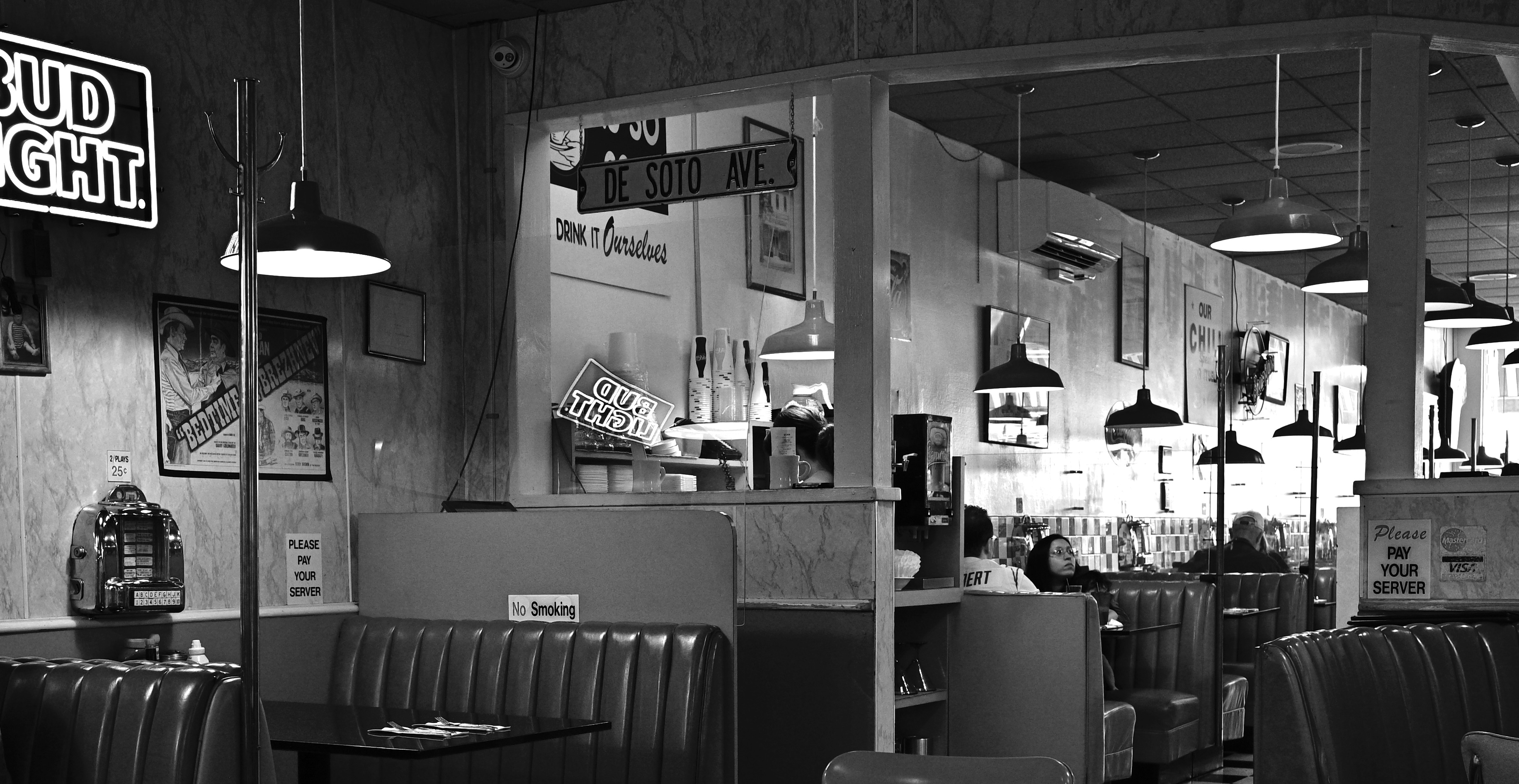
Public places like the diner shown here are like wipeboards of experience. Assemble a given set of things on that board, and the message is merriment, the enjoyment of a gathering. Then wipe down the board and arrange a few shadowy shapes. In an instant, the same board is a portal to introspection, isolation, sadness. This creative “optioning” goes across artistic lines. For example, songs mirror the plasticity of photography when it comes to interpreting spaces. One composer looks at a neighborhood joint and writes Roll Out The Barrel, We’ll Have A Barrel Of Fun, while another views that same hangout and pens It’s A Lonesome Old Town When You’re Not Around. Like the photographer, the songwriter sees what is and asks whether it would be better off being something else.
The burger palace seen here, built to recall the simpler times of the Happy Days era, is, in its natural state, fairly exploding with color, most of it Coca-Cola Red. It’s impossible to make the place look moody or poignant with the distraction of all that splendor, and so I did the master shot in mono, since converting a color shot didn’t render the same contrasts. In reality, the place bears the jolly name of the Busy Bee Diner, but, in my view, it works better as the Last Chance Cafe, and so there you are. Shakespeare, had he been born after about 1800, might have delighted in the camera’s ability to shape perception, much as Lord Hamlet loved to cast his Danish gloom over everything in his path. Of such things are plays and pictures made.
TURNING THE PAGE
By MICHAEL PERKINS
DURING AN INTERVIEW EARLY ON IN HIS DIRECTORIAL CAREER, Martin Scorcese once confessed to (gasp) a crime.
Relating stories of his poor childhood to a reporter, he rhapsodized about how essential his local library was in his younger years, especially the very few volumes dedicated to cinema history in the Queens of the early 1950’s. He had his favorites, and borrowed them as frequently as he could, but the images within one special work, Deems Taylor’s A Pictorial History of the Movies, burned their way into his mind in a such a singular way that he simply could not bear to part with them, and he succumbed to his passion by ripping out selected pages and spiriting them home. Hardly the stuff of Goodfellas, but, as a fellow book nerd, I can relate.
And, as a photographer, I am still falling madly, deeply, weirdly in love with books, and in many cases, I find it torture to prevent myself from “pulling a Scorcese” and carting the odd volume away. The elegance, the design, the permanence of books penetrates to my soul, and so it’s fortunate that I have had a camera on hand when eyeing other people’s libraries over the years; it’s kept me out of the pokey.
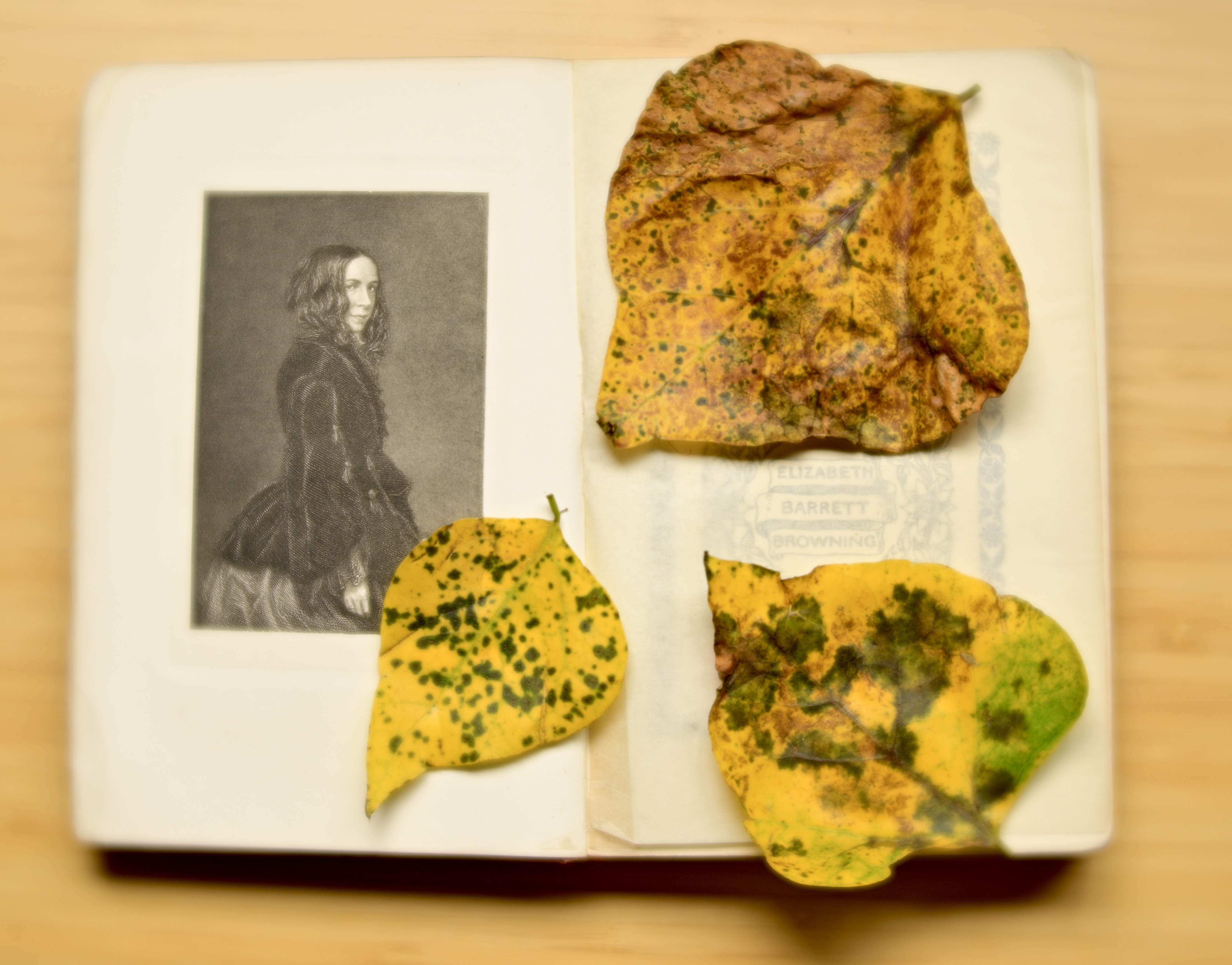
In the case of the collection of Elizabeth Barrett Browning poems seen here, “our” meeting was most random. Marian and I rented an AirB&B for a recent vacation stay, a lovely little casita outfitted with wonderful taste by its owner, who truly went the extra mile on decor, making the space resemble a cozy, settled household rather than a rental unit. One of the nicer touches was her use of variously sized books, the kinds sold in lots as visual props, and available from many design houses. Most were recent novels of no distinction, added merely for color and texture, and so the Browning volume was striking in that it looked not only a great deal older, but was also more intricately detailed and designed.
It was a triumph of little touches. Its title page illustration of Ms. B. was protected by a delicate tissue (still intact). Its binding was gnarled and pebbled. Its pages were slightly browned at the corners. Its typefaces were elegant and intricate. I seriously teetered for a moment on the brink of “should I snag this?” but defaulted to a tabletop homage instead, making the old poetic word for pages, or “leaves”, into literal bookmarks, and using a Lensbaby Velvet 56 for a soft, ethereal glow. And so, without resorting to thievery, I now owned something of the original book, and yet something uniquely mine as well. That’s what a photograph can do; it uses reality as a mere point of departure, with the ultimate destination anyone’s guess.
ONCE MORE, WITH FEELING
By MICHAEL PERKINS
THE ESSENCE OF LIVING IN A CONSUMER SOCIETY is being regularly encouraged to discard the past, to believe, as did Henry Ford, that “history is bunk”, that, in the interest of selling more and more goods, any and every thing we might hold dear must, instead, be held in contempt, as tossable, replaceable, impermanent. We have now spent nearly two solid centuries living under that instinct, and, as they say, look where that got us. We are urged to discard the things we once loved so we can love their newer, sexier replacements.
This puts photographers on perpetual alert, since part of our function is to mark transitions, those quick flips between the established and the endangered. Grand, sprawling coverage of the vanishings in our cities, for example, have been created by the likes of Eugene Atget, who documented the decline of old neighborhoods in 19th-century Paris, and his pupil Berenice Abbott, whose Changing New York project recorded the same shift in that city’s five boroughs in the early 20th. Photography is the only visual art that is responsive enough to try to keep pace with the accelerating rapidity of change, and even it falls short, in that things are going away faster than we can memorialize more than a small percentage of them.
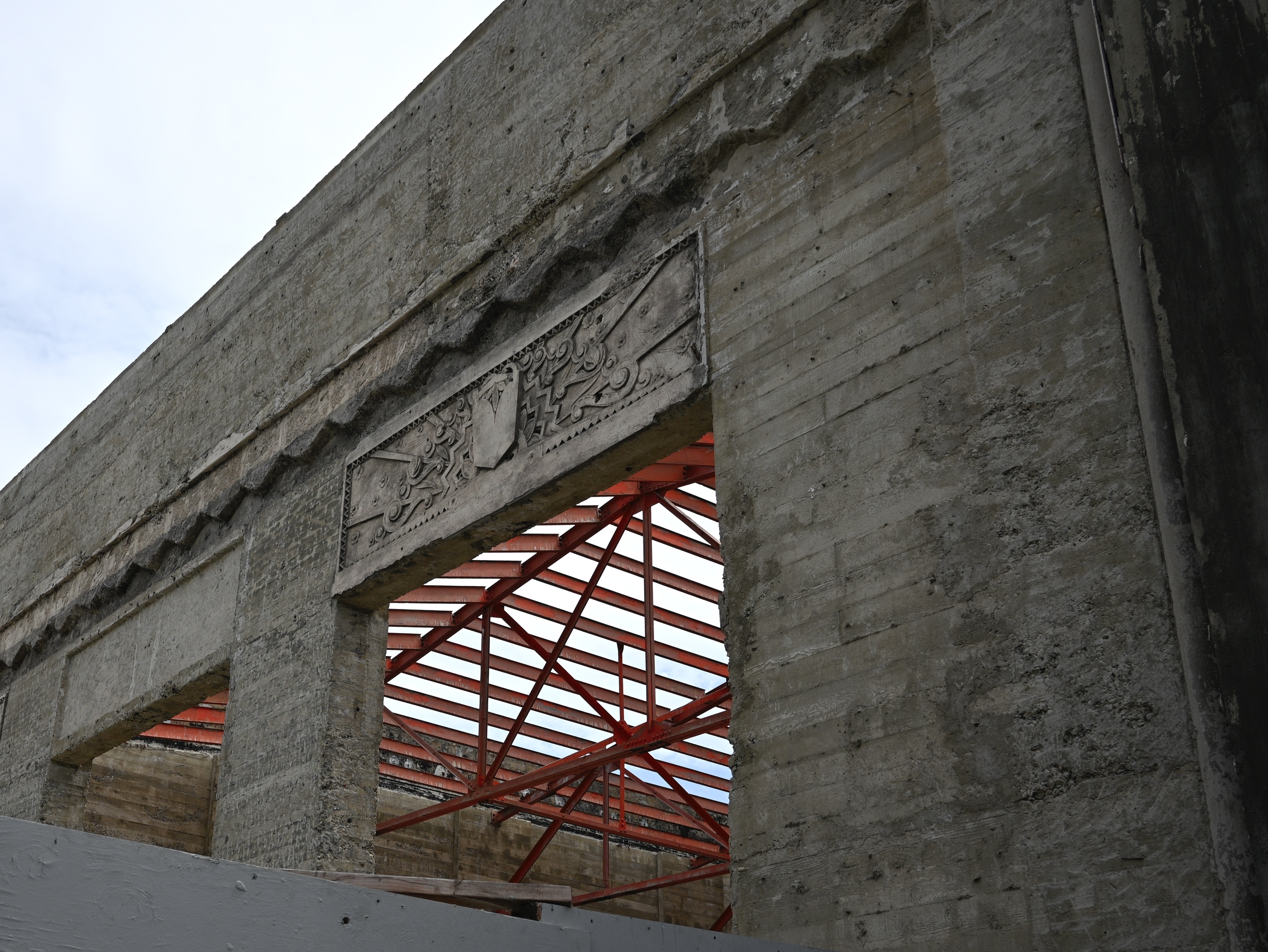
It falls to the individual photog to select which transition stories to tell, where to spot both vital and trivial shifts in our love of things, as well as our crazed craving for the ever-new. Epic or incidental, all change is a commentary on our priorities. In the case of the above image, it signaled to me that someone in the ever-shifting mix of retail in Santa Monica’s Third Street Promenade thought that the shell of an old Art Deco building deserved to stand just a while longer, albeit gutted and repurposed throughout. The same building in a different area in a different time might have met a very different fate, but this one will fend off the executioner for a while longer. Consumer societies are hard-wired to chuck out the old in favor of the new, simply because it is new, or at least that’s been the pattern for a long, long time. The recent emphasis on “once more, with feeling”, stressing the repurposing of our material goods, deserves a chance as well, though; and that presents a universe of fresh opportunities for the making of pictures.
POWERING THROUGH
By MICHAEL PERKINS
IT’S A FACE THAT’S BALANCED ON A KNIFE’S EDGE, teetering between courage and despair, desperation and aspiration. And it’s a face that we, as photographers have not only seen before, but have, in a very real way, inhabited before.
The face of someone struggling to power through.
It was that utter familiarity, that universality that, for me, visually distinguished the face you see here to me, amidst a crowd of dozens of young taekwando students, all gathered for various exercises that would determine their individual readiness to advance in rank. I was actually there to photograph my wife’s grandson, but this young woman drew my attention again and again throughout the evening. At first, her face seemed merely stoic, noncommittal, maybe even blasé or bored. In fact, as I was to learn, it was a disguise of sorts, a brave mask concealing an increasingly keen state of anguish.
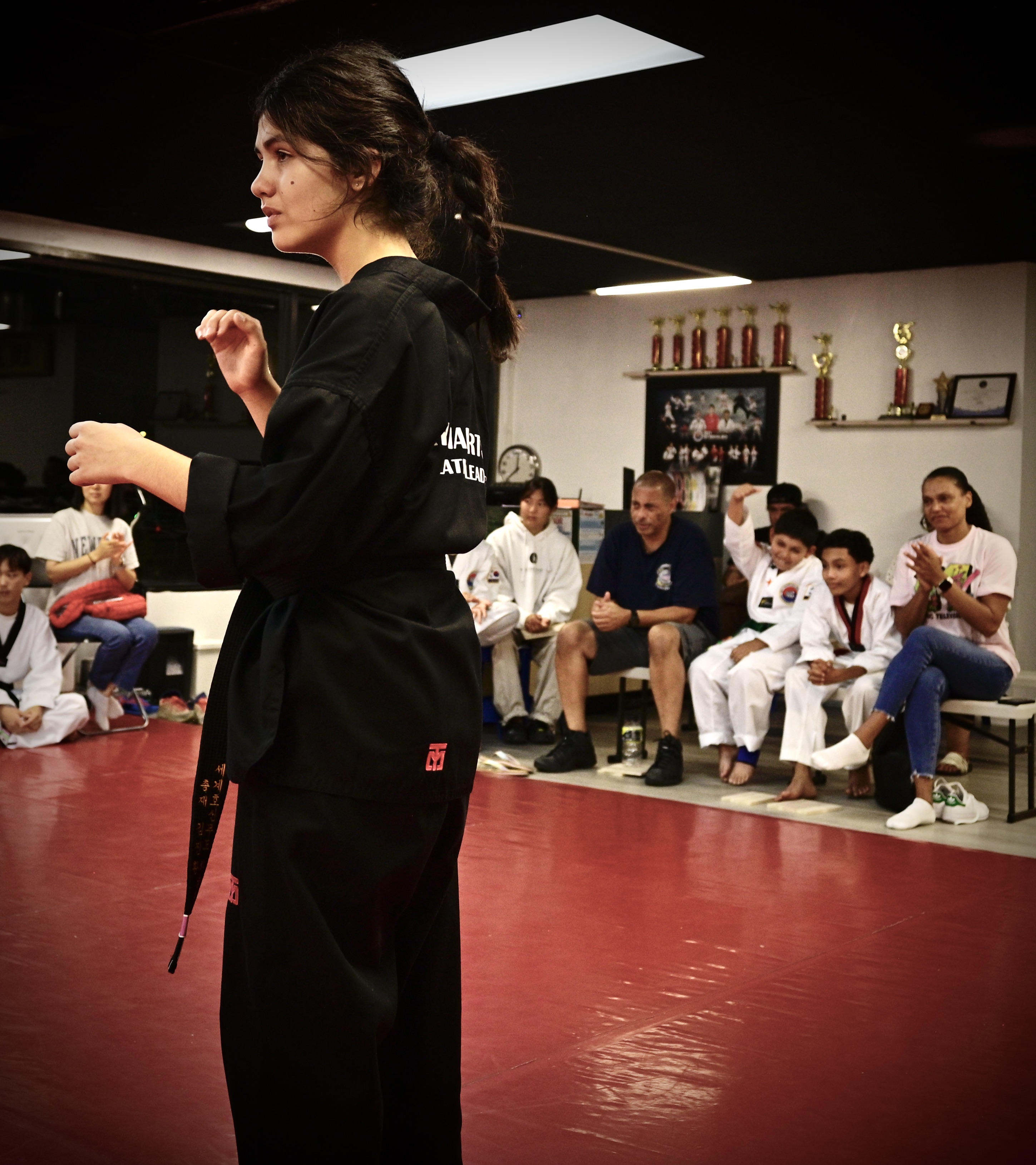
Thwarted not once but nearly eight times in trying to shatter a board, her movements had become slower and more unsure, as the physical toll of each attempt visibly compounded itself. I had taken random shots of almost every crack she took at the board, and she had maintained most of her protective mask for nearly all of them, but, In the frame you see here, she was clearly in a horrible space between embarrassment, agony and anger. This particular shot does not show the small glistening of tears visible in the images that follow it in sequence, and yet, in a very real way, her every feature is crying. Crying because she is uncertain if she will be able to please her instructor, her family, herself. Crying because, for this instant, she is trapped, truly trapped inside an uncertain moment that must seem to last an eternity. It is the face of all of us, at one time or another. There’s fear in it, but also resolve.
Minutes after this was taken, she did finally succeed, then slinked off into the outside hall to spend the rest of the class recovering near her family. It wasn’t a triumph; it wasn’t a failure. It was something else entirely, this powering through. I stopped as Marian and I and her grandsons prepared to leave and told her I thought she was very brave. She uttered her thanks, but her face had once again become a cipher. I hope she heard me. She had indeed managed to avoid shattering her foot, but she could not know that she had, incidentally, broken my heart.
WHATEVS AND INEVITABS
By MICHAEL PERKINS
JUST LIKE PARENTS IN SOME FAMILIES, PHOTOGRAPHERS HAVE THEIR FAVORITE CHILDREN, those images that require no effort whatever to love. You have some of them yourself, I’m sure; the shots where everything in the concept came home perfectly, where idea and opportunity and execution locked into place like the final triumphant click of a Rubik’s Cube. And then there are, within your selfsame life portfolio, photography’s problem children , the kids not living up to their potential, “troubled” in some way. Their exposure or composition’s off. They’re rambunctious. Technically or conceptually, they won’t sit up straight and eat their vegetables.
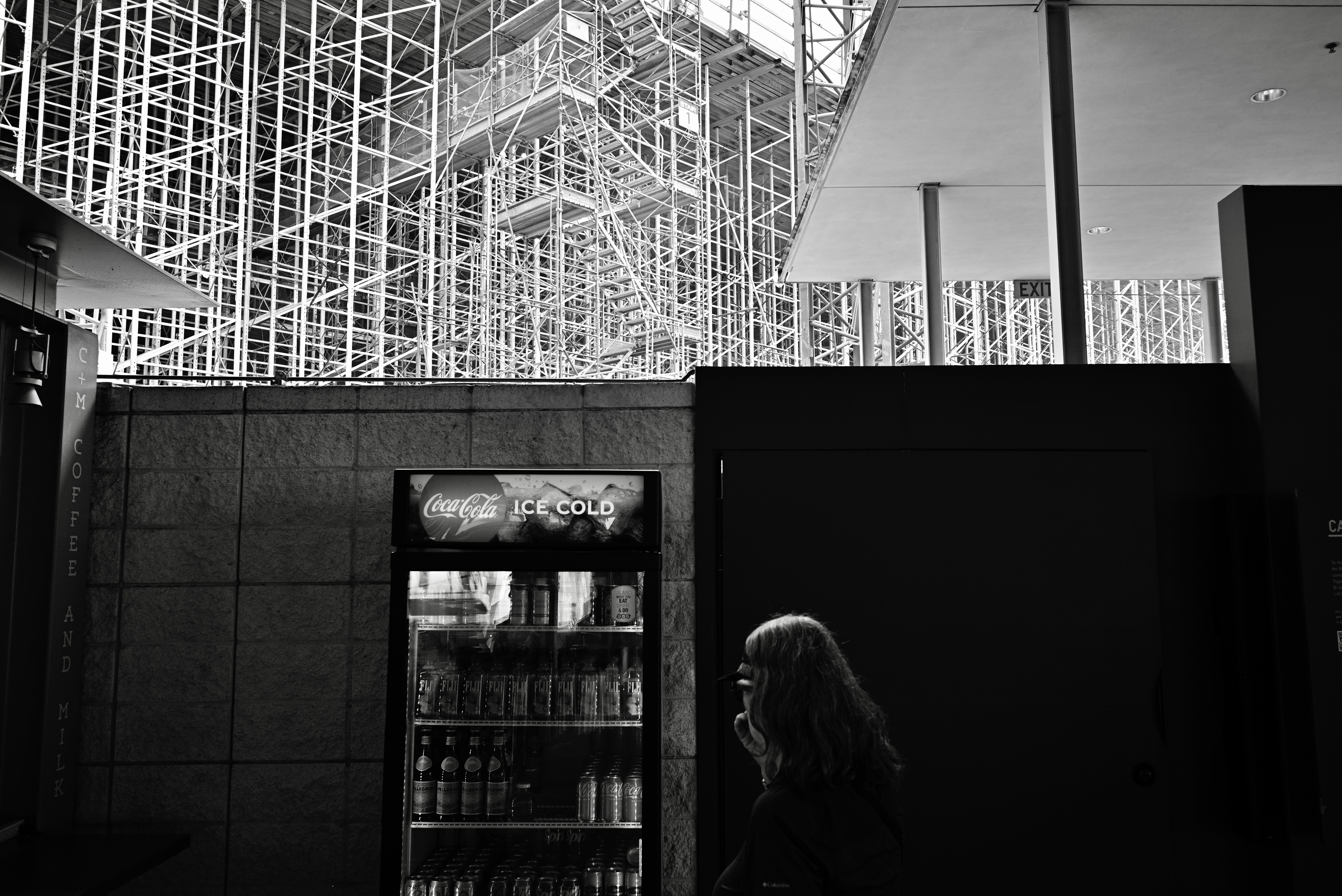
Poor Orphaned Thingy #463, 2023. I don’t know what this is. Why ask?
As with a parent, the expected reaction of a photographer is to praise the kids/photos that got all “A’s” and lament the wayward kids/photos that underachieved. But many photogs I know actually take the opposite approach, embracing the strange, oddball images that make no sense to love, while taking the A-list stuff for granted, maybe even stifling a yawn at the sight of them. As I have stated here several times over the years, my “orphan” shots are infinitely more fascinating, and certainly more instructive to me, than my sure-bet pictures. It’s not that I don’t cheer when I get things right; it’s more like I recognize a truer, if more raw energy at work, one I realize from my first days with a camera, in the shots that I can’t explain. With some of my “whatev” images, I can’t even convey to someone else either what I was going for or why I like the result. The picture just had to be done, and just is. In that way, it’s not only a “whatev”, it’s an “inevitab”.
I fervently believe that influential photographers, even as they assemble monographs of their best work, should also anthologize their weirdest. Stuff with no commercial potential or market. Shots that cannot even be captioned, since their origin exists only within some dark little basement of the shooter’s mind. It’s important that we celebrate the raw ideas that come into our head, since they have the same basic DNA as our keepers, and will no doubt someday be components in pictures that we may eventually count among our favorite children.
 thenormaleye