RISE OF THE UPSTARTS
By MICHAEL PERKINS
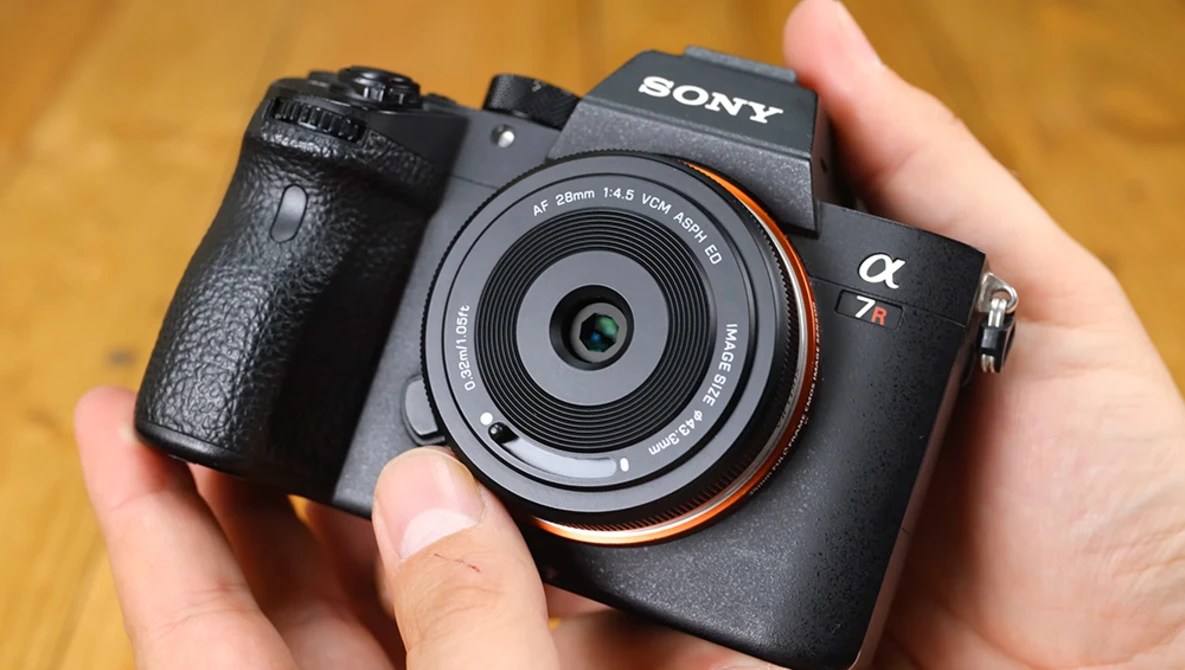
Pancake with a punch: newcomer Viltrox’. body-cap-sized 28mm f/4.5 for full-frame cameras (various mounts) with AF.
THE MARKET FOR CAMERA LENSES HAS ALWAYS EXPANDED in all directions at once, affording photographers an embarrassment of riches when it comes to selecting their best optical options.
There is always the most traditional route, in which various makes of cameras promote their own proprietary lines of brand-new products from macro to telephoto and everything in between…what one might call the “brand-loyal” route, a path which can lead to a substantial investment in cutting-edge tech. Then there is the “lest we forget” wing, in which new cameras are paired with older model optics long vanished from their parent company’s active product line, often adapted from one format to another, such as the refit from DSLR-era glass to new uses on full-frame cameras. Lately, there has also been a kind of retro retrenchment, as lo-fi (but not always lo-cost, lol) lenses are marketed to “serious shooters” for a rebirth of randomness, error or “authenticity”, as unpredictability is re-introduced to a process that’s grown, for some, a bit sterile.
And now, as we near the one-third mark on the 21st century, a tremendous wave of fresh product is coming from a new crop of third-party optics houses entering the market at the low end of the investment scale, providing amazing features that traditionally were found only in costlier major-brand lenses. Established third-party players like Tamron and Sigma have been joined by new players that include Laowa, Rokinon, TTArtisan, 7Artisan, and Viltrox, with more players entering the game each year. And while the new kids had mostly been sporting models with manual focus only, that barrier is falling as well. The small-as-a-body-cap Viltrox 28mm f/4.5 pancake lens shown here delivers quick, responsive auto-focus for just $99, with other brands rushing their own wafer-thin, fixed-focal-length versions to market as we speak. Reviewers whose critical default is a down-the-nose dismissiveness toward upstarts have had to rethink their biases, and the “rules” of who can be competitive in the optical field are likewise being radically rethunk. Long gone are the days when one country, tradition or brand had a lock on what constituted a “good” lens, a leveling of the playing field which can only benefit the consumer.
WHO’S ZOOMIN’ WHO
By MICHAEL PERKINS
THE LONGER YOU’RE INVOLVED IN PHOTOGRAPHY, the greater chance there is that, at some point, you’ll at least wonder if a telephoto lens should be in your arsenal of gear. As with any other lens, I believe that, over time, the need for a zoom will become fairly obvious….either obviously needed or obviously superfluous. That is, your shooting will drive your technical needs and dictate what you deem as essential equipment.
That means not buying any lens, especially a zoom, before you find yourself in repeated situations where it might have made the difference in your work. The reason I deliberately state what should be a “duh”-type truth is that there are still some photographers who gear up with everything under the sun before they demonstrate their strengths or desires by the kind of images they pursue. This means that you don’t buy lenses and then try to find a use for them. Working that way all but guarantees that the things you never evolved a genuine need for wind up consigned to the top of the hall closet or on a yard sale table.
So let’s go back to the example of telephotos. It’s completely possible that your particular work will never indicate that you need one. I can cite many amazing photographers that seldom, if ever, use them. I myself have only one modest 55-300mm zoom, which I can safely is in use once, maybe twice a year. And that’s a net increase in its use, due to the fact that I now spend increasingly more time accompanying my wife on her birdwatching expeditions. Even at that, I seldom use the things for actually photographing birds. My eye is far too untrained to locate them in most cases, and I am just as content to use the 300mm for landscapes, macros and other wildlife. Were I bitten as hard by birding bug (bug?) as Marian, I may already have ponied up the dough for a more powerful version of what I use. But bitten I am not, and so I am stuck with my original biases against zooms…..that is, that they are generally too slow, too dark, too poor at color rendition, and supremely aggravating to focus on the fly. Am I grossly over-generalizing? Of course. But you judge these things on your own results (indifferent) and your own limits (considerable).
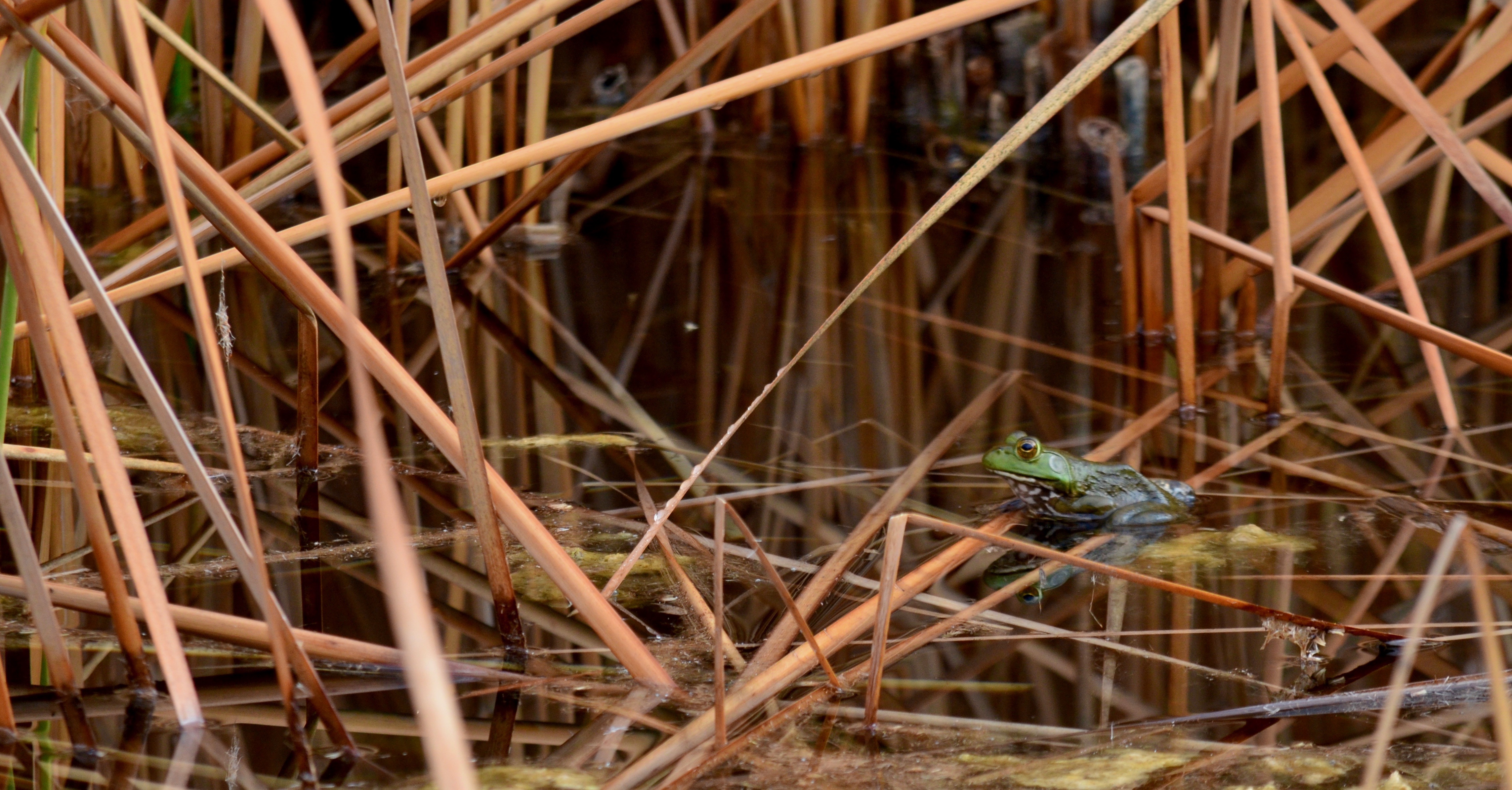
The Lord Of Little Things, 2019. 1/250 sec., f/10, ISO 500, 300mm.
In the view you see here, I am almost at the extreme limit of my 300’s usefulness, with my bullfrog quarry about thirty yards away, making him a medium-large speck in the viewfinder even when I’m fully zoomed out. This means that locking auto-focus on him will be strictly hit-or-miss, necessitating a shoot-check-shoot-check cycle in an effort to catch the toad before he can get bored and blow the scene. And that’s assuming that I can get auto-focus to lock at all. In many cases, going manual will keep me from issuing a verbal blast of mostly blasphemous bile in getting the shot, but even that is no guarantee when working hand-held. Are we having fun yet? My point is that, at least for me (notice the italics), zooms trade access for precision and speed. Sometimes, as in the marginally lucky result you see here, the trade-off is worthwhile. Other times….
So, to my earlier point. I could trade up to a more powerful zoom, if I were to demonstrate a need for one by the typical work I produce….. and if I decide to give up food and shelter to finance the thing. Again, the idea is….let what and how you shoot dictate what you’ll buy to shoot with. From where I stand, one frog a year still doesn’t scream ‘buy more glass”. As always, what makes some of us grin makes others of us grimace. And vice versa.
 thenormaleye