Fotofatigue
BY MICHAEL PERKINS
IN ENGAGING REAMS OF PHOTOGRAPHIC IMAGES AT A SINGLE SITTING, the human eye can react like any other over-used muscle in the body. It grows weary, numbed by the sheer volume of information that is often viewed like a shuffling deck of cards rather than absorbed at a leisurely pace. It’s almost as if, having taken these trillions of pictures, we have to pay visual lip service to them by at least trying to view them all. But that method merely wears the mind down, resulting in what I call fotofatigue. We all know, logically, that less actually can be more, but when it comes to looking at images, we act counterintuitively, flooding and dulling our ability to perceive anything deeply.
One thing that can worsen this problem is for us to, like the guitarist in This Is Spinal Tap, crank everything….every effect, every technique, every everything, up to 11. I’m all for taking one’s vision or gear to the limit, just not all the bloody time. Take a specialized lens like a fisheye, which is so ultra-wide that it can render everything it sees in a rigidly circumscribed bubble of deliberate distortion. It is designed for a specific effect, but, like any other specialized look it should not be used in every shooting situation. What starts out as a novelty becomes, in repetition, a “signature” look, and then a crutch.
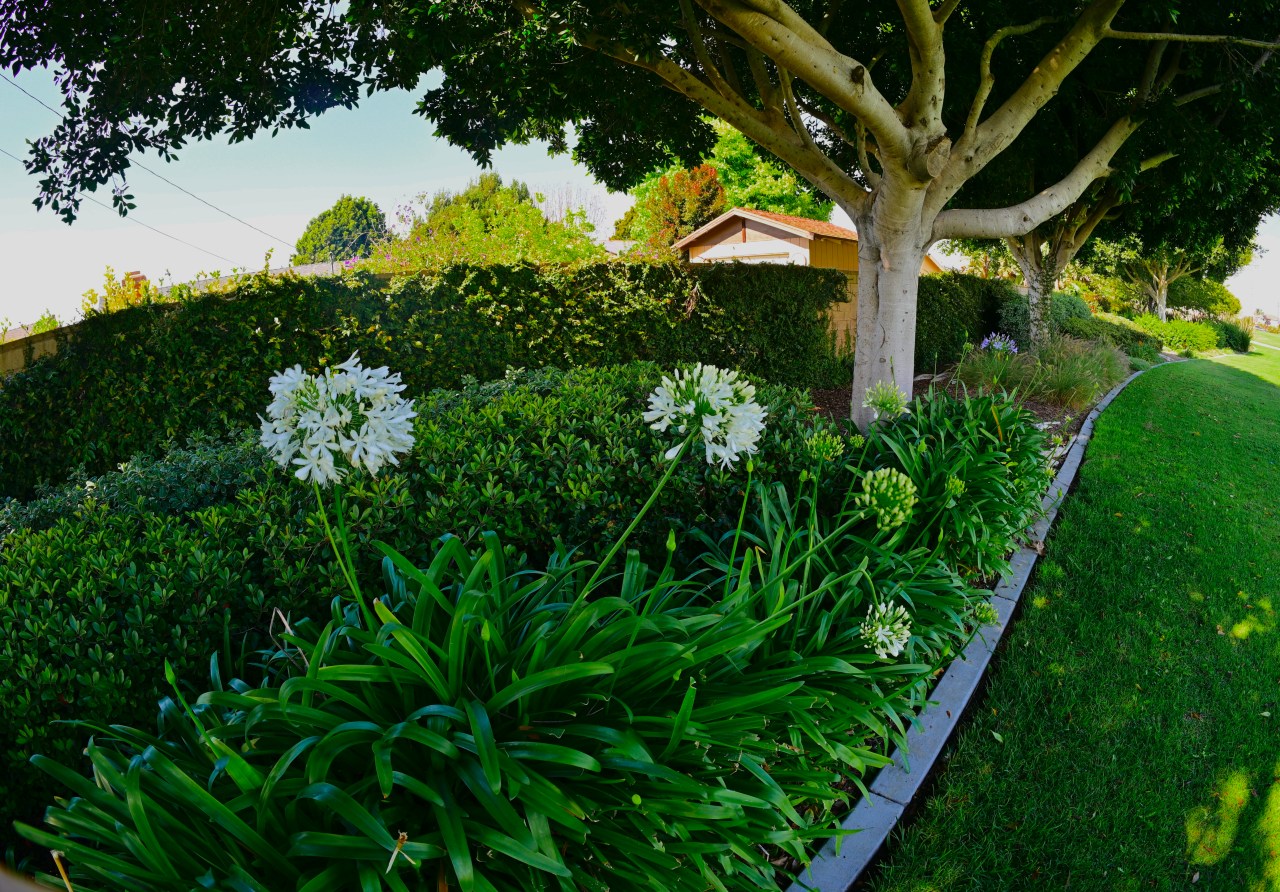
The shot shown here, shot with an 11mm fisheye renders plenty of realistic detail and depth of field but does not careen fully into circular-for-circular’s sake. It uses some of the flexibility inherent in the lens, but stops well short of turning the garden into the cover art for a psychedelic rock band from 1967. Shredding away on our artistic guitars at 11 is exhilarating, but I believe that the best photographs benefit from at least some degree of restraint, choosing to engage the eye for a more contemplative view rather than merely stab it with the sharp stick of shock. Photographs that merely hit at the speed of ZAP! POW! eventually wear out the viewer, and are easily dismissed and forgotten. Mona Lisa’s smile, small and slight, need not be stretched to engulf the entire lower half of her face just to grab our attention. Her mystery comes as much from what is concealed as what is revealed. Good images should always strive for that.
A.L.s and E.L.s
By MICHAEL PERKINS
THE FIRST TIME I HEARD ANOTHER PHOTOGRAPHER REFER TO “art glass” I thought he was referring to a Hollywood talent agent. I guess I thought that using the modifier “art” to any reference to a lens was, at the very least, kind of a “duh” redundancy, since lenses serve no other purpose but to abet art. From wide-angles to superzooms, we program the way we choose to record the world based on the particular optic we choose. And within those choices are two very different additional paths to the pictures we are trying to create.
These paths begin with the selection of either an affect lens or an effect lens. If an optic helps shape an idea by enhancing its successful execution, it affects the outcome, but may not completely shape it. For example, faster lenses, or ones with a very deep focal length, help determine how a shot will come out, but the shot is not about that look per se. The opposite is true with an effect lens, where the special properties of enhancement or distortion inherent in the optic (fisheyes, macros, selective focus) can have a truly active role in shaping the final product, even going so far as to having that product be about the unique look created by the lens. Affect lenses are aides: effect lenses can do that, too, but also be the leading voice in an image, becoming, in fact, its content.
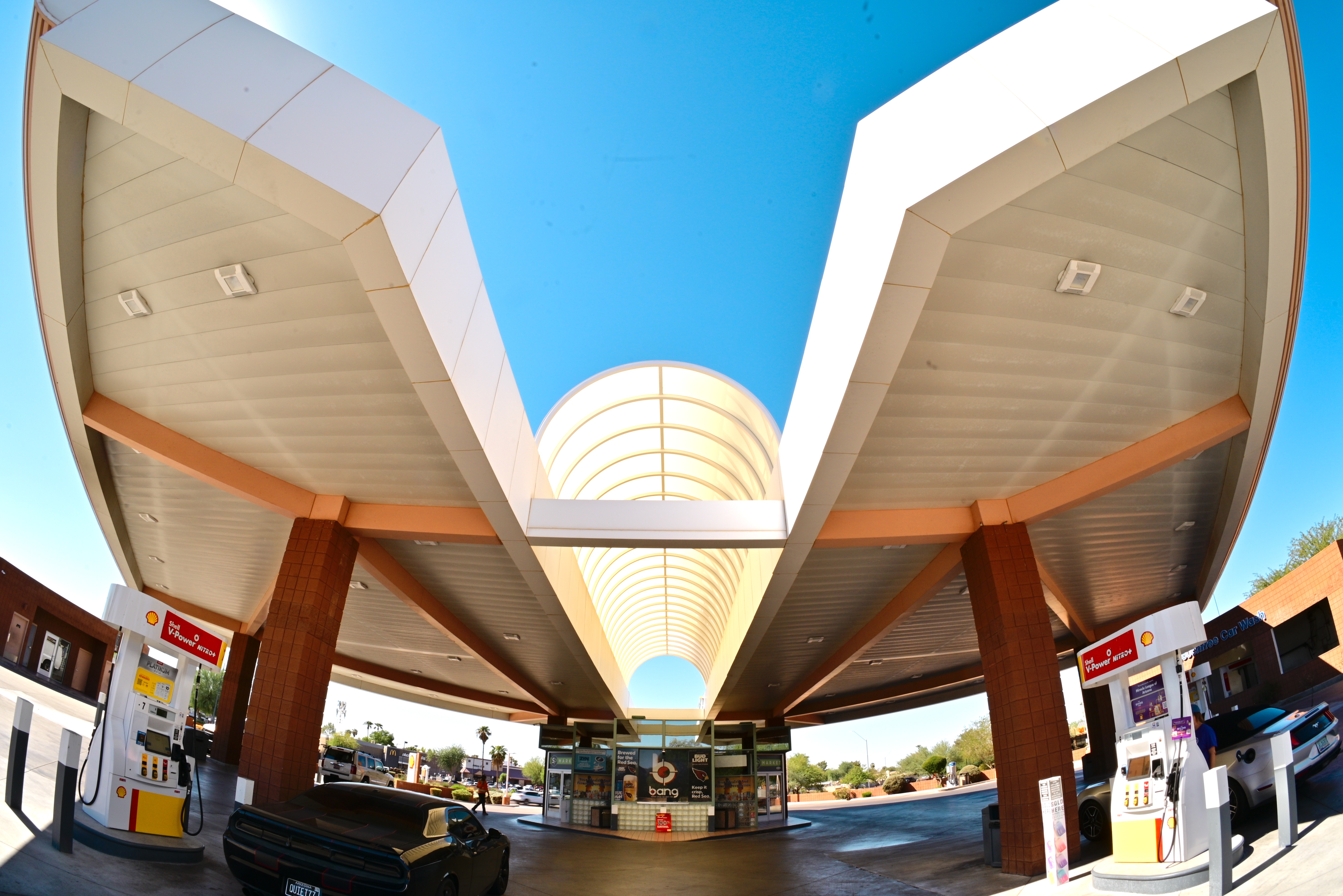
The image seen here was taken with an extreme wide-angle, a f/2.8 TTArtisan 10mm fisheye, and the hardest part of working with such a lens is not letting it run away with you, and having the picture be all about, “wow, that really looks weird, man”, which is the rabbit hole that you can easily go down with an “effect” lens. For the record, there was an actual objective in shooting a gas station with this lens, which was to emphasize the wing-like contours of its architecture, something that is lost in a conventional street view of the structure, but which can be brought out through dramatic distortion at a particular vantage point. Of course, whether the fisheye helps me show what I’m seeking to show, or eclipses it with its extreme strangeness, is for others to judge. Part of me, for example, says that if I have to write a paragraph explaining what I was going for, I’ve already lost the argument. Up to you.
We often use glass as both “AFs” and “EFs” at the same time, and it can be frustrating when we are intending one thing and winding up with something completely different. But that’s merely another part of the journey we’re on in these pages: teaching the eye to not only see, but to choose the visual language essential to sharing out that vision.
OH, BABY, BABY, IT’S A WIDE WORLD
By MICHAEL PERKINS
WHEN USING WIDE-ANGLE LENSES, we believe that we are revealing more “reality”. That is, we began to think that a narrower aspect ratio is somehow “hiding” or clipping off visual information, whereas a wide allows us to “see everything”. But once you’ve shot with a wide-angle for a while, you realize that it’s, at best, a trade-off. The lens giveth and the lens taketh away.
Wide-angles do, certainly, increase the view from left to right, but, in so doing, they add their own little quirks, such as softer resolution along the edges, chromatic aberration, barrel distortion (that feeling that straight lines are bending outward at the sides of the frame), and an exaggeration of the distance between the front and back of the shot.
Bearing all this in mind, I feel that, since a pretty wide lens, the 18-55mm, is now included with nearly every DSLR camera kit, it’s important to see wides as both an aid to showing reality and an effective tool for interpreting or altering it. Think of your wides as art glass, as effects lenses, and you open up your mind to how it can not only record, but comment on your subject matter.
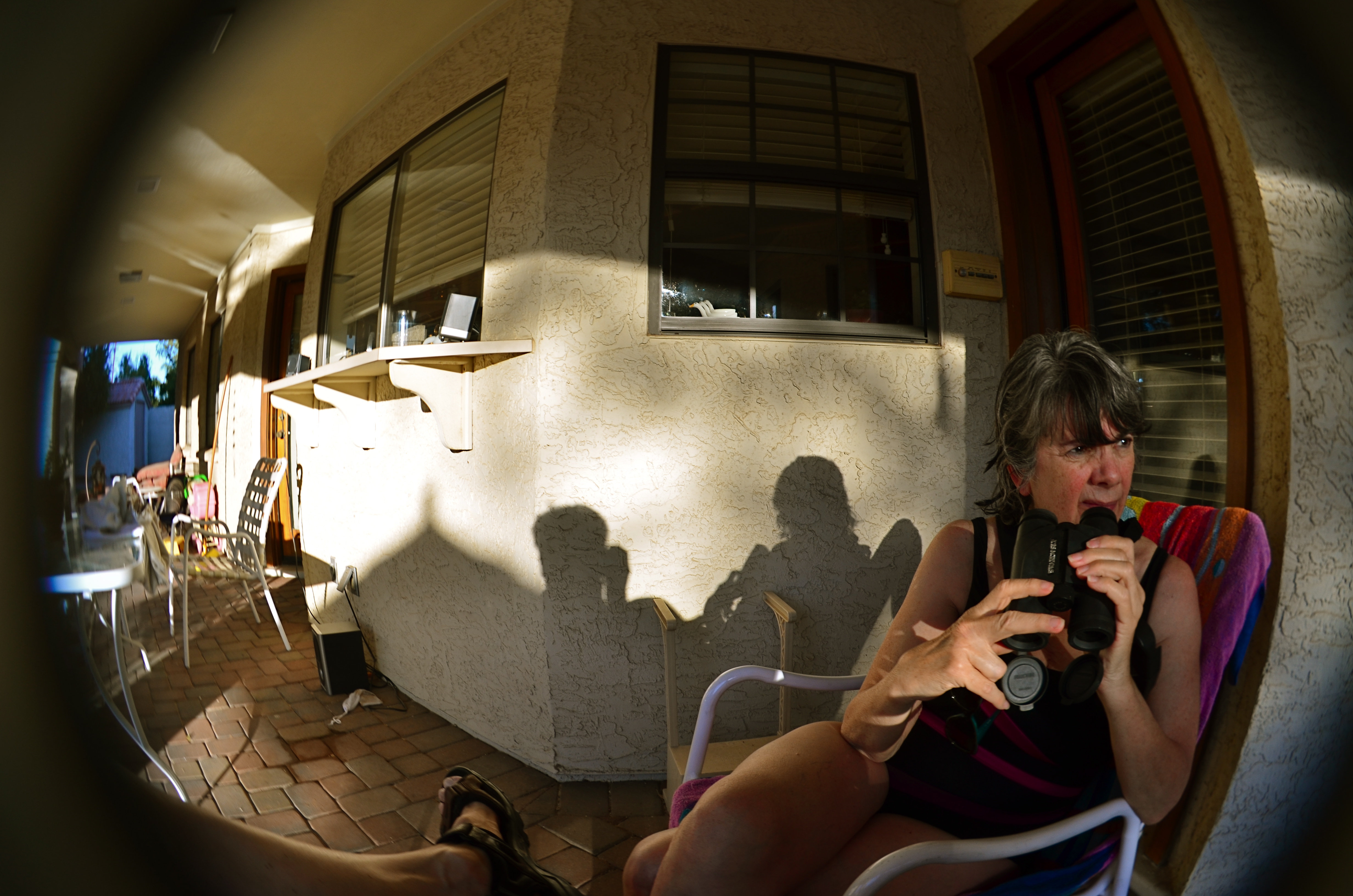
Fisheye lenses demonstrate what all wide-angles do: create an unreal look that can be managed and massaged to fit your ends.
And, let’s take it a step further, as in when wides become ultra-wides, as in the 8 to 12mm range, where the lens becomes a true fisheye. Now we’re consciously aware that we’re using an effects lens, something that is designed specifically for a freakish or distorted look. And now we have to challenge ourselves in a different way.
The standard fisheye shot is a self-contained orb, a separate universe, within which everything radiates distortion outward from the center concentrically, like a kaleidoscope or a paper snowflake. But a fisheye frame can also be composed to combine all the left-right, back-front information of a standard wide-angle (more narrative space) while also playing to the surreal look of something designed to challenge our visual biases of what’s “real”. The effect can also, as in the above image, forcefully direct the viewer’s eye to see along very precise channels. In this picture, the action of the shot begins at the right front, and tracks diagonally backwards to the left year, with the focus softening as you look from “important” to less “important”. The drama in the woman’s face is also abetted by the unnatural dimensions of the image, like one part of a nightmare serving to stage another part.
Wide-angle lenses can conceal and interpret, not just reveal. They allow us to see more from left to right, but there is a lot of wiggle room in how we show it. You have to accept the idea that all optics are distortions of reality to some degree, and make the bias of your particular glass serve your narrative goals.
 thenormaleye