THE FEEL OF REAL
By MICHAEL PERKINS
MUCH OF OUR INHERITED SENSE OF TEXTURE IN PHOTOGRAPHY was shaped early on by what the earliest camera images could practically deliver. We experience historic images of Lincoln, Twain, and the great generals of the Civil War through the very rough “tooth” of the processes that almost exclusively recorded them, chemical and technical methods that rendered features, clothing and skin in a certain limited fashion. And over time, those methods dictate our concept of how the skin and features of those people should look, forever, even as they define for us what words like tough, stern, brave, frightening or serious ought to mean in terms of how smooth or how coarse a mood we’d pursuing.
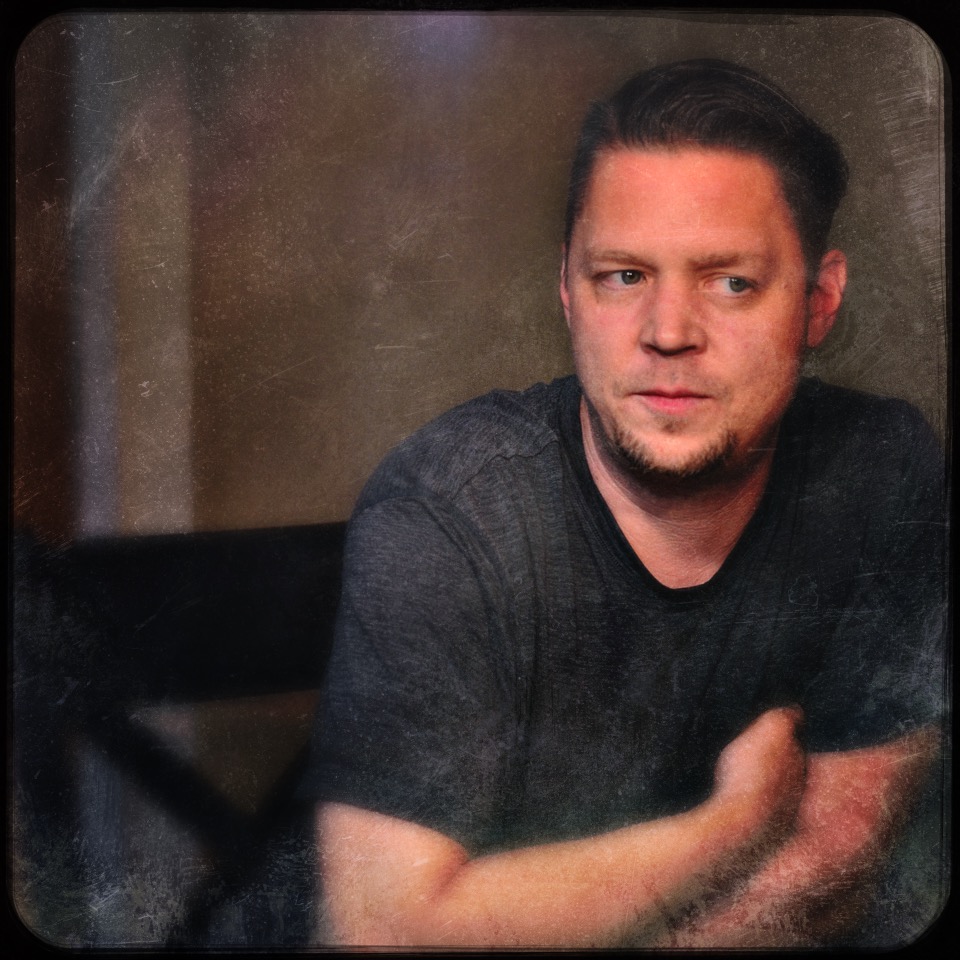
Ryan Michael Perkins, Columbus, Ohio, 2017
And it’s not merely historic; a big part of the recent retro movement toward analog imaging even a rec-creation of it on digital platforms, lies in in aping or recreating the textures we saw of people as they were depicted in previous eras. What we collectively call a “film look” is, in fact, many different looks, depending on whether you’re recalling an 1850 daguerreotype or a 1975 Kodachrome slide, with special emphasis on the degree of grit or silkiness appropriate for different time frames. In some circles, this emphasis on texture has risen to the same level of importance as such fundamental pillars as color and exposure.
I myself will often assign an older texture to selected portrait subjects, based on what elements of their personalities I wish to suggest, as in this image of my oldest son Ryan. It’s safe to say that, over his nearly fifty years of life, he has veered far closer to rough times than serene ones. A perfectly-lit or balanced image of him seems as ill-fitting as a pair of jeans that’s two sizes too small. He doesn’t do “easy”, and so my favorite pictures of him attempt to capture that fact, calling, in this case for example, a kind of sandy, friction-rubbed aging to the final frame. I don’t embrace all of the “just like film” movement, but there are moments when even the freshest faces should have a little acid-washed quality to them, as if to suggest all that time has etched into their features. “Real” and “feel” are subjective words, and they are likely, for photographers, to remain ever thus.
YES, CHEF!

By MICHAEL PERKINS
Photographers are often instinctual artists, like the cooks in your family who have never cracked a cookbook in their lives but who know, deep in their gut, that, in their hands, a pinch of this or a dash of that results in culinary perfection. They perform without a net with a mastery that seems magical. Other photographers are like chefs, building recipes through exacting amounts, precise steps, and critical timings. Both kinds of shooters “cook” their way to miracles with their own individual approach to the kitchen, and both create amazing delicacies.
When I am in my “chef” mode, I love to play with the many “recipes” touted online by various photographers, endless customized lists of pre-sets that can be dialed into your camera’s brain ahead of the shutter snap, many stored in modes that can be summoned with a click of the function wheel, allowing the shooter to change his/her mind in an instant, as well as giving him/her a whole series of comparative variants on a scene in a way which was, well, impossible in the pre-digital world.
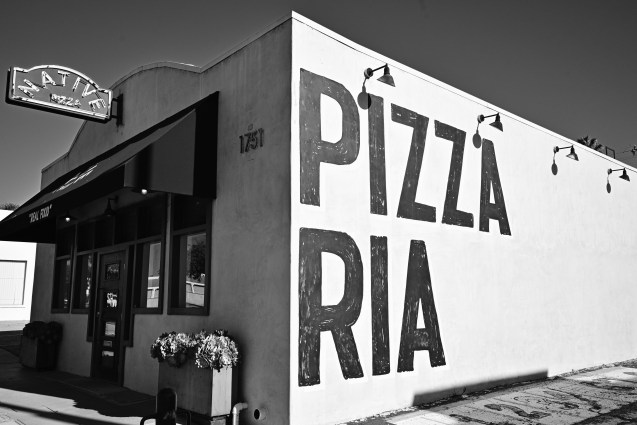
The ergonomics of my camera allow me to dial up as many as five different customized modes (beyond built-ins like, say, Aperture Priority) without taking my eye away from the EVF, guaranteeing me almost the same exact composition across multiple shots, each taken with their own exposure, metering and white balance ingredients. This gives me true choice in a real-time environment, which is perhaps the greatest luxury in shooting with today’s cameras.
The top image seen here of an architecturally stark pizza joint in Ventura, California is the product of a faux-Kodachrome recipe stored on my Nikon Z5’s “U2” mode, while the second shot is a decent re-creation of the old Kodak Tri-X monochrome film (tweaked to simulate the use of a red filter) and shot with a recipe I had stored on “U1”. Both shots have their points, and whether the image works better in color or mono is a battle for another day, but the point is that, with today’s gear, no one has to calculate these looks from scratch while they’re trying to shoot. Nor do they have to wonder whether a scene would look better with a certain look. They can just dial it up, do it, compare, judge, and shoot again, all while the light is right and the subject is still there in front of you. Somewhere my 12-year-old self, armed with a $5 plastic box camera equipped with one shutter speed and a single aperture, is popping champagne corks.
 thenormaleye