EDGE OF NIGHT/CUSP OF DAY
By MICHAEL PERKINS
OF THE VARIOUS DEFINITIONS OF THE WORD “TWILIGHT” found in most references, one is generally factual in a kind of scientific sense, i.e.,
the soft glowing light from the sky when the sun is below the horizon, caused by the refraction and scattering of the sun’s rays from the atmosphere.
….which is nice if you’re a meteorologist, I guess. But a second interpretation of the word is more poetic, and, for my money, a little more on the philosophic side, as in
a period or state of obscurity, ambiguity, or gradual decline.
…or, to break it down more personally, I am sad to behold the first kind of twilight because I tend to typify the second type.
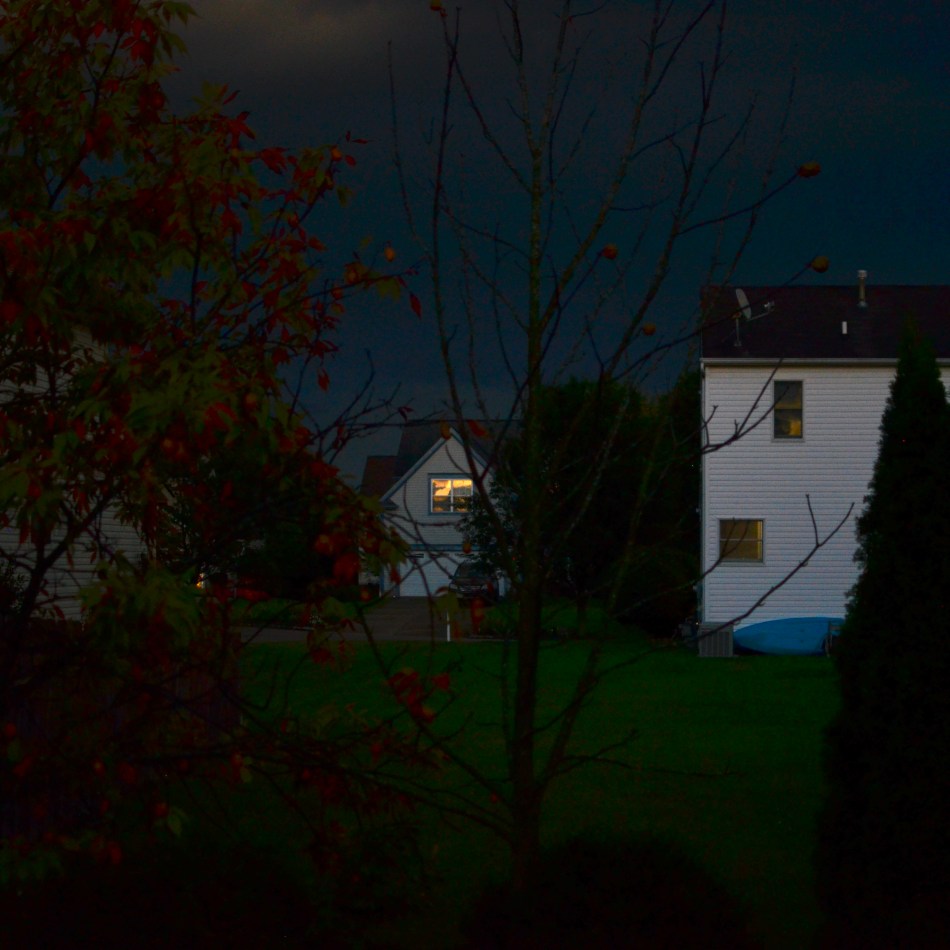
Photographically, I am always drawn to the strange inter-stages of life, in which things exist in more than one plane of existence at once.
For example, in the frame shown here, which I took just as a normal summer dusk was about to be swallowed up in a sudden surge of storm clouds, things are rather stuck in neutral. There is some bright light to be had, but it’s suggested more than stated. In like “midphase” fashion, the thunderheads that rolling in are not absolute black, just an overripe version of daylight colors. Everything is coming, and going, about to happen, and absolutely over with, all in the same moment. As this all came together, I wasn’t sure I could snag any usable image at all, but in instances like these, with everything mutating every second, you have to try, if for no other reason than to immortalize the weird convergence of forces.
Or, to use this collision of edge of night/cusp of day to refer back to the contrasting definitions of twilight we started with: I saw something ending in the day, and likewise felt something ebbing away in myself, and that’s why I took the picture.
THE RELUCTANT WITNESS
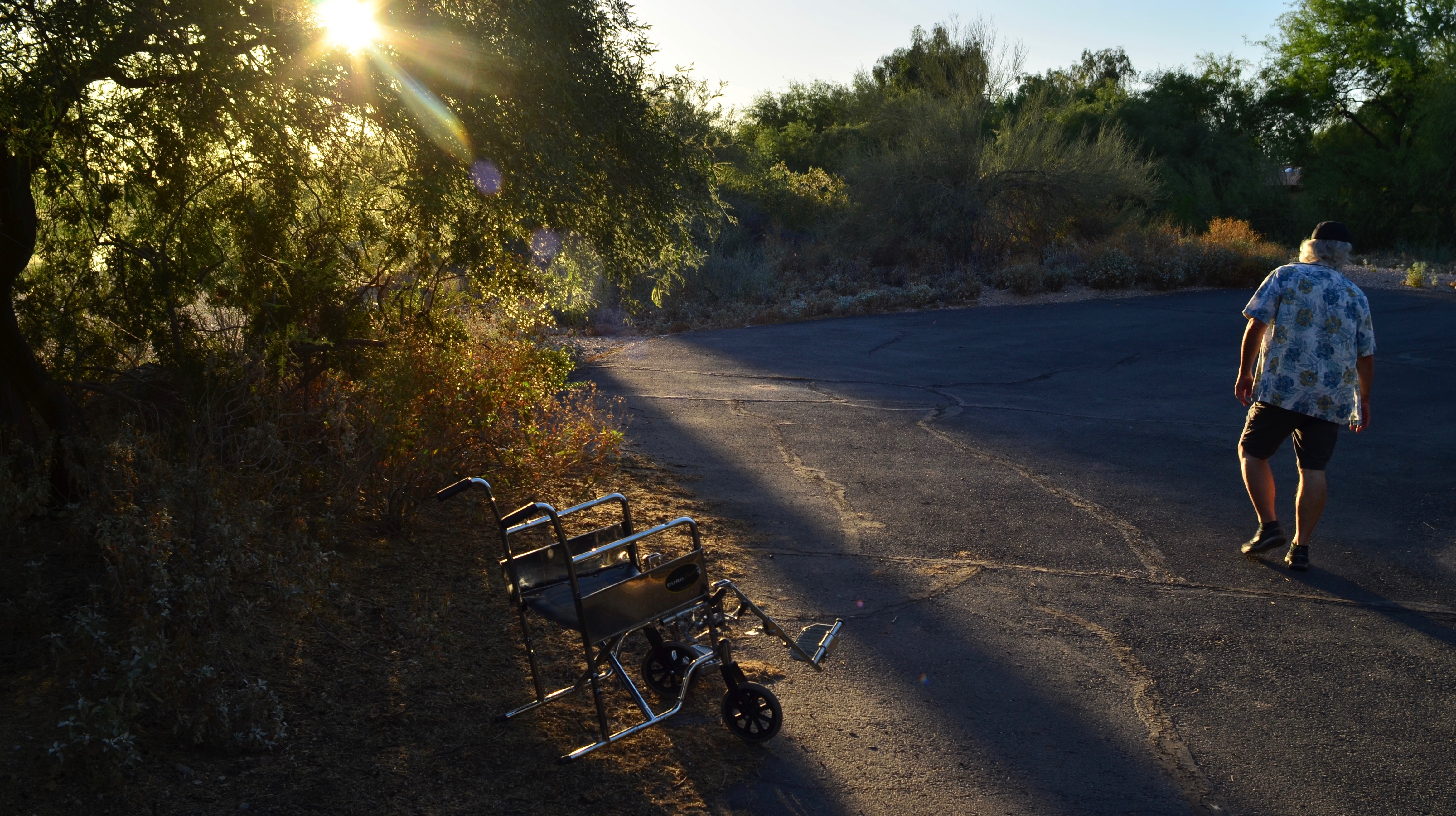
Two Strollers, 2019
By MICHAEL PERKINS
PHOTOGRAPHERS PASS A VERY IMPORTANT MILEPOST when they first learn that pictures can be both reliable and unreliable narrators. As neophytes, we assume that the camera doesn’t lie, that it is a trustworthy tool for capturing the truth, a kind of optically-based lie detector. Later, we learn that, in certain hands, the camera can also distort, mislead, and, certainly, lie. It’s a heartbreaking moment for some, while it’s almost freeing for others.
Bearing witness with a camera is a noble calling, but, even among the most ethical or clear-minded image-makers, there are visual stories that can’t be plainly told, tableaux in which the scene itself is a reluctant witness. Call them pictures without ample evidence.
Shooters can certainly use their interpretive skills to play connect-the-dots in many a photo, but what can be done when there aren’t enough dots to connect? In such cases, merely starting a conversation is the best one can hope for.
I simply had to record the scene you find here. I was walking with some friends toward an urban sewer tunnel from which thousands of bats were guaranteed to emerge at sundown, when, with one of our party nearing the rendezvous, I spotted the abandoned wheelchair you see at left. Clearly this was a case in which no photograph could be expected to “explain” anything, but which was visually irresistible nonetheless. The mixture of object and place equals…what? Why would someone bring a wheelchair to a semi-remote location, and then just leave it? Did someone experience a miracle cure that obviated any further use for the device? If so, why go to the trouble of dumping it out in the sticks? How does one dispose of an unwanted wheelchair? Had someone upgraded to a better model, and thus turned their previous unit into roadside litter? Was some semi-ambulatory adventurer off on a brief stroll in the area, eventually returning to the chair to rest in before heading home? Would someone seeing a picture of my friend walking away from the chair assume he had been its occupant? If so, what would they assume happened? And, of course, was I being dishonest for even including him and the chair in the same frame?
You can see where this is all going. The frame is hardly a “gag” or “gimmick” shot, and it’s not unique among photographs (mine or others) in posing more questions than it can possibly answer. Moreover, I certainly don’t have any explanation for the chair’s appearance that makes any sense, at least to me. And yet, I wouldn’t dream of not shooting the picture, as it’s too much of an “A” example of what happens when the photo itself is a reluctant, even hostile, witness.
Seeing may indeed be believing, even if you can’t actually decide what it is you’re being asked to believe.
 thenormaleye