BLANK CANVASES
By MICHAEL PERKINS
I GENERALLY STEER CLEAR OF THE WORD “ABSTRACT“, since, like many other terms of art, it has been bludgeoned, by misuse and repetition, into a blunt instrument, rather than the surgical tool it might have been. If the word means, as one dictionary has it, something “disassociated from any specific instance” or, in another, as “expressing a quality apart from an object“, then it actually becomes a fairly accurate way of defining what happens when one art beholds another. We take the object away from its original context, or redefine it in our own terms. We begin to personally possess it, using words or pictures to say, “I know what this was ‘supposed’ to be . This is what this is to me.”
In this way, a person with a camera can approach any subject, regardless of its “actual” history, as if it were a blank canvas.
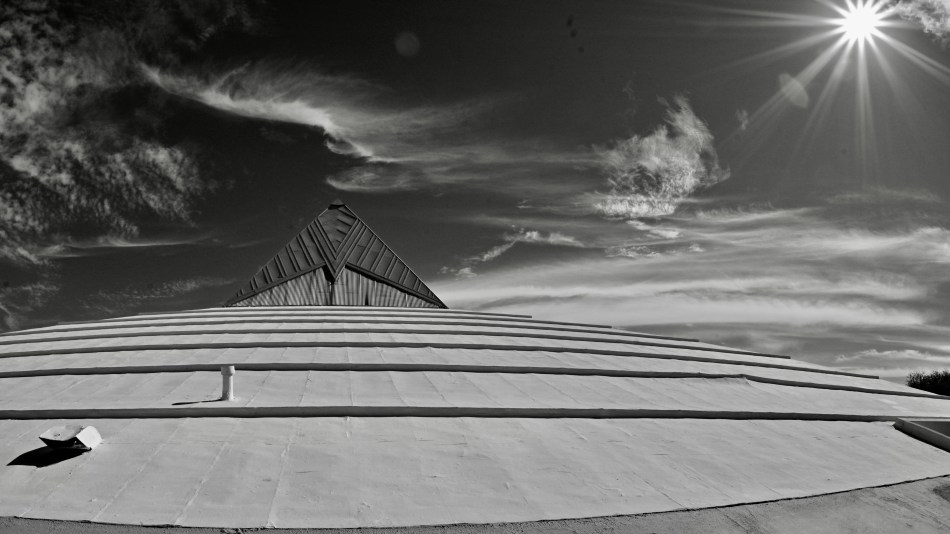
I approach the building seen here in exactly that way. Originally, it was a church of some kind, and by “some kind” I mean of the ooky-spooky, not-of-this-world variety. Hey, no judgement. The pyramid cap up top was deemed significant in some way in the overall design, but, as the place had long since been de-sanctified and put to other purposes by the time I first encountered it, the intent of the creator(s) has been lost to me….hence the “blank canvas”. The structure has no history at all, at least as far as my eye is concerned, freeing me to assign any meaning (or no meaning) to it pretty much at will.
Strategy-wise, part of the making of this image is an attempt to tie the building to something ethereal or mystical, leading me to shoot in monochrome for mood and using an f/16 aperture to convert the midday sun from a blinding glob to a multi-pointed starburst. I also decided to jack the contrast to extreme levels and darkened the insanely bright Arizona sky into something foreboding, imbuing the passing clouds with a bit of menace. The result? A temple? An alien mother ship? A gateway to another dimension? Your rules and your choice. The structure, as I came upon it, meant nothing to me, and so I got to determine its meaning. Or “a” meaning. And that, to me at least, is abstraction. Or maybe it was just a way to kill fifteen minutes while waiting on my wife. Or maybe I live in a world in which both things are true.
THE FAULT IN OUR DEFAULT

Potential nightmare: uneven light and wildly varied contrast. But I can save this shot because I can take direct control of camera settings.
By MICHAEL PERKINS
CHILDREN THINK THAT HAPPINESS RESIDES IN ALWAYS BEING TOLD “YES”. Of course anyone who has ever (a) been a child or (b) had to deal with one knows that this is actually the worst of strategies. Even without being Tiger Moms, we can all pretty much agree that there are many times when telling a kid “NO” will improve, perhaps even save, his life. Negative responses carry important information. They can be guidelines. Most importantly, they convey that there are limits, consequences.
“NO” also helps you be a better photographer.
In the ’60’s, one of the most basic cameras ever sold, the teen-marketed Polaroid Swinger, had a shutter that you pinched to check if you had enough light to make a picture. If the word “YES” appeared in the viewfinder, you were solid. “NO”, given the simplicity of the gadget, meant, sorry, point this thing somewhere toward, you know, actual light. Easy. Unmistakable. Take the picture with a “NO”, and it’s on you.

Similar light conditions to the scene shown above, but now the phone camera has decided for me, to jack up the ISO, degrading the image. And there wasn’t a thing I could do to prevent it.
DSLR’s still flash a similar warning. With Nikon it’s “subject is too dark”. But the camera isn’t a mean parent that won’t let you choose ice cream over asparagus. It’s being a good parent that’s trying to give you a happy outcome. By contrast, smartphone cameras are bad parents. They never tell you “no”. If anything, their attitude is, point anywhere you like, anytime you like, darling. Mommy will still make a picture for you. That’s because the emphasis of design and use for smartphones is: make it simple, give the customer some kind of result, no matter what. You push the button, sweetheart, and we’ll worry about all that icky science stuff and give you a picture (image at left).
The default function of smartphone cameras is wondrous. You get a picture, every damn time. Never a blank screen, never a “no”. But in low-light situations, to accomplish this, the camera has to jack up the ISO to such a ridiculous degree that noise goes nuclear and detail goes buh-bye. The device has been engineered to make you happy over everything else, and its marketers have determined that you’d rather have a technically flawed picture than no picture, so that’s the mission. And that guarantees that your photography will linger in Average-land pretty much forever.
With iPhones, you have no override. You have no thumbs-up-thumbs-down decision. You have, actually, no input at all except your choice of subject and composing style. Now, you may think that this “frees” you, with the camera “getting out of your way”, and all, but it really means that, even if you have a better idea for making an image than your camera does, you cannot act upon it. Cameras that say “NO” are also saying, “but if you try something else, you will get to “YES” (image at top). Cameras that only say “YES” are really saying, “I know best. Leave it to me.”
Which of course, is something you heard all the time, years ago.
When you were a child.
 thenormaleye