EYES WIDE OPEN
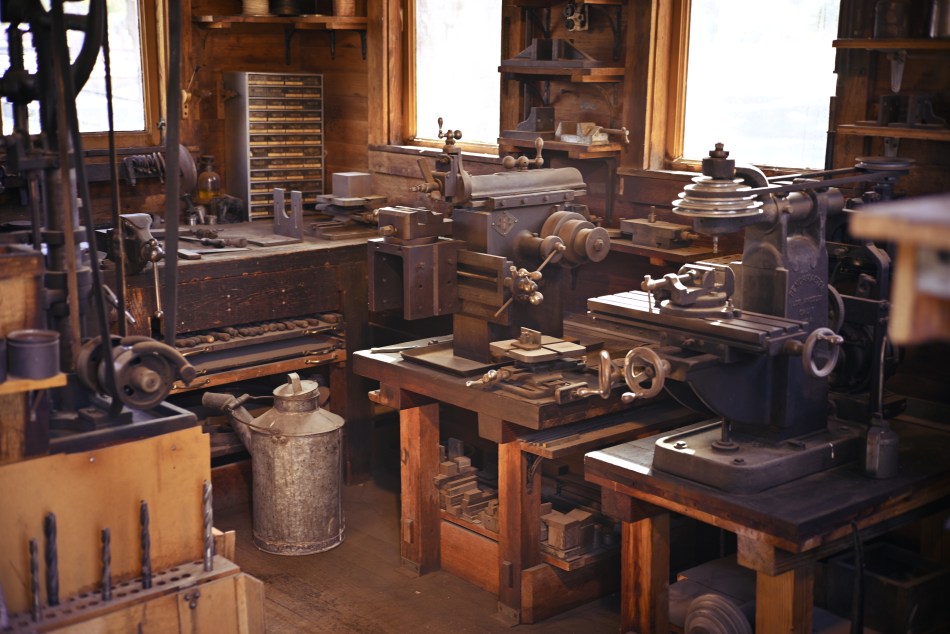
A quaint old workshop, but it’s inside a room that is too small for everything in it to be shown with a standard focal length.
By MICHAEL PERKINS
I DUNNO. IT MAY BE BECAUSE WE ASSOCIATE WIDE-ANGLES LENSES WITH LANDSCAPES. You know the kind of images I mean: vast canvasses of sprawling geography that seem to draw our eye enormous distances between left and right sides of the frame, enforcing an idea that we have to “get everything in” when composing our image. Perfect solution: Wiiiiiiide-angle! No cropping of a cool mountain or a winding river needed! Hey, all you trees, crowd in together, willya?
In reality, I almost never use a wide-angle lens for exposition of big subjects. The lens can magnify distances, especially front-to-back distances, that I don’t particularly need to magnify, and so I use a normal focal length and just stand farther away from the scene. I believe that wide-angles are not designed to “get everything in” your picture. They are best used when they put you, yourself, farther inside a scene. Most wide shots fail because they are taken from too far away, when the feeling of “being there”, of having yourself immersed in a scene, is only accomplished the closer you are to the action. Or if you think of it in sonic terms, consider how more immersive stereo feels if you create the illusion that you are amongst the musicians instead of across from them.
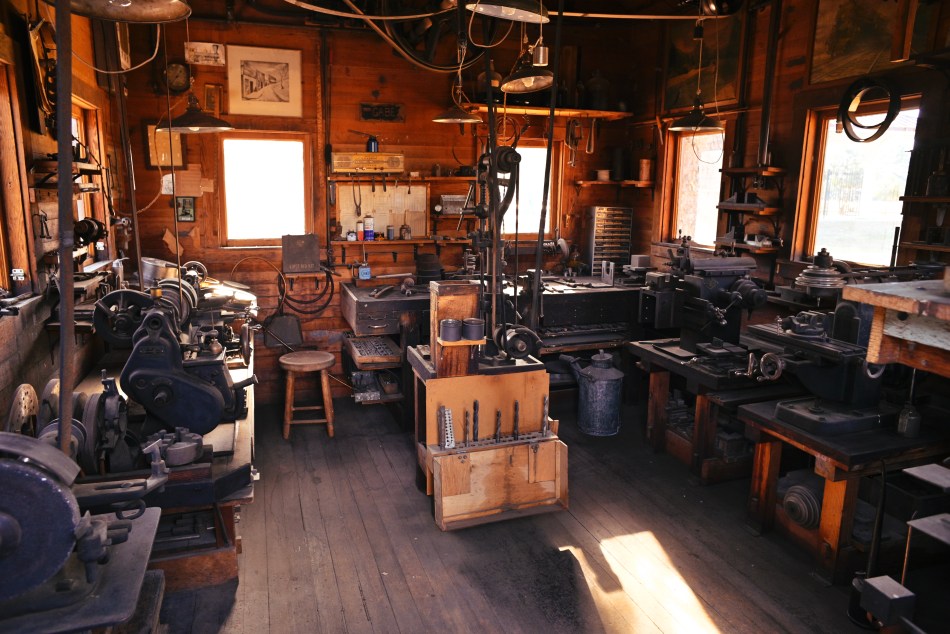
Same room, now shown completely by moving in closer and using a 24mm wide-angle.
With this in mind, I think that wide-angles are absolutely essential when you find yourself in a cramped space, whereas using a normal 50mm width in such a situation, as seen at the top of this page, heightens the feeling of claustrophobia. More than half the detail in the medium-sized workshop in the image is simply lost, including the space’s entire left side and ceiling, both of which are loaded with interesting information. Snap on a 24mm wide-angle, however, as I did in the second view, and the room opens up, even though I am leaning physically farther into the room’s doorway than I did when using the 50. Instead of using a wide-angle to back up and “get everything in” (what? the door frame? the outside of the tool shack?) I placed myself further into the scene and let it, if you like, wrap around me.
Composition is part instinct, part inspiration and part calculation. Focal lengths can operate counter-intuitively in some situations, but ahead of the right tool comes the right idea. When both arrive at the scene together, the good stuff happens.
THE GENTLE GIANT NEXT DOOR
By MICHAEL PERKINS
I DID NOT INHERIT MY FATHER’S PASSIONATE TALENT FOR GARDENING and landscaping, although I have always envied the way it miraculously devours him, each season bestowing on him distinct and endless variants of joy. He has owned and maintained the creekside half-acre back of his house for a third of a century now, and, as the aches and pains and limits of his ninety-three years often forbid his going out to play in his own private Walden, I cheer on days when I know it is clear enough, or warm enough, or safe enough for him to be out there. He and the yard get lonely for each other.
What was transmitted to me was his very special love of trees. I can’t recall a time when I wasn’t awed by their beauty, their power, their endurance. That’s why my favorite part of my own “estate” is my view of the towering, sprawling titan just over the rear fence in my neighbor’s back yard. It’s unusual for an old, solid, massive thing like this to have survived the yank-everything-out-start-over ethos of the Southwest suburbs. Perhaps removing it was simply too expensive, too troublesome, leaving it to stand when many lesser trees might have been cleared out to make way for (??) progress? In any event, like anything that is purely or simply beautiful, it makes photographing it fairly complicated.
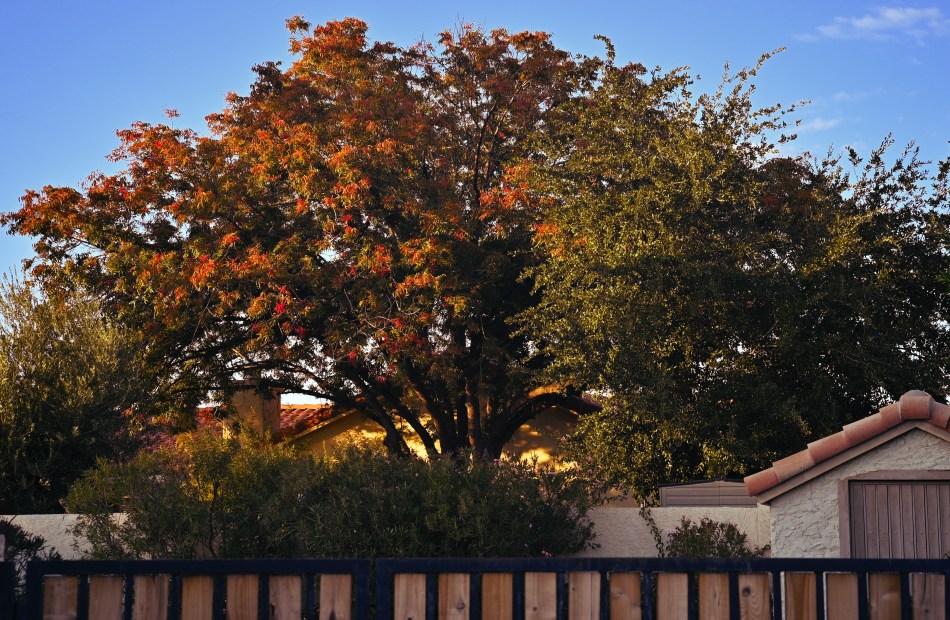
Over the past twenty years I have captured it in low light and full, dusk and dawn, rain or shine, and still I always come away feeling like I have failed to deliver its full story. Then again, what can its “story” even be? It’s a tree. But therein lies the paradox of making images of anything living, from human passersby to majestic landscapes. Their life is both static and in motion, both in and out of time. The camera both records accurately and lies absolutely when I point it at such a thing.
And so I keep going. What you see here is but the latest attempt from a few days ago. If you have the time, I can put on the kettle and guide you through the hundreds of other attempts I’ve made over the years at finding the soul of my gentle giant. Being that I don’t have to journey to the forest primeval to find something to admire this much, I admit to thinking that I have, you know, plenty of time to get it right. But, while the tree isn’t going anywhere, I certainly am headed, and before too long, for the stage exit. And so I keep going.
The tree has already gotten it right.
Maybe, by running a little harder, I can, in time, catch up with it…..
I AM A CAMERA. NO, I REALLY AM
To quote out of context is the essence of the photographer’s craft. His central problem is a simple one: what shall he include, and what shall he reject? While the draughtsman starts with the middle of the sheet, the photographer starts with the frame.
–John Szarkowski, The Photographer’s Eye
 By MICHAEL PERKINS
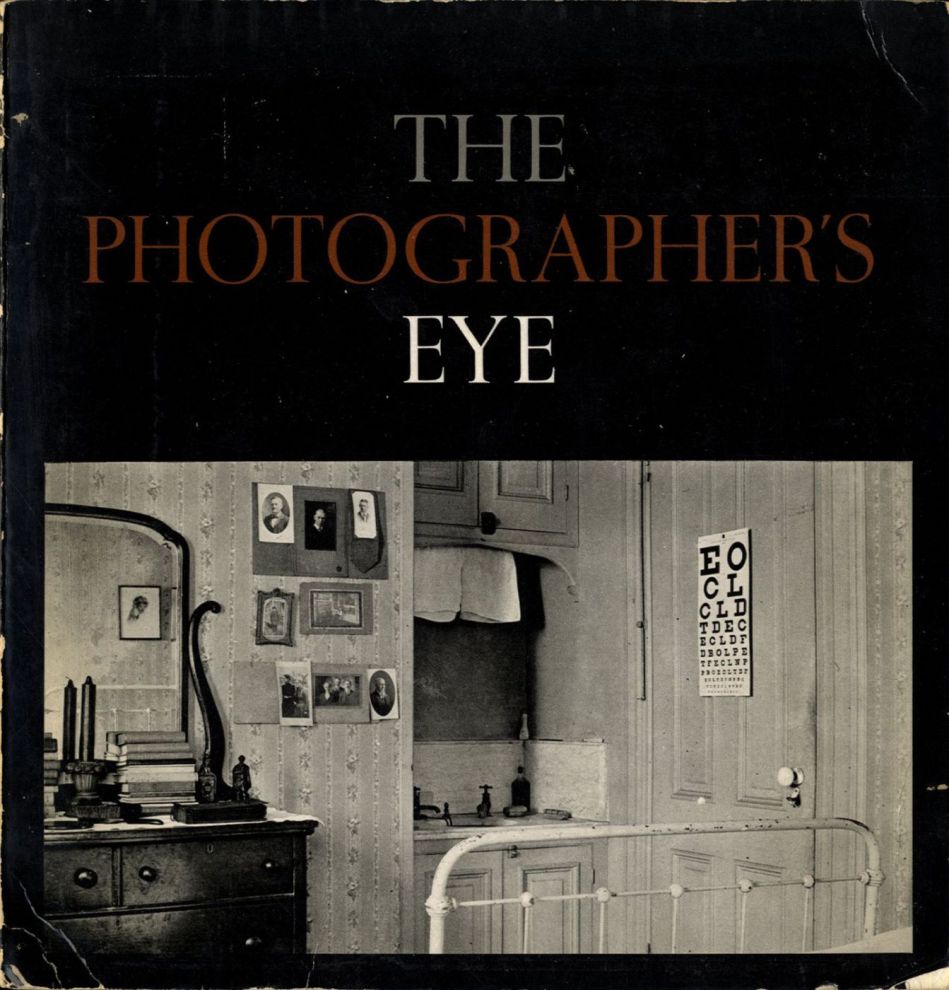
EVER SINCE I FIRST READ THAT SHORT PARAGRAPH, many moons ago, I realized that it contained everything I would ever need to know about composition. Other writers have rhapsodized both long and short, clear and muddy, beyond those few words, but John Szarkowski, the most significant figure in the curation of American photography, laid out, in concise prose, the terms of engagement between shooter and subject in such a clear fashion that little more need be said on the subject. It’s all there.
Szarkowski (1925-2007) was not the first director of Photography at New York’s Museum of Modern Art, but he was certainly among the first to act as a forceful, articulate voice to advocate for the act of making pictures, insisting that it assume its rightful place, without apology or embarassment, among the established arts. Moreover, he purposefully curated MOMA’s photographic collections with the fervor and eloquence of a true believer, using the institution’s reputation as a springboard to advance the careers of Diane Arbus, Lee Friedlander, Garry Winogrand, and dozens of other emerging American artists*. His third MOMA exhibition, 1964’s The Photographer’s Eye, was adapted into a book by the same name two years later, and has since maintained a vital place as one of the foundational primers not only on what to see, but also how to see. I recommend it to all avid new shooters, but also to anyone who even looks at photographs and wonders what all the fuss is about. It’s that essential.
TPE contains 172 duotone images arranged into five distinct sections, each addressing a part of the mystery: The Thing Itself, The Detail, The Frame (from which the above quote is taken), Time, and The Vantage Point. Szarkowski confines his commentary to a brief set-up essay ahead of each section, then lets the pictures, taken by unknown amateurs and pros alike, to do most of the talking. The Photographer’s Eye was followed by other instructional canons over the course of Szarkowski’s career, including 1973’s Looking At Photographs to 1989’s Photography Until Now among many others. If you’re keen on building an essential library, throw these in the shopping cart as well.
Coming from a sensibility borne of his own photographic output, John Szarkowski forever ended the debate about whether the camera could produce “art”, even as he sparked many other discussions about what that art should look like. The Photographer’s Eye is as essential to picture-making as learning how to select an aperture or calculate a shutter speed, as it glorifies all the myriad motives for what goes into, or stays out of, that wonderful frame.
*Winogrand, Arbus, and Friedlander were, in fact, specifically showcased in Szarkowski’s historic exhibition, New Documents, in 1967. Here’s a link to MOMA’s page celebrating its enduring impact—M.P.
FROM WHERE I SIT
By MICHAEL PERKINS
SMALL TOWNS ACROSS AMERICA STILL PRACTICE a way of observing life that many of us have more or less abandoned, the idea of our homes as reviewing stands for humanity’s passing parade. Porches, as we built them in our smaller, slower days, were more than mere entrances into our homes: they were places to visit, observe, and comment. The wraparound verandas and shaded repose that we designed into our houses were like a buffer layer between the raw world out there and the warm world beyond our thresholds. Porches, in the days before the stubby stoops and short step-ups we feature today, were for something.
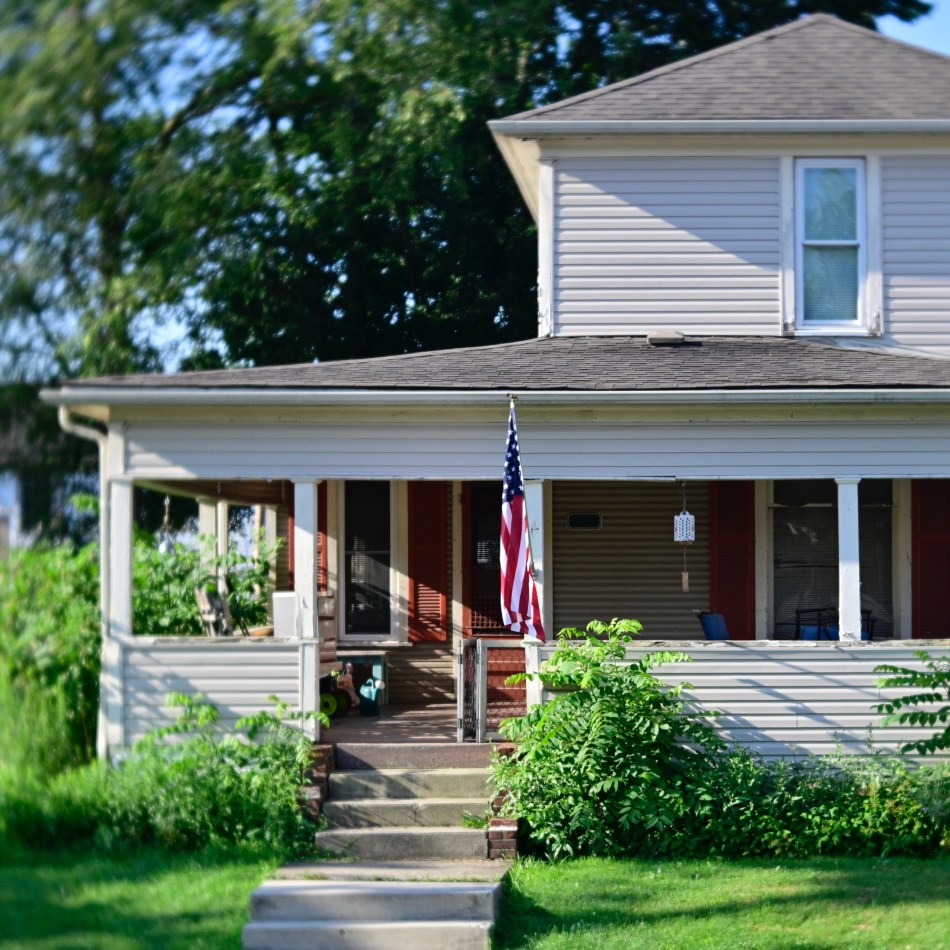
Visit someplace that has been lucky enough to survive the transition from village life to city life and you will find these places still personalized and painted, still decked with mini-gardens, flags, and seasonal decor, still serving as a distinct middle world between inside and outside. The idea of the street as a kind of low-impact entertainment, with neighbors and newcomers alike filing past, some to be actively engaged with, some just serving as moving scenery, has a slow, simple appeal in an age dominated by screens, scrolling and infinite entertainment options. But you have to pause, and breathe, and be patient to get the full effect.
It’s worth lingering over, and that is why, in visiting small towns, the very first place I go is the main residential boulevard. That’s where the action is. The sad fact is that we are often moving too quickly to see that action. It’s like trying to train yourself to observe the movement of the hands of a watch. Getting yourself aligned with the steady but imperceptible pace of the timepiece takes practice, and learning to see the gradual reveal of a house’s heart by first taking the measure of its porch is a habit that we have long since lost the natural knack for. But there is a reward in it, and there are pictures in it, and therefore it is worth doing.
I GOTTA WORK TOMORROW, BUT……
By MICHAEL PERKINS
AS I CRUISE MY WAY CAREFULLY TOWARD THE END OF YET ANOTHER YEAR, I have the distinct sensation of coming to a slow, smooth landing after having descended through a bank of dense storm clouds. Having made pictures for over half my life, I find my mind, near year’s end, riffing through a stack of images that now serve as a catalogue for the markers and milestones of more than two thirds of a century, as if my existence somehow compiled one of those kids’ flip books that, when properly thumbed, looks like a continuous movie.
And as November careens toward December, I find that I want to slow the movie down. I want to celebrate moments that were miraculously, often accidentally, destined to be frozen, evergreen, in my mind. Trying to determine what pictures within a year earn the title “keeper”, I am also rotating past earlier years, to purer and purer depictions of joy that I could never have created myself, but was blessed to be witness to. This is one such picture.
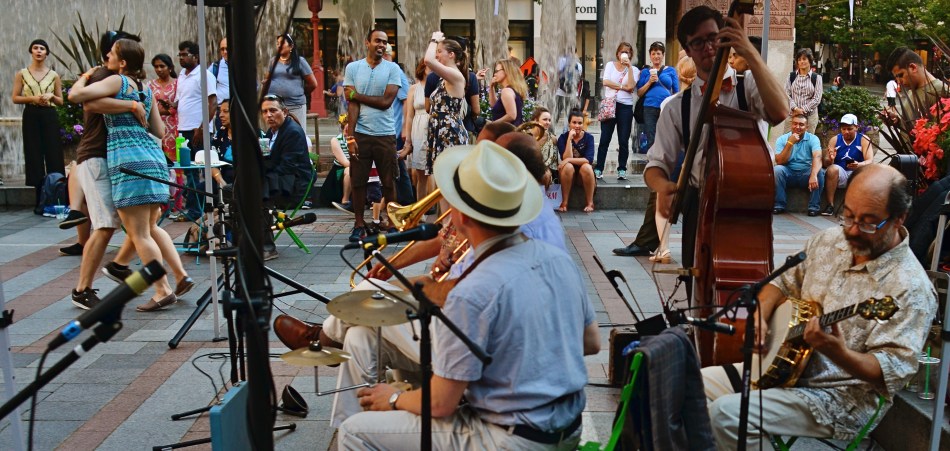
2016.It is a summer Sunday evening in Seattle, Washington. I have never walked through this neighborhood before, but the joyful whoop of this street party has drawn me blocks away from my hotel. I am enjoying the long, golden sunset hours that are a photographer’s bounty in that part of the American Northwest, and I am drawn like a magnet to these wonderfully free and frolicsome people. The music is loud, the dancing is carefree, and the mood is lighter than a dandelion seed on a breeze. This is what happiness looks like.
I know nothing about who sponsored this shindig, be it the parks department, a bunch of friends, or just the sheer life-affirming impetus of a summer night. It matters little what started, it or why: what matters is that, when I enter this space, I never want to leave it. However, I know I am bound for other places, and so, if I must leave, I’m taking a souvenir.
Click.
One of the things I love most about this picture is that nearly everyone in it is present, attending to some other person or persons. They are there, not scrolling, not checking their Instagram, but immersed in the miracle of being with other human beings. Tomorrow, they have to work. Tomorrow, they have to report to someone, fulfill deadlines, make plans, cut their losses.
But here, in this frame, it ain’t tomorrow yet.
And it never will be.
CUTTING ALONE WON’T CUT IT
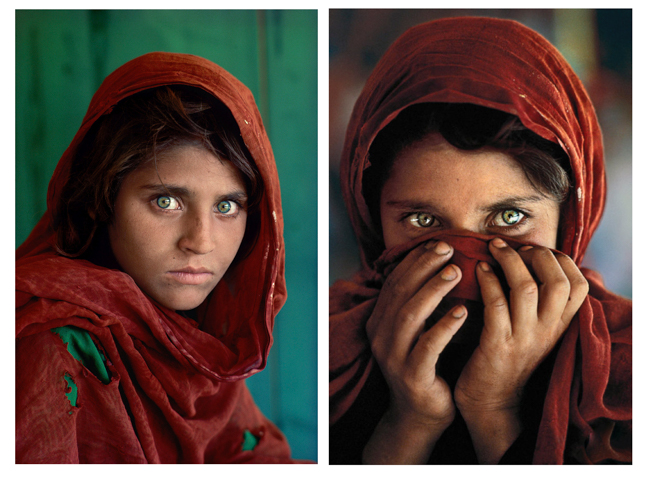
The published take of Steve McCurry’s immortal “Afghan Girl” and the frame that was nearly chosen in its stead.
By MICHAEL PERKINS
THE ENDLESS DEBATE ABOUT WHETHER GOOD PICTURES ARE “BORN” OR “MADE” shows no sign of abating anytime in the next foreseeable millennium. In fact, it’s kinda fun bickering endlessly about whether success stems from the concept of an image (nature) or the loving care afforded by processing and editing (nurture). It’s the kind of infinite chicken-or-the-egg loop that enlivens all the better cocktail parties. I myself have fought fearlessly on both sides of the aisle at different points in my life, but my latest thoughts on the subject are becoming a bit more nuanced.
While I marvel at the astounding raft of choices born from the use of various post-processing platforms, I reserve the specific word editing for the mental judgement, the trained eye that can not only distinguish good pictures from bad, but great pictures from good ones. Sadly, all too often, our emphasis is on how we can improve or “fix” a picture with processing, trying to salvage shortcomings that should have been weeded out by the conscious, deliberate act of editing.
Recent articles on NatGeo’s Steve McCurry’s iconic “Afghan Girl” portrait (the Face That Launched A Thousand Camera Purchases, not to mention selling a crap-ton of Kodachrome) have centered on one of the alternate frames taken at the time that lost out to the final image. Both pictures, as you can see, are marvelous in distinct ways, and so it took McNally’s discerning and experienced eye to separate the gold from the platinum and select the photo that was not merely poignant, but, in a way, transformative, the final visual word on a tough subject. It’s not the kind of decision that can be made by merely boosting the color, cropping, or filtering the shot through a dozen afterthought layers, even though such operations can place the cherry on top of an already strong photograph. It’s the ability to criticize and evaluate one’s own work, fearlessly and in depth, which must exist in the photographer’s mind.
The best pictures are always improved by tools, but they can never be about those tools. In the interest of humility, I keep entire folders of near-misses, images I could not, even with infinite fiddling, rehabilitate. In case after case, I used post-processing to complete the task of story-telling that I only partly achieved in the making of the master shot. Not quite lipstick on a pig, but clearly the work of someone who is covering his tracks. To have a “McNally Eye” takes total honesty, a skill which is harder to master than all the technical know-how in the world. A great job of tweaking can never compensate for a bad job of narration. It’s the different between a girl with a plaintive look in her eyes and a girl with a stare than can sear its way into your soul.
BACK TO THE BLUE PLATE
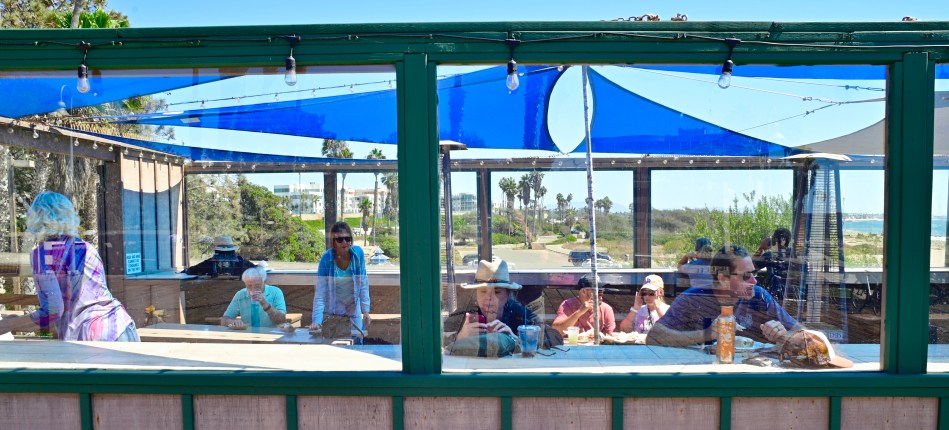
The lunch crowd at Beach House Tacos, Ventura, California, 2022
By MICHAEL PERKINS
THERE IS A KIND OF ROMANCE, CALL IT A CULT OF THE INDIVIDUAL, that informs our love of what can only be called The Great American Joint. We have a special affection for the one-location, one owner store or restaurant that outlasts global competitors. We revel in diners that celebrate “100 years at the same location” or burger stands that offer only one house specialty (no substitutions!) And it is altogether appropriate that Americans, in particular, should hold the Moms-and-Pops of the world dear. After all, we did everything we could to put them out of business.
The multiple-location business model was actually born in the U.K. in the 1700’s but really hit its stride in the States in the1860’s when a local New York tea shop owner opened multiple branches around the city. By 1900, The Great Atlantic & Pacific Tea Company (or the A&P to you) became the first true grocery chain, and from there, the chain movement exploded to include hardware and department stores, hotels, clothiers, drugstores and, most importantly, restaurants. Over a hundred years later, chains offer familiarity and reliability as we move from one golden arch to the next, but they also starve the landscape of variety and, worse for photographers, distinctive visual experiences.
That’s why I doggedly seek out joints when traveling and shooting. The food varies wildly in quality, and that’s just fine: one man’s uncertainty is another man’s adventure, if you like. Beyond that, joints offer the chance to celebrate the different, the odd, the innovative. Chains are all about guaranteed outcomes. With Bob’s Crab Shack or the Keep Portland Weird Cafe you never know what you’ll get, and, for the sake of the pictures, unpredictability is a strength. And, in terms of karmic balance, it’s only fair that the country that tried to un-invent the private business learn, in its maturity, how to nurture what’s left. And if that means occasionally eating at a place where we have only one kind of burger, made daily on the premises, and when we’re out we’re out.….well, then, save me a seat. I’ll be with you as soon as I switch lenses.
ARE WE BEING SERIOUS NOW?
By MICHAEL PERKINS
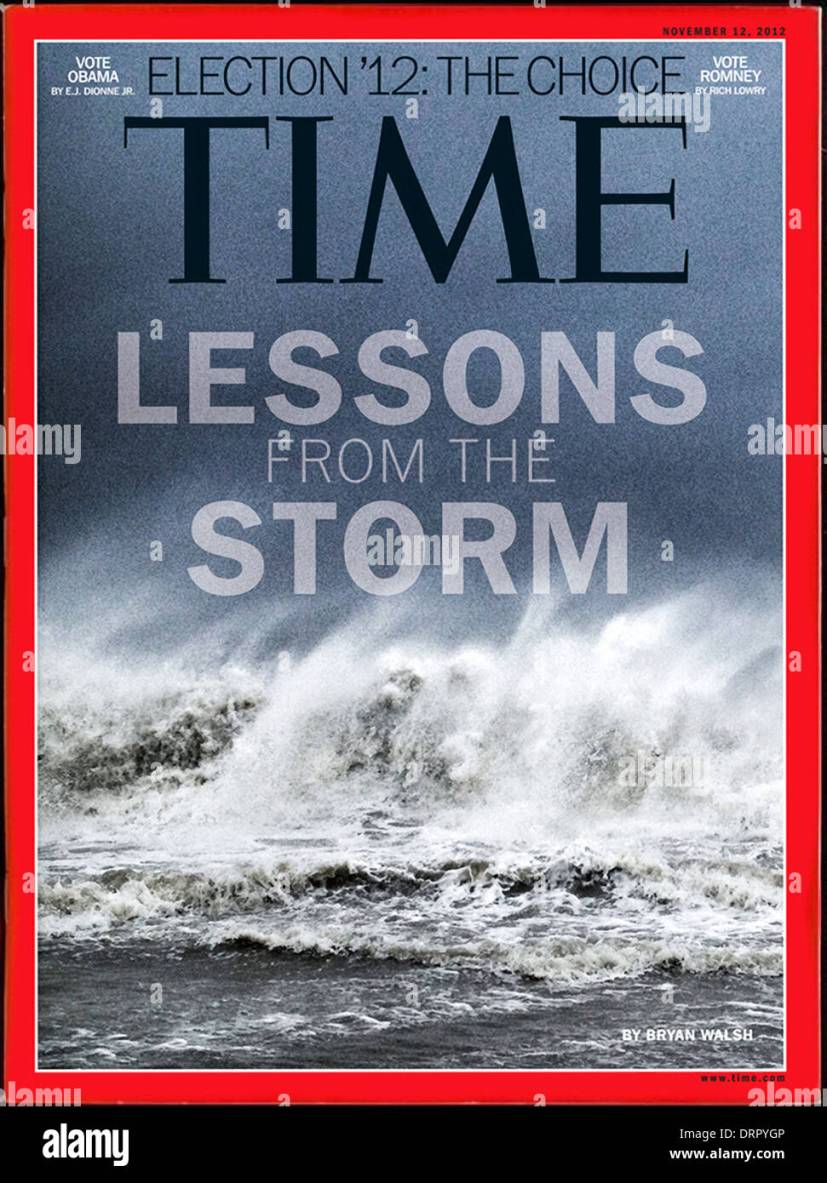
THIS MONTH MARKS AN IMPORTANT MILESTONE IN PHOTOGRAPHIC HISTORY, in that it was almost exactly ten years to the day that a major news magazine, on deadline amidst a horrific disaster, decided, for the first time, to run a cellphone image from an Instagram posting as its cover picture. The devastation caused by Hurricane Sandy in 2012 was, due to the newly accelerated penetration of mobile photography, covered to a much greater degree by the average shooter, but it was one very above-average professional, news photographer Ben Lowy, who provided the magazine with the image that would define the destruction and fury of the superstorm, and he took it not with his usual battery of Nikon and Canon gear, but with an iPhone 4S.*
This seems trivial in retrospect, but at the time, it actually represented a fairly seismic shift, as publications changed their idea of what constituted “real” coverage of a major new event. It also conceded what millions around the world already knew in their DNA: that their camera of convenience was now, also, their device of choice, their “real” camera. if you like. Lowy himself explained the mindset: “People don’t think twice about it. It’s a fast little camera, and I do like that on a tough assignment. At times, though, ‘pros’ will push me aside, assuming I’m a tourist or amateur. It’s the mind of the photographer that defines the quality of the image, not the equipment. Everyone has a pen, but not everyone can draw.”
Just as the average phone shooter knew by 2012 that the best camera is the one you have with you, so the world of editors had to grudgingly admit that a picture is a picture is a picture and who the hell cares what it was captured on? Of course, we know the answer to “who the hell cares”, as we all know people who argue that you need a “real” camera to get artistic results, at which point I remind them how many Pulitzer Prize-winning images are, in fact, underexposed, blurry, badly composed, or askew, despite the fact that they were made by world-class equipment. They copped Pulitzers because, despite how much we may spend or scrimp on gear, in the end, a compelling picture trumps everything else.
I have made my own dog-legged journey in my conception of a “good” camera, the device I would count on to make the “official” or “permanent” images of an important event or place. When traveling, for instance, I still use my mobile for snapshots, experiments or “pencil sketch” versions of things, bringing my formalized equipment in to render the “final” edition. I’ve gradually become more and more even-handed in budgeting shots between my “casual” and “serious” camera, but I know too well that I am behind a kind of global curve in thinking this way. Turns out photography is not merely about perfecting one’s technique, but also about perfecting the brain behind the shutter finger.
*Full disclosure: a bit of texture was added to Lowy’s shot before it was posted, not with Lightroom or Photoshop, but with the phone app Hipstamatic.
 thenormaleye
ALONE AGAIN, NATURALLY
By MICHAEL PERKINS
TAGGING, OR MARKING A BUILDING WITH GRAFFITI, seems to me one of the strangest bids for immortality that an artist can undertake. It’s obviously, on one level, a plea not to be ignored: I was here. But since so much of the information in its various signatures and symbols are rigidly encoded, it’s only a testament to some people for some vague stretch of time. Soon, like the grass reclaims the battlefield, rust and amnesia efface the artist just as surely as if he had never passed this way.
When infrastructures rot and fail, they either collapse in catastrophe (like a fallen bridge) or needless suffering (like a municipal water system), and, as their pieces are hauled away, every cultural element tied up in their daily use, especially signs or writing, are taken away as well, robbing the tagger of his/her shot at immortality. Other times, the rot just stands, useless and unmourned amidst other changes in our daily world, still emblazoned with the phantom scrawlings of earlier poets who now cannot rely on either memory or context to make their work persist in meaning.
The strange legend on this disintegrating trestle bridge in Ventura, California was explained to me by a local as a reference to a heinous crime that occurred in the area. She didn’t seem to recall the precise details nor the time frame, although I assume it does not pre-date the invention of aerosol spray paint. Point is, even though the bridge has the year of its erection, 1909, stamped into it at the back and front, the span’s name, to everyone who passes until it plunges into the river, will be “the ‘Baby Girl’ bridge”. Unfair to the anonymous scribe who sought to freeze a horrific event in time, but eventually a moot point.
I wanted to shoot the bridge because of the textures of its deterioration, but then I realized that, eventually, I was also making what would, eventually, become the lone record of a message that someone, somewhere, thought important enough to stamp onto the trestle’s oxidized remains. Maybe, in some way, I think it’s important as well. Artists hate the idea of other artists dissolving into history. We come into the world by ourselves, and, after mingling with the world, we all end up, as the song goes, alone again. Naturally.
Share this:
November 13, 2022 | Categories: Uncategorized | Tags: Commentary, history, memory | 1 Comment