SEA CHANGE
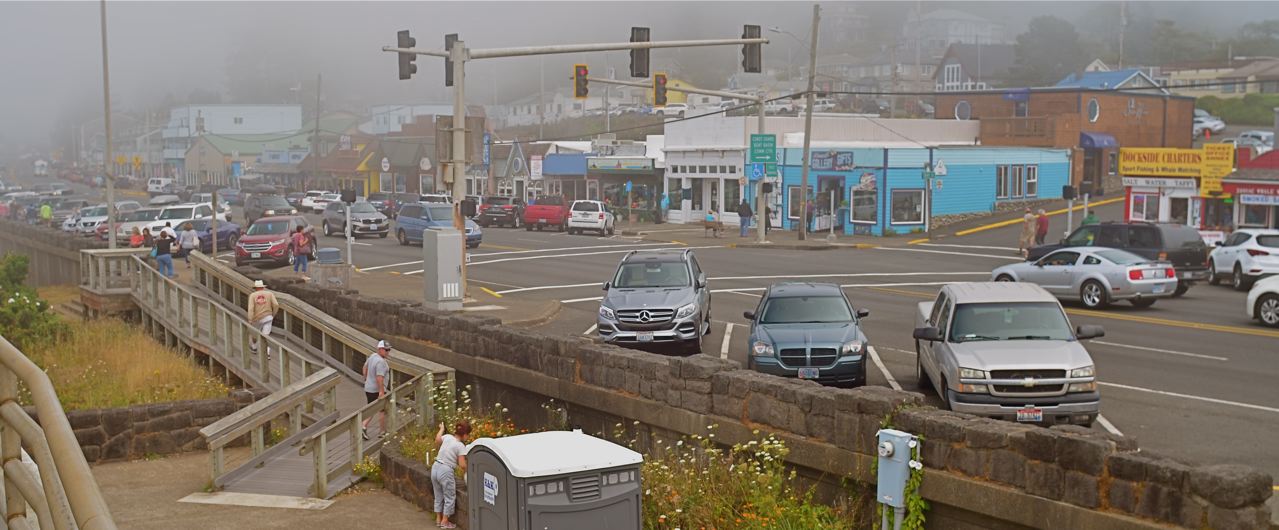
Downtown Depoe Bay, Oregon
By MICHAEL PERKINS
THE COASTAL OREGON TOWN OF DEPOE BAY (pop. 1,398) advertises itself as “the world’s smallest harbor”. They might have saved themselves the cost of a sign. Everything about this little strip of gristle along U.S.101 suggests small, conveying the unmistakable feeling that you are Miles From This, A Further Piece Up The Road From That, or On The Way To Elsewhere. This place right here, though, is not much more than craggy connection tissue between other places, places that have substantially more going on.
But then there is that coastline, most of it seen in five minute out-of-the-car stretches by passersby who follow the signs for the Whale Watching Center. The decidedly no-nonsense concrete slab that houses said center sits atop a pile of blackened, stony scab that boasts but one break in its protective sea wall, a narrow channel that admits just one boat at a time (tourist charter local fishing skiff, or Coast Guard cutter) from the “harbor” across the street, a small collection of crafts most towns would label a “marina”. This traffic flow is regulated by the outcome of the daily conundrum, will there be whales, or, more accurately, will whales, or anything else, be visible beyond a hundred yards?
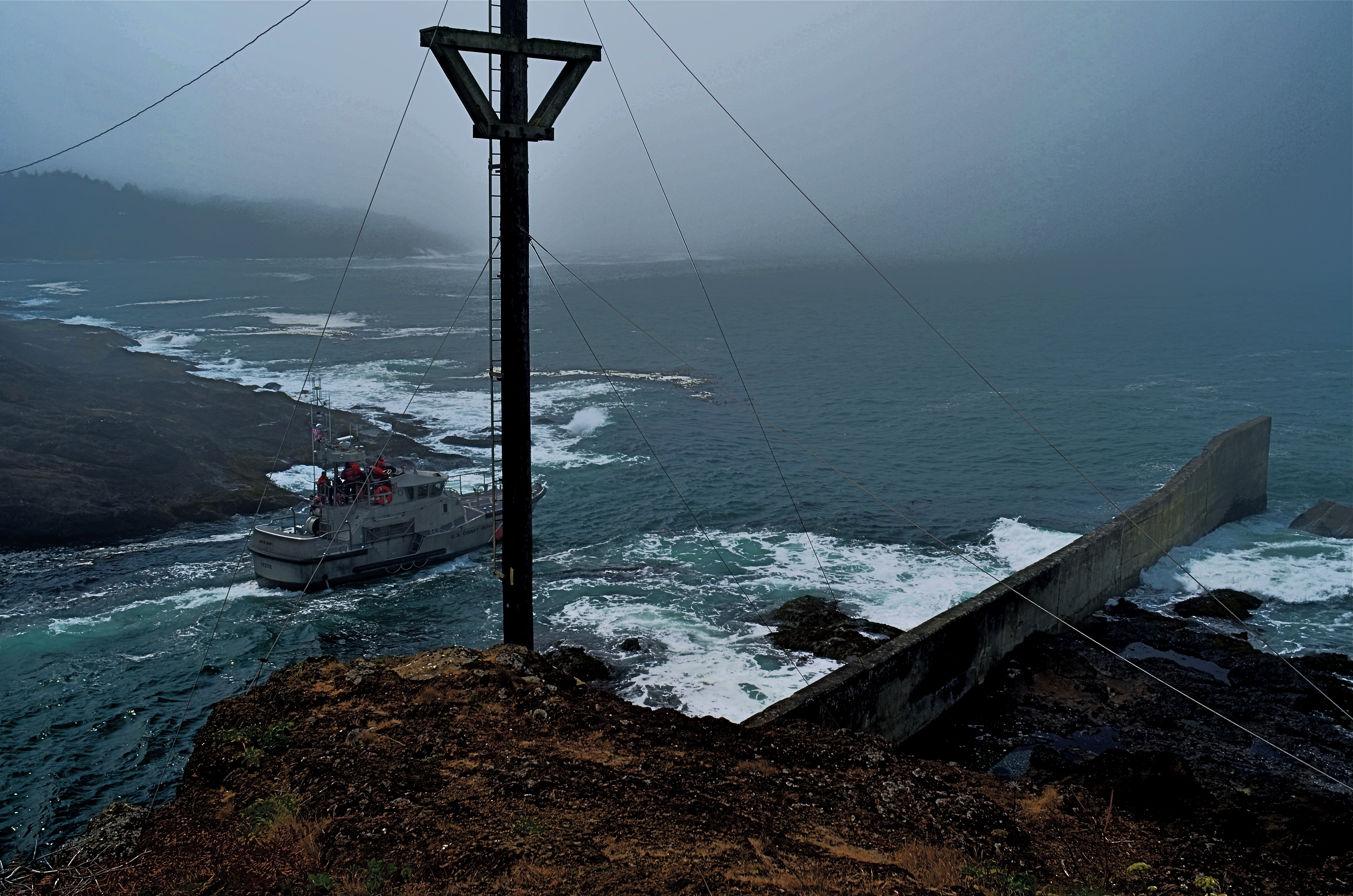
And yet, even swallowed up in soupy fog, the snaky fingers of which close upon the coast like grasping, ghostly fingers balling into a fist, Depoe Bay could make Melville’s Ishmael himself pine for the open sea. Paradoxically, it reveals all and conceals all at the same moment. It’s a portal to departures, an end point to journeys, a portent, a welcome, a warning…..and an irresistible itch that only a camera seems able to scratch.
Coastal towns like Depoe can subsist on their four blocks of bar-laden business district, their single low-power oldies radio station, their preciously tacky gift shoppes, the gallons of chowder dispensed each day. But the real show is the one that won’t stay still, the one that is equal parts miracle and menace, doldrum and dream. With it, the Depoe Bays of the world maintain their tenuous spots on the map. Without it, all poetry vanishes in a bank of mist.
WHEN THE NOISE DIES
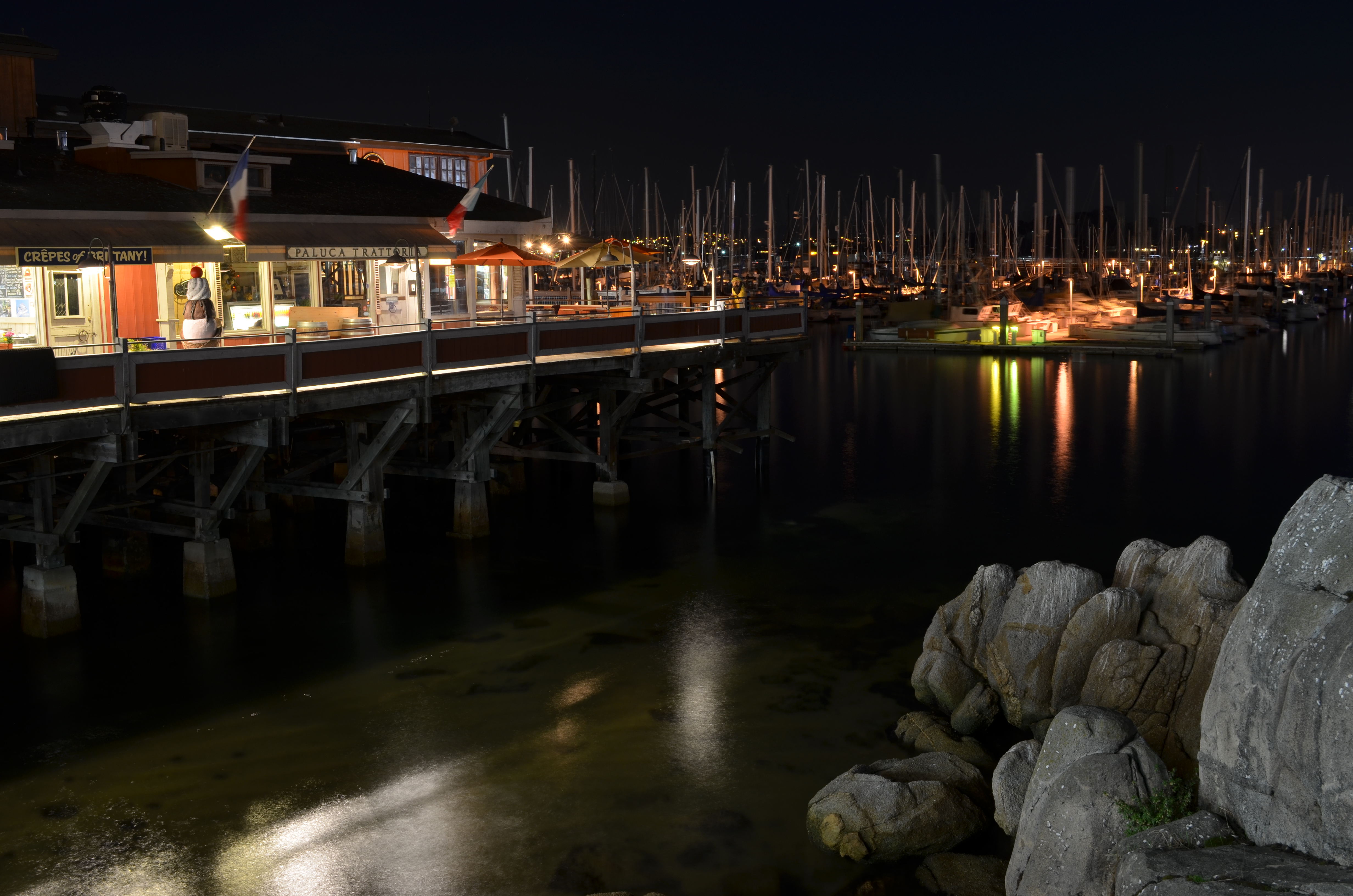
In the day, this place is a madness of color and noise. At night, you have its wonders all to yourself. Fisherman’s Wharf in Monterey, California. 25 second exposure at f/10, ISO 100, 24mm.
By MICHAEL PERKINS
AMERICA IS A LOUD PLACE. IF WE DON’T HEAR NOISE WHEREVER WE GO, WE CREATE OUR OWN. It is a country whose every street rings with a cascade of counterpointed voices, transactions, signals, warnings, all of it borne on the madly flapping wings of sound. There are the obvious things, like car horns, screeching tires, soaring planes, thundering rails, somebody else’s music. And then there are the almost invisible hives of interconnecting lives that tamp vibration and confusion into our ears like a trash compactor.
We no longer even notice the noise of life.
In fact, we are vaguely thrown off-balance when it subsides. We need practice in remembering how to get more out of less.
That’s why I love long night exposures. It allows you to survey a scene after the madding crowd has left. Leaving for their dates, their destinies, their homes, they desert the fuller arenas of day and leave it to breathe, and vibrate, at a more intimate rhythm. Colors are muted. Shadows are lengthened. The sky itself becomes a deep velvet envelope instead of a sun-flooded backdrop.
The noise dies, and the quiet momentarily holds the field.
The above image is of Monterey’s Fisherman’s Wharf, one of the key tourist destinations in California, a state with an embarrassment of visual riches. During the day, it is a mash of voices, birdcalls, the deep croak of harbor seals, and the boardwalk come-ons of pitchmen hawking samples of chowder along the wharf’s clustered row of seafood joints. It is a colorful cacophony, but the serenity that descends just after dark on cold or inclement nights is worth seeking out as well.
Setting up a tripod and trying to capture the light patterns on the marina, I was stacking up a bunch of near misses. I had to turn my autofocus off, since dark subjects send it weaving all over the road, desperately searching for something to lock onto. I am also convinced that the vibration reduction should be off during night shots as well, since….and this is counter-intuitive….it creates the look of camera shake when it can’t naturally find it. Ow, my brain hurts.
The biggest problem I had was that, for exposures nearing thirty seconds in length, the gentle roll of the water, nearly imperceptible to the naked eye, was consistently blurring many of the boats in the frame, since I was actually capturing half a minute of their movement at a time. I couldn’t get an evenly sharp frame, and the cold was starting to make me wish I’d packed in a jacket. Then, out of desperation, I rotated the tripod about 180 degrees, and reframed to include the main cluster of shops along the raised dock near the marina. Suddenly, I had a composition, its lines drawing the eye from the front to the back of the shot.
More importantly, I got a record of the wharf’s nerve center in a rare moment of calm. People had taken their noise home, and what was left was allowed to be charming.
And I was there, for both my ear and my eye to “hear” it.
Thoughts?
Related articles
- Vibration Reduction (nikonusa.com)
 thenormaleye