CONTACT STREET
By MICHAEL PERKINS
FOR STREET PHOTOGRAPHERS, ONE VERY SAD BY-PRODUCT OF THE PAST TWENTY YEARS has been the incursion of the cell phone and its impact on the shooter’s art of chronicling life in the raw. Sifting out the potential keepers in a day’s work shooting among the public now consists largely of image after image of people turning inward, holding conversations with no visible partners, their faces frozen in the permanently bent, blank dataflow which now passes for life. It’s boring to look at, disheartening to witness, and death for pictures. The beauty of solo thought or quiet contemplation that used to be the harvesting field for street work is winking out of existence, one redundant text at a time. To photograph a person on a phone is to repeat the same dreary image of isolation over and over ad nauseam.
That’s why, in recent street shoots, I now search out groups of two or more people, just to show persons in actual, active contact with other persons. The back-and-forth of shared experience animates the face, and the street is once again filled with humans rather than mere ambulatory receiving stations. And when I go looking for visually clear evidence of this sort, I eavesdrop on the friendship of women.

This is all my own subjective view, of course: however, to my mind, women speak to each other in emotionally layered engagement, a physical reinforcement of their connection that is starkly different from the talking that occurs between men, who, even when they are standing alongside each other, look like they’re either waiting for a bus or queueing up for a physical. There are exceptions, of course, but when I’m looking for street subjects that look like they are actually involved with each other, I look for two or more women chatting.
Generally speaking, and in ways which greatly inform candid photography, men share information, data, or analysis, while women share all that plus feelings. They move beyond mere transactional talk into vivid communication. Images reveal the underlying connections between people, all the more eloquent because they are not always intending to show them, or are unaware of the clues that they unwittingly share out despite their best efforts. The world doesn’t need even one more lonely picture of a person on a phone, but true pictures of people experiencing a genuine connection will always surprise and fascinate. And for me, there is a qualitative deepening of that connection when it’s shown on women’s faces. If you want to know the ball score, ask the guys. If you want to know the real score, ask the girls.
A TERN FOR THE BETTER
1:45pm, August 24, 2023
By MICHAEL PERKINS
BIRDWATCHING AND PHOTOGRAPHY FORM A PERFECT NATURAL SYMBIOSIS, the kind of interlocking of passions that’s been a particularly satisfying bond between my wife Marian and me. The simple division of labor involved (she spots ’em, I snap ’em) allows us both to approach the task from our respective strengths, overlapping in a shared purpose that teaches both of us about looking and waiting. Often, events out in the wild unfold slowly, almost imperceptibly so. And then there are days when change comes in like a sudden surge of surf.

1:47 pm, August 24, 2023
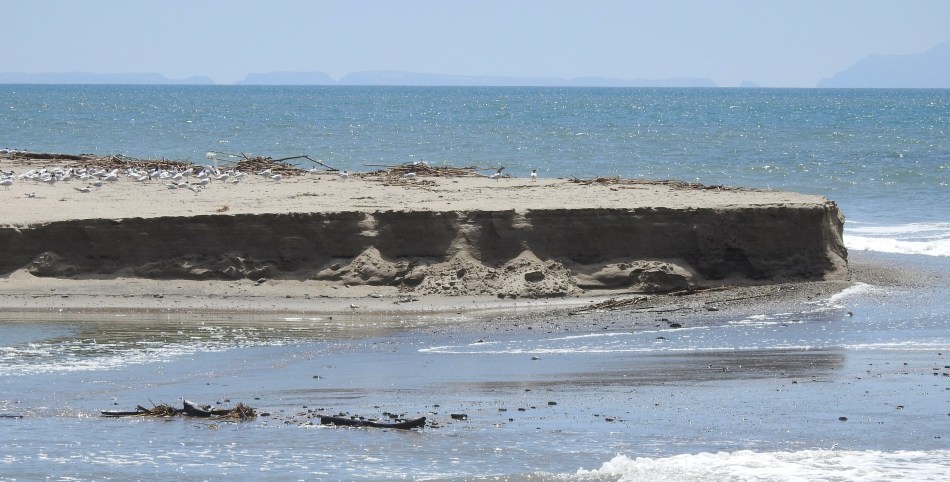
These images come from a recent walk along the stretch of oceanfront near the confluence of the Pacific Ocean and the Santa Clara River, which meet in an estuary just downwind from the busier beaches of the Channel Islands National Park in Ventura, California. It requires about a quarter of a mile’s walk away from the madding crowd, but local birders know the payoffs are real. Our first glimpse of the enormous rock shelf situated right next to the tidal line (top) showed it stark and empty, but, just two minutes later, a massive flock of terns was holding a reunion from end to end of the crag (above). Even in a static picture, the transition was/is stunning.
Much of birdwatching is an exercise in patience, with many days of hiking and neck-craning yielding next to nothing aside from a decent walk. Thankfully, there are also days when Nature comes bounding into view with a suddenness that takes your breath away. You see the rhythms of the world, cycles that are rooted in millennia of repetition, drumbeats of life that predate you and will continue after you as if you were never here. The humility forced on one when faced with the inexorable ebb and flow of Life on the planet eventually informs everything else you do, and certainly shapes your observational skills. It’s a forced cooldown, as well as the greatest display of existence asserting itself, striving to compete, to adapt, to thrive, skills which would be well emulated by anyone aspiring to art.
COMFORT
By MICHAEL PERKINS
Home is the place where, when you have to go there, they have to take you in.—Robert Frost
PHOTOGRAPHY IS ABOUT BOTH SUBSTANCE AND SYMBOLS, about showing things in their most minute detail, and, alternatively, also about suggesting volumes with simple arrangements of light and shadow. I began my professional life as a writer struggling to fully explain the world, documenting everything from mountains to grains of sand with meticulous accuracy. It was exhausting, and I imagine that it exhausted whatever readers I had at the time as well. Over the decades, I became comfortable with talking less and saying more, especially when it came to the important things like Love, Truth, Knowledge, even the creative act itself. That evolution had the principal effect of streamlining my writing, but it also simplified my approach to photography. I don’t always express the important ideas of life in the simplest terms, but the effort is there.
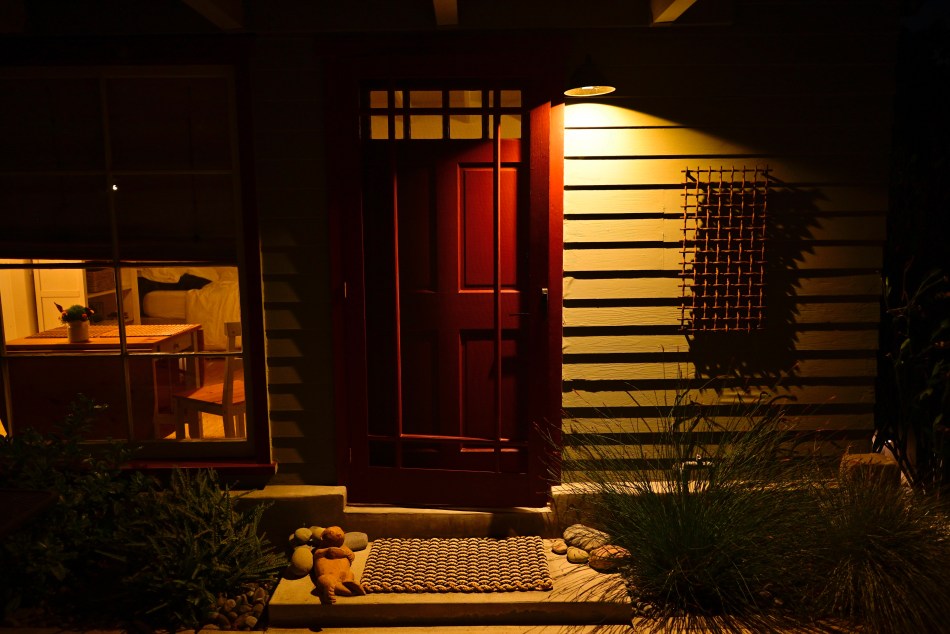
When it comes to a concept like “home”, I really try to take all the thicker poetic, philosophic and emotional implications of the term and reduce it to the simplest visual symbols I can muster. Buildings instead of the people within them. Stark compositions of color and shade, with an emphasis on under-exposure whenever possible. A muting of the decorative clutter that complicate the impact of a home, with a focus on doors, windows, paths. Strong rectangles and triangles. Lighting that hints at things instead of spelling them out.
As I say, I still waver from a simplicity that, by now, should be an article of faith. Sometimes I use the camera to blurt out a paragraph when a half-sentence will do. In this image, which is not of my own house but a casita I was renting on vacation, I am trying to convey the idea of what the psychologist Christopher Lasch called a haven in a heartless world, or Frost’s concept of a place where “they have to take you in.” The interlocking rectangles and squares, the warm red of the door flanked by the yellowish porch light, the amber tones through the window, and the simple straw welcome mat all combined to form a kind of comfort food for my eye, and I made the picture very quickly. This is not the way to think of “home” merely a way. But it is in finding our own truest ways that we make our truest images. And, more and more, mine run truer when I manage, in small ways, to speak smaller, not bigger.
BACK TO BEING…A BEING
By MICHAEL PERKINS
VACATIONS ARE HARD WORK.
To be clear, lying poolside and trying to flag the waiter for uno mas of whatever’s in this drink is not as labor-intensive as, say, shoveling concrete. It’s just that applying mental mastery to the process of letting go can require practice, “focus”, if you like, for both man and camera. Doing nothing is actually just doing another kind of something, and figuring out what that something is shapes the kind of pictures you make while “taking it easy”. Like everything else “vacay”, I often feel like I’m just beginning to get the hang of things just when it’s time to pack up for home.
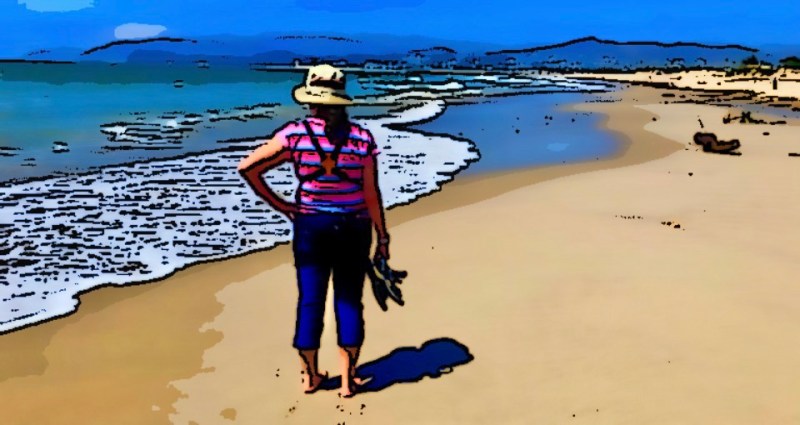
It’s not just that you shoot “looser” or more instinctively when on a trip, although that can certainly be a factor. It’s the intangibles as well. You’re not only evaluating, in the relaxed setting of a holiday, what a photo is for, you’re also making different judgements of what things are worthy of a photo. And then there are equipment issues; for example, when away, I tend to divide my work almost equally between a cel phone, on which I use a narrower, if more dramatic array of post-production remixes (see above) and my full-function mirrorless, with which I almost always shoot straight out of the camera.
In many vacation situations, the cel also acts as a kind of first-take “sketch pad” reference for ideas that I later finalize on some other device. And all of this is operating in my backbrain while my forebrain keeps nagging me to relax, damn you. But sometimes the magic breaks through. I can actually come home from time away with a small yield of pictures in which I managed to see a little differently, or somehow got out of my own way to a greater degree. In such cases I re-experience a part of the thrill I got the first time I put my eye to a viewfinder.
Now that’s relaxing.
EVERYTHING IS ON THE HOUSE

By MICHAEL PERKINS
THE MODERN-DAY FOOD TRUCK has brought back the concept of what used to be call a stand, as in hot dog stand or hamburger stand, a self-contained place where food was sold on the spot over a counter and usually by the side of the road. The customers were always served outdoors, because, unlike with a standard restaurant, there was no “indoors” as such. Following the nationwide expansion of the automobile in the 20th century, stands were situated wherever brief stops and quick eats were required by an increasingly mobile America. Photographers immediately fell in love with the individualistic, even quirky visual signatures of these small businesses.
One of the hallmarks of the stand was the time-saver of listing the joint’s entire menu on the front of the place, a kind of “this is what we have” simplicity that is now the hallmark of Food Truck Nation. The other place where single-purpose stands still survive, in an age of Denny’s and Burger Kings, is on the shabbily chic streets of beach towns, like this Thai takeaway in Ventura, California. Just a block from the ocean, this stand truly lives up to the phrase “everything is on the house” as the bill of fare is literally the entire front of the place. I don’t know if the stuff is delicious, but it sure ain’t pretentious.
I love places that have managed to thrive despite coloring outside the lines of corporate commodification. They offer hope that the American dream is still an individual vision, both for the stands and the artists of the world.

EVERYTHING, IT’S NOT
By MICHAEL PERKINS
PHOTOGRAPHERS ARE CONSTANTLY UPDATING THEIR VIEWPOINT ON ENDURING SUBJECTS; we never make just one sunset, nor do we think that our first portraits have to power to define any person for all time. Rethinks become re-takes; one day’s verity becomes a later day’s uncertainty. In making images, we not only catalogue what a thing is; we also attempt to reveal what it no longer is as well.
What you see here is the first dedicated “record shoppe” I’ve stepped inside in many years, although vinyl itself has been “back”, if you like, for nearly a decade. During that time, I’ve seen many book or department stores and artsy boutiques launch new, limited record sections here and there, but have found few stores that are completely dedicated to evoking the spirit of the all-vinyl era of my youth….the wood crates, the album cover wall art, the overall hippie/head shop vibe. This joint, located in a comfortably funky section of downtown Ventura, California, met all the visual criteria for a poignant memory jog, and yet my pictures of it seem less than substantial somehow.
For me, record shops were my community center, neighborhood hang, local pub and church, meaning that, for that part of my life, I was bringing something to the experience that certainly wasn’t present in just the discs and black light posters alone. And, that being true, there would be no way to capture that feeling, or its lack, in a photograph.
Some banishments or changes wrought by time are easily measurable with a camera, while other times, our attempts to show how our attitudes have changed toward a given subject may not be mechanically recordable, however keen our emotions on the subject. I am now well clear of the allure of the long-playing record. And while I have an affection for a time when such things were central to my existence, just wandering into a record shoppe won’t absolutely me to make a picture of everything it isn’t.

THE WAITING GAME
By MICHAEL PERKINS
THE SAYING “HURRY UP AND WAIT” may be most closely associated with the maddening stop/go cycle of events in the military, but it certainly also applies to anyone who serves the public for their living. This is especially true in small business. Not for nothing is the work of independent retail referred to as “waiting on” the customer, with most of the waiting spent in dead stretches until the next prospect actually walks in the door.
For photographers, small shoppes offer unique canvasses. Unlike the designs of chain stores, in which themes and decor are standardized on a nationwide basis, the layout of locally owned stores is as personal as a signature. The choice of where and how to mount displays, stock, even mementos is as personal as it gets, making every establishment a unique statement. But the arrangement of space is only half the equation; the other half resides in the physical presence of the proprietor.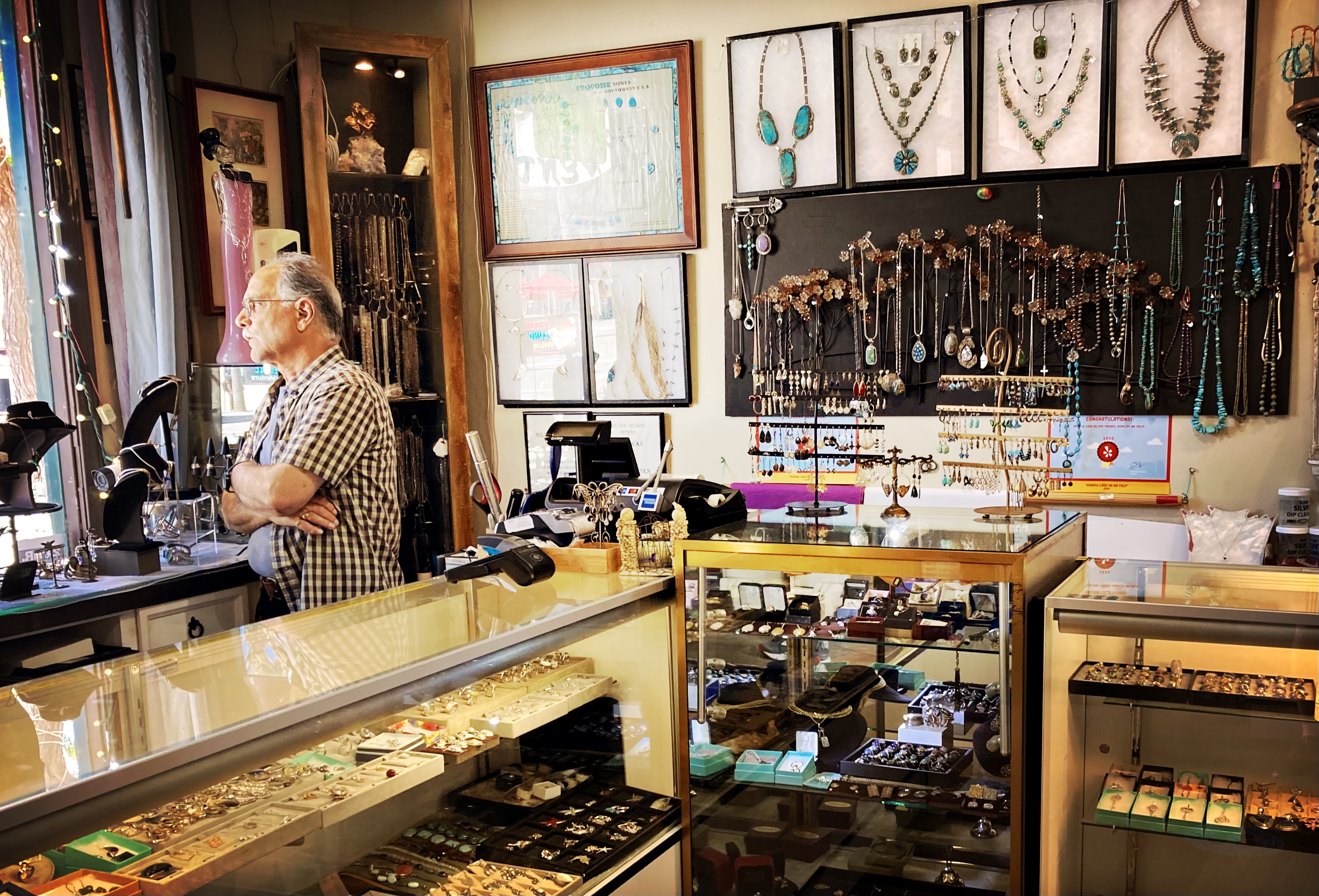
Snap a local shopkeeper and you’re exploring the face and body of the decision maker. The person who has the greatest investment in the outcome, the man or woman whose fortune is on the line. Someone who is rooted into the neighborhood, who knows who will buy and who will walk. Most importantly, his or her movement within the space tracks the technique of the shopkeeper’s most essential skill: waiting.
Images based on emotion, even the quiet, slow kind, are rich harvesting grounds for photographers. Showing the engagement of the heart and mind builds strong stories in pictures, since they are more persuasively about hopes and dreams.
SIMPLER DAYS, SMALLER DREAMS
By MICHAEL PERKINS
SMALL TOWNS ARE OFTEN ROMANTICIZED as places “where time stands still”, a label which speaks more of sentiment than reality. Our desire for a return to our personal Edens, the cradles of our formation, fires the imagination with a flurry of “what ifs” and “if onlys”, creating a fond longing for the impossible little burgs where such fantasy havens reside. Photographers, like the rest of us, hunger to capture signs that there might be a realm where the insane clock of progress is at least slightly slowed. It doesn’t take a lot to sell us the illusion.
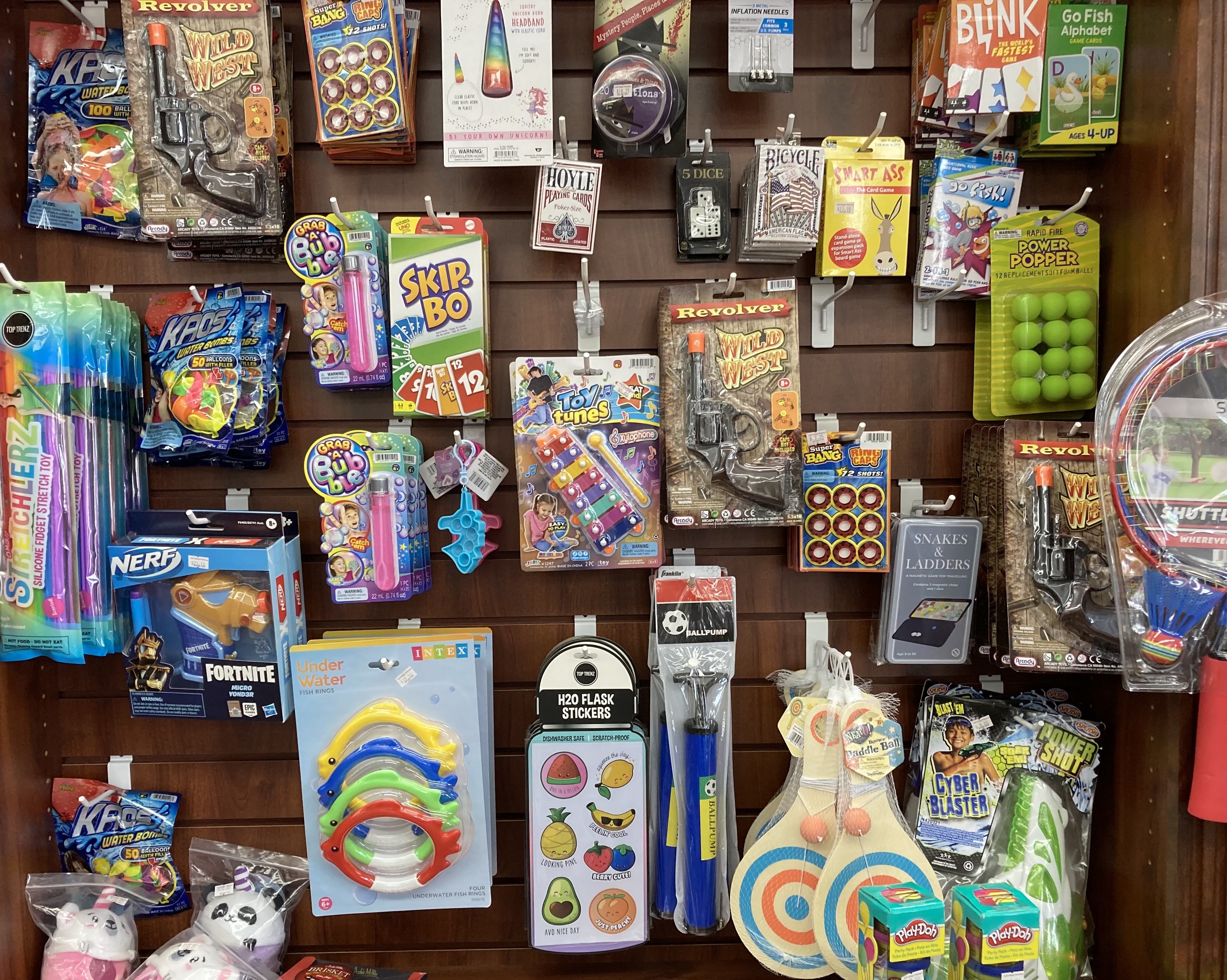
Hence the strange compact pocket of commerce seen here, found in a corner of a little pharmacy in Ojai, California, encompassing the store’s entire “toy department”. And what toys; the lowest-tech collection of kid stuff to be found this side of 1958, pastimes and playthings that seem to have rocketed from the heyday of Dennis The Menace to the microchip era by magically leap-frogging past the Nintendos and pocket screens of the ‘70’s, 80’s, and 90’s. I mean, paddle balls? Bottled bubbles? Cap guns? “Go fish” card games? Holy Cold War, Batman, where did I put my skate key?
This image completely composed itself, as framing it just a few inches in any direction would have placed the viewer back in the land of contemporary meds and nostrums, unmistakably dreamless totems of the 21st century. The result is a strange kind of border region; a perimeter of “Adult” junk, cheek by jowl with a portal to simpler days and smaller dreams, a place where you measured a kid’s value by how well Suzie could negotiate the gyrations of a jump rope or whether Bobby could make it to his “fivesies” with a set of jacks. A world in which all the grand dreams of childhood could reside in one small corner of the local drugstore, snugly stored between innocence and awe.
A FEW WORDS IN EDGEWISE
By MICHAEL PERKINS
OH, IT’S YOU…
Or, more appropriately, good to see you….
It’s been far too long since I’ve laid out the welcome mat to all the new subscribers who’ve signed up for updates from The Normal Eye since the last turn of the season. Please excuse my manners, which are more AWOL than non-existent. Obviously, none of this would still be limping along, eleven years on, without you.
TNE was never intended to be a one-way soapbox, or, in fact, any kind of soapbox at all. It started as sort of a diary of my own journey as a photographer, an unsure chronicle that I worried would have little or no utility to the public at large. After all, no one journey is applicable to all, and so I made no attempt to hold myself up as a general guide for technique per se, since everyone and his brother can teach the technical end of the craft far better than me. The blog thus kind of grew into an attempt at a two-person conversation, with my questions about the value of my own progress being thrown out not as an example but as a starting point for discussion. The point wasn’t to write about “how I did it” so much as to try to answer the bigger question, which was why I decided to do it at all.
For me, everything starts with vision and motivation, something I’ve tried to convey every time I sit down to compose this humble small-town newspaper. Tech is fascinating and fun, but, when it comes to art, machines are just machines, something we will all be struggling to remember as A.I. becomes either helpmate or Frankenstein monster as regards our photography. What makes a camera valuable is the eye in back of it, and the soul back of that eye. Getting at least that one point across has remained a constant aim in these pages, and you alone must decide if it has any value for what you’re also discovering about yourselves.
But back to point one; there is no Normal Eye without you, and I don’t re-state that as often as I should. So thank you. For your patience, for your advice, for your passion. And for striving always to see, to see, to see. That’s the entire ballgame.
THE SOUND OF NO HANDS CLAPPING
By MICHAEL PERKINS
I’VE HEARD A LOT OF HYSTERICAL HAND-WRINGING LATELY over whether anyone can still be a photographer is the age of artificial intelligence, as if the decision were solely in technology’s hands. I believe all this panic is wrong-headed; Art makes a grave error when it assumes that it can be nullified by any force outside the artists him/herself. Creative energy begins within and explodes outward. Its conception is private, sacred and inviolable.
What happens to intellectual property once it lands in the marketplace, legally or otherwise, is a different matter. Battles will be fought, and are being fought (talking to you, Screen Actors’ Guild), to protect a creator’s right to the publication of or profit from his/her work, and that’s as it should be. But while we’re fighting those battles, let’s observe what has happened to the integrity of the photographer already, in just the short space since the dawn of digital and social media.

Conduct your symphony for an audience of one. That’s the only one that matters.
We post and publish constantly, as if that’s all there is to making ourselves “photographers”. We make ourself slaves to approval, spending as much or more time pursuing likes and reposts than we did in the generation of our work. We’ve somehow adopted the idea that all this gratuitous praise will make our work stronger, more “authentic”; worse, we’ve come to embrace the notion that the world is breathlessly waiting for our pictures. Both ideas are demonstrably wrong.
If you’re going to be a photographer, then you must carry your own water. Own your concepts and execute them as best you can, but be prepared to be their only champion. No one is waiting for your next picture, and no amount of self-promotion can improve even a single image if you mangled either the concept or the execution of it. You must concentrate on the making of the picture first, last, and always. You must also face the fact that your best work may have no other jury than yourself, and be okay with that. The poet spoke of “the sound of one hand clapping”, but we must also be content with the sound of no hands clapping.
What makes this all worth re-stating is that worrying about someone (or some thing) stealing your work in the Age of A.I. is a non-issue unless the stuff is worth stealing in the first place. And just as in the case of social media, Art that is produced merely for approval is just pandering. For most of us, the work will have to be enough. Those of us lucky enough to emerge from the pack will find, just as we did in the earlier days of mass production, Xerography and Photoshop, ways to ensure that our pictures remain our work, and ours alone.
OLD AND NEW AND STRANGE
By MICHAEL PERKINS
PHOTOGRAPHY IS BOTH A DESTROYER AND RE-SHAPER OF CONTEXT. Destroyer, since, by freezing isolated moments, it tears things free of their original surrounding reality, like lifting the Empire State out of Manhattan and setting it afloat in the upper atmosphere. Re-shaper, since it can take the same iconic building and, merely by shooting it from a different angle or in a different light or on a different street, make it seem novel, as if we are seeing it for the first time. That odd mix of old and new and strange are forever wrestling with each other depending on who wields the camera, and it’s one of the qualities that keeps photography perpetually fresh for me.
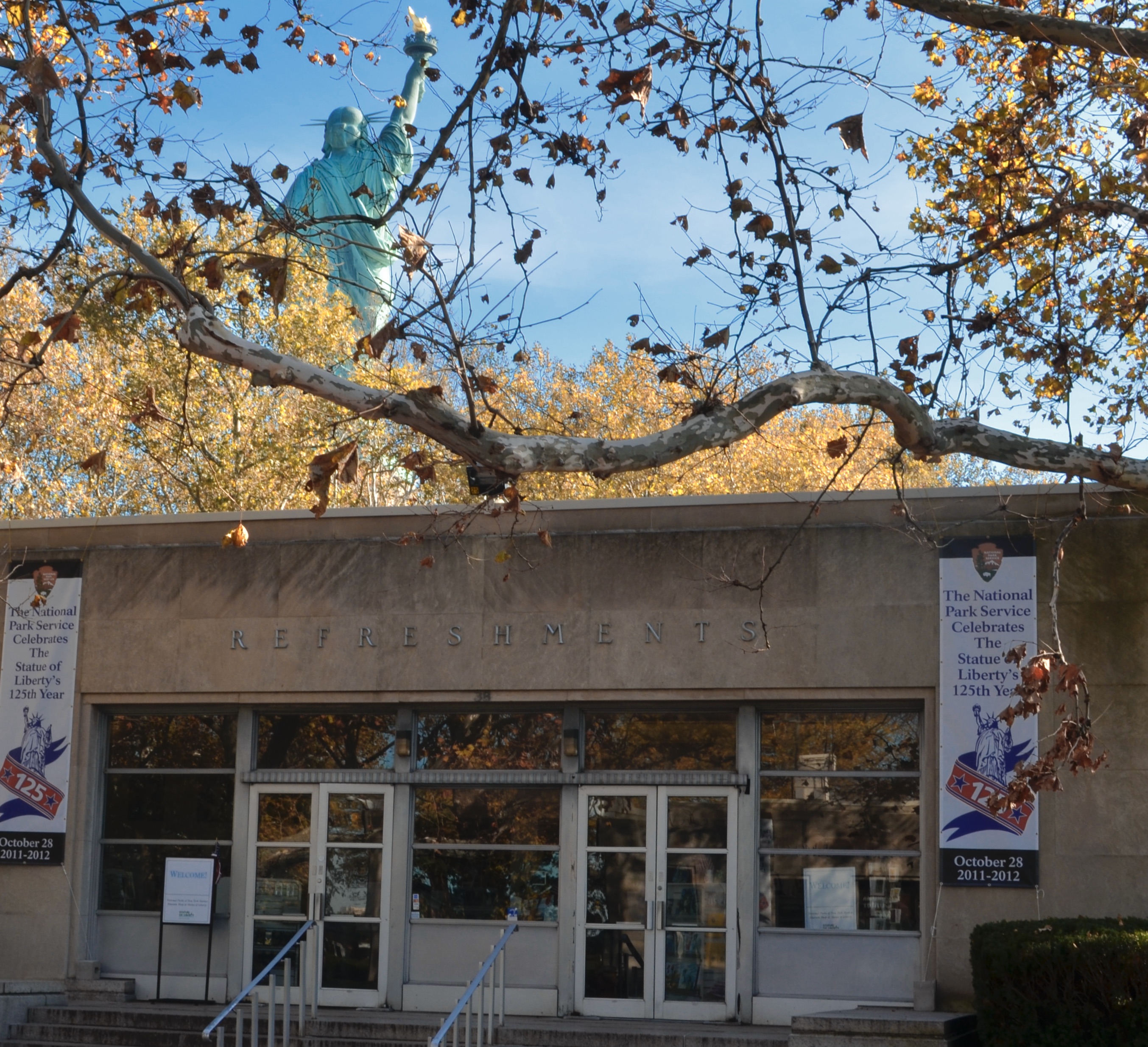
Take our famous Lady Liberty. It is burned into the global consciousness as one of the most powerful symbols on the planet, and its strength derives in part from the more-or-less “official” way it is photographed. We see it towering above the harbor, mostly from the front or side. Most of our snaps of it are destined to be echoes and recreations of mostly the same way of seeing it that has been chosen by the millions that have gone before us. Its context seems locked in for all time, and that frozen status strikes many of us as “proper” or “appropriate”.
But what does the same object look like if we force ourselves to go beyond the official view? Seen from the back, for example, as seen here, can it be upstaged, or at least redefined, by a refreshment stand or the golden colors of autumn? Do we even think of the statue as being in front of or to the side of or behind or framed by anything? Of course, what you see here is not a majestic picture, as may be the case in the standard “postcard” framing. But can that be valuable, to reduce the icon to merely another object in the frame? Can anything be learned by knocking the lady off her lofty perch, separate from all accepted versions?
Thing is, as we stated up top, that re-ordering of our visual concept of something is a key function of the making of pictures. We not only shoot what is, but what else may be. I’ve spoken with New Yorkers whose daily commute placed the Statue right outside their car window every morning of their working life, eventually rendering it as non-miraculous as a garbage truck or a billboard. For them, would a different version of the figure be revelatory? Making pictures is at least partly about approaching something stored by everyone in the “seen it” category, and saying, “wait….wait…not so fast…..”
GIVE IT TO ME STRAIGHT
By MICHAEL PERKINS
I’M NOT REALLY CERTAIN IF THE EYE actually has a preferred way to see, factory settings for composition that say “order” and thus facilitate the intake of information. Like you, I have read all the cautionary notes in the how-to books that insist on adherence to certain laws for framing a picture. These tips dictate how to create engaging portraits; how to arrange space for best narrative effect; and, perhaps chief among all of them, a level horizon.
Now here’s where the “rules were meant to be broken” faction in the audience begins to roar its disapproval, as the very idea that art should be subject to rules of any sort is as loathsome as ketchup on cottage cheese. And, yes, I understand that artists gotta art, and that too much formality can be the death of creativity. But then there’s that whole debate (see intro) on how the eye sees, and whether it has a bias toward information that’s arranged in a certain way. Pondering this too long can actually lead to photographic paralysis, a state in which you worry so much about shooting pictures that are “wrong” that you can’t shoot any pictures at all. And, as the Temptations once sang, “that ain’t right…”
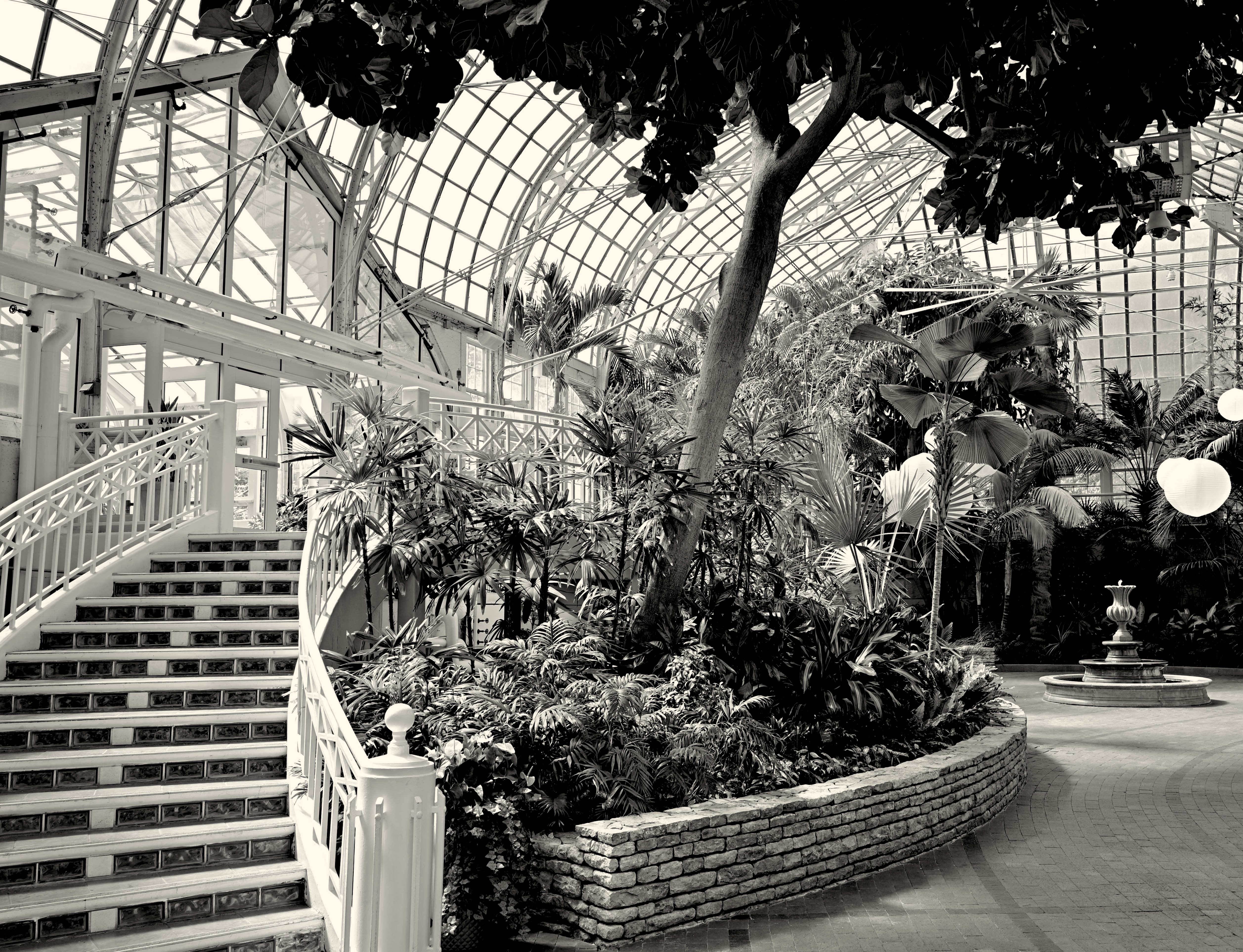
Does this look “bent” or “saggy”, or is it just the two martinis I had at lunch?
The idea of trying to put enough “correctness” in the layout of a shot gets tougher the more complicated its subject matter. Consider this image, taken inside a massive conservatory greenhouse. The curved staircase, the arched supports in the ceiling, the standard vanishing points and convergences….all make this composition very, very, complex, and trying to force it to adhere to some kind of calibration or “starting point” by which to engage the eye is tricky. And then there’s the entire discussion over whether I chose a lens (28mm in this case) that is too wide to ensure that the shot is free from distortion, making matters even worse.
The result is certainly dramatic, but perhaps less clear as regards a viewer who is encountering it “cold” without all the mental gymnastics that I put into shooting and tweaking it. And that’s important, because, in a photograph, that’s where my head and someone else’s eye are supposed to meet, to coordinate, if you like. Pictures start in one person’s eye, are transmitted to a machine, and then, at some point, are extruded to become conversations. If you’re lucky. How do we improve our luck? That takes more wisdom than can be contained in the how-to books.
THE PRECIOUSNESS OF VANISHMENT
By MICHAEL PERKINS
IN THE EARLY NINETEENTH CENTURY, PHOTOGRAPHY’S ORIGINAL PROMISE was to offer something that had never existed before in the history of the world; the seeming ability to capture reality, to make the tyrant Time itself subject to our will. In an age in which every force in nature, from electricity to distance, was being harnessed to the use of science, this prospect seemed logical. We could now, with this device, preserve our lives as surely as we might imprison an inject in a jar, the better to study at our leisure.
Of course, the truth turned out to be a bit more nuanced.
Instead of imprisoning all of time, we were merely snatching away pieces of it, affording us not an entire view of life, but selective glimpses. Trickier still, we found that all our images, even those we preserved and curated, were still connected to their original context. And as time robbed them of that context, as events and people passed into the void, the pictures that were plucked from that daily continuum also lost a bit of their meaning. Ironically, the thing that was designed to explain everything could eventually be rendered an unfathomable mystery.
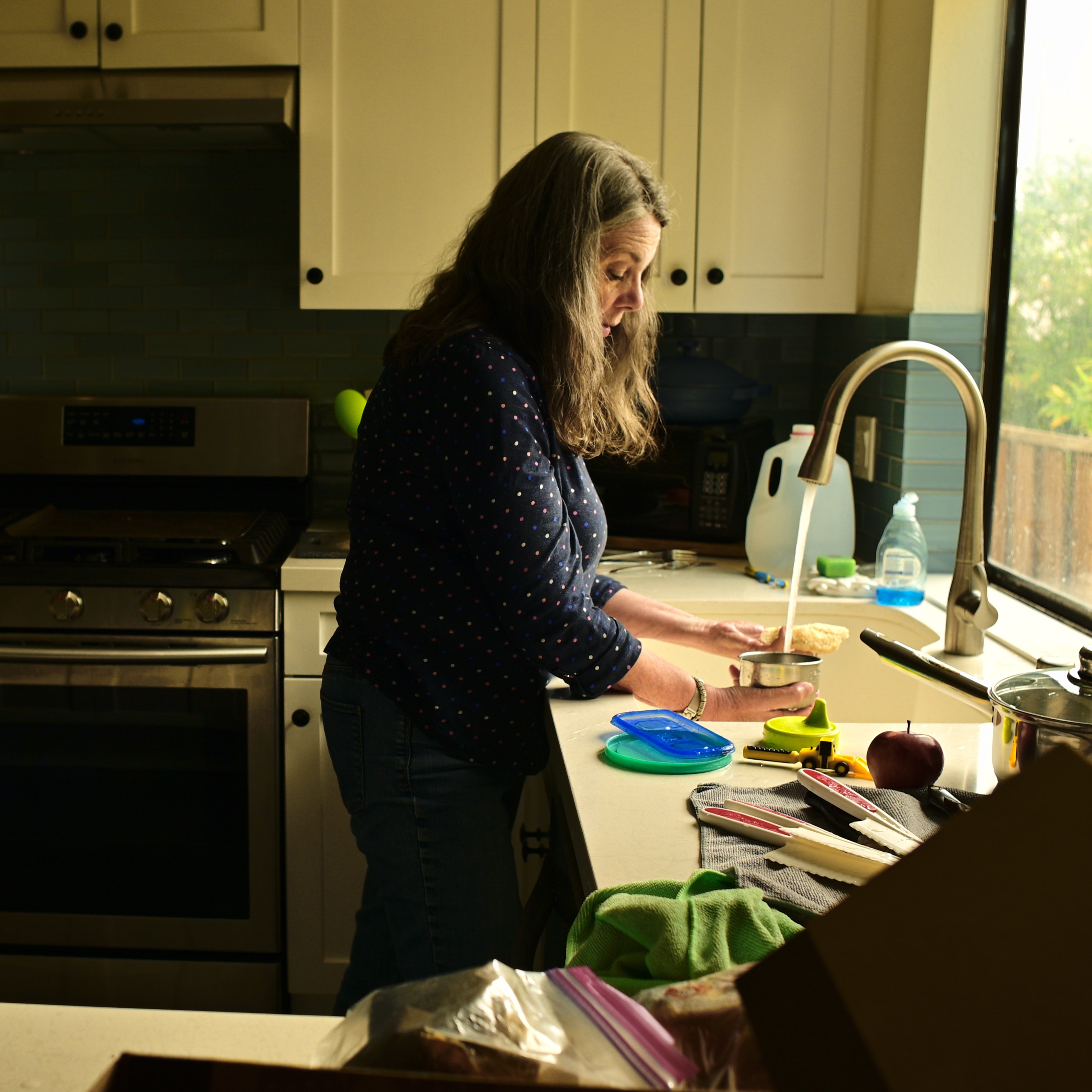
Most of the pictures we make of our most cherished people show them in the ordinary acts of living. In the main, they are not chronicles of big things or important days, but, on reflection, it may be that very ordinariness that makes them all the more special, more singularly personal. Over our life together, I have made thousands of pictures of my wife Marian, most of them random, reactive shots rather than pre-conceived portraits. This is strategic; she doesn’t especially like her picture taken, and actively disdains most of the results by most shooters. If I draw a comment as positive as a “that isn’t too bad”, I feel I have beaten the game, or, more precisely, that I have managed, in small ways, to show her what I see every time I look at her.
One day she and I, the “real” people that provide the context for all these pictures, will be no more, and a special kind of mental captioning that accompanies them will also go. Will the images have enough value to be more than the anonymous curiosities we now explore from photography’s earliest days? Will these faces be precious is some way even as their foundation myths are vanished?
HEY, LOOKA ME
By MICHAEL PERKINS
ONE OF THE MOST PREDICTABLE PHOTOGRAPHIC CLICHES OF CONTEMPORARY TELEVISION consists of the “establishing shot” used in many drama shows, depicting a particularly important locale wherein the action of the show will take place, be it a corporate HQ, a cop station, a courtroom. The site, whatever its purpose to the story, is shot in the widest angle possible, drastically distorting all sight lines and perspectives, as if to get the viewer’s attention in a visual shorthand that announces that something important is about to happen here. And, consistently, the first scene inside these places, shown immediately after, is shot with a much narrower, or, if you will, “normal” focal length. It’s a one-two combination that has become part of the visual grammar of storytelling.
Drama, as it’s artificially created by visual camera optics, can certainly be an effective narrative tool, but it can also become an effect for effect’s sake, a crutch used to juice up a subject that doesn’t deliver enough impact without it. And of course, the use of tech to dress up an essentially weak image is always a temptation, especially since more and more shortcuts than ever before afford the chance to enhance and tweak. And like many giddy sensations, it can evolve into an addiction.
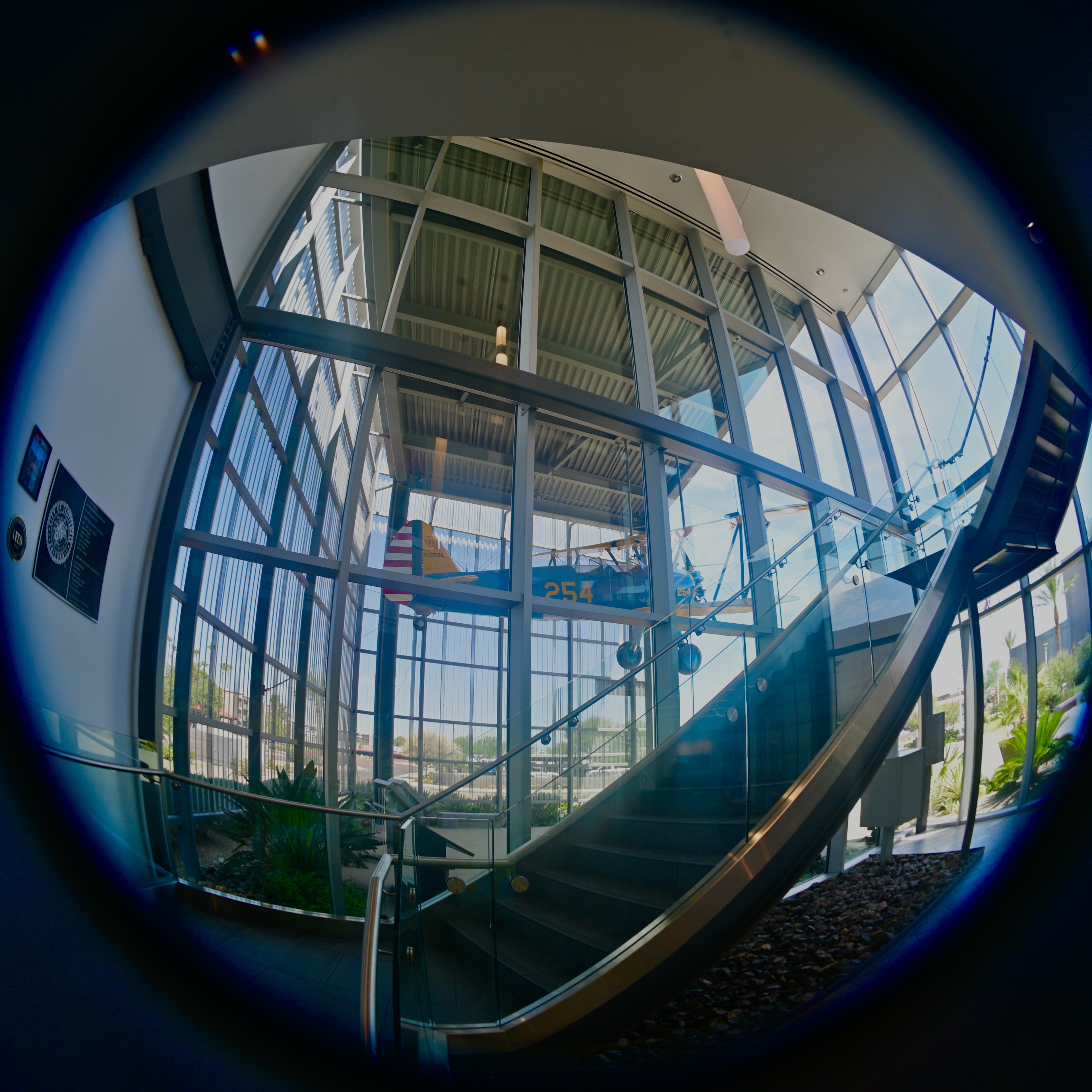
I have been trying to get “THE shot” of this classic biplane for years, trying to tie into its history and mystery by switching lenses, taking different angles and approaches, shooting in both full natural and completely unnatural light, the works. In this image, I’ve resorted, like many TV directors, to photography’s big go-to for instant drama….an ultra wide. Just as in courtroom and cop shows, the distortion, the unreality of this 12mm fisheye is used to give the subject more power than it might have in standard perspective. The nearly 180-degree coverage of the lens also allows me to get the entire plane in one shot, something that’s proved difficult because of the tight glass “hangar” in which it’s displayed. Here, I have tried to render the plane itself in nearly normal aspect, choosing instead to distort the showroom it’s encased in. As always with wide-angles, it’s not totally about getting everything into the middle of the shot, but getting yourself deeper into the middle of everything that you frame. If that sounds like double-talk, well, welcome to the wonderful world of counter-intuitive photography.
I might have fallen in love with distortion at an early age since I was raised on comic books, where cartoonists freely violated perspectives in the service of a story. Comics are by nature gross exaggerations of reality that pass themselves off as plausible substitutes for it. My camera eye may still want to linger in that playland. Sometimes we just want our pictures to shout, hey looka me, and we’re fairly shameless at going for those eyeballs.
THE WAITING ROOM
By MICHAEL PERKINS
I’VE NEVER BEEN THE SORT OF PERSON to derive peace or comfort from most inherited cultural rituals, especially the formalized etiquette we have constructed around death. The trappings of mortuaries and cemeteries offer me no connection with people I have personally have lost over the years; I experience the vibe of such sites distantly, more like an anthropologist might wonder at the rites of a vanished culture that he’d stumbled upon in his studies. And that means that photographing the symbols and structures of such place is purely an appreciation of design, producing no pangs of emotion. I’m just making pictures of things that strike me strange.
Walking into a cemetery, for a photographer especially, means encountering strange juxtapositions. There are the fixed objects that never change, i.e., the headstones and statuary, and then there are the temporary signs that speak to the fleeting feelings of the living, items that briefly intersect with the permanent fixtures; the flowers, messages and other improvised memorials that eventually will be cleared away by the groundskeepers (as will we all) .
Most can be readily understood. And then there is the occasional mystery.
Like a mylar balloon tethered to a stone angel.
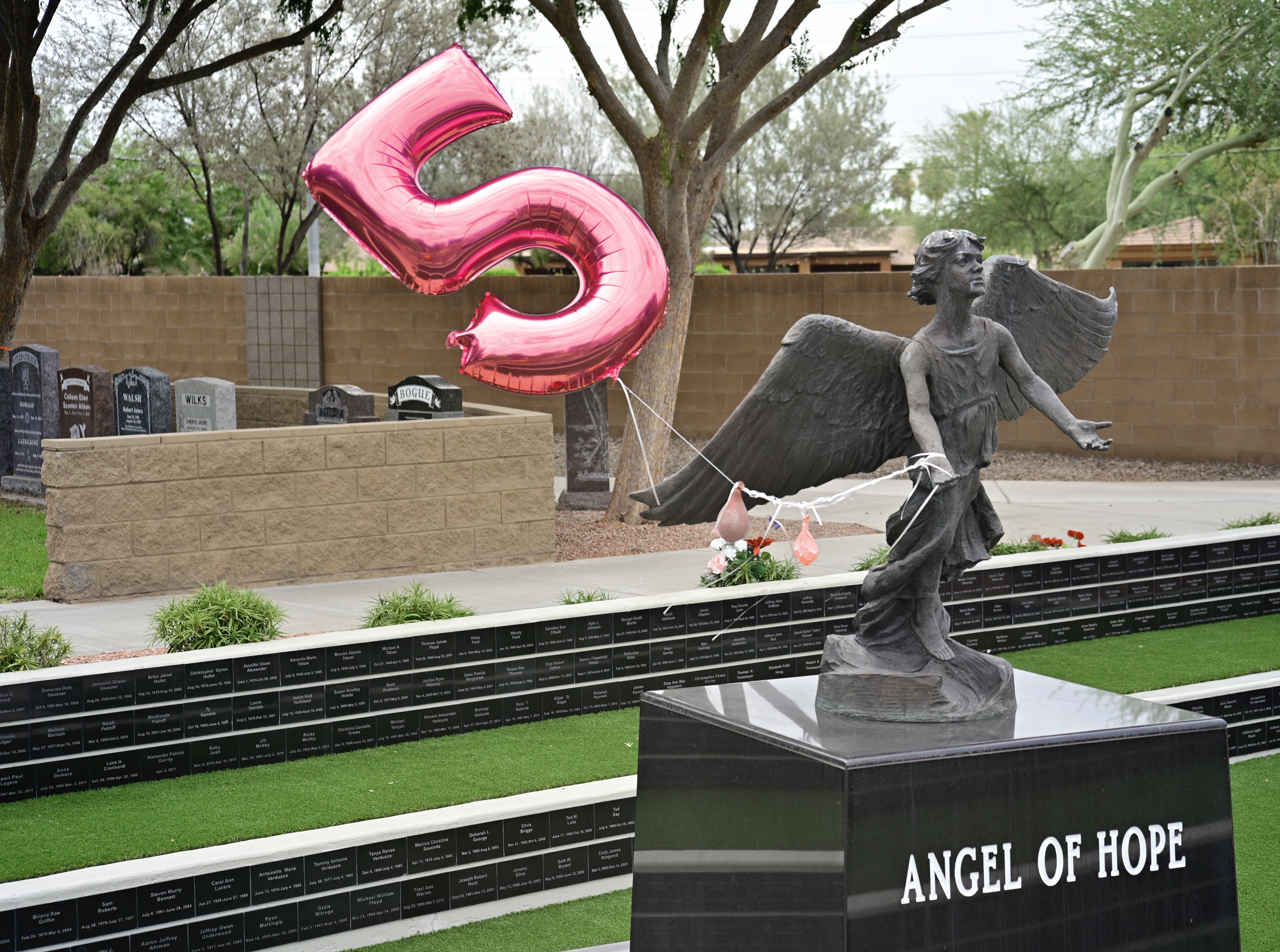
Most motives in graveyards are readily decipherable, but I will likely never know what the number 5 shown here means. It is the most private of messages, and a strange mix of the bouncing of the breeze-blown balloon with the fixed, stiff pose of the Comforter. Regardless of whether it’s been 5 years since someone left, or whether they were merely 5 when they were taken, or…or….?, the picture I snapped out of curiosity is a frozen puzzle, appropriate in a space where all things are now frozen. Suspended. Interrupted.
The fact that I explore narrative clues among the graves of strangers is odd, given that I don’t visit the graves of people I actually knew. I may be trying to find some bond between the loss of others and my own, but I don’t think that’s it. I believe it’s just that I love pictures, especially the odd ones, the ones that defy explanation. Visual art is all about dealing with questions, after all; the running box score of what we learn, or don’t learn, from these random instants that we’ve yanked out of time. Sometimes, just having successfully stolen that odd, singular thing from eternity is enough. Sometimes, it does a number on you.
A LAW OF AVERAGES
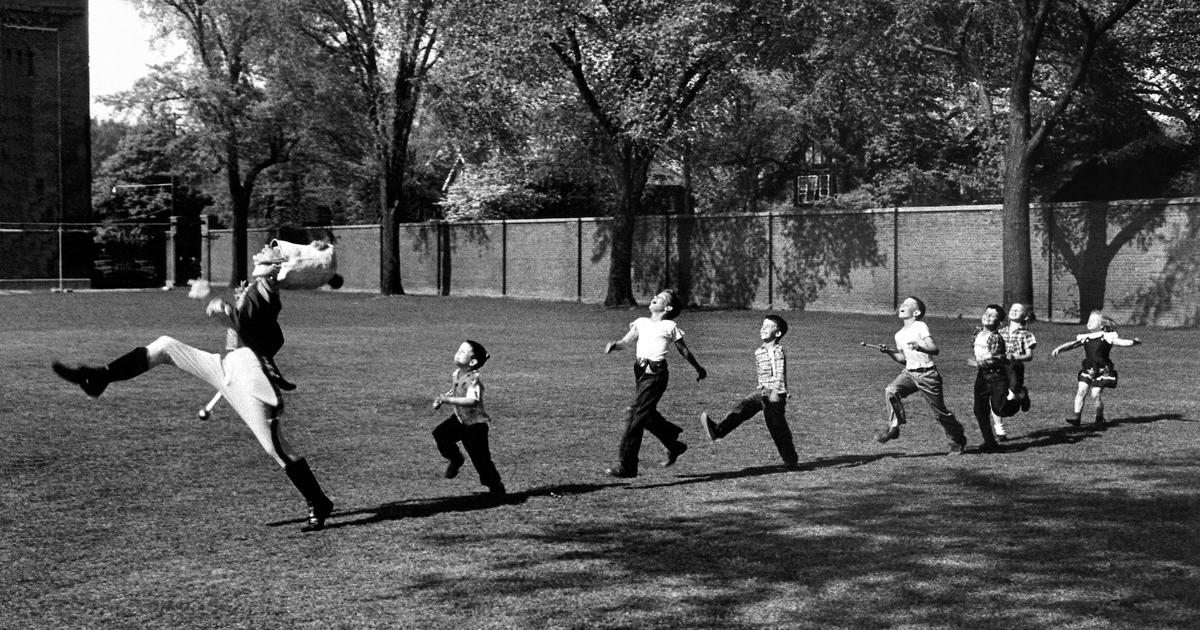
Alfred Eisenstaedt demonstrated the value of being in the moment, often with the simplest possible gear.
By MICHAEL PERKINS
IN RECENTLY RE-WATCHING A BBC DOCUMENTARY on the legendary Associated Press and Life magazine photographer Alfred Eisenstaedt, I was struck by how, over his lifetime, he moved steadily toward simpler and simpler equipment, beginning with the bulky plates of early 20th century press cameras and moving on to the sleek and light Leica that helped him created many of his most iconic images. Simply put, as he shot more and more, he carried less and less.
This was a deliberate choice.
“Eisie”, as he was known to peers and subjects alike, chose cameras that worked within the law of averages, gear that, on balance, delivered most of what he wanted most of the time. This eliminated unneeded change-outs of over-specialized kit, adding to the reaction time he needed to capture so many evanescent images of our time. He didn’t specifically disdain formal studio work, nor did he pooh-pooh the use of artificial lighting, and yet he shot almost always in the moment, where the action was happening, and under the conditions prevalent in that moment. That meant using a generally serviceable camera that could perform well virtually everywhere versus packing a crap-ton of extras that might or might not be needed. As a result, his work was divinely human, imbued with empathy, wisdom, and a whimsical sense of humor.
We often get drawn off the mark, in thinking that a given piece of equipment should always be on hand “just in case”, rather than honing our eye and our soul, which is where all the good pictures come from anyway. Purveyors of optical toys can be quite seductive in persuading us otherwise, getting us gear-focused, hungering for the next technical breakthrough, the magic lens or gizmo that will, finally, make us a better photographer. It’s a little like saying that you’d drive nails better with a more expensive hammer. But the spell is strong and it often leads to many people with many closets crammed with many devices, which may or may not yield better results than solid, basic gear.
Eisenstaedt showed time and again that the ability to read conditions in the field, to anticipate, to solidly compose, to know the value of a changing event, can succeed without a shooter having to shovel cash into the constant accumulation of stuff. If a camera does your bidding consistently and eloquently, it is a “good” camera. If your essential needs truly change, those needs will point like a neon arrow to whether you need a technical upgrade. But the best shooters prove in every age that when, as drag race drivers say, you simply “run what you brung” the pictures will most very often find you.
TRAVELS WITH MY NVr-WZ
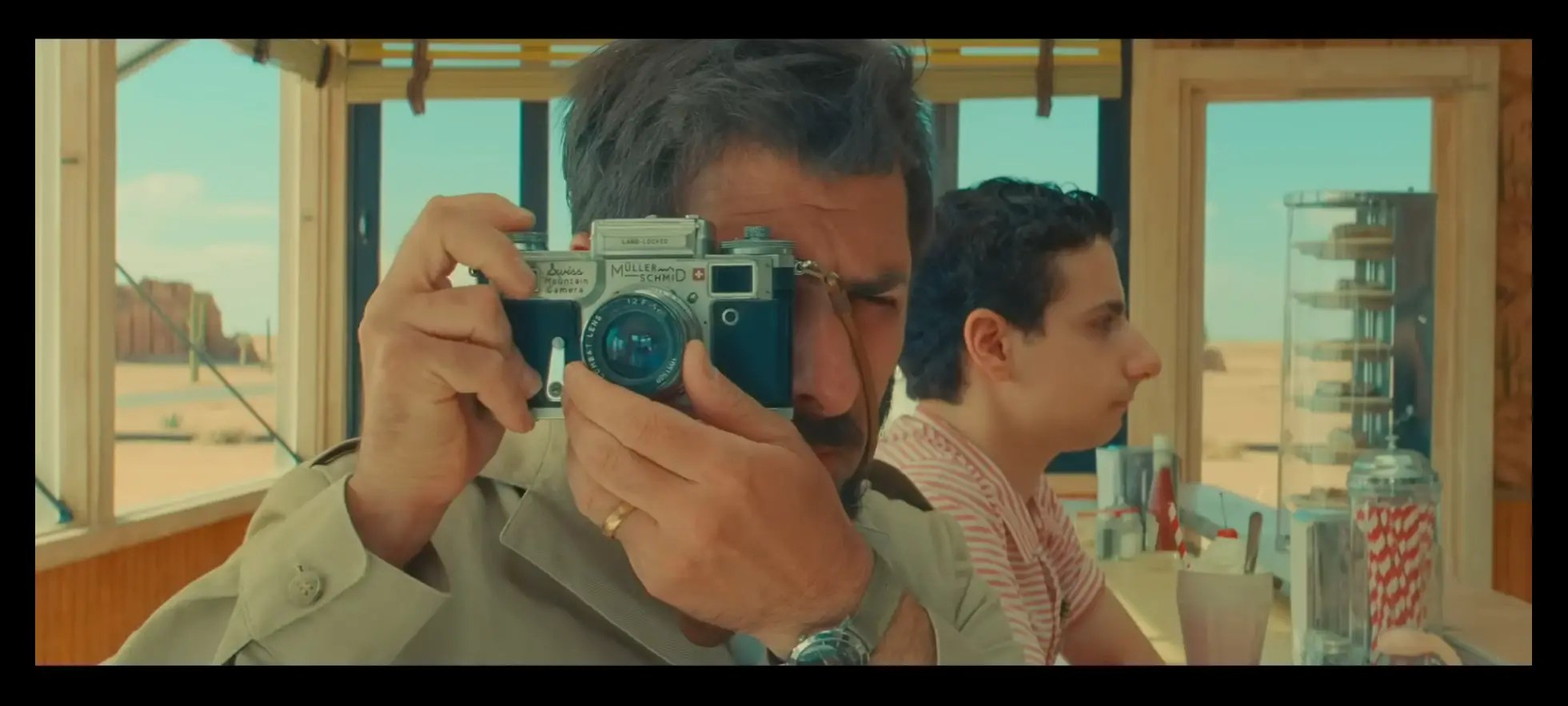
What the discriminating fictional snapper relies on in the American desert of 1955; Jason Schwartman’s fictional “Muller-Schmid Swiss Mountain Camera” in Wes Anderson’s “Asteroid City”
BY MICHAEL PERKINS
PROP DESIGNERS FOR MOVIES have to walk a bit of a tightrope when creating on-screen objects, dodging copyright laws (unless product placement is truly the goal), redefining the physical properties of things (think planes that could never actually fly) or even crafting plausible gizmos that cannot exist in the real world (think phasers). Combine all these skills with the recent craze for burying hidden in-jokes or “Easter eggs” in movies to reward multiple viewings by the nerdiverse, and you have the special world of fun fakery, a world where, on occasion, the coolest cameras reside, all bearing the NVr-WZ (never was) trademark.
Fictional cameras in film set my inner geek’s heart a-racing, and, judging by a general search of the interweb, I am not alone. A recent entry is the camera that is sported by Jason Schwartzman’s character Augie Steenbeck in the new Wes Anderson hallucination Asteroid City. In the frame above, Augie, said to earn his bread covering various world crises, sports a “Muller-Schmid Swiss Mountain Camera”, which, of course, never existed in any world outside Anderson’s unique 1955 desert-y destination for science dreams and Cold War nightmares. The deliberate fakiness of the device has sent camera lovers into a game of Clue as to its design origins. And, as with everything else debated on-line by camera lovers, well, let’s just say the results are inconclusive.
The labelings on the camera are the biggest part of the fun, with the optic being labeled as a “combat lens” (so…can it not be used to snap, say, family events in peacetime?), and the overall model being referred to as a “Swiss Mountain” camera, as if there may be additional variants for Italian or Greek or Tibetan mountains elsewhere in the product line. And then there is the brand name itself, “Muller-Schmid”, which may or may not be a reference to Joey Schmidt-Muller, a surrealist painter who pioneered a style called New Objectivity in the 1930’s and who invented a term for his work called “traumatic realism”. In fact, Anderson may just have pulled the two names out of thin air, although I doubt it.
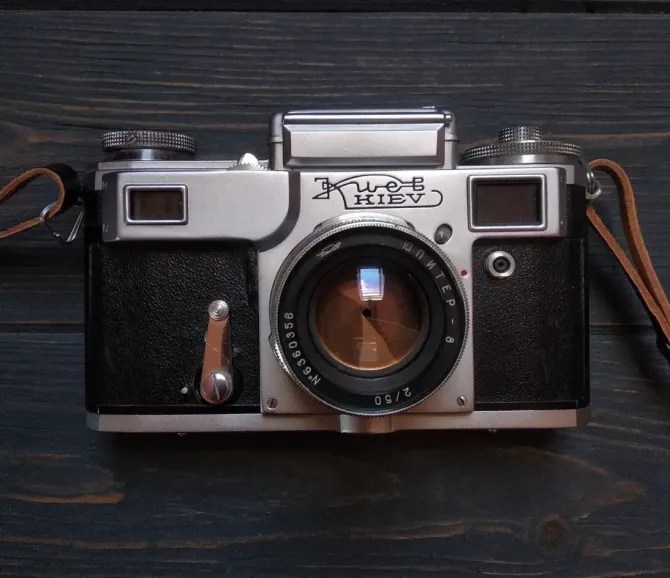
Was the Soviet Kiev 4M the inspiration for Augie Steenbeck’s imaginary kit?
A lot of online detective work, however, has focused on the general layout of features on the camera, with most fans insisting that it must be based on a Contax III rangefinder (introduced in the 1930’s), while another large camp is certain that it’s actually more like the cheap Soviet-era knockoff of the Contax, the Kiev 4M (seen just above). Does it matter? Welllll, either a great deal or not at all, depending on your perspective. What does seem consistent is Wes Anderson’s talent for sending cues to our collective subconscious, our inherited warehouse of cultural impressions, and tossing all that data like salad to create new worlds that are alien and familiar at the same time, worlds where a vintage NVr-WZ is the perfect camera for the task at hand.
HERE WE ARE AGAIN FOR THE FIRST TIME
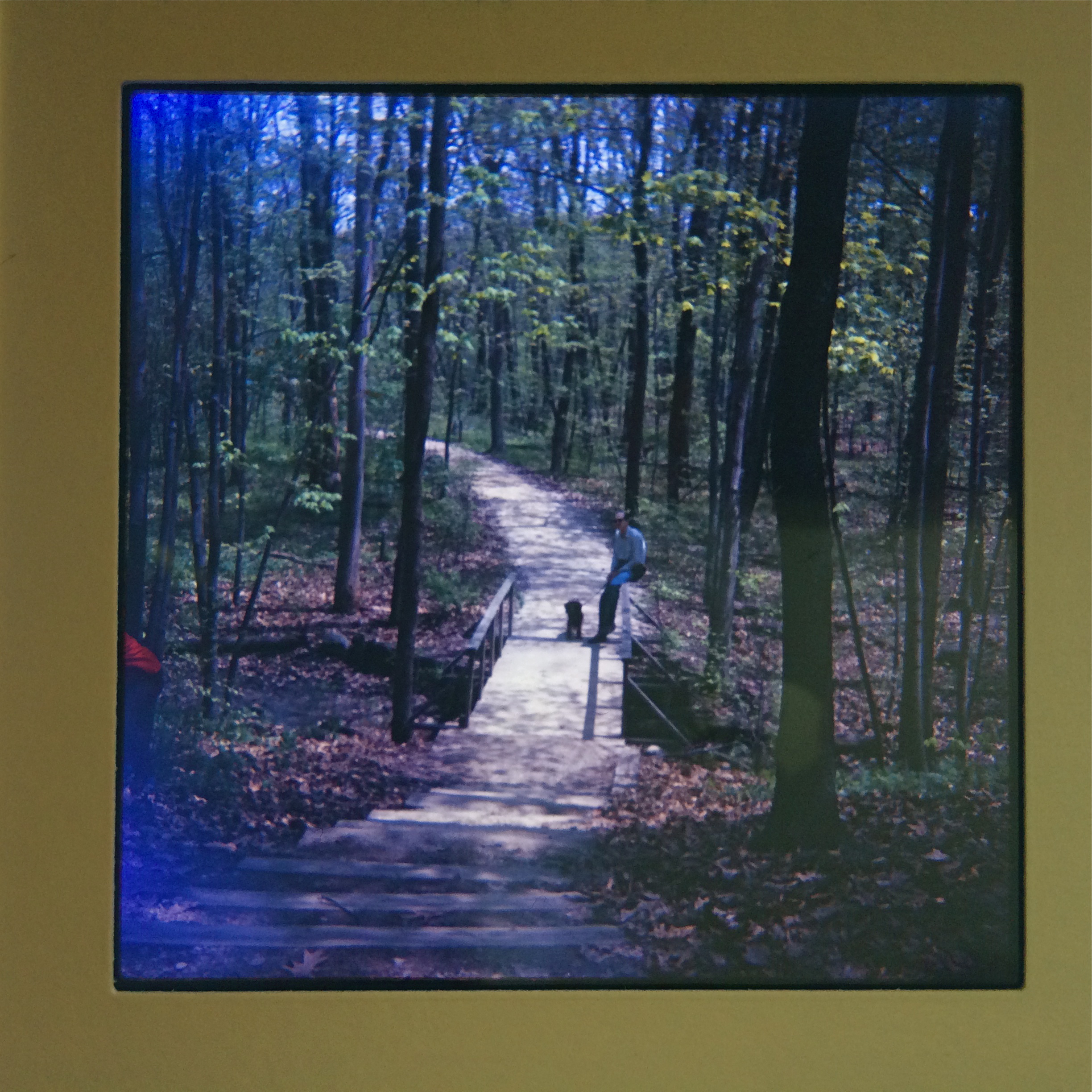
1966: An early attempt at an “atmospheric” scenic, complete with the kind of light leak that a five-dollar plastic toy guarantees. What a long, strange trip it’s been.
By MICHAEL PERKINS
WE OFTEN MANAGE TO SUCCESSFULLY EXPORT AN IMPRESSION OF A PICTURE from our mind’s eye into our cameras, and ofttimes the result is reasonably close to how we originally envisioned it. Of course, there is always a gap, small or great, between conception and execution, and the life work of a photographer is learning to negotiate that gap, and sometimes, to do battle with it over and over again. Our first tries at a picture may be immortalized on a sensor, but the germ conception remains in our heads for a lifetime.
This means that certain images, consciously or not, periodically re-assert themselves into other “takes” further down a person’s timeline. We actually may take many versions of a “type” of image over years, seeing its design as a kind of baseline, like the chord progressions in Bach’s Goldberg Variations, which act as a steady foundation for an amazingly distinct number of alternate realizations, each unique unto themselves, each anchored by the same central spine of changes. I am now far enough from my earliest pictures to realize that certain pictures demand a return or a restatement as I move through time.

2023: Different path, different time, different camera. But a different result overall?
One favorite theme from my first days with a camera, the old “sunlit path winding back into the forest”-type composition, recently came back to visit (haunt?) me in a stop by almost the same space where I first tried it in 1966. The top image seen here was shot on 620 medium-format ASA(ISO)-rated slide film on a plastic toy camera with a fixed aperture, a plastic lens, and a single shutter speed. The man pausing with his dog on the footbridge was the kind of cue that your brain (and all of the classic how-to manuals) tells you “might make a good picture”, and so I took it. Luckily, the path and the woods got enough light to save the shot, something which was not the case in 99.99% of my woodland tries at the time. The second shot was taken just weeks ago in the same metro park system in the same city, and this time, as I was armed with a Nikon Z5, the decidedly lower available light did not spell defeat, although I confess to having goosed the luminescence of the path a bit afterwards.
Why do some compositions and conditions urge us to repeat, and perhaps, refine our approach to a familiar subject? Is it merely a pang for a do-over, or do we believe, on some level, that we can actually bring something new to an old subject at different times in our lives? I suspect it’s a little of both.
SIZE MATTERS
By MICHAEL PERKINS
TRICK PHOTOGRAPHY seems to travel along two parallel tracks in its relationship between shooter and viewer. If we approach it in a purely creative sense (Track One), we intend to deceive the eye into believing that the alternate realities we’ve created are plausible, essentially acting as magicians who choose a camera over a wand. The audience is there to be fooled, and we are there precisely to fool them.
In Track Two, however, shooter and viewer are in a kind of winking partnership, in that they are in on the joke. We and they both know we have visually concocted a lie, with each party deriving enjoyment at how clever is the deceiver and how hip are the deceived. There’s no attempt to pass off what we’ve created as “real”, and no embarrassment at having purposely left clues for the viewer, who is all too glad to catch us in our fib. It is this second track which seems to underlie the photographing of miniatures.
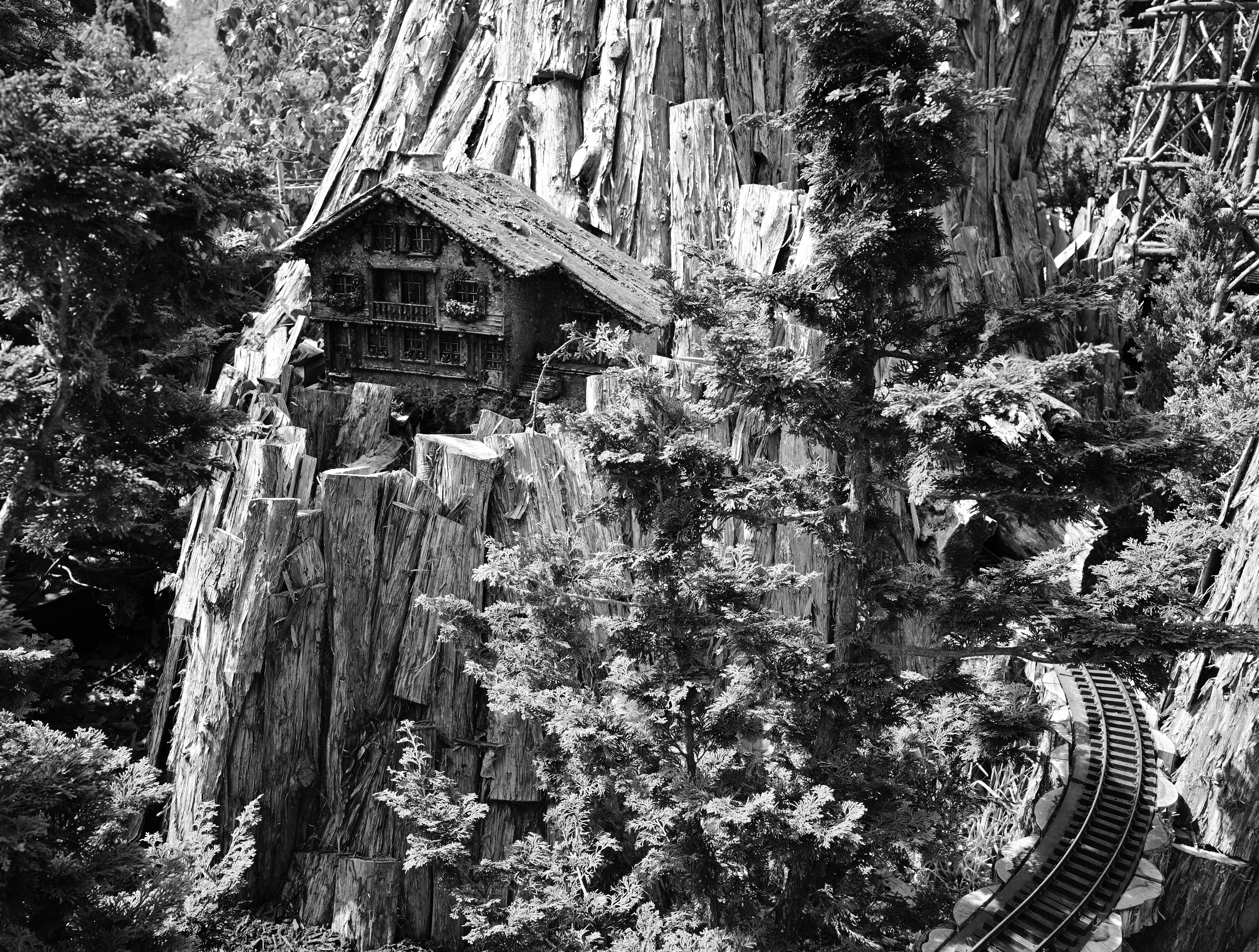
Many of us have at least dabbled in shooting scaled-down simulations of various scenes mounted atop tables and pretending to pass them off as the real thing. The audience knows that we know we’re faking, and feel satisfaction at not being taken in, even as both they and us tacitly agree that the object was not to actually deceive. Tabletop tableaux have spawned an entire separate school of lens-making and technical disciplines to aid the illusion, but in two simultaneous directions: making miniatures pass for full-size objects and shooting full-sized scenes of actual objects or people and making them seem like scale models.
In the case of the “mountain cottage” seen here, you’re looking at an intricate, fairly large model railroad layout staged in a public park, which I’ve framed so that it’s easy to either believe that you’re looking at, well, a fake, or, if you prefer, have suddenly been transported to a lonely alpine retreat that’s totally not in a botanical garden at all. Photography is always partly about pitting actual reality against constructed reality, sometimes within the same image, and so, in the service of a good joke, it’s not unusual that you would embrace both the roles of charlatan and sucker. And be happy either way.
ALL TOGETHER NOW
By MICHAEL PERKINS
IT STARTED OUT WITH MY LIFELONG REGRET at not being able to interview the world’d greatest photographers. Beyond the fact that too few opportunities for actually meeting the greats would ever present themselves in a dozen lifetimes, there was the problem of what, in the name of all that’s holy, I would even ask. Which of them could define, for all the others, what constituted a good picture? Which single person’s work could speak to the full possibilities of the medium? I learned to be content with studying the piecemeal remarks some of them had made, words that often were as evanescent or mysterious as their visual work. And then I realized that they were all, equally, correct.
More precisely, they were all, in an infinite variety of viewpoints, all articulating the same quest, the same terms for their work. Technical mastery, yes, but also personal discovery, a constant struggle to better know one’s self, to hone one’s eye, to synch it with the soul more effectively. I decided to try to show how common this struggle was, across the words of so many shooters, by concocting a kind of “superquote”, a coherent general statement about photography that was actually a composite of the thoughts of many. I served one up in these pages about a year ago, and it was such fun that I offer what follows here as the sequel. As before, different sentences or thoughts originated with different photographers, the identities of which are given, in order of their appearance, in the key below. We are all different, and we are all the same.

Q: How would you (all of you) characterize your personal view of your work?
A: Photography is the simplest thing in the world, but it is incredibly complicated to make it really work. It’s not enough to just own a camera. Everyone owns a camera. To be a photographer, you must understand, appreciate, and harness the power you hold. Only photography has been able to divide human life into a series of moments, each of them with the value of a complete existence. In photography, there is a reality so subtle that it becomes more real than reality. It’s about finding out what can happen in the frame. When you put four edges around some facts, you change those facts. To me, photography is the simultaneous recognition, in a fraction of a second, of the significance of an event. The eye should learn to listen before it looks. Photography takes an instant out of time, altering life by holding it still.
Technology has eliminated the basement darkroom and the whole notion of photography as an intense labor of love for obsessives and replaced them with a sense of immediacy and instant gratification. But no matter how sophisticated the camera, the photographer is still the one that makes the picture. The two most engaging powers of a photograph are to make new things familiar and familiar things new. Of course, there will always be those who look only at technique, who ask ‘how’, while others of a more curious nature will ask ‘why’. Personally, I have always preferred inspiration to information.
So stare. It is the way to educate your eye, and more. Stare, pry, listen, eavesdrop. Die knowing something. You are not here long.
(1.Martin Parr 2. Mark Denman 3. Edward Muybridge 4. Alfred Stieglitz 5. Garry Winogrand 6. Henri Cartier-Bresson 7. Robert Frank 8. Dorothea Lange 9.Joe McNally 10. Doug Bartlow 11. William Thackeray 12. Man Ray 13. Walker Evans)
 thenormaleye