THE YEAR OF THE “GO” PILE
By MICHAEL PERKINS
THIS SPRING SAW THE CURTAIN RUNG DOWN ON OUR LIVES IN PHOENIX, ARIZONA. Marian had stuck it out in the Valley Of The Sun for thirty-three years; I put in twenty-five. We were both, as the young say, “over it” for some time prior to our move to California, but we had to wait until all the planets and stars lined up along with our retirement options to give us an escape window. What made the final phase of this strange was that, after decades of dreaming about The Final Day, we found the end-stage events leading up to it to be traveling at light speed. At the end of a looooong stretch of “wait”, we were fired out of a big “now” cannon.
I didn’t chronicle the entire project. On most days. there was simply too much to do in too short a span of time to stop to pick up a camera. We had about three furious weeks to finalize our new lease in Ventura, sort 3,000 square feet of earthly goods into a take-with pile comprising about half that space, hire and direct the efforts of an estate sale agent, get the surviving stuff packed and trucked westward, re-carpet the entire empty house, meet our transferred junk on the other end, and supervise the sale of the house through phone, fax and email. As I say, not a lot of time for snaps.
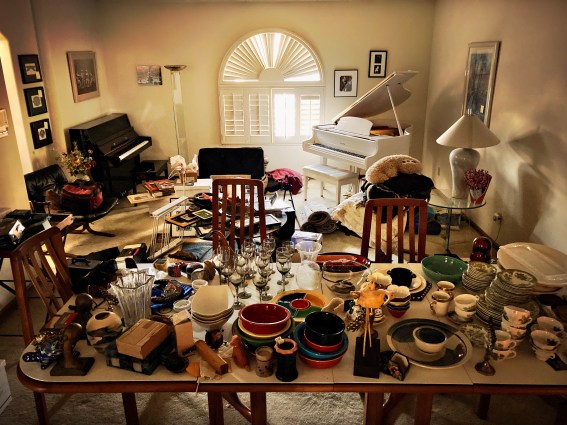
The scene here is something of a mish-mosh, in that it’s an early study of what-goes-what-stays, done before any final decisions for any of it were made. Hence, I can pick out objects, here and there, that we actually brought with us, some that went to estate sale, some that had yet to be ruled on, and a few things we thought we could sell that eventually went to charity. The reason this photo recently bobbed back up into my consciousness was because Marian and I are presently in the “did we leave that behind, or did we pack it?” phase, which looks as if it will go on for the next immediate….millennium. There were other photos made during the madness, including many tabletop commemorations of school and art projects by her two children going back over thirty-some years. Every museum isn’t a house, but every house is a museum. I could sum this all up by saying something philosophical about how little you can live with once you make a few tough calls, but I don’t want to congratulate myself too much while I am still occasionally opening boxes filled with “why the hell did I bring this…..?”
PARALLEL TRACKS
By MICHAEL PERKINS
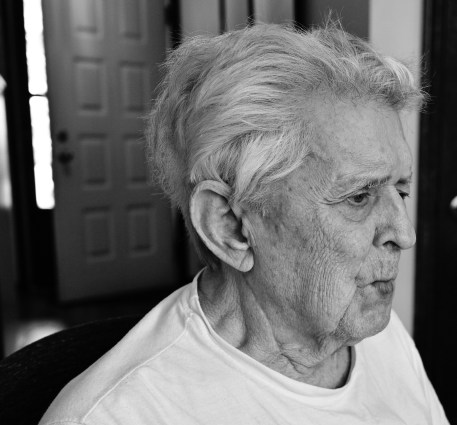
I’VE SPOKEN IN THESE PAGES BEFORE about the obligation and/or honor of photographically chronicling my ninety-five-year-old father’s last years, of being torn between wanting to create an honest, unvarnished record of his gentle but inevitable decline, and feeling duty-bound to also make the most reverent images of him possible for a family that will never really be ready to say goodbye to him.
It’s one massive juggling job, much of it done with a very solid lump in my throat. It’s chronicling a single human life along parallel tracks with dual versions of itself.
As a photographer himself, Dad raised me to be as visually alert and as honest as possible. He taught me that there is no such thing, for example as a “line” in nature, that what we call that thing is actually just a difference in the kind of light that meets two adjoining surfaces. That interpretation means respecting what you see but also extracting what’s not readily visible as well. Were he still able to see well enough to make pictures himself, I’d like to hope that he would support a version of him like the one seen above. I didn’t seek his permission. I had him in most cases totally to myself, and quietly, candidly made the images I felt needed to be made, but of two minds.
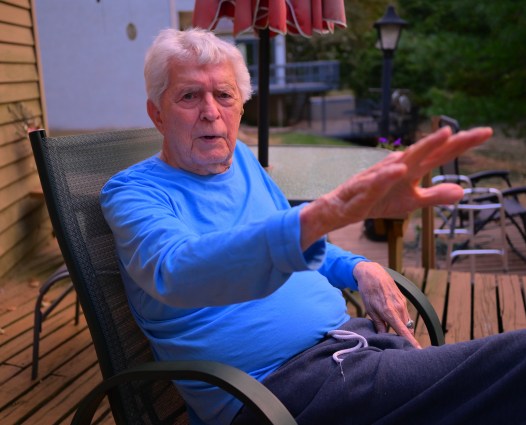
The second “mind” regards the way we would all prefer to think of him as his candle flickers. It’s taking the measure of the same face, maybe even on the same day, but with the benefit of a fresh shower and sunshine instead of cold overcast and emotional exhaustion. It’s as close to the difference between day and night as photographs can be. Both have their truth. Both have their special place in the heart.
Not every one will agree with both of these series of photos. Either they will regard one as too cruel, or they will see the other as too candy-coated. Maybe some would reject both. But if Dad taught me anything at all, he taught me to make something as well as you can. Well enough that you are proud to put your name to it at the bottom, to, in fact, testify, if you will, that you did it, you own it, you believe it. I hope I learned the lesson well enough for at least that.
QUEER QUBISM
By MICHAEL PERKINS
PHOTOGRAPHS ARE MORE AN INSIDE-OUT THAN OUTSIDE-IN PROCESS. We tend to think that the images we capture just sort of seeped or flooded their way into our cameras, but, just as often, we begin with a desire behind our eyes that then pours itself outward into the lens. Point of view is the real determinant of how a picture will be created: the thing is never really as simple as pointing at something and shooting. Where we stand, our choice of tools, our intuitive interpretation…these make or break a picture.
In recently shooting the “Canopy Walk”, a new treetop-height attraction in Reynoldsburg, Ohio’s Blacklick Woods Metro Park, I found myself confounded by the rangy, twisty contours of the platform. None of my standard lenses seemed able to corral the thing into a single frame, and, after several attempts to tell its story in that fashion, I switched gear completely and opted for an approach I can only call cubist.
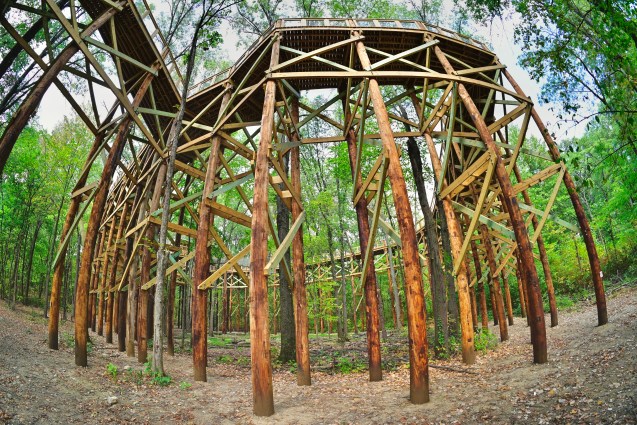
The widest lens I have in my kitbag is a TTArtisan 11mm lateral fisheye, which can enable more than one plane of view at a time, similar to cubist work from Picasso and other painters who felt imprisoned by the standard flat image and tried to suggest all sides of their subjects (left, right, over, under, etc.) by simply painting it that way, and “reality” be damned. The fisheye gives a photographer much the same freedom, as, in this image, we’re looking both down onto the forest floor, as if shooting from above, and up to the bottom of the platform, as if looking skyward. The lens also creates the illusion of looking around corners that would appear like hard angles in viewing them with a standard optic, plus both compressing and exaggerating spaces as they are twisted into strange mutations of their actual dimensions. The overall sensation is one of bigness, but a surreal kind of bigness, a design sprawling out of control. Like a cubist painting, the image is one of disorientation, a deconstruction of reality.
Or maybe it’s just a weird picture.
As is always the case, there is either a connection between my own queer cubism and the viewer’s tolerance, or there isn’t. The idea of making a picture isn’t really to have the final say but to have the first say, and then get a conversation going. Where we meet, or don’t meet, on each others terms of what “art” is can be frustrating or fun, actual or true.
ANOTHER OPENING, ANOTHER SHOW
By MICHAEL PERKINS
THE GOLDEN AGE OF CINEMA THEATRES, which saw its high tide during the glory days of the silent era, placed grandiose entertainment palaces within the reach of the common man from one end of America to the other, bestowing gilded temples, dripping with over-the-top ornamentation, on towns large and small. These grand retreats, awash in velvet curtains and cavernous prosceniums, recalled the lavish excesses of Aztec, Spanish, Greek and Moorish architecture, and served as gathering places where more than movies were on display. They were fantasy worlds in plaster and gold leaf.
By the end of the ’20’s, the era of the huge operatic movie palaces had mostly cooled, with a secondary crop of smaller venues dotting the map in tinier towns. By 1929, when the Boulevard theatre opened in the small farming community of Oxnard, California, there was a greater emphasis on streamlined Art Deco exteriors, spare ornamentation, and simple inner auditoriums. The Boulevard served for many years as the city’s only theatre, switching to Spanish language films in the ’60’s in order to survive a general downturn for neighborhood screens. By the 1990’s, the shuttered Boulevard had long since been renamed the Teatro, its old popcorn machine mouldering in the lobby and its seats an occasional refuge for the homeless. But as one curtain was ringing down for the building, another was about to go up.
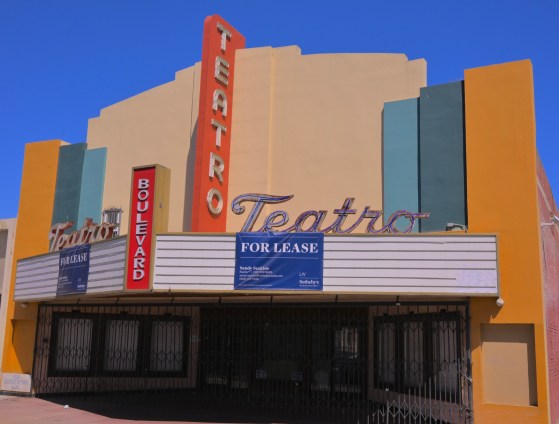
Oxnard, California’s Teatro Boulevard Theatre, frozen in pastel time, 2024
In 1995, recording engineer Mark Howard, taking a turn through the town, which was, at that time, right off the Pacific Coast Highway, spotted a “for lease” sign on the Teatro’s marquee and thought it might make for the kind of makeshift recording site which he favored over traditional studio setups. He suggested the idea to producer Daniel Lanois, already famous for having shepherded classic albums like U2’s Unforgettable Fire, Peter Gabriel’s Us and Bob Dylan’s Oh Mercy, and the two began a five-year collaboration on a series of recording projects that also had the effect of rehabilitating the latter-day careers of veteran rock and country legends. Among the best: the demo sessions for Dylan’s 1998 masterpiece Time Out Of Mind (which was actually finished in Miami) and Willie Nelson’s aptly titled Teatro, which featured an album cover picture of the theatre entrance very like the one I shot here.
After Howard and Lanois went their separate ways, other artists continued to seek out the Teatro, including Emmylou Harris, Red Hot Chili Peppers, and, most notably, Neil Young, playing with WIllie Nelson’s sons Lucas and Micah on The Monsanto Years, a protest about industrial farming practices in Southern California in towns like Oxnard. Today, the Teatro is again seeking a sponsor, its current owner dreaming of converting it to a live music venue, studio, or both. The former Boulevard’s exterior is still proud, elegant and colorful, and pretty much ready for its third act. I can’t wait to see how the movie ends.
POST CARDS FROM MEMORYLAND

Dave Willardson’s classic album cover for The Beach Boys’ CARL AND THE PASSIONS / SO TOUGH (1972)
By MICHAEL PERKINS
SOMETIMES THE WORST LOCATIONS TO PHOTOGRAPH A SUBJECT are the places where the most admirers of that subject are gathered. To put it politely, people generally make composition of an image an uphill slog, crammed together as they might be to appreciate a hobby, an event, or a collectible. This is certainly true with that staple of the weekend festival, the classic car show.
It’s one thing to find a bygone ride that you adore. It’s something else entirely to visually have it to yourself, with your fellow fans ogling, leaning in, looking into, posing with, or merely passing by in packs. Shooting an entire car at once becomes a virtual impossibility, and so the car has to be, to varying degrees, abstracted, with tighter-framed sections of it standing in for the whole. This usually means a focus on the elaborate grills, exterior contours like fenders or fins, or, in the case of this image, a door/wing window/mirror panel on a Ford Country Squire station wagon. The SoCal sunshine on the day of the shot had already boosted the extreme colors of the treated wood trim and aqua body, making the old girl look like one of those hyper-processed “Greetings from L.A.” post cards, and might have made for a great view of the entire side of the car had the area not been clogged with humanity. So the challenge became: how little of the car can I show in a cropped shot and still sell the idea effectively?

Hop In, Kids, Oxnard, California, 2024
The answer actually came to me later, in the editing phase, when my mind traveled sideways to a great cover from the 1972 Beach Boys album Carl & The Passions/So Tough, which featured a similar viewpoint by airbrush painter Dave Willardson, whose work graced dozens of classic records in the early ’70’s. Being that he wasn’t confined to mere reality, Dave was free to show a few fantasy palm trees and a surfboard reflected in the driver’s-side window, but the great thing about his conception was how little of the total car he actually showed. I played around with my own shot and decided that less could indeed be more in my case as well. Fans of anything can mar the view of the thing most adored, but that doesn’t mean the thing can’t be effectively photographed. You just cut away everything that isn’t an essential part of the story. It’s a fun ride.
NOT REAL. JUST TRUE.
By MICHAEL PERKINS
FOR PHOTOGRAPHERS, THE APP KNOWN AS HIPSTAMATIC BEGAN (in 2009) AS A BIT OF A CARNIVAL TRICK, back when mobile-based platforms for photo processing were the same kind of trendy novelty as custom phone rings. Just as it was fun, in the first heady days of iPhones, to replace the heads of your friends with squirrels or kitties, it was considered “crazy” that an entire app would be dedicated to simulating the look of various analog films or lenses. Hey, this is the digital age. Didn’t we just get rid of that stuff. What’s next, faux tintypes?

It’s Around Here Someplace, 2024. Master shot on an iPhone SE, post-processed with Hipstamatic “Jack London” lens and “Love 81” film filters
Well, of course, those came along, too…but the naysayers missed the point in thinking that a photog would only want to recall the look of Kodachrome or a pinhole lens just for the sheer weirdness of it. Turns out Hipstamatic and its many later imitators filled a need, just as, in another medium, a certain kind of brush or canvas might shape the final iteration of a painting, or a director may deliberately choose black-and-white as the better format for a feature film. Every era in photography has its own look, simply because the qualities, or even limits, of the recording systems in those eras had their own visual signatures. But if all Hipstamatic had provided photographers with was nothing more than the means to make new shots appear old, it would have rapidly faded. Instead, it became an interpretive tool, its digital filters shaping the outcome of pictures instead of just making another “version” of them. That makes Hipstamatic at least as legit for shooters as, say, silkscreening was for Andy Warhol. We’re talking tools.
International prizes for photography and journalism of Hipstamatic images by the likes of Francois Besch and the New York Times’ Damon Winter, awarded more than ten years ago, are no longer outliers. Certainly, many photo apps in the digital era are one-trick ponies or, worse, mere goofs, but the key to a tool’s survival is how many people decide to give it a permanent place in artists’ toolbox as a regular go-to or solution. If it’s used, it’s needed. If it’s needed, it stays.
KEEPING MY LUNCH DOWN
By MICHAEL PERKINS
I’M PRETTY SURE THAT MY FIRST-EVER DIGITAL CAMERA was the product of intense guilt. Allow me to explain…
For a while after my divorce and my move from Columbus, Ohio to Phoenix, Arizona, my ex and I persisted in buying Christmas and birthday gifts for each other, partly to convince ourselves that the break-up was amicable (it mostly was) and partly to delay admitting to ourselves that everything was, indeed, finished (boy, was it). And thus my introduction to digital photography, a puny Olympus Cambodia C-1, rocking an intense 1.3mp of raw power, arrived at my new apartment as a result of that awkward and protracted goodbye process.
At that point, early 2000, I was, like many people raised on film, still trying to decide if this whole digital deal was just a faddish toy, spiking its way into the pop culture stratosphere only to crash to earth with equal speed. I was far from impressed with the results from the camera, which I only occasionally picked up to play with, feeling I was obligated to at least try to like it since it was a guilt gift. The resolution topped out at a mighty 1280 x 960 pixels, rendering a barely acceptable image on a computer screen and absolute garbage for any print larger than a credit card. The Olympus was soon relegated to vacation snaps and candids only, with my “real” cameras doing the heavy lifting for any images that mattered.
But, of course, that changed, dinnit?
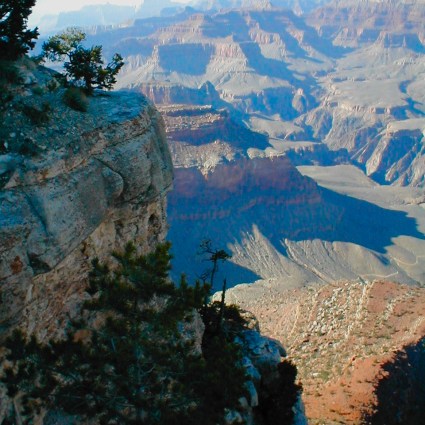
So ask yourself: what was the first digital image that you shot that was decent enough to share, or point to with any modicum of pride. For me, it was this Grand Canyon quickie, taken almost two years after I got the camera. This was the first inkling I got that, hey, this “dig-it-all” stuff might become something….someday.
Around this time, Chase Jarvis, a photographer who had made his professional bones shooting for accounts like Nike, Pepsi, Volvo and Apple (!), published The Best Camera Is The One That’s With You, a then-daring book of nothing but digital photographs shot on a two-MP camera on his phone. I was astounded at the audacity of the project: his results were as grainy and off-color and smudgy as my own….and he didn’t seem to mind. The entire point of the book was that you didn’t only shoot on days when you happened to pack your serious gear, but that you should free yourself by shooting whatever was in front of you, in the moment, with whatever was handy. It was a revelation/revolution for me as a shooter.
Suddenly I started reading up on the evolving state of digital…..who was switching to it, and why, and how the new medium was making its way into the mainstream. I had always known that stodgy old clubs like Arizona Highways or National Geographic would continue to cling to film as if it were the last copter leaving Saigon, but now I wanted them to justify that stance, to convince me that the old way still deserved to hold sway. My second digital camera, a Sony CyberShot sporting a screaming 5.1MP finally gave me pictures that evinced more smiles than winces, and I felt like a convert to a new religion. The deed was done and could not be undone. I was a digital guy.
In preparing to move westward to California several months ago, I spent far too much time poring over way too many photo files from my twenty-five years in Arizona, and the emotion I am experiencing most often is gratitude. I am grateful for the thousands of Ugly Duckling photos that eventually allowed me to occasionally produce a swan. As with all of the best in photography, you grow your gear after you’ve grown yourself, eventually hitting the plateau where you can make pictures with your best camera, which is, of course, the one that’s with you.
RE-EMBRACING THE RANDOM
By MICHAEL PERKINS
LIFE FOR PHOTOGRAPHERS HAS BECOME ENTIRELY TOO SAFE.
It’s to be expected, really. In recent decades the forward tsunami of technical improvement in cameras and editing options has almost completely “idiot-proofed” the process of making pictures. In nearly every possible scenario, today’s gear guarantees that you will at least get something usable every time you take a shot, and, in many cases, images that are far better than even your best efforts could have guaranteed just a few years ago. The risk of making visuall lousy photographs has been nearly zeroed out.
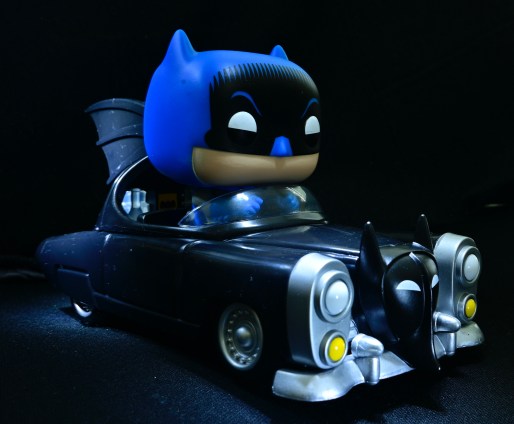
And that’s the problem. Because with the randomness of luck, which used to mean the potential for ruined images, there’s also the potential for the happy accident, the unplanned discovery that comes when something unpredictable is introduced into the mix. I was reminded of that in a recent return to the tabletop fun of light painting, where you shoot an object in complete darkness, with your camera set on full manual and mounted on a tripod. Using a remote shutter release for extra stability, you start the exposure on “bulb” setting, meaning that the shutter will stay open until you click it shut. You then selectively “paint” light onto the subject, passing over different parts of it with a small penlight. Unlike a static lighting scheme, this system more or less guarantees randomness, since you will never pass the light over the scene twice exactly the same way. And that very randomness affords you a kind of impulsive, instinctual indulgence from frame to frame.
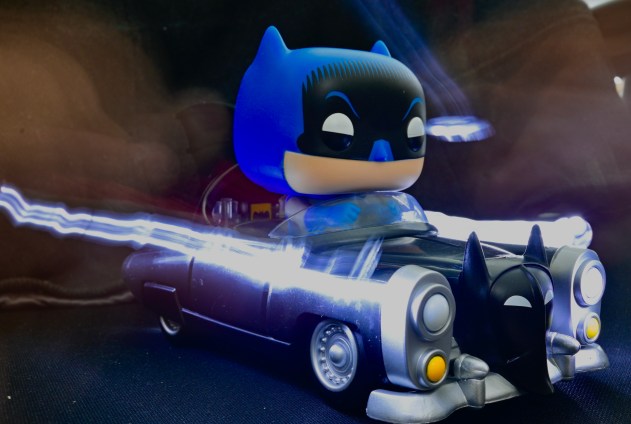
I usually shoot anywhere from thirty to fifty frames when doing a light painting, as I am always surprised or inspired by how the smallest variation in my passes will drastically affect the results. I can literally make the light look like it came from any direction, with whatever intensity I desire, from deep shadows to total blowouts. I can even let the flashlight itself be seen in the frame to suggest motion or speed, as seen in the above shot.
Is it art? Well, in that randomness is an element of risk/reward in photography, I’d say that art occurs when you can’t absolutely nail everything down. It’s often considered an alibi to say, of one’s occasional errors, “hey, I’m only human”, but, in photography, the same phrase might actually be a valid brag.
A.B.W.T.B.S.
By MICHAEL PERKINS

I AM NOT THRILLED WITH THIS PHOTOGRAPH.
However, it could have been a whole lot worse, in that it might never have been attempted at all.
We talk about “no day at the beach”, but on the day this was shot, that’s all I really wanted. My mood found me with no camera on my shoulder, a condition so weirdly rare that my wife, in her very New York sense of sarcasm, asked, “whaddya, sick?” Indeed, it’s not often that I go out photographically inert. I had a camera, but it was in a parked car, a quarter of a mile away from where we were walking. Then I spotted Mister Man here.
The cabled-off area you see in the top shot protects recovering sand dunes (they are living things, trust me) at California’s San Buenaventura State Beach from visitors who might otherwise tramp through them en route to the surf, which faces directly opposite. The approved entrances to the sea breach this dune “wall”, and we had walked through one of them from the parking lot just to walk off some tension when Marian’s binoculars picked up, not your typical gull or sandpiper, but a gorgeous peregrine falcon, apparently scanning the coast for a shot at lunch. “Can you get him?” she asked, even though she knew I was bare-handed. My heart sank. My telephoto was all the way back home, and the Nikon Z5 in the car was only fitted with a 28mm, far too wide for a proper portrait of the raptor. However, after a bit of fussing that the ideal was not possible, I opted for the real, walking back to the car to salvage what I could with the wide-angle.

More “crap” than “cropped”, but you can’t blame a gal for trying…
When we had been near the falcon beforehand, he seemed spook-proof, absolutely rooted to the spot. Passersby and beach patrol wagons had both failed to make him take flight, and, sonofagun, upon our return, he was still there, not flinching so much as a feather. I got as close to him as the steep bank of the dunes and the shifting sand would allow, inching within about twenty feet. Of course, in the view of the 28mm, he might just as well have been in the next county, but I took my shot (that is, about thirty of them). Better to have loved and lost than never to have blah blah blah.
The narrative of the shot, which even at a super-sharp f/16, could not be cropped enough for a really detailed portrait, shifted now, to be about the bird as the sole feature of interest in a wide, rolling terrain. And I can live with that. The old photographer’s advice to A.B.S. (always be shooting) sometimes translates to A.B.W.T.B.S, or “always be willing to be shooting”. No, I am not thrilled with this picture. But I am thrilled for the chance to have made the attempt. Any good batter knows that hits are a consequence of a huge-number of at-bats, most of which result in pop-ups and strike-outs. To get to the good stuff, you just gotta keep stepping up and taking a swing.
HURRY UP AND WAIT
By MICHAEL PERKINS
THE VERY NATURE OF PHOTOGRAPHY IS THE PURLOINING OF TIME, of snatching random instants from the continuous flow of zillions of moment-drops that compromises the tidal surge of life. We sneak out tiny frozen bits from this flow and lock them in a box, making the moments stand for the totality. Even two-plus centuries into this process, it ought to still strike us as a supernatural act, a miracle.
Because it is.
And since we’re treating time as something we can steal pretty much at will, we can take it a step further, using our cameras to customize the nature of the theft. In freezing an instant, are we snatching a sample of something that was lived in “real” time, or an unreal distortion of it, or a combination of both? In tweaking what is already an illusion (an abstraction substituting for the actual thing), images like this become easy:
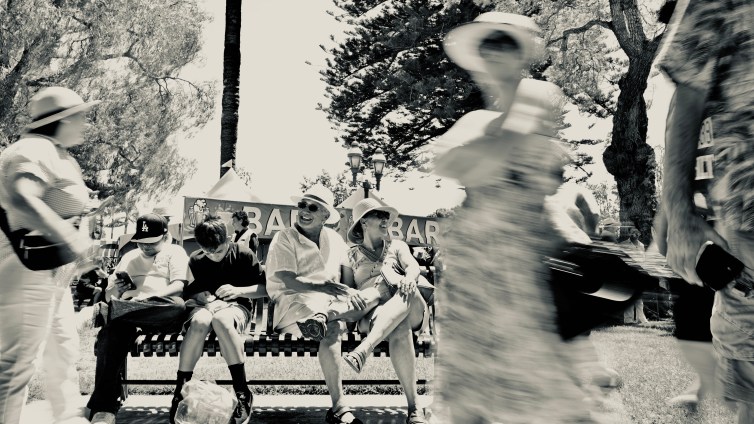
Technically, making a picture in which time travels at several speeds at once is pretty much a snap (sorry). The “still” elements are shot at f/16, insuring sharp detail in the people on the bench. The passers-by in the foreground, by comparison, are in constant motion, and, with an exposure of just over 1/10th of a second (which is still “fast” enough to freeze the sitters), they are nearly transparent, and might even vanish into pure blur, were the exposure over, say, a second or so. Thus, in one picture, there are two contrasting captures of the passing of time, or whatever we like to think of as time.
Moreover, when, without a camera, we view this scene in what we fancy as “real time”, picture after picture’s worth of information is refreshed for our eyes every second, making both foreground and background figures appear, of course, to be equally solid, or “moving at the same speed”. What’s the take-home? That our cameras do not see the same way that we do, which makes them a fit instrument to show things that we cannot see without a little manipulation and/or magic. So, when someone says that “photography takes time” they are more right than they know. It takes it, and then it frees it from its bonds. The results are variable. Unpredictable.
Miraculous.
Of Hauntings Great And Small
By MICHAEL PERKINS
AS A PHOTGRAPHER, I TEND TO DIVIDE MUSEUMS into two general classes. The first includes the grand halls that act largely as warehouses for collections of disparate items from across history. The second consists of the more personal spaces that were actually once someone’s private dwelling, such as a presidential home or an historic manor. In the first class, the emphasis, at least for me, is on the visual appeal of individual objects, i.e., the mummy cases, caveman tools, etc. In the second class, the narrative lies in the physical space that surrounds the relics, that is, the feel of the house or structure itself.
When I am being conducted through a home where a great family raised its children, where its dreams and schemes were birthed, I of course am fascinated by their quilts, kerosene lamps, butter churns and such. But, since this was a place designed not as a housing for curiosities but as a place where actual people lived, I am interested in trying to show what it might have been like to personally occupy that space. What it was like to wake up with morning light streaming through a bedroom window. What the anticipation of callers felt like, viewing the back of the front door from the second-floor landing. What solitude a certain room might have afforded. Where glad and sad things happened.
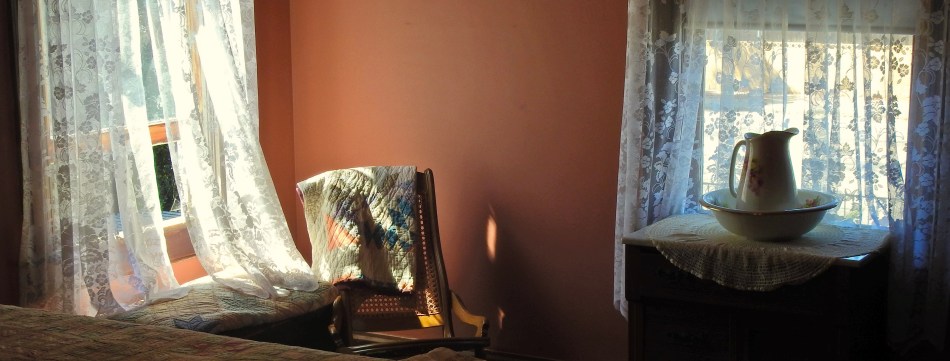
Take me to the Met and I will want to see certain things. Take me to an old family home and I will try to depict certain feelings. In the frame seen here, I was lucky enough to be in a bedroom where the delicate lace curtains at left were bending slightly inward from the window, courtesy of a cooling breeze. I began to wonder what it might be like to wake in such a room. What you would see first. How the basics of the room could create a feeling of solidity or safety. My only visual prop was the washstand at right, but that was enough. The suggestion of a life lived was present in just those basics, uncluttered by the mash of curios and collectibles that filled many of the home’s other rooms. Museums sort of represent a variety of hauntings, and their spirits can often speak more clearly in sparse, open settings. It’s like a whisper that you have to teach yourself to listen for. And then the pictures come…..
SNEAKING WITHOUT SPOOKING
By MICHAEL PERKINS
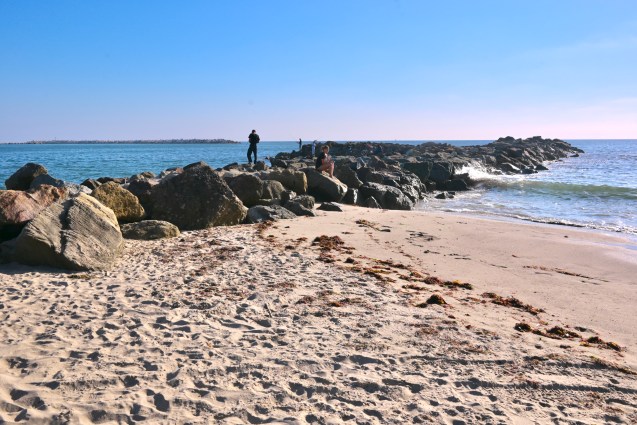
No zoom on hand, and yet I see a potential story happening at the center of a very wide frame. Take the shot anyway? Abso-photo-lutely.
THERE IS A DELICATE BALANCE TO STREET PHOTOGRAPHY, which is really spywork of a kind. Just as wildlife shooters tread carefully so as not to flush birds to flight or startle feeding fawns, street snappers must capture life “in the act” without inserting themselves into the scene or story. Quite simply, when it comes to capturing the real eddies and currents of everyday life, the most invisible we are, the better.
Part of the entire stealth trick is about making sure that we don’t interrupt the natural flow of activity in our subjects. If they sense our presence, their body language and behavior goes off in frequently unwanted directions. Undercover shooting being the aim, then, it’s worth mentioning that such work has been made immeasurably easier with cel phones, simply because they are so omnipresent that, ironically, they cease to be noticed. That, or perhaps the subjects regard them as less than “a real camera” or their user as less than threatening somehow. Who knows? The thing is, a certain kind of visible “gear presence” is bad for business. That said, telephotos can become attractive simply because, shooting from longer distances, they are easier to conceal. But is that the One Best Answer?
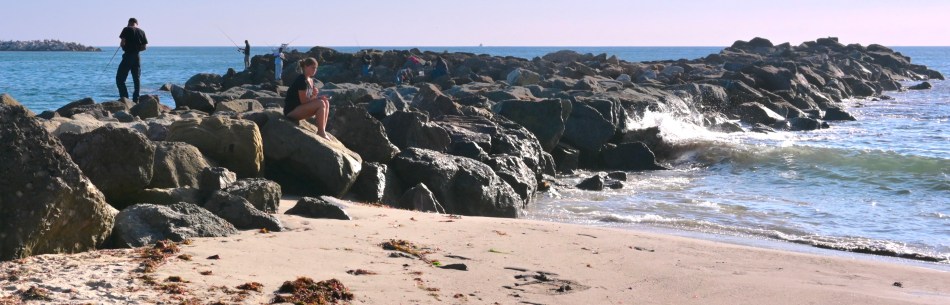
Same story, severely cropped, but with more than enough sharp detail to deliver the central idea.
To carry as little gear as possible as well as keep things simple, I mostly do “street” shots with a fixed wide-angle prime lens, meaning that I simply won’t have a telephoto as an option, nixing my ability to hang back from a great distance undetected. And yet I seldom feel handicapped in staying fairly far from my subject and just shooting a huge frame of what could be largely dispensable/ croppable information once I locate the narrative of the shot within it. In fact, shooting wide gives me the option to experiment later with a variety of crop-generated compositions, while shooting at smaller apertures like f/16 on a full-size sensor means that I will still have tons of resolution even if half of the shot gets pared away later.
Another consideration: besides being bulkier/easier to spot, telephotos have other downsides, such as loss of light with each succeeding f-stop of zoom, or having problems locking focus when fully extended. Your mileage may vary. The top shot here was taken with a 28mm prime. about a hundred feet away from the water’s edge, but the cropped version below still has plenty of clean, clear information in it, and it was shot at half the equipment weight and twice the operational ease. These things are all extraordinarily subjective, but on those occasions when I come out with a simpler, smaller lens, I don’t often feel as if I’ll be missing anything. For me, the first commandment of photography is “always be shooting”, or, more specifically, “always take the shot.”, which means that the best camera (or lens) is still the one you have with you.
TO SEE THE SEA IN FULL
By MICHAEL PERKINS
I AM VERY NEW TO DAILY LIFE in California. After decades of longing to convert my occasional doses of this marvelous state into the stuff of everyday experience, to go layers beyond mere vacation sensation, Marian and I have actually done it, making a new home in Ventura, a mid-size city along the Pacific coast about fifty miles north of Los Angeles. This means that the ocean is something we don’t just perceive as a getaway or a holiday destination. It’s something we see nearly every single day.
And once you’re a local, especially a photographer local, you see things that go far beyond the gorgeous sunsets and the lapping waves, including several things you wish you could un-see.
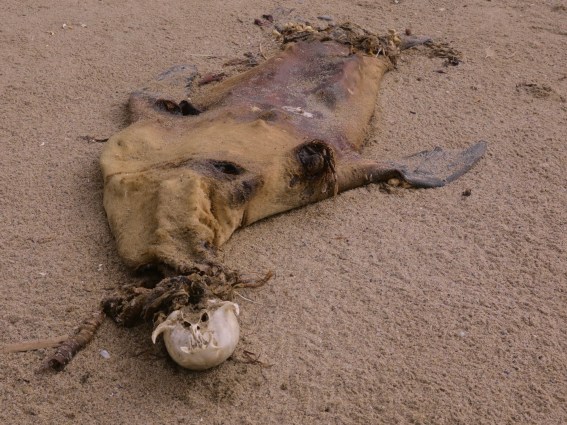
This dessicated pelt, a lunch opportunity for shorebirds and scavengers along the Hollywood Beach, was once a young sea lion. Its bones now picked clean down to the very contours of its skull, it is, sadly, also a more frequent sight for those of us walking the area coastline. Hundreds of sea lions have been washed ashore to suffer and die this year along the California coast, poisoned by an invisible scourge happening silently out to sea. A compound called demoic acid, a species of plankton, is in a state of high surge at present. That is to say that chemical changes which typically convert very small amounts of it to a deadly neurotoxin are currently churning it out like crazy. Fish eat the algae that contains it, apparently without harm to themselves, but sea lions eat the contaminated fish, and the result is an epidemic of sea lion death in San Luis Obismo, Santa Barbara, Ventura, and other coastal towns.
The process by which these toxins are produced in bulk is called upwelling, which occurs when the right combination of colder water meets the right amount of nutrients. Upwelling seasons are a part of oceanic life, occurring randomly since the beginning of time. But what’s puzzling to science, and deadly for mammals like the sea lion, is the increased frequency and intensity of such toxic “blooms”, which may very well prove to be yet another sinister side effect of climate change.
California has so much of its life anchored to the seasons and cycles of the sea that such threats are front and center for policy and abatement, meaning that the state is already seeing things the rest of us have not seen, making match-point decisions that will eventually echo across the great middle of the nation. But to know a thing is happening, we first need to see it happening. Cameras are great for vacations. But we are also obligated, now and going forward, to also use them to bear witness, if not to head off destruction for ourselves, then to chronicle, for our wiser children, what fools their forebears once were.
STAX OF WAX
By MICHAEL PERKINS
PHOTOGRAPHERS WHO HAVE STRADDLED THE LINE BETWEEN DIGITAL AND ANALOG, doing most of their daily duty as dedicated pixel peepers but occasionally dipping their toe back into film, should certainly sympathize with those who, in recent years, have reverted to the comfort of dropping a needle onto a vinyl record, even if they themselves haven’t invested in a new turntable or a disc-washing device. Heading back to the happy land where experiences were a little more tactile can, indeed, be a lovely little side trip into comfort. For me, however, as a music lover who has long since divested himself of the bulk and maintenance of tangible tune storage, it’s not so much the worship of vinyl that interests me: it’s the places where the vinyl worshippers go.
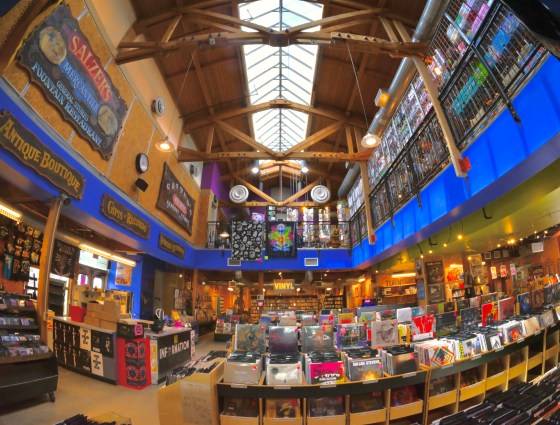
Salzer’s Records, est. 1966, Ventura, CA
One of the most welcome side benefits of the rebirth of records is a surge in dedicated record stores, not the measly music departments niched into Sears or Targets but places designed just to sell vinyl, and lots of it, along with bongs, t-shirts, and other headgear. The Sam Goodys and Licorice Pizzas and Peaches of the world may be long gone, but a new crop of repurposed shop spaces in re-gentrified neighborhoods is springing up in their place, alongside the few hardy survivors from the First Great Golden Age of Wax, such as San Francisco’s amazing Amoeba Records, Minneapolis’ Electric Fetus, and, as seen here Ventura, California’s Salzer’s Records, originally opened in 1966 and still so huge that, even using a fisheye lens, it’s impossible to show its entire two-story interior in a single shot.
Upon entering, you can smell the patchouli oil and incense, returning you either to your hippie roots or your favorite fantasy of what that era might have been like, depending on your age. Most remarkable from a photographic point of view is that the elder LP shops still exude the same energy as when we were all tender little flower children: the idea of music as but one component in a total immersion into creative energy, a tribal coming together of sounds, smells and sensations. Admittedly, it’s hard to capture all that in a camera, but, like blindly pulling out a random album from your library and slapping it on the turntable, you just drop the needle, and see what happens.
Far out, man….
YES, CHEF!
By MICHAEL PERKINS
Photographers are often instinctual artists, like the cooks in your family who have never cracked a cookbook in their lives but who know, deep in their gut, that, in their hands, a pinch of this or a dash of that results in culinary perfection. They perform without a net with a mastery that seems magical. Other photographers are like chefs, building recipes through exacting amounts, precise steps, and critical timings. Both kinds of shooters “cook” their way to miracles with their own individual approach to the kitchen, and both create amazing delicacies.
When I am in my “chef” mode, I love to play with the many “recipes” touted online by various photographers, endless customized lists of pre-sets that can be dialed into your camera’s brain ahead of the shutter snap, many stored in modes that can be summoned with a click of the function wheel, allowing the shooter to change his/her mind in an instant, as well as giving him/her a whole series of comparative variants on a scene in a way which was, well, impossible in the pre-digital world.
The ergonomics of my camera allow me to dial up as many as five different customized modes (beyond built-ins like, say, Aperture Priority) without taking my eye away from the EVF, guaranteeing me almost the same exact composition across multiple shots, each taken with their own exposure, metering and white balance ingredients. This gives me true choice in a real-time environment, which is perhaps the greatest luxury in shooting with today’s cameras.
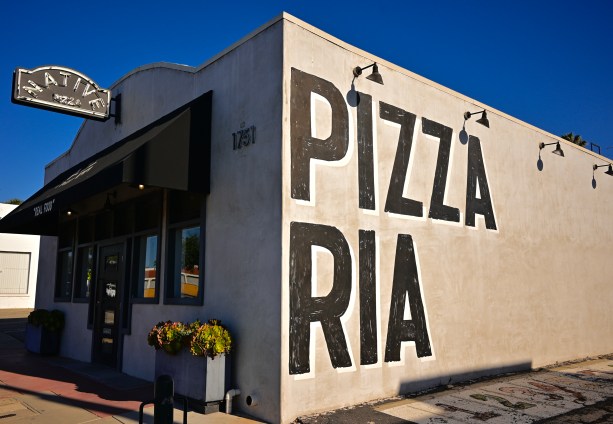
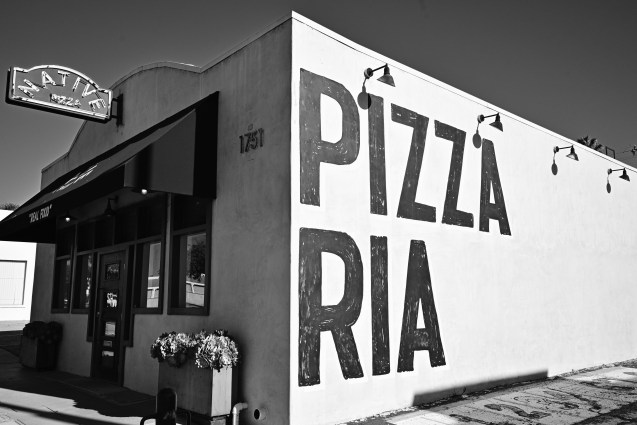
The top image seen here of an architecturally stark pizza joint in Ventura, California is the product of a faux-Kodachrome recipe stored on my Nikon Z5’s “U2” mode, while the second shot is a decent re-creation of the old Kodak Tri-X monochrome film (tweaked to simulate the use of a red filter) and shot with a recipe I had stored on “U1”. Both shots have their points, and whether the image works better in color or mono is a battle for another day, but the point is that, with today’s gear, no one has to calculate these looks from scratch while they’re trying to shoot. Nor do they have to wonder whether a scene would look better with a certain look. They can just dial it up, do it, compare, judge, and shoot again, all while the light is right and the subject is still there in front of you. Somewhere my 12-year-old self, armed with a $5 plastic box camera equipped with one shutter speed and a single aperture, is popping champagne corks.
SUNSET ON MY SHOULDER
By MICHAEL PERKINS
SOMETIMES IN PHOTOGRAPHY, AS IN ANY OTHER ART FORM, the only way to break through to new creative ground is to run in the opposite direction from your inherited viewpoint. We’ve spoken in these pages about the problem of finding anything fresh in a subject that’s been “seen to death”, such as a familiar landmark that nearly everyone has snapped in the standard “post card” view. This is why it’s really tough to show anything new about an Eiffel Tower or an Empire State Building. To honor such subjects in a unique or personal way, you really have to tear them to shreds, reassembling the pieces into some totally new configuration. Replicating what everyone else has done usually fails as an homage and just becomes a replication.
This need to destroy (in order to create) extends to conditions as well as objects, things that might include, for example, an ocean sunset. Face it: we’ve all had our take on that kind of image, and sadly found that, while nailing the technical execution of it is not that tricky, finding any new thing to say with such a shot is truly daunting. Beginning 2024 as a new resident of coastal southern California, I was tempted, a few weeks ago, to do my “official” version of an amber, dusky sundown scene along the coastline near Ventura. The results were not bad, but they were also undistinguished, like asking thirty actors in a row to recite the soliloquy from Hamlet, most of them meriting an “A” for execution, but a “D” for originality.

In the case of my own dusky dilemma, it was only when I turned my camera in the opposite direction, i.e., away from the setting sun, that I found something halfway interesting to play with. As the light faded beneath the horizon to the north, the sun began to tattoo a golden glow onto the metal plate mounted on the side of a lifeguard station facing south. It was very much a thing of the moment: three minutes before I shot the frame, the light was only bright: then, for a brief moment, it burned with a fierce intensity. Another three minutes later, the entire structure was muted in shadow. The image you see here, then, is much more about the delicacy of capturing a fleeting moment than a standard static sunset shot, a picture of things that can easily be lost, disappeared. In other words, what a photograph is for.
The standard ways of seeing things are our photographic comfort zones. We make pictures of what, from our sense memory, we think a thing ought to look like, since it’s much harder to see things and places as if we have never seen them before. Familiarity may not necessarily breed contempt, but, in the making of pictures, it very well might breed predicability, which can actually be worse.
PICTURES OF PICTURE TAKERS OF…..
BY MICHAEL PERKINS
PHOTOGRAPHERS SPEND A SIGNIFICANT AMOUNT OF TIME marking the passing of various elements of their world. We chronicle the end of stuff.
Things go out of fashion. The mass mind discards ideas or ways of doing this or that. And technology, that rocket sled of change, surges madly forward in ways that keep even the most alert shooter’s eye spinning like a top.
Film, as one example taken from our field, is always about to die off, never quite breathing its last, but rising from one potential deathbed after another, always in danger of winking out forever, never quite doing it. One thing that has, in fact, shrunk nearly out of sight, however, is the list of places where film can be served or processed. In my lifetime, dedicated film/camera stores were common elements of daily life, like post offices or drugstores. Now the holy temples where film still reigns supreme are vanishing into dust in favor of mail-in or online resources. And, on most days, in digital’s second quarter century, that’s usually enough to serve a solid but diminished analog audience.
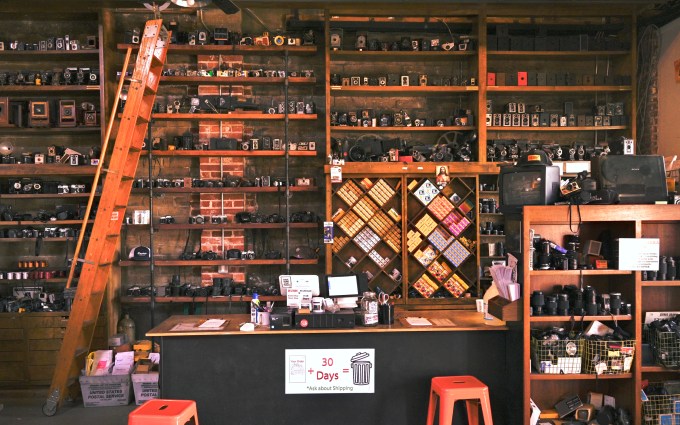
Dexter’s Camera, Ventura, California, May 2024
But I am just sentimental enough to want to make pilgrimage to where the magic is still actually made, where emulsions and paper and controlled conditions combine to produce a tangible product. Even as I myself reserve film for special projects, I treasure a trip to an honest-to-God camera shop like an archaeologist yearns for a walk-through of Tut’s tomb. The image here resulted from my recent visit to Dexter’s Camera, which has done business at the same address in Ventura, California since 1960, with no end in sight. Well, nearly no end. As I write this, the business address of Dexter’s has moved a few blocks away, meaning that you are looking here at a physical photographic space which now can only be experienced, well, in photographs. Pictures of people and places that make pictures. Film is dead, long live film.
RE FOCUS, JULY 2017: THE WORLD FROM QUEENS
SPHERE ITSELF
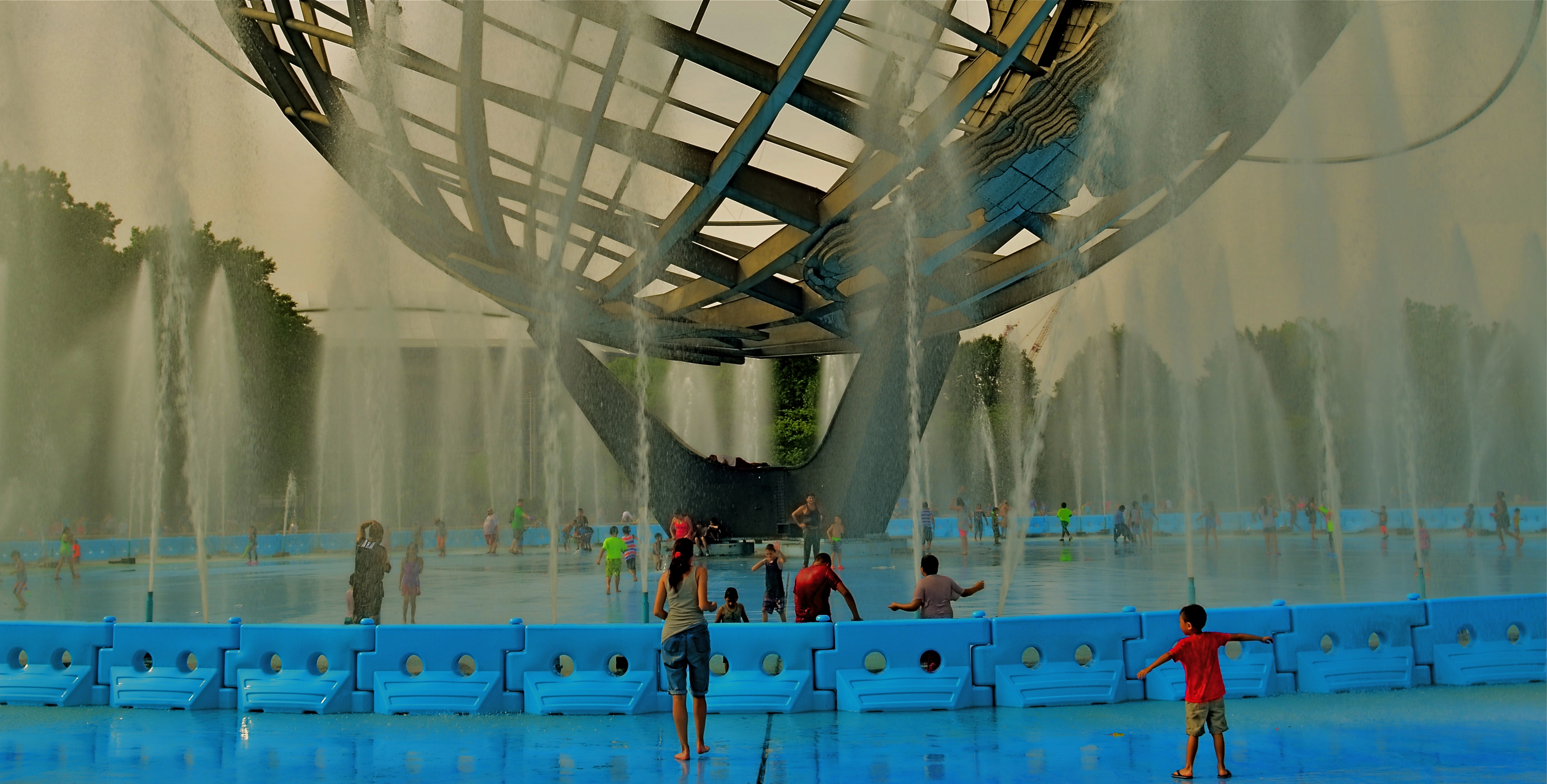
Wet Democracy (2017): The 1964 World’s Fair’s central icon as play space.
By MICHAEL PERKINS
CULTURAL ICONS, which burn very distinct patterns into our memory, can become the single most challenging subjects for photography. As templates for our key experiences, icons seem to insist upon being visualized in very narrow ways–the “official” or post card view, the version every shooter tries to emulate or mimic. By contrast, photography is all about rejecting the standard or the static. There must be, we insist, another way to try and see this thing beyond the obvious.
Upon its debut as the central symbol for the 1964 New York World’s Fair, the stainless steel structure known as the Unisphere was presented as the emblem of the peaceful ideals put forth by the Exhibition’s creators. Under the theme “Peace Through Understanding”, the Uni, 120 feet across and 140 feet in height, was cordoned off from foot traffic and encircled by jetting fountains,which were designed to camouflage the globe’s immense pedestal, creating the illusion that this ideal planet was, in effect, floating in space. Anchoring the Fair site at its center, the Unisphere became the big show’s default souvenir trademark, immortalized in hundreds of licensed products, dozens of press releases and gazillions of candid photographs. The message was clear: To visually “do” the fair, you had to snap the sphere.
After the curtain was rung down on the event and Flushing Meadows-Corona Park began a slow, sad slide toward decay, the Unisphere, coated with grime and buckling under the twin tyrannies of weather and time, nearly became the world’s most famous chunk of scrap metal. By 1995, however, the tide had turned; the globe was protected by the New York City Landmarks Preservation Commission, and its rehabilitation was accompanied by a restoration of its encircling fountains, which were put back in service in 2010. The fair park, itself staging a comeback, welcomed back its space-age jewel.
As for photography: over the decades, 99% of the amateur images of the Unisphere have conformed to the photographic norm for icons: a certain aloof distance, a careful respect. Many pictures show the sphere alone, not even framed by the park trees that flank it on all sides, while many others are composed so that not one of the many daily visitors to the park can be seen, robbing this giant of the impact imparted by a true sense of scale.
In shooting Uni myself for the first time, I found it impossible not only to include the people around it, but to marvel at how completely they now possess it. The decorum of the ’64 fair as Prestigious Event now long gone, the sphere has been claimed for the very masses for whom it was built: as recreation site, as family gathering place..and, yes, as the biggest wading pool in New York.
This repurposing, for me, freed the Unisphere from the gilded cage of iconography and allowed me to see it as something completely new, no longer an abstraction of the people’s hopes, but as a real measure of their daily lives. Photographs are about where you go and also where you hope to go. And sometimes the only thing your eye has to phere is sphere itself.
90 DEGREES OF ENTREATY

By MICHAEL PERKINS
ALL PHOTOGRAPHERS HAVE A DEFAULT ORIENTATION.
I’m not talking here about political bias or sexual preference. No, this stray thread of thought is all about which way one natively holds a camera for most of their work. I myself instinctively compose for landscape, even when I am actually creating a portrait. This may come from the first camera I owned that shot in anything other than square format, giving me a giddy feeling of liberation at being able to frame an image with surplus information on the left and right.
I realize that in an era now dominated by cell phone photos, I may be increasingly in the minority, especially following the Tik Tok revolution, which is portrait-dominant in a major way. I must confess that many TT videos leave me a bit claustrophobic , as if I am hemmed into a world in which I can’t “look around” inside the image, but that’s the way the platform performs, and so be it.
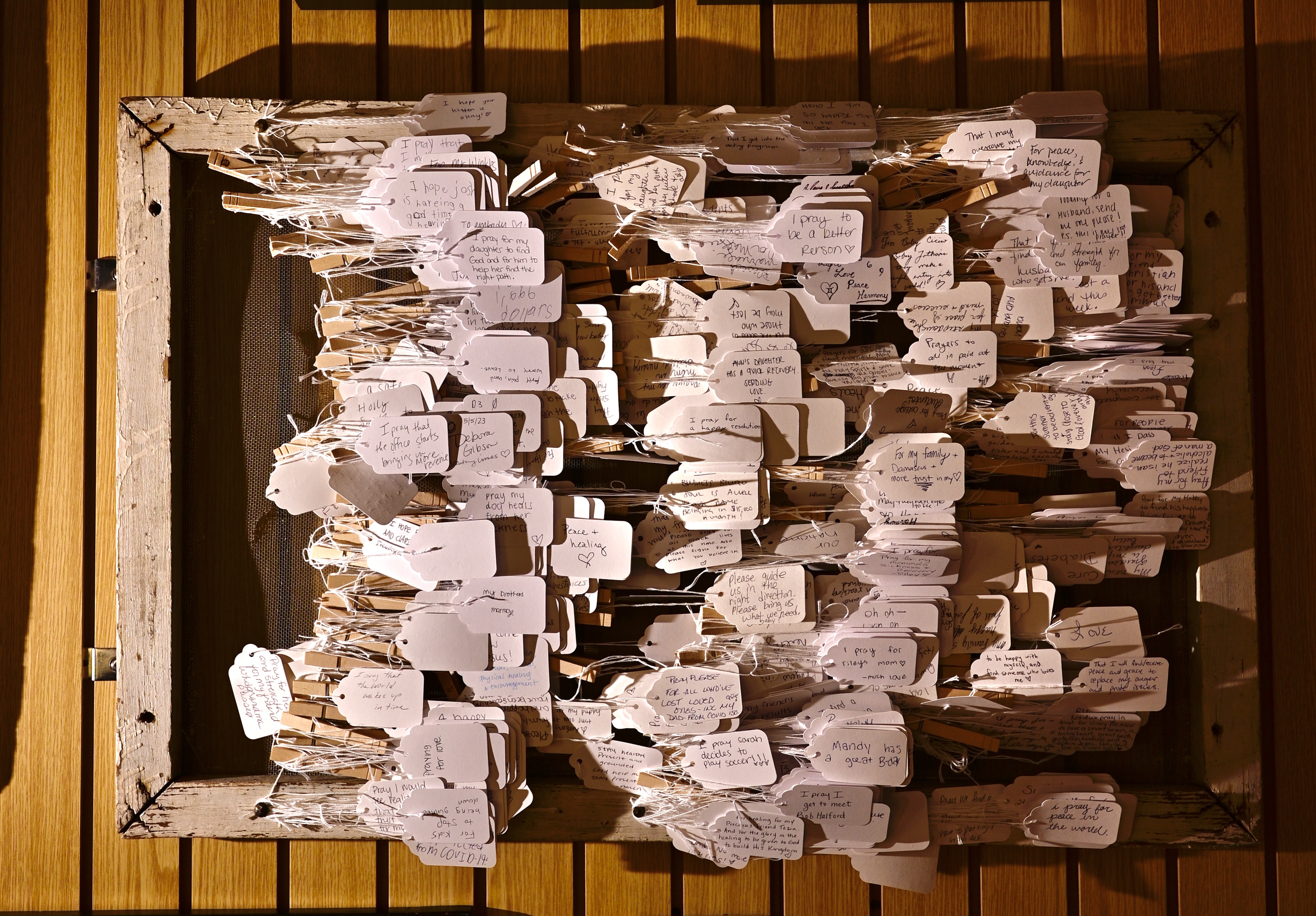
But orientation is not merely determined in the moment a shot is taken. On occasion, long after I’ve captured something that I feel I “nailed”, I find that a mere ninety-degree tilt can open up the interpretation of a picture, as seen here. This “wish-prayer” collection (top image), actually a framed piece of art that I saw in a gift shop, originally appealed to me because of the dense jungle of shadows created by the cascading layers of tags as seen in one-sided natural light. However, later on, I considered that perhaps the real story of the picture was the viewer’s access to the individual messages of hope, that maybe the photo’s “truth” was all the board’s accumulated entreaties and one’s ability to more easily read them. Ninety degrees later, the entire impact of the photograph has been altered, changing the emphasis from mere design to a straight narrative. I like the image both ways for very different reasons.
But, then again, it might just be my orientation.
SHUTTERING THE LAB
By MICHAEL PERKINS
MANY PHOTOGRAPHERS HAVE LOCALES THAT ACT as muses, triggers for their creative processes. Ansel Adams had Yosemite; for Walker Evans, it might be the streets (and subways) of Manhattan; and, of course, Paris inspired Eugene Atget to tell its story through indelible chronicles of its vanishing streets. As I prepare to leave Arizona after twenty-five years, the scene of most of my photographic crimes remains Phoenix’ amazing Desert Botanical Garden. Created as a nursery for the most unique plant life in the country, it has provided me with the breeding ground for thousands of images taken in every season, in every kind of light, and across the entire range of human emotion. It has, simply, been a laboratory where I go to work on the project of making myself into a better photographer.
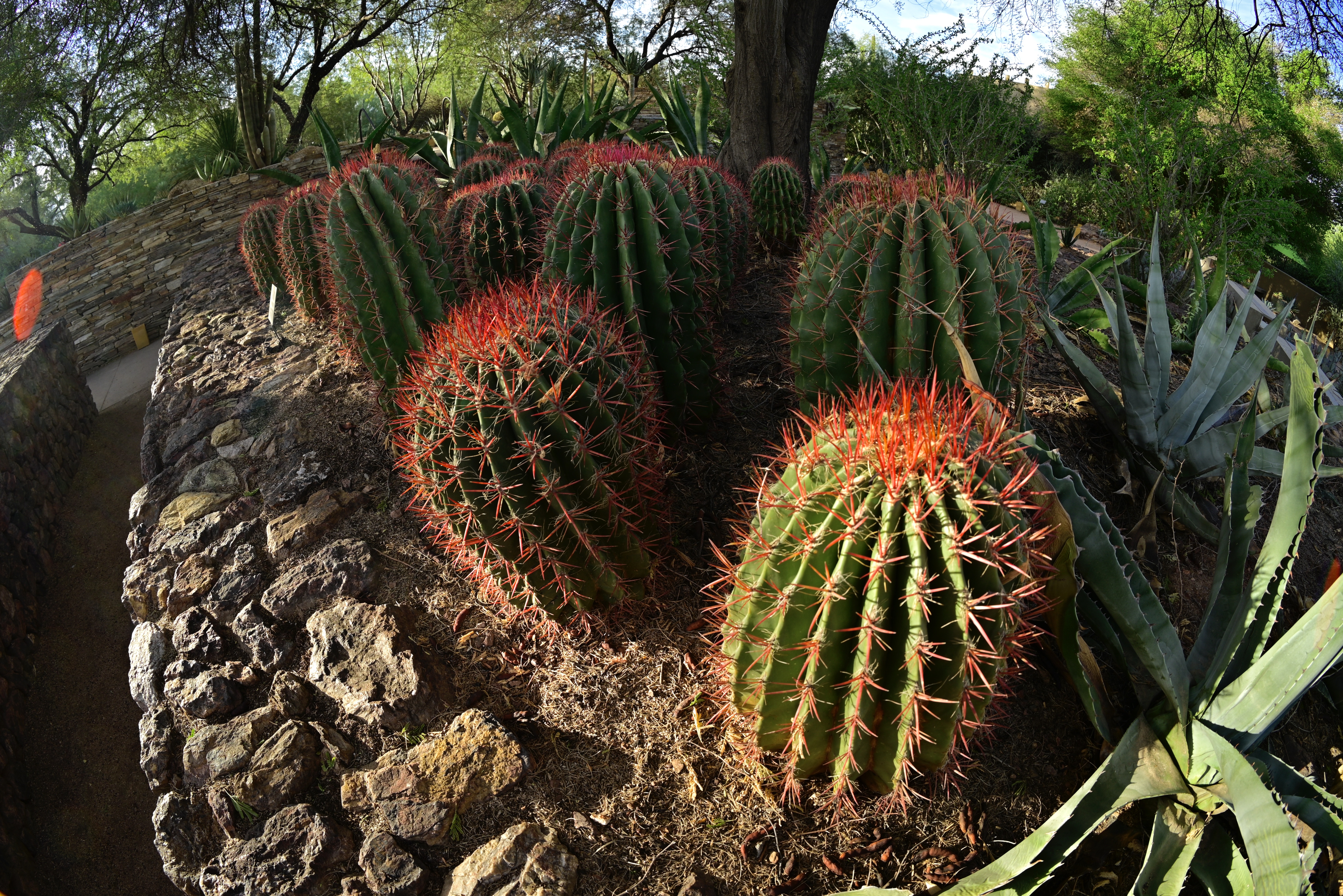
I’m still not really “done” with the DBG, but the feeling of leaving something unfinished that I’m experiencing actually cements its place as a legit muse. Even the cacti and trees that I can practically find blindfolded along its paths still reveal new secrets to me, as they have done since I first vacationed in the area in the mid-90’s. From then til now It has been a testing ground for a slew of different film stocks, over six different cameras, countless lenses and a crazy variety of processes and approaches, from HDR to minimalism, analog to digital, soft-focus to low-fi. I’ve shot pictures of quiet contemplation and audacious art installations; I’ve taken casual snaps of awestruck visitors on winter vacations and pensive portraits of native “Zonies” who have made it their personal retreat. Most importantly, the garden has become my go-to playground, the most reliable place for me to stage my pictorial equivalents of an off-Broadway premiere.
The images I have made there, for better or worse, are a reliable road map of every major turn in my development as a photographer over a quarter century. All my light-bulb moments, my moods, my breakthroughs, my barriers. It’s all there amongst the aloes and the ocotillos, the starched plains and the insistent pops of floral color set against the restrained hues of the American desert. Life, death, joy, disaster, and above all, discovery…all of it has happened on these paths. Does that somehow make it the “best” place to take pictures? Well, that’s a very personal thing. Finally, it’s not about whether a particular place is of universal interest or appeal to everyone with a camera. The fact that it acts as a lab for kitchen–testing your concepts is enough, serving as a launch pad for your most perfect, most serious work.
 thenormaleye