CUE THE CUMULUS
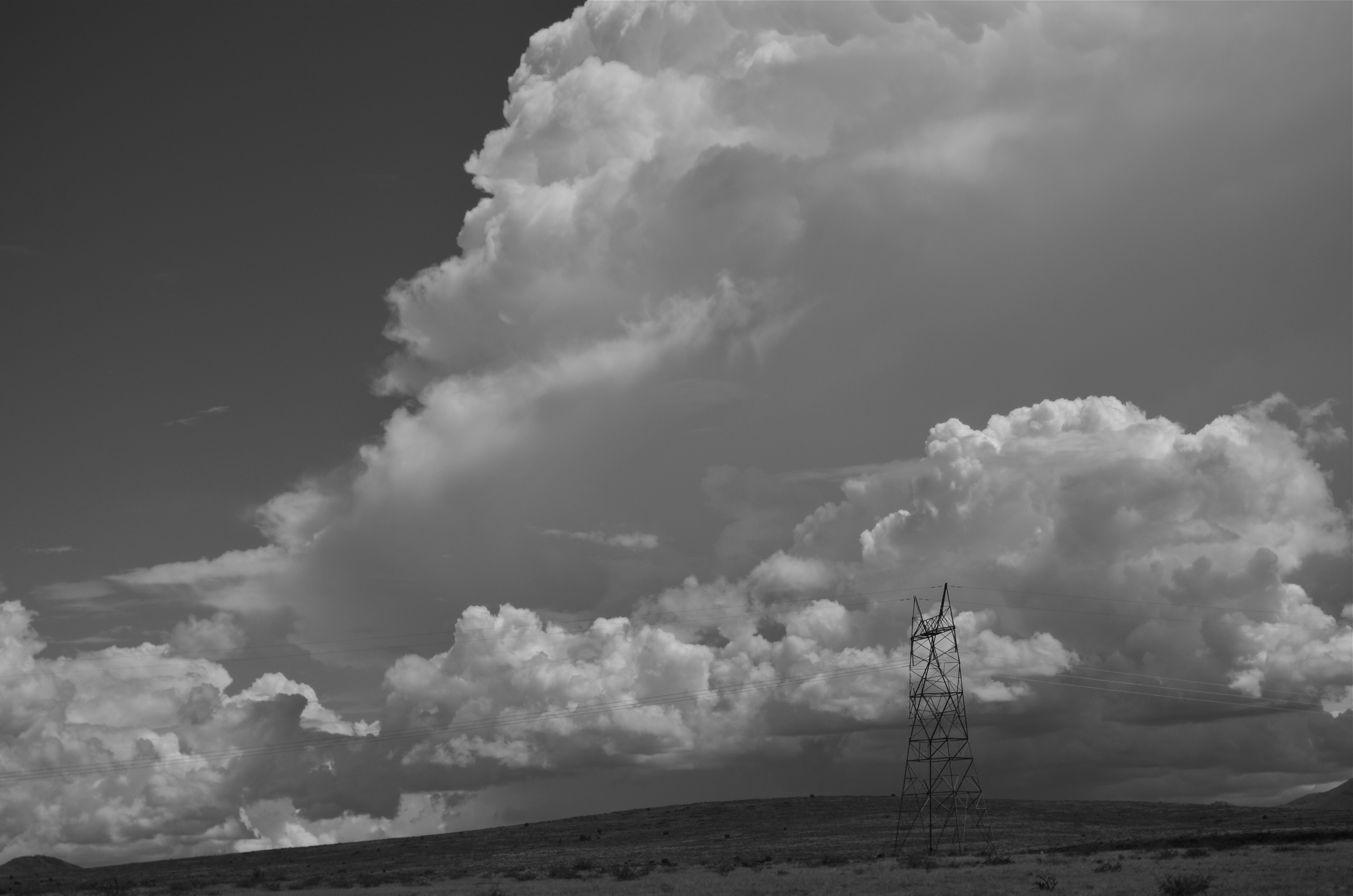
“Relay”, Black Canyon City, Arizona, 2013. 1/500 sec., f/8, ISO 100, 55mm.
By MICHAEL PERKINS
AMERICA’S SOUTHWESTERN STATES COME EQUIPPED WITH SOME OF THE MOST SPECTACULAR SCENERY TO BE HAD ANYWHERE ON EARTH; jutting crags, yawning canyons, vast valleys, and more sky than you’ve ever seen anywhere. Photographically, the mountains, mesas and arroyos deliver on drama pretty much year-round, while the sky can be an endless expanse of, well, not much, really. Compositionally, this means rolling the horizon line in your framing pretty far toward the top, crowding out a fairly unbroken and featureless ocean of blue….except for more humid summer months, when cloud formations truly steal the scene.
It’s true: as the storm season (sometimes called the “monsoon”, for reasons that escape me) accompanies the year’s highest temperatures in desert regions, rolling, boiling billows of clouds add texture, drama, even a sense of scale to skies in Arizona, Utah, New Mexico, and California. It’s like getting free props for whatever photographic theatre you care to stage, and it often makes sense to rotate your horizon line back toward the bottom of the frame to give the sky show top billing.
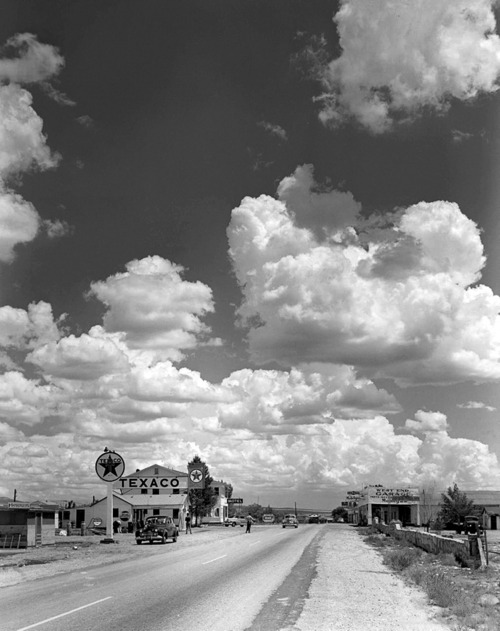
Andreas Feininger’s masterful staging of Arizona skies for Life Magazine. Copyrighted image.
Early photographers often augmented the skies in their seascapes and mountain views by layering multiple glass negatives, one containing ground features, the other crammed with “decorator” clouds. The same effect was later achieved in the darkroom during the film era. Hey, any way you get to the finish line. Suffice it to say that the harvest of mile-high cloud banks is particularly high in the desert states’ summer seasons, and can fill the frame with enough impact to render everything else as filler.
I still marvel at the monochrome masterpiece by Life magazine’s Andreas Feininger, Texaco Station, Route 66, Seligman, Arizona, 1947, which allows the sky overhead to dwarf the photo’s actual subject, creating a marvelous feeling of both space and scale. I first saw this photo as a boy, and am not surprised to see it re-printed over the decades in every major anthology of Life’s all-time greatest images. It’s a one-image classroom, as all the best pictures always are. For more on Feininger’s singular gift for composition, click the “related articles” link below.
Big Sky country yields drama all along the America southwest. And all you really have to do is point.
Follow Michael Perkins on Twitter @MPnormaleye.
Related articles
- Photography Monograph (conordoylephoto.wordpress.com)
GIFTS
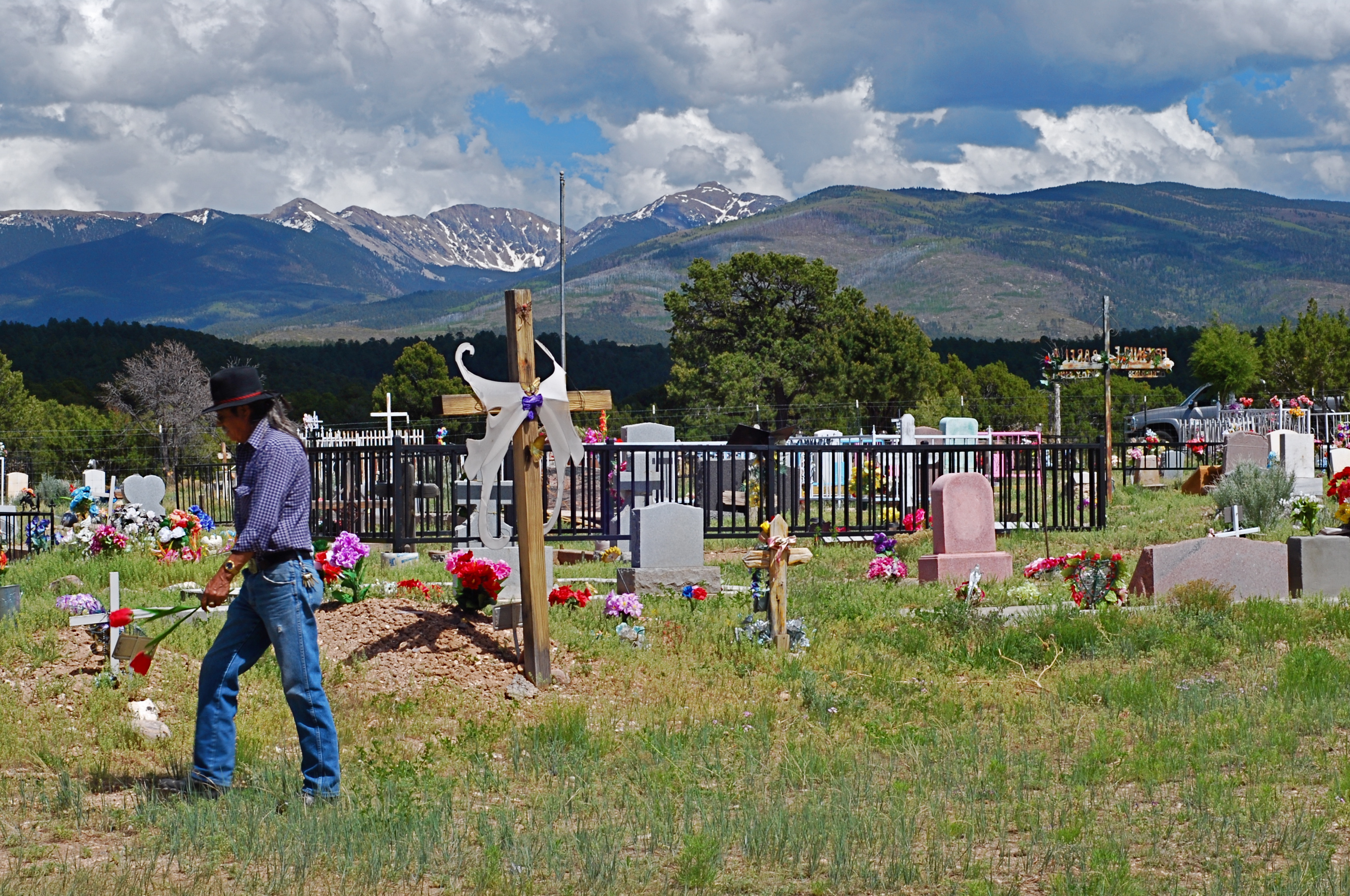
Some things you work hard for. Some things fall right into your lap. Learn to be gracious and grateful for the happy accident. 1/125 sec., F/14, ISO 200, 50mm.
SOMETIMES YOU CAN BECOME SO FIXATED on the shot you think you want that the shot you could have can’t squeeze through the mental haze. You might even regard an element that has the potential to actually save your image as an annoyance, as if it’s blocking the view of your sacred “plan”. The alternate idea buzzes around your skull like some stubborn house fly, and you’re eager to bat it away and get back to your grand vision.
A while back, such an element was fighting to get my attention. It was the very thing my picture needed…and the very last thing I wanted. I wish I could say I came to my senses, but it was actually only after I viewed a burst of shots, after the fact, that I fully realized I had been given a gift.
The above scene, a small rustic graveyard, can be found in a mountainous village near the greater Santa Fe area in New Mexico. The location pulled me off the road with its breathtaking setting, as well as the many hand-crafted monuments scattered among the more traditional headstones. I was thinking: nice, self-contained scenic shot, lots of local flavor, warmer-than-normal desert light, just point and click, right? Simple.
Simple, that is, until our friend here showed up. Immediately I regarded him as noise, as an interruption of my “ideal” shot. Never mind the folly of thinking that there is only one way to approach a subject: I was muttering a few silent oaths even as I continued to click and track him as he crossed the graveyard. When was he going to get out of the way, so I could back to my master plan?
Idiot.
I kept everything I shot, figuring that I might have accidentally gotten my wonderful empty scenic before my visitor came along. Instead, at full-size review later, I came back again and again to look at him. His slim solitary form, his simple dress, his two plain flowers, and his downcast gaze all lent a story to what had been a simple, if nice, still life. In giving that sad little field some badly needed human context, his presence proved that it was he who belonged there. If there was an intruder in this drama, it was me. I was just there to take pictures of his life.
He was busy living it.
I frequently find that if I just turn my mind off and stop obsessing about my “vision”, many settings yield something stronger and more elequent than my original design. Think of it as being a sketch artist who keeps his options open by laying in as many pencil lines as you can before inking the final choice. Most importantly, you must trust and be thankful for the occasional gift.
Thoughts?
 thenormaleye