BEYOND THE THING ITSELF
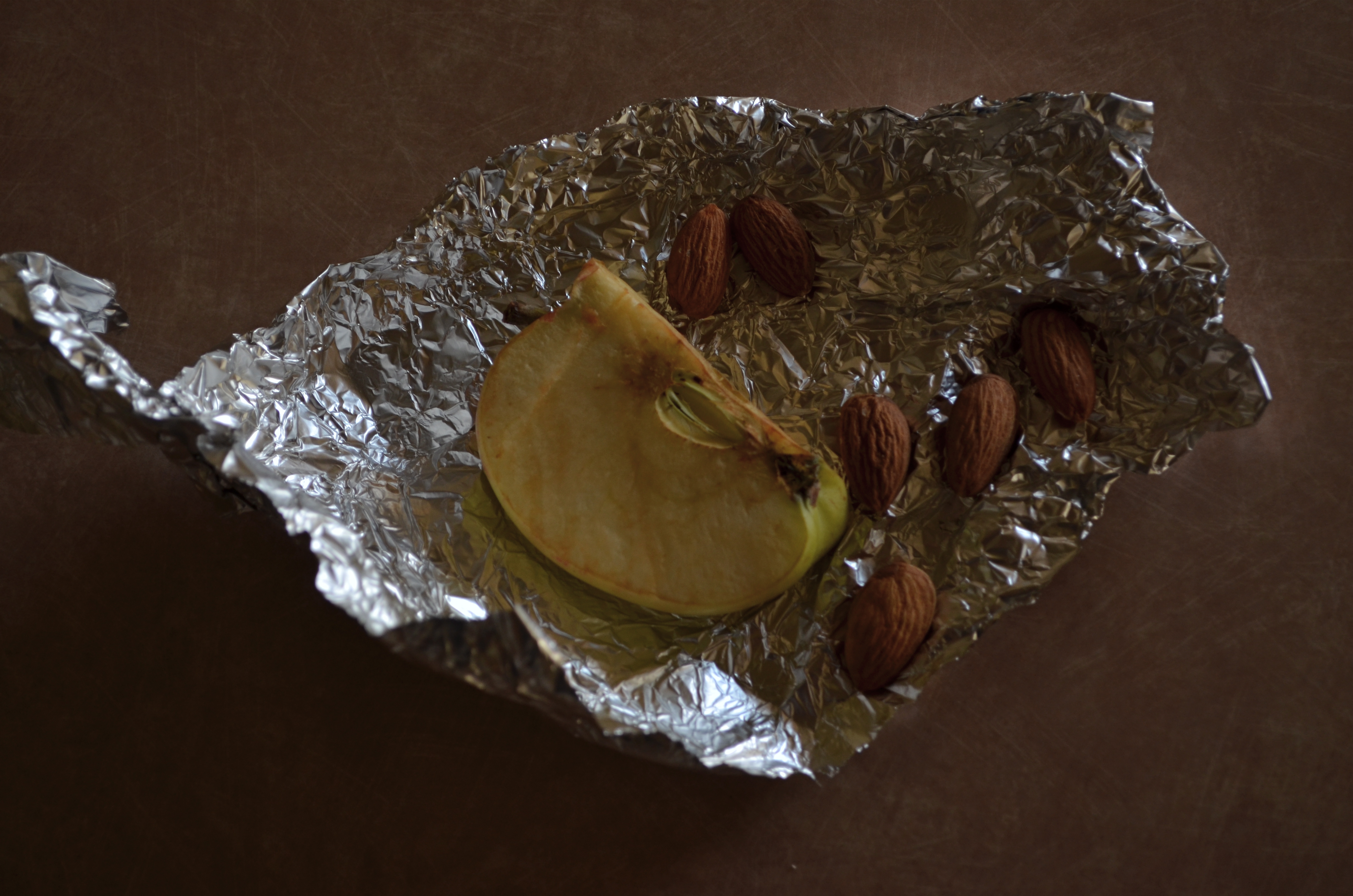
Saved from the trash can, long enough to satisfy my curiosity. 1/50 sec., f/5.3, ISO 200, 40mm.
By MICHAEL PERKINS
YOU NO DOUBT HAVE YOUR OWN “RULES” as to when a humble object becomes a noble one to the camera, that strange transference of energy from ordinary to compelling that allows an image to do more than record the thing itself. A million scattered fragments of daily life have been morphed into, if not art, something more than mundane, and it happens in an altogether mysterious way somewhere between picking it and clicking it. I don’t so much have a list of rules as I do a sequence of instincts. I know when I might have stumbled across something, something that, if poked, prodded or teased out in some way, might give me pleasure on the back end. It’s a little more advanced than a crap shoot and a far cry from science.
With still life subjects, unlike portraits or documentary work. there isn’t an argument about the ethics or “purity” of manipulating the material….rearranging it, changing the emphasis, tweaking the light. In fact, still lifes are the only kinds of pictures where “working it” is the main objective. You know you’re molding the material. You want to see what other qualities or aspects you can reveal by, well, kind of playing with your food. It’s like Richard Dreyfuss shaping mashed potatoes into the Devil’s Tower.
If I have any hard and fast rule about still lifes, it may be to throw out my trash a little slower. I can recall several instances in which I was on my way the garbage can with something, only to save it from oblivion at the last minute, turn it over on a table, and then try to tell myself something new about it from this angle or that. The above image, taken a few months ago, was such a salvage job, and, for reasons only important to myself, I like what resulted. Hey, Rauschenburg glued egg cartons on canvas. This ain’t new.
My wife had packed a quick fruit and nut snack into a piece of aluminum foil, forgot to eat it, and brought it back home in her lunch sack. In cleaning out the sack, I figured she would not want to take it a second day and started to throw it out. Re-wrapped several times, the foil now had a refractive quality which, in conjunction with window light from our patio, seemed to amp up the color of the apple slice and the almonds. Better yet, by playing with the crinkle factor of the foil, I could turn it into a combination reflector pan and bounce card. Five or six shots worth of work, and suddenly the afternoon seemed worthwhile.
I know, nuts.
Fruits and nuts, to be exact. Hey, if we don’t play, how will we learn to work? Get out on the playground. Make the playground.
And inspect your trash as you roll it to the curb.
Hey, you never know.
Thoughts?
GLO-SCHTICK
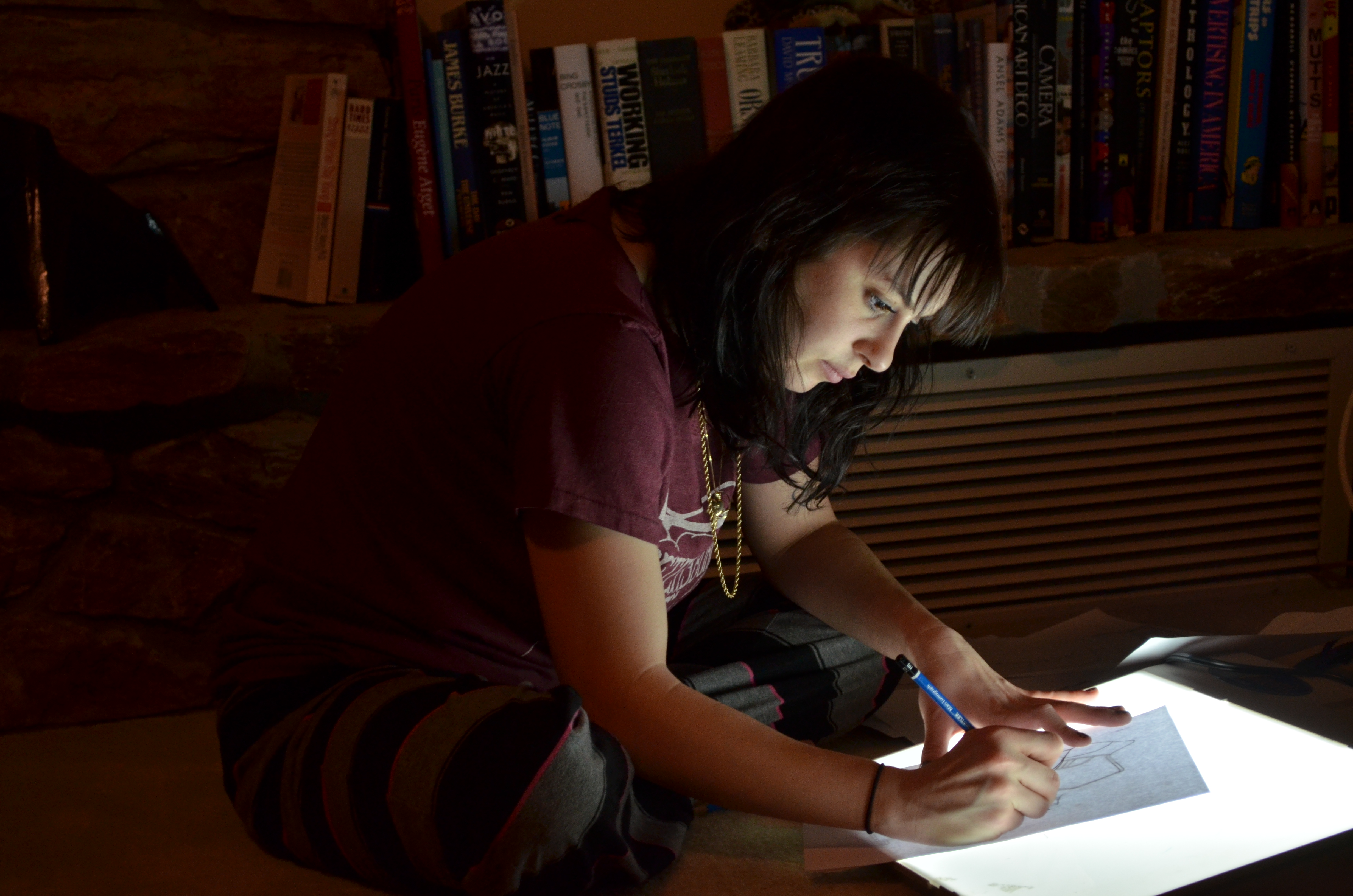
Sometimes just a bit is just enough. A bump up to ISO 640 kept me fairly free of noise and allowed me to use the screen’s glow as my only light source. 1/30 sec., f/5.6 at 52mm.
By MICHAEL PERKINS
THE BEST TECHNIQUE is one that does not scream for attention like a neon t-shirt emblazoned with the phrase LOOK WHAT I DID.
Now, of course, we are all messing around backstage, working hard to make the elephant disappear. We all manipulate light. We all nudge nature in the direction we’d prefer that she go. But what self-respecting magician wants to get caught pulling the rabbit out of a hole in the table?
I recently had the perfect low-light solution handed to me as I watched a young designer working in a dim room, and, thankfully, only marginally aware of my presence. “Lighting 101” dictated that, to get a sense of her intense concentration, I send the most important light right to her face.
Turns out, a light tracer screen, in a pinch, makes a perfect softbox.
Better yet, the light from the screen thinned out and dampened after it traveled left past her shoulders, leaving just enough illumination to keep the rest of the frame from falling off completely into black, making the face the lone story-teller. An ISO bump to 640 and a white balance tweak were enough to grab the best of what the screen had to give. At this point in the “gift from the gods” process, you click, and promise, in return, to live a moral life.
Sometimes you don’t have to do anything extra to make a thing look like it actually was. That’s better than finding a hundred-dollar bill on the street.
Well, almost.
What was your best light luck-out?
BAM!
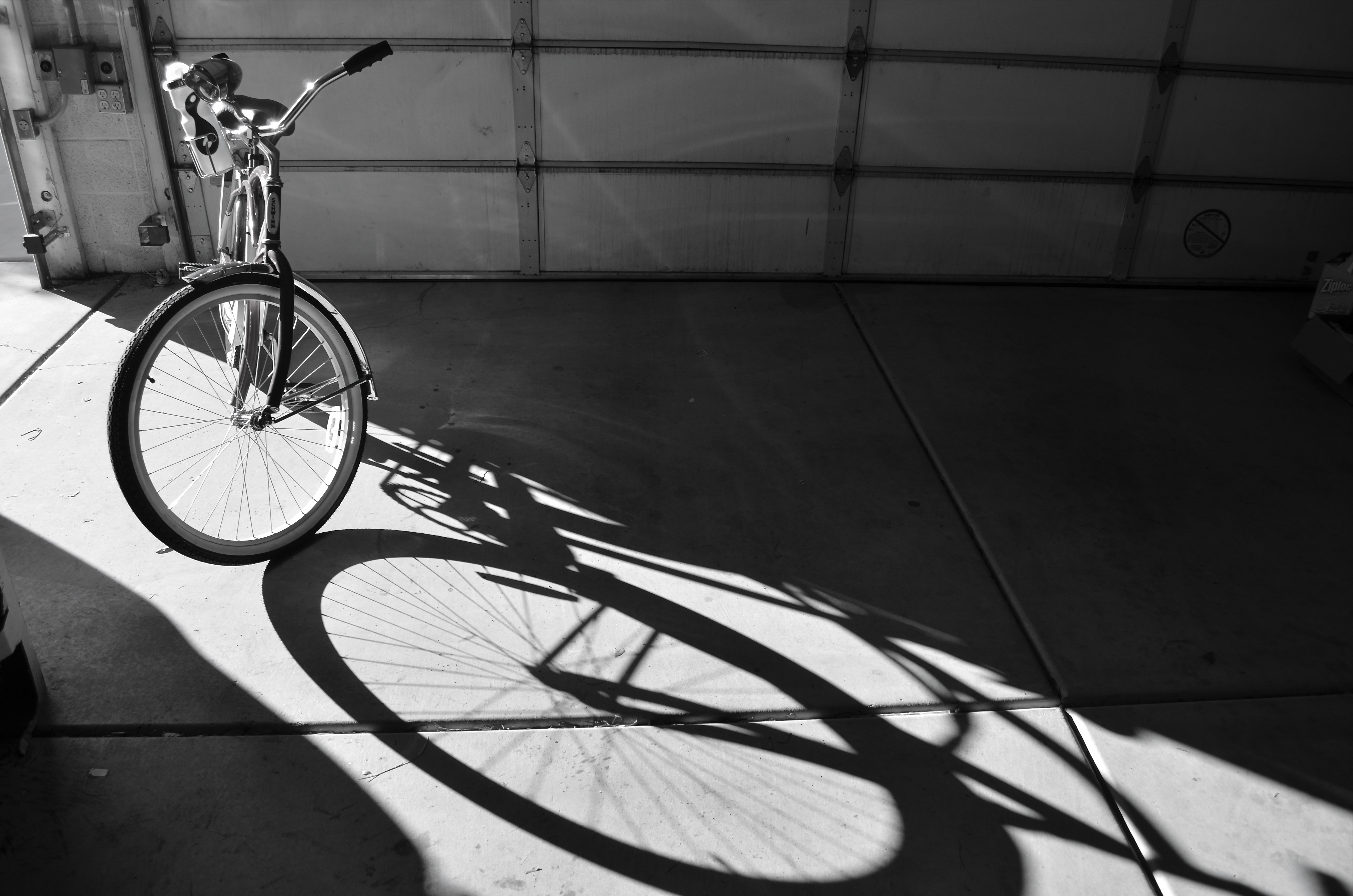
My early morning “garage studio”, an impromptu place to stage objects large and small, lit by an early morning blast of Arizona sun. 1/160 sec., f/6, ISO 100, 18mm.
THERE IS A DELIGHTFUL SEQUENCE toward the end of Martin Scorsese’s Hugo which shows the silent movie pioneer George Melies creating films in his own primitive studio in France. Like Thomas Edison, who built the Black Maria, a tarpaper shack that rotated on a turntable so its roof and front wall could be turned toward the sun for all-day shooting, Melies improvised his own turn-of-the-century solution for how to get adequate light to slow film. Like Edison, he built his studio to stand out in the open sun, but fashioned its walls completely of glass, huge panes mounted inside a simple metal frame cage. The frame held fixtures and scenery in place, and its spartan design gave Melies a pure, huge, natural light box inside which he directed the first minor masterpieces of world cinema. It’s a reminder of how truly elementary some of our light problems are. Just put yourself at the service of the available light and be ready to make magic….in seconds.
The point is, most of us probably have daily access to at least one “sweet” spot, either in our houses, or the yards and grounds that surround them, or somewhere near us, where there is abundant, reliable light, on a daily basis, sufficient to shoot almost anything..without muss, fuss, or flash. For me, it’s the southeast corner of the house, where the blazingly, brilliant Arizona morning light comes slamming in by way of the opened garage door, the front entrance sidelights, or the west window near where I am posting this. And when I say light, I mean BAM! light, with long, solid shadows and, just after dawn, a super-saturation of color that will vanish by midday, when the western sky is one big blinding, squinting, over-exposed whiteout.
In recent months, I have actually created crude mini-studio areas at these various BAM! points, staging objects on everything from snack tables to packing cartons, baffling or channeling the light in some cases with strips of cardboard or towels, but mostly just placing still-life objects right in the path of these killer rays. On occasion, I am rewarded with a great image before breakfast, which is a psychologically great way to put the right early spin on the day.
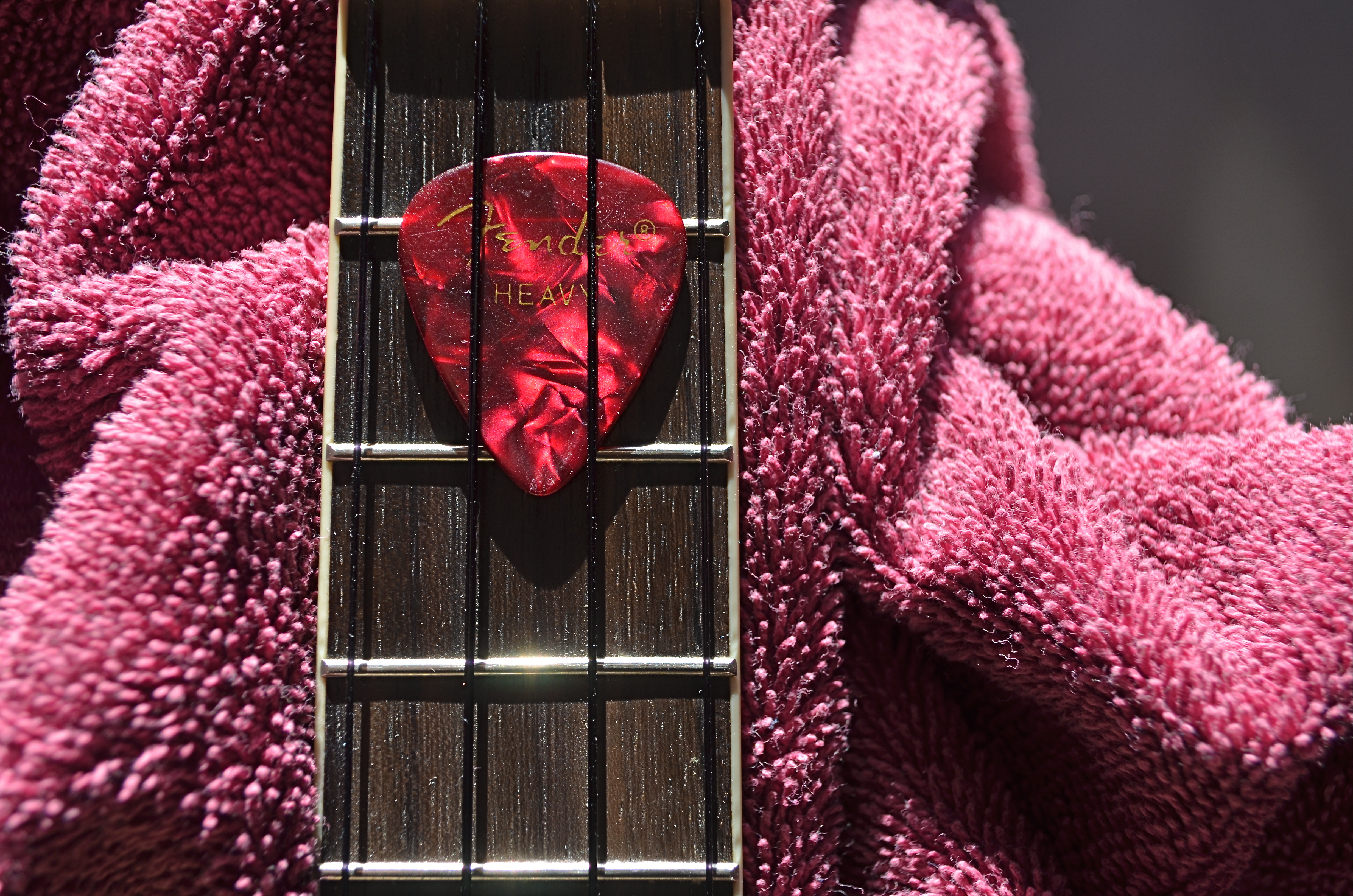
Same staging area, different day. This tight shot on one of my ukes was set up lying on its back, held aloft on a tall packing carton. 1/160 sec., f/5.6, ISO 100, 30mm.
It also harks back to my childhood and the five dollar Imperial box camera that started it all. With one focal length and one shutter speed, you had to be cagey, to, in fact, get any image in other than ideal light. There was, to say the least, a high fail rate. Next time you stop by the house I can show you the shoebox of shame, wherein lie interred all the keepers that might have been. Rest in Peace.
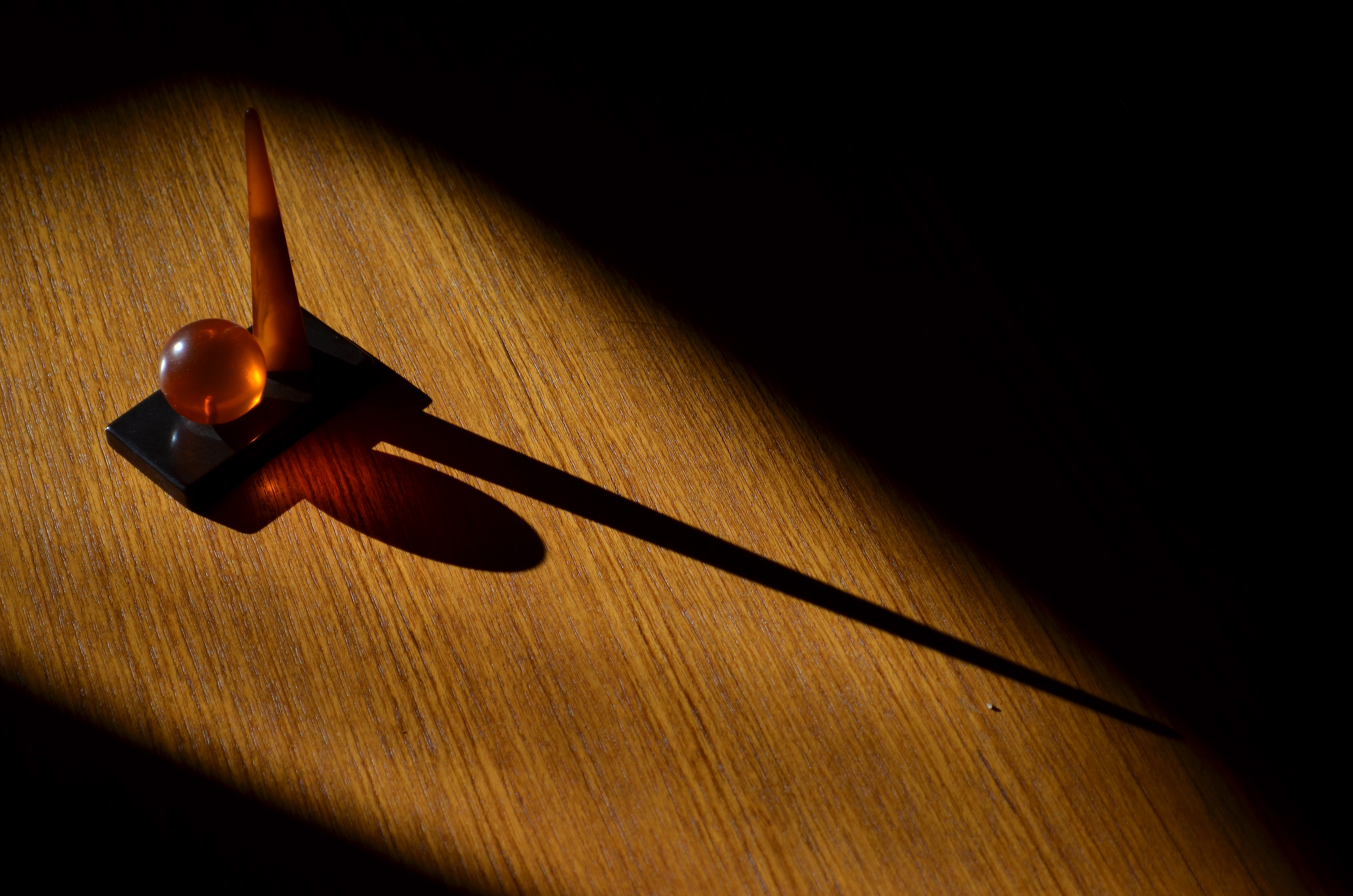
A translucent souvenir paperweight from the 1939 New York World’s Fair, made into a kind of glow torch courtesy of morning light shining on my dining room table. 1/500 sec., f/5.6, ISO 100, 55mm.
Part of my mad pursuit of available light has been fed, in recent years, by the adventure I undertook of shooting exclusively with a 50mm f/1.8 prime lens for an entire year. Freed by this wonderful glass to attempt an ever wider scope of do-able shots, I did everything I could to push the envelope in whatever situation I could devise. Eventually I compiled a book of the luckiest results entitled The Normal Eye, and was left with a renewed passion for low-and- no-light opportunities.
Find the BAM! spot around your crib and have your own Melies moment. Turns out, the tools we need are never far off.
Make light of the situation.
Thoughts?
(The Normal Eye is available through Blurb Books at www.blurb.com/bookstore

