NEW ANGELS
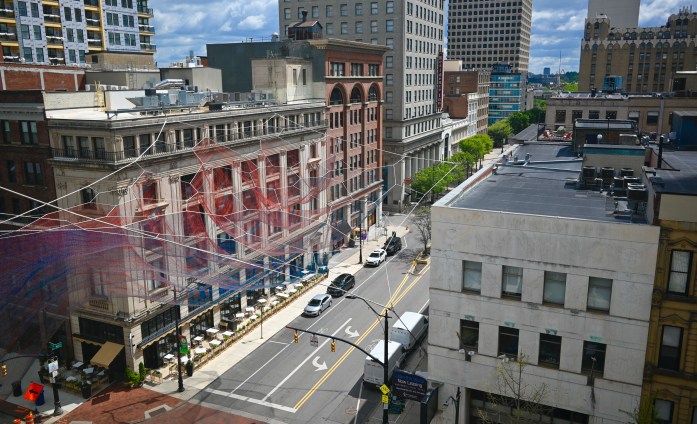
Current, a rope and cord art installation in Columbus, Ohio, created by “fiber artist” Janet Echelman
By MICHAEL PERKINS
FOR ME, ONE OF THE MOST EXCITING TRENDS IN URBAN DESIGN, in the twenty-first century, is not the latest generation of skyscrapers or town plazas, but a bold new redefinition of the concept of public art. Where once it was sufficient to plop down a statute of some wartime general near the county courthouse, commissioned works now make mere sculpture look as primitive as cave paintings. We have evolved past the commemorative earthbound seraphim that once graced our parks, to flights of fancy that connect and shimmer from the air. It is an age of New Angels, and Janet Echelman is one of its patron saints.
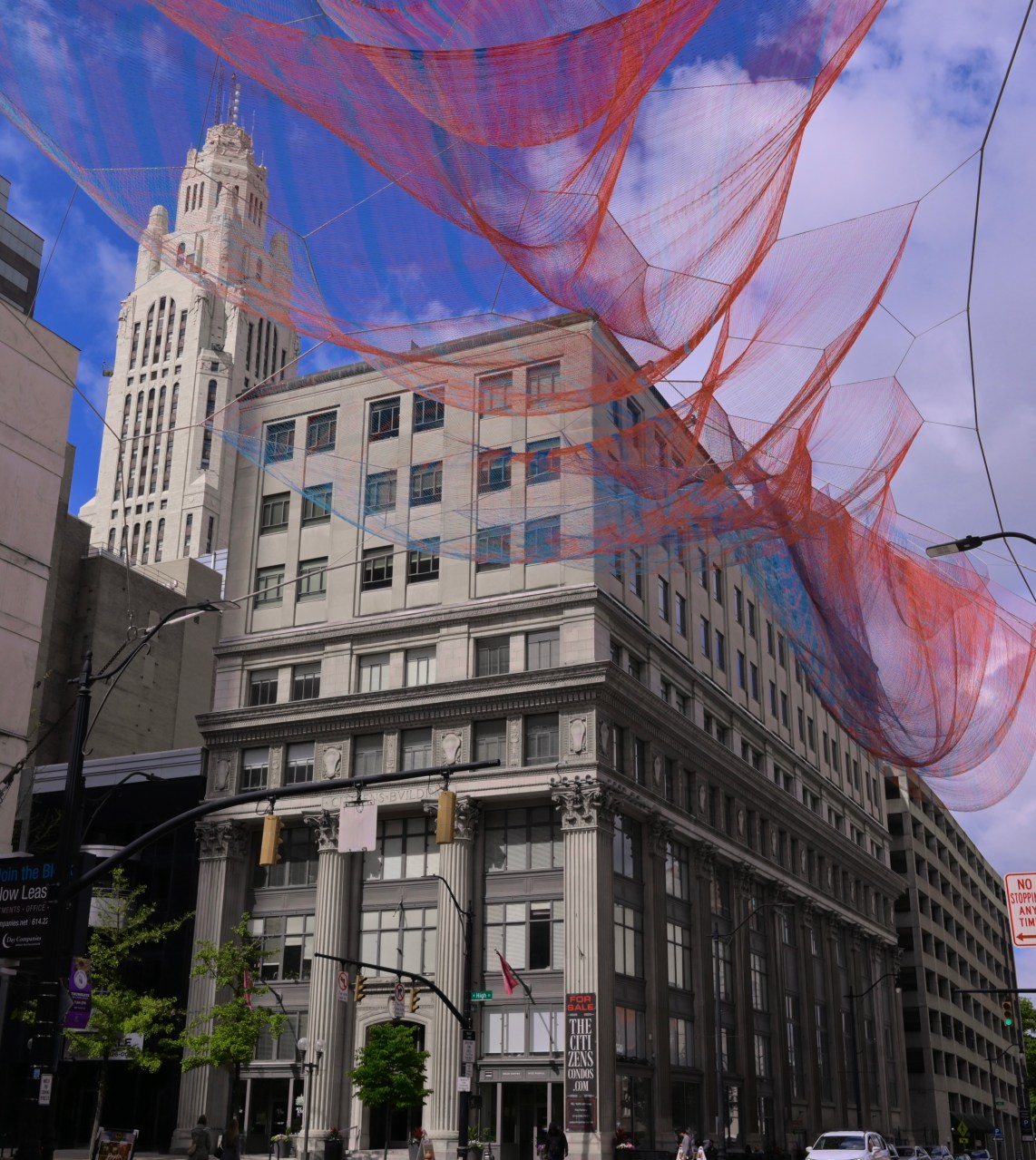
Echelman, a Guggenheim fellow and Harvard graduate, who refers to herself as a “fiber artist”, is, in fact, an altogether new kind of sculptor. Instead of being grounded on pedestals, her arrangements of shimmering color, created by mixtures of fiber, netting and rope, hang in suspension over cityscapes like vast spider webs, refracting the rainbow and generating waves of shifting hues depending on changes in sunlight, wind or the angle of view. Some of her creations are billowing circles and cones that resemble a whirlwind of cyclone; others look like sky-bound rivers, curling and twisting into tributaries of red and blue. Each is uniquely tailored to its specific location in cities like San Francisco, Vancouver, Seattle, and a half-dozen other cities around the world. They are, simply, magnificent, and the best challenge for any photographer, since they appear vastly different under varying conditions.
I first saw one of her works while working at Arizona State University, where Her Secret Is Patience floats like a phantom hot air balloon near the school’s Cronkite School of Journalism. And just this spring, I was thrilled to see her first work to be floated over an entire intersection, 2023’s Current, which spreads across the meeting of High and Gay Streets in Columbus, Ohio, anchored to the tops of buildings at the crossing’s four corners. Commissioned by a local real estate developer as a kind of front porch for his refurbished bank building (now housing deluxe condos), Current can be seen from any approach within a four-block distance of the area, an irresistible advertisement for the regentrification of the neighborhood. Janet Echelman is but one voice in a rising chorus that demands that public art re-define itself for a new age. That age will not only withstand controversy but actively court it, just as any art, including photography, needs to do.
A GRAIN OF TRUTH
By MICHAEL PERKINS
TEXTURE IS ONE OF THE MOST VARIABLE FACTORS in photography, in that its importance in an image goes all over the map given the situation. While exposure and composition, even focus, are key considerations in the making of nearly every picture, texture can jump to the front of the line and become the crucial element in the making of a photograph, moving from merely part of the story to its central point.
In photographing, for example, Da Vinci’s Last Supper, you’re creating a narrative not only on the figures in the fresco or of the painter’s technique; you’re also making a document of the current physical condition of the work, commenting, in effect, on its state of deterioration, the befores and afters of any restoration efforts, even the grain and grit of the surface itself, since, over the centuries, the art, and what it was created on, are now inextricably linked; two halves of a whole.
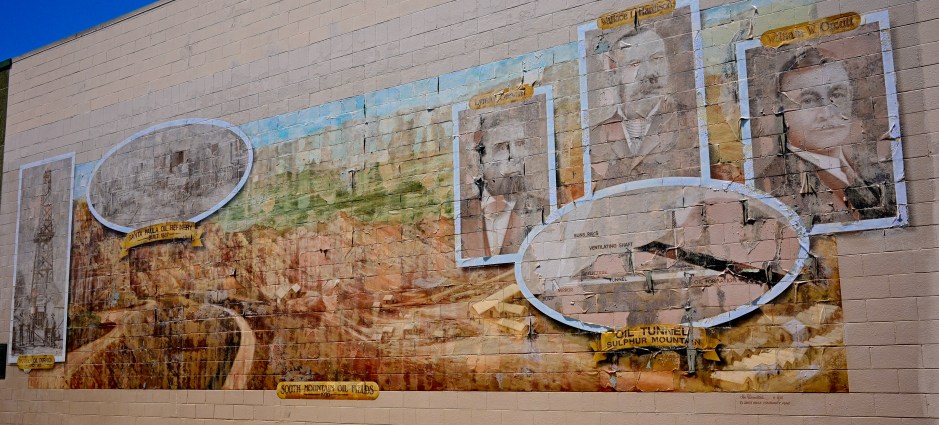
Murals in particular can only be complete documents when the aging or weathering factors on surfaces can become part of the story. This memorial to the central west coast’s oil industry (top) seen on the side of a building in Santa Paula, California, can, years after it was created, no longer merely be a painting or an homage.
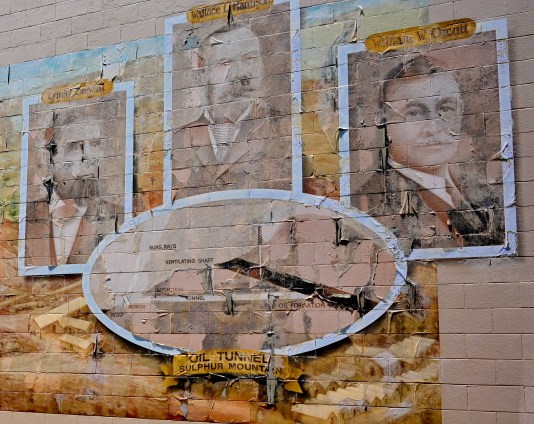
In a very real way, the wall has become part of the painting, an expression of the toll of years since the town’s glory days. This elevates texture to the status of a key factor in the relating of the area’s history. As seen in the detail, just above, the peeling and cracking of the work is a story in itself, an unstated what happened? that forms in the mind of the visitor. as in the Last Supper or other venerable works, the ravages of time root an event or an era in fixed historical position. We are aware that we are looking at a relic, still visible in this world; a souvenir of other, vanished worlds.
In photographs, the final effect ranges from casual to formal, from mere reportage to historical commentary. We bring intent to a scene when we capture it in a box, adding accents along the way to underscore what we feel about it. Come to think on it, that is about as close to a working definition of texture as you can get.
MULTIPLE RECKONINGS
By MICHAEL PERKINS
CERTAINLY SINCE THE DAWN OF DIGITAL PHOTOGRAPHY, and, with it, the fall of the last economic barrier to the making of many, many pictures, my urge to document simply everything that comes into my daily experience is stronger than at any time in my life. In short, I can afford to make many more attempts to document my journey through life than was even thinkable in the film-dominant age of my youth.
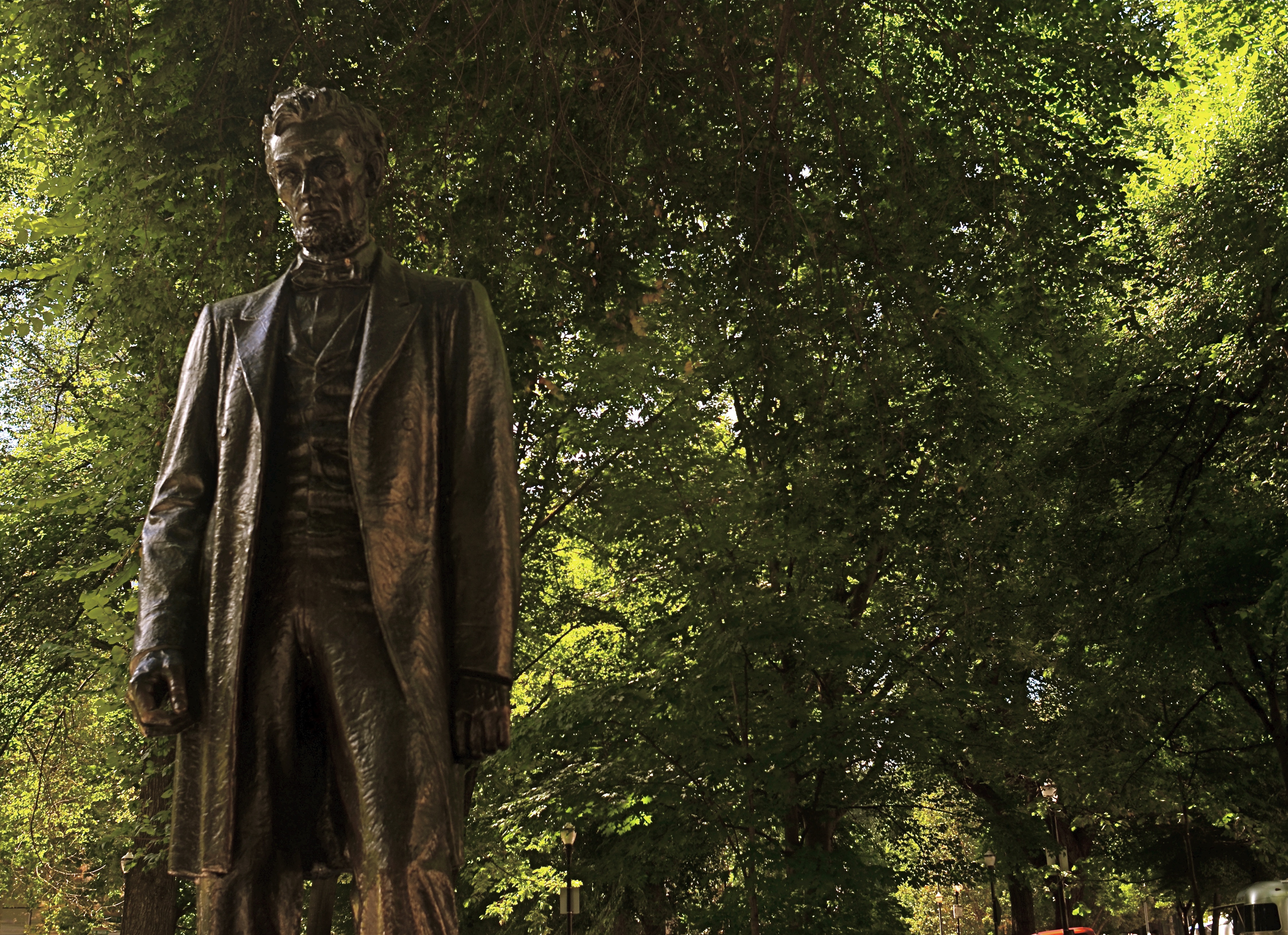
This means that I wind up recording much more of the world, and, accordingly, preserving more from its ever-changing churn of events. That fact came roaring home to me the other day when I was looking at some shots from a walking tour of Portland, Oregon that I took in 2018. One of the then-constant sights within the city’s South Park Blocks district was George Fite Waters’ statue of Abraham Lincoln, and, in happening upon it, it seemed like a no-brainer to take a quick snap of it. In reviewing the image, I idly wondered just how many public statues of the 16th president had actually been produced in the 163 years since his death. Turns out he may be the most memorialized figure in American history, with sculptures in over thirty American cities as well as carved effigies in Mexico, England, Norway, Scotland and even Russia (where he is depicted shaking hands with the Tsar…you may want to fact-check that event). Waters’ statue is perfectly average in every respect, except for the fact that, since I last viewed it, it just isn’t there anymore.
Apparently a particularly boisterous 2020 protest on the annual Indigenous Peoples’ Day Of Rage resulted in the toppling of not only the Lincoln statue but a marble depiction of Teddy Roosevelt’s Rough Rider days, with the result that both works are presently in a protective suspended state. Of course, what with all the tortured re-evaluations of the American Civil War seen in recent seasons, it seems consistent that Honest Abe himself remains as controversial as when he walked among us. At this writing the mayor of Sandy, Oregon still has an offer on the table to host both statues in his town, but the entire issue remains in limbo. Which allows me to circle back to my original point: nothing could be easier in the digital age but shooting any and everything that catches your fancy, for any reason. You don’t even have to have an opinion on whether something should be. The mere fact that it is, as well as the knowledge that, at a moment’s notice, it might no longer be, is enough to merit a picture. Snap away.
IT’S COMPLICATED
By MICHAEL PERKINS
THROUGHOUT HISTORY, MEMORIALS TENDED TO BE FAIRLY STATIC THINGS. A tomb or monument depicting a battle, celebrating a leader, or enshrining a belief was built, and it stood, for as long as time and fortune might allow. After the invention of photography, however, things tended to be not fully finished, especially tributes and honors. We track their context with pictures in real time: over consecutive eras, we document their rise and fall, and that of the societies that produced them.
The equestrian statue of Theodore Roosevelt, parked for 80 years at the entrance to New York’s American Museum of Natural History (which T.R.’s family riches helped establish) has, as of this writing, been removed, transferred to what historians hope will be a better teaching context. His mounted figure, flanked by depictions of both Native and African-American men on foot, had been problematic for the museum, passersby, and, indeed the Roosevelt family itself in recent years, given the 26th President’s troubling mix of views on race, eugenics, and colonialism, and so the removal came as little surprise. Now, however, as a consequence of the move, anyone taking a photograph of the work henceforth will be interpreting it through the “lens” of a completely different societal context.
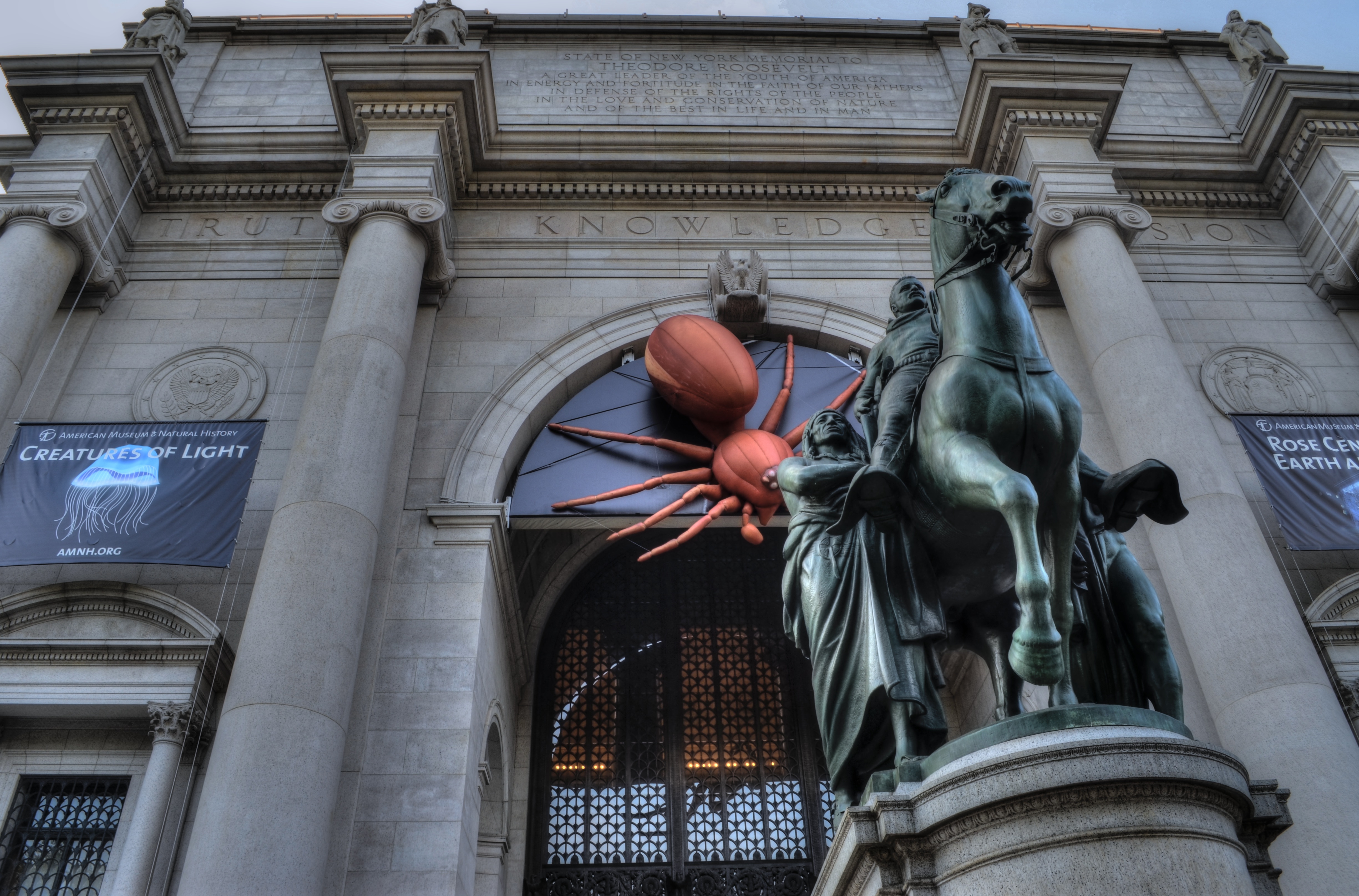
Now you see it, now you won’t: the recently removed Teddy Roosevelt statue, an 80-year fixture at the entrance to the American Museum of Natural History, as seen by the author in 2012.
When people change, the symbols they value, as well as the images they create of those symbols, change as well. Just as it’s odd now to see the Statue of Liberty’s disembodied torch hand in old photographs, the images makes sense once one realizes that the landmark originally came to American in stages, with the arm on display in Manhattan for a time in a push for funding to complete the memorial. Thus that picture, in its original time frame, makes perfect sense. It’s only that more familiar pictures have replaced that view, rendering its original reality strange.
It’s not for this author to try to climb into the mind of the original creators of the T.R. statue in question: it was a product of its time. Similarly, this image I made of it, from its chosen angle to its processing to the unsettling presence of an enormous red spider(!), is now locked away from all other moments on a single day in 2012. “The moving hand writes, and having writ, moves on”. Heroes, from generals to philosophers, are nuanced, complicated. Making pictures of our struggle with that complexity is part of our quest to tell our complete story.
BECAUSE WEIRD ISN’T FOREVER
By MICHAEL PERKINS
WHAT DO YOU DO when you’re a quirky bit of modern art and the museum that hosts you has been shuttered for missing the rent? Futher, let’s assume your creator’s homeland regards your “art” as political blasphemy and let’s also stipulate that you are, say, a fifteen-foot-high chromed head of Vladimir Lenin with a tiny baby balanced on its top.
In the words of Randy Newman, “I Love L.A.”
Beginning in 2011, expatriot Chinese artist brothers Gao Zhen and Gao Qiang found a home for their satirical sculpture, Miss Mao Trying To Poise Herself At The Top Of Lenin’s Head, in front of Los Angeles’ ACE Museum at 4th Street and La Brea Avenue. Locals and tourists alike soon embraced the weird, much as motorists might grow fond of sites like The Giant Ball Of String or The World’s Crookedest House, worshiping the sheer asinine novelty of the thing over any aesthetic merit. The result? Art meant as provocation landed, instead, with the soft cushiony comfort of fun, an ironic landmark, as in, “to get to my house, take the first left after the Lenin head..”
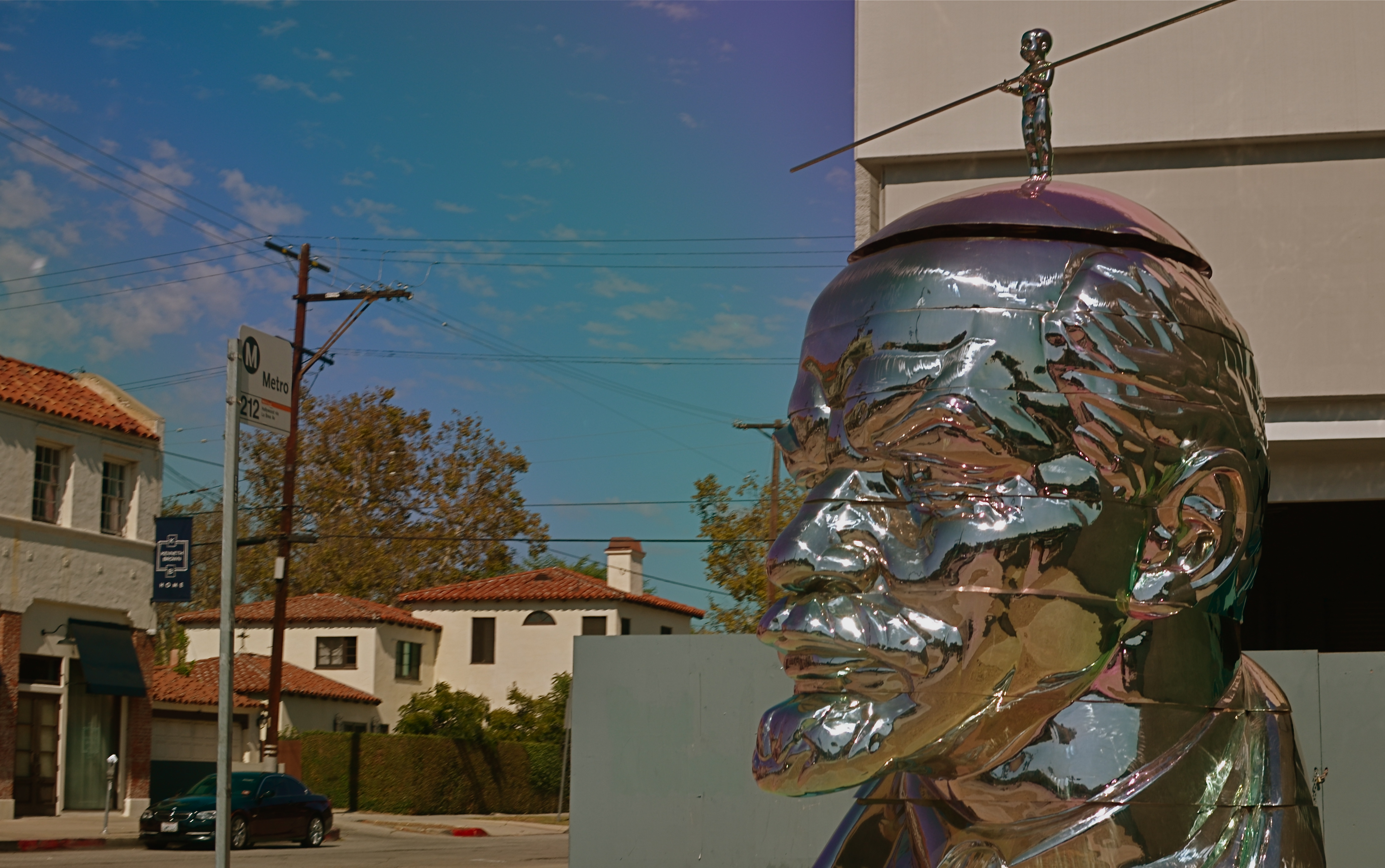
I Caught Lenin when he did L.A.
But here’s the take-away for photographers. Part of our job is to freeze the human drama as it shifts and morphs. That means being particularly sensitive to the things in society that change the quickest, including the fashion waves of the art world. And if serious art falls out of favor quickly, art that is loaded with satire or irony really races to the front of the obsolescence checkout. Weird ain’t forever.
Lenin and Miss Mao found by 2017 that it’s hard to stay a head (sorry) when the ACE Museum was evicted, leaving the work essentially homeless. Zhen and Qiang tried in vain to land the Commie Chromedome a new roost in China, but the Big Red One basically told them to pound sushi (humorless bunch, those socialists). What’s a murderous goateed revolutionary to do?
Well.
At this writing (June 2018), the most recent citing of Vlad’s Big Head was at the site of a trucking company near Newberry Springs, California, in the Mojave Desert, property owned by artist Weiming Chen, a friend of the Gao brothers who operates the area as a kind of statuary boneyard for his own works and those of others. A snapshot taken of the head showed Lenin looking characteristically defiant, although absent the lovely Miss Mao. I like to think she’s found peace as the hood ornament for a 1966 Diamond Reo rig highballing down CA-10. Hey, I can dream.
So, I treasure my 2014 snap of the head in situ in L.A. (seen above), back when life was good and fate was kind. Photography is commentary, but often, the top comment that comes to mind is something like “okaaaaay, so that happened..” No matter: it’s always worth a grin, and usually worth a picture.
As with Miss Mao, it’s a balancing act.
JUST OUT OF SIGHT
By MICHAEL PERKINS
PART OF THE EVOLUTION OF A PHOTOGRAPHER’S EYE is the imparting of new importance to things we have forgotten to see, those everyday objects that line or border our rituals and our daily to-and-froms, but which gradually are rendered invisible because our gaze is focused elsewhere. We fix upon the subway train that we have to catch, but miss the miniature tales buried in brick, steel, rust, entrances and exits. We’ve been down this street a million times, and always pause to peer in the window of, in order, the bakery, the newsstand, the Chinese take-out joint. Across the same street are a dry cleaner, a watch repair shop, and a storefront cathedral. We have never seen them.
Photography involves extracting stories where others see a blank slate, but that means first training ourselves to constantly re-see the things we believe we “know”, only to find that there are stunning revelations mere inches away from those known things. It’s the hardest habit to cultivate, this revealing of new layers in what we assume is the familiar. And yet it’s really the fresh blood that rejuvenates our art when it’s gone anemic.
One trick I try more often than I used to is to pause, after entering a building, to look back at the other side of that entrance…in other words, the view I would see facing me if I were using that entrance as an exit. It’s a very simply thing, but frequently there’s something fresh that presents itself, in something I believed I knew all about.
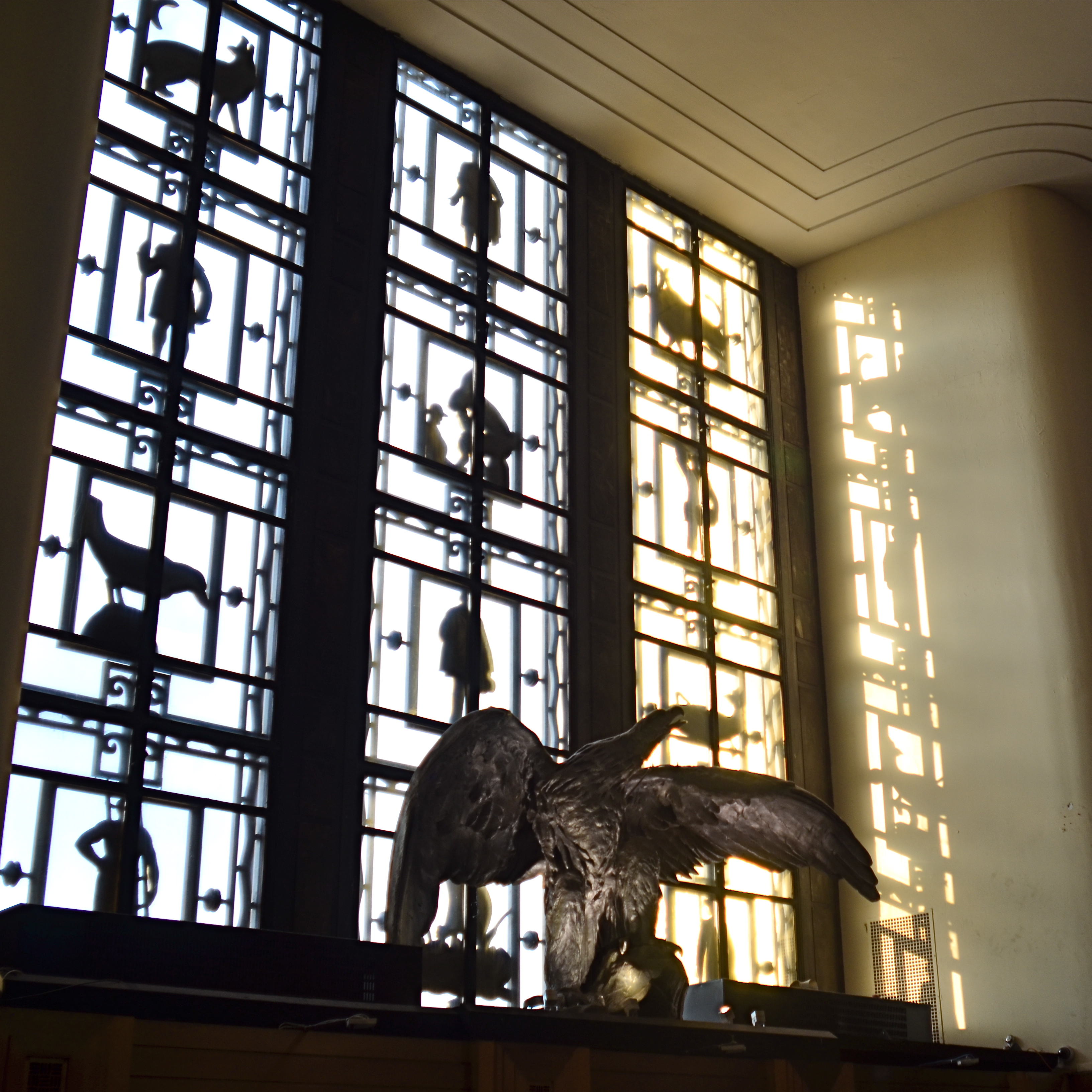
Flights of fancy, right under our wing….ah, nose.
The above image comes from such an exercise. It’s taken just inside the main entrance to the Brooklyn Public Library, which, as you can see, has a great Art Deco grille of storybook characters over the door. But that’s just as you walk in. Pay equal attention when you’re walking out, and you see a strange bird looming over the entrance (now your exit). But not just any bird. It is, in fact, a rescued statue which once graced the main lobby of the long-departed Brooklyn Eagle newspaper, out of its old context as a symbol of high-flying journalism, but now a reminder of one of the city’s best voices. Best of all, the late afternoon sun projects the silhouettes of the storybook grille onto the eagle and the adjacent wall in an unearthly display of shadow. It’s worth looking back at. Or I could say I am always looking forward to looking back at it.
When looking for something new to photograph, seek out the places in which you’ve seen it all. You’ll never be happier to be proven wrong.
ARCHITECTS OF HOPE
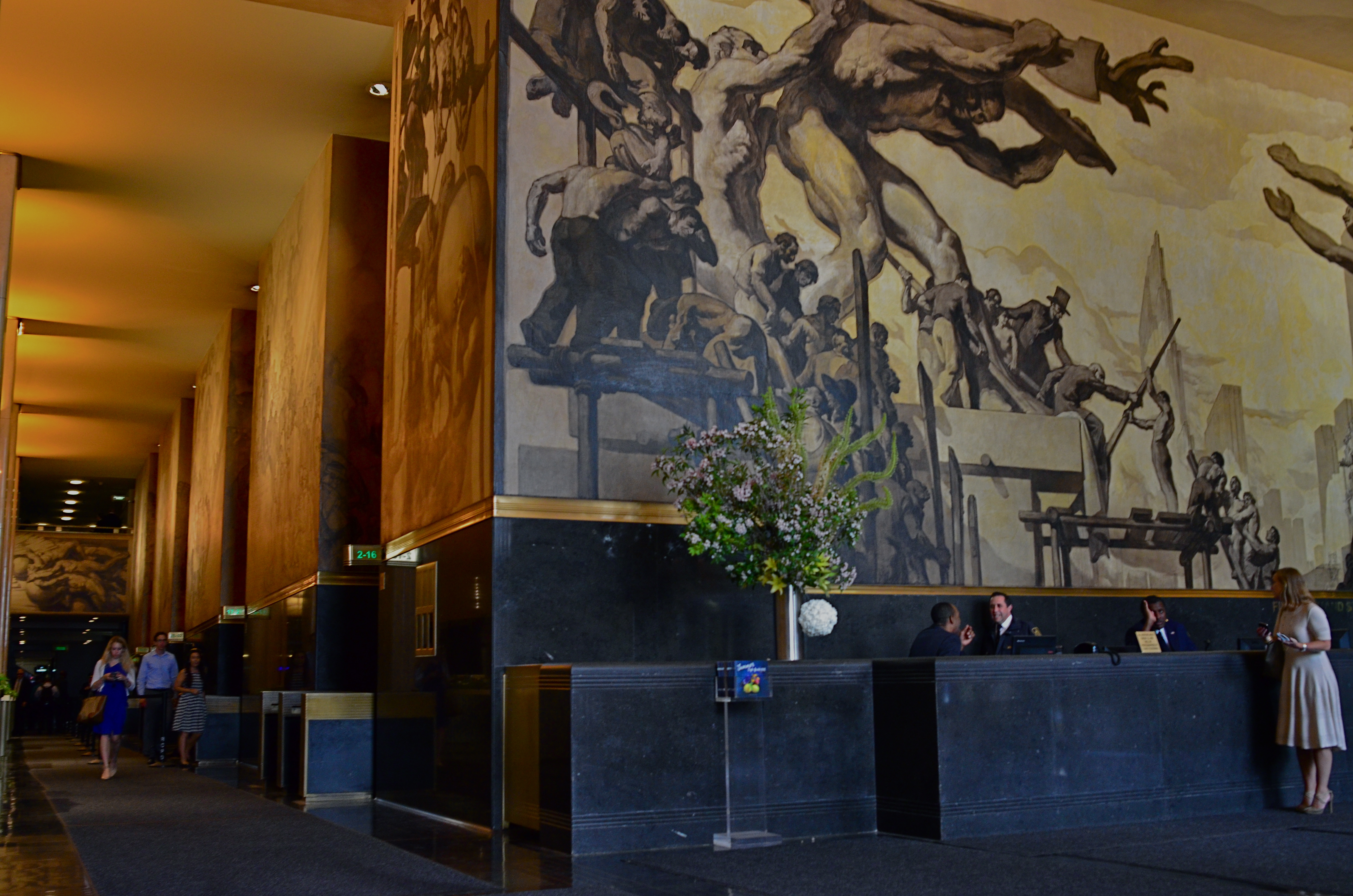
Part of Jose Maria Sert’s soaring mural American Progress (1937) above the main information desk just inside the entrance to 30 Rockefeller Plaza.
By MICHAEL PERKINS
THE EROSION AND COLLAPSE OF THE GREAT AMERICAN URBAN INFRASTRUCTURES of the 20th century is more than bad policy. It is more than reckless. It is also, to my mind, a sin against hope.
As photographers, we are witness to this horrific betrayal of the best of the human spirit. The pictures that result from this neglect may, indeed, be amazing. But we capture them with a mixture of sadness and rage.
Hope was a rarity in the early days of the Great Depression. Prosperity was not quite, as the experts claimed, “right around the corner.” And yet, a strategy arose, in private and federal project alike, that offered uplift and utility at the same time. People were put to work making things that other people needed. The nation erected parks, monuments, utilities, forests, and travel systems that turned misery to muscle and muscle to miracle. Millionaires used their personal fortunes to create temples of commerce and towers of achievement, hiring more men to turn more shovels. Hope became good business.
One of the gleaming jewels of the era was, and is, the still-amazing Rockefeller Plaza in New York, which, in its decorative murals and reliefs, lionized the working man even as it put bread on his table. The dignity of labor was reflected across the country in everything from newspaper lobbies to post office portals, giving photographers the chance to chronicle both decline and recovery in a country brought only briefly to its knees.
Today, the information desk at 30 Rockefeller Plaza, home of NBC studios, still provides a soaring tribute to the iron workers and sandhogs who made it possible for America to again put one foot in front of the other, marching, not crawling, back into the sunlight. It still makes a pretty picture, as can thousands of such surviving works across the country. Photographing them in the current context of priceless inheritance offers a new way to thank the bygone architects of hope.
 thenormaleye