THE PERSISTENCE OF PRESENCE
By MICHAEL PERKINS
REVOLUTIONS IN TECHNOLOGY ARE CYCLICAL IN NATURE, in that, in ushering in the transition from one era to the next, they also create an entry door for future revolutions, to one day facilitate in the unseating of the age that is currently unseating something else. We see discoveries tear free from past versions of themselves, even as they guarantee that they themselves will be rendered obsolete. The loop is perfect and consistent.
The history of the railroad is the tale of worlds being annihilated or repurposed, of distance and time being shattered in favor of new means of measuring both. If trains were already completely obsolete, it would be necessary to erect monuments to their once-great power, but, as it is, their fade has been gradual enough that the infrastructure of the railways themselves serve as their own headstones. We can only imagine the true muscle they once flexed across the globe, but they are also in enough daily use to serve as miniature museums to their former glory.
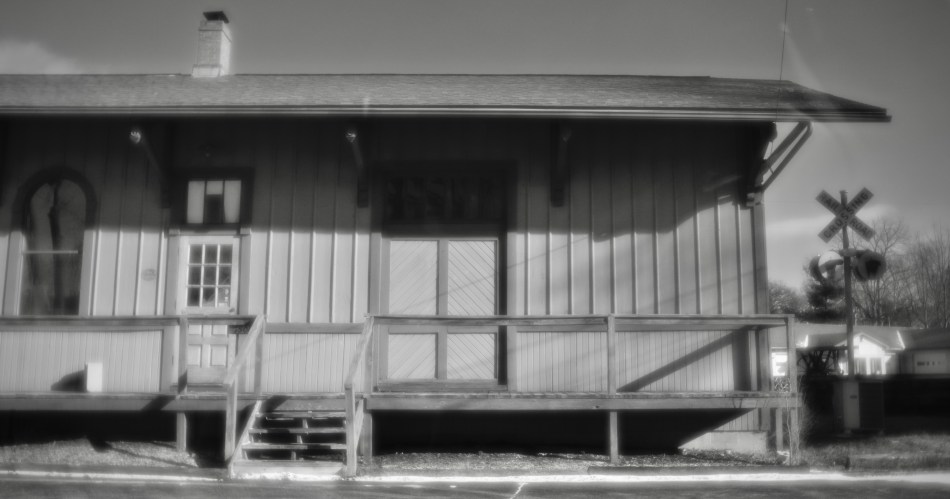
The depot seen here was erected in 1879 in Pickerington, Ohio, the same year the Toledo and Ohio rail line first sliced a diagonal across the town. The city, permanently frozen in size as a small farm village, never required a bigger version of the building, which is only slightly larger than a standard boxcar. One historian has noted that the architecture of such places was little more than an echo of the railroad itself, parallel to the tracks and low-profile in both shape and height. One thing seems certain about this particular depot, and that’s that it helped usher in its own obsolescence, when a local named D.B. Taylor took delivery of the first automobile registered in the town shortly after 1900. By 1956, local train service to Pickerington slowed to a trickle, then winked out completely. The station was restored in 1975 by a man named Grunewald, whose family still retains ownership, landing the building a prized berth on the National Registry of Historic Places.
I have visited Pickerington dozens of times over the years, and each time, I shoot the depot all over again, somehow seeing some small something different in it each time. Good weather and bad, fancy cameras or plain, film or digital, wide-angle, macro or soft focus lenses (like the Lensbaby Velvet 28 used here), I can’t resist having one more go. I suppose I’m actually photographing the different persons I have been over a lifetime, and so, even when the village is out of my way on a given trip, I drive to “Picktown” to assure myself that something of value from the past, however drab or simple, has been allowed to remain, to instruct, to educate, and to fill wandering man-boys’ heads with dreams of riding the rails.
BEYOND THE PATH OF THE GLACIER
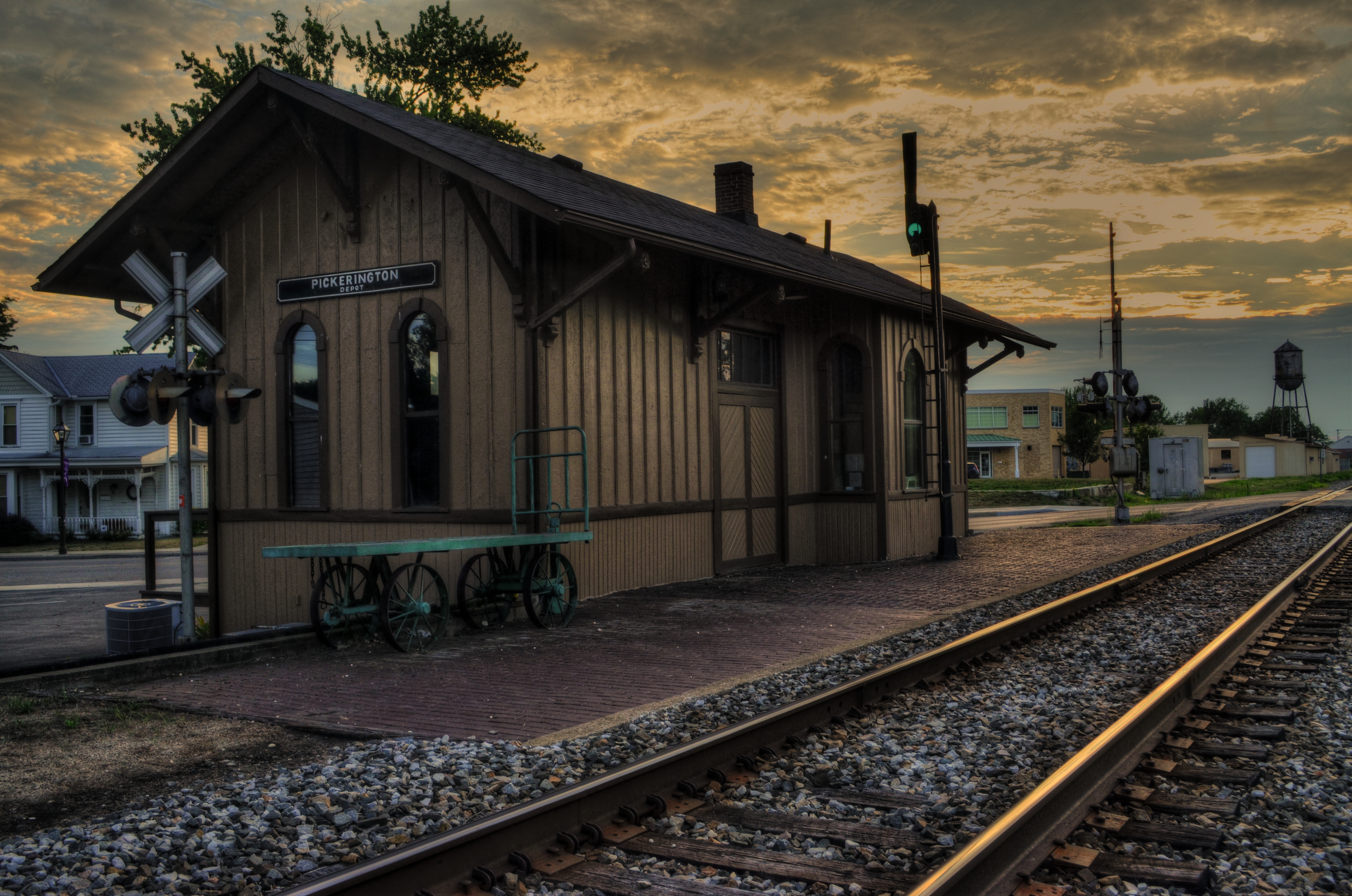
Sentimental Journey: the original depot building for the Toledo & Ohio Central railroad, still standing in Pickerington, Ohio. Just because.
By MICHAEL PERKINS
IN AMERICA WE GET ACCUSTOMED TO SEEING OUR URBAN HISTORY REGULARLY REDUCED TO RUINS, not because our cities are laid to waste by invaders or sacked by conquerors, but because we are such paltry stewards of the architectural legacies we share in this essentially young nation. Obvious nationalistic images aside, the wrecking ball, our answer to the crushing glaciers of history, is the real visual signature of the USA. We get tired of looking at old stuff. We knock the old stuff down. And in doing so, we squander the value of things to which we once attached great importance, rendering them moot, as if we really never cared about them at all.
The change glacier usually sweeps through the vast canyons of our larger cities, cutting a swath of wreckage that levels, implodes or simply knocks down any testimony to history, fashion, flair, whimsey, and the thing we most dread, uselessness. Every town has its casualties; stadiums, grand hotels, transportation hubs, retail centers, neighborhoods…it’s simply not American to get too attached to anything. It’s all going away, all of it, and with it, any sense of continuity, memory, or a contextual place in time.
Fortunately, it is the tendency of the glacier to “think big” that keeps the crushing onslaught of “renewal” concentrated in the larger urban centers, often leaving more survivors in small towns and rural communities. That means that some things in off-track towns, being below the radar of macro-change, are simply left alone, allowed to survive, because they are neglected by the bigger sweep of things.
This means that the “in-between” parts of the country still hold some treasures, a few gentle ties to times we have largely disposed of in the major hub cities. And while no one is suggesting that we bring back the village blacksmith and the local cobbler’s shop, it’s comforting in some way to be able to see and touch what in other parts of the nation are merely footnotes in books. That is, if we haven’t burned the books.
The building pictured at the top of this post is such a survivor. Built in 1879 just as the Toledo & Ohio Central railroad was being cut across the small village of Pickerington, Ohio (just southeast of Columbus), this compact little structure was the nerve center of trade and travel for “Picktown” for more than half a century. Its three rooms included an entry area for freight, an arrival room for passengers, and, in the center, an office for the combined jobs of depot agent and Western Union telegrapher. It was not until the hiring of its first female depot agent in 1947 that the facility could boast indoor plumbing, but the T&O’s tracks, during rail’s heyday, criss-crossed the tiny town with spur lines to a lumberyard, a grain mill, a hoop factory and warehouses.
Amazingly, the depot survived an extended closure from 1958 to 1975, when private money made its restoration possible. Lanterns, tools, bottles, wall maps, schedules, freight wagons, and a fully functional Western Union telegraph key were all assembled to visually cement the station in time. And there it stands to this day, serving no other “function” than to mark where the town, and we, have passed on our way to the inevitable.
Better than my luck in finding this place was in finding it just as dusk was streaking across the sky, giving me the perfect visual complement to the passing of time. And yet, here, out of the path of the glacier, time was allowed to tick just a little slower, slower enough to teach. And remember.
Thoughts?
 thenormaleye