BASIC CABLE
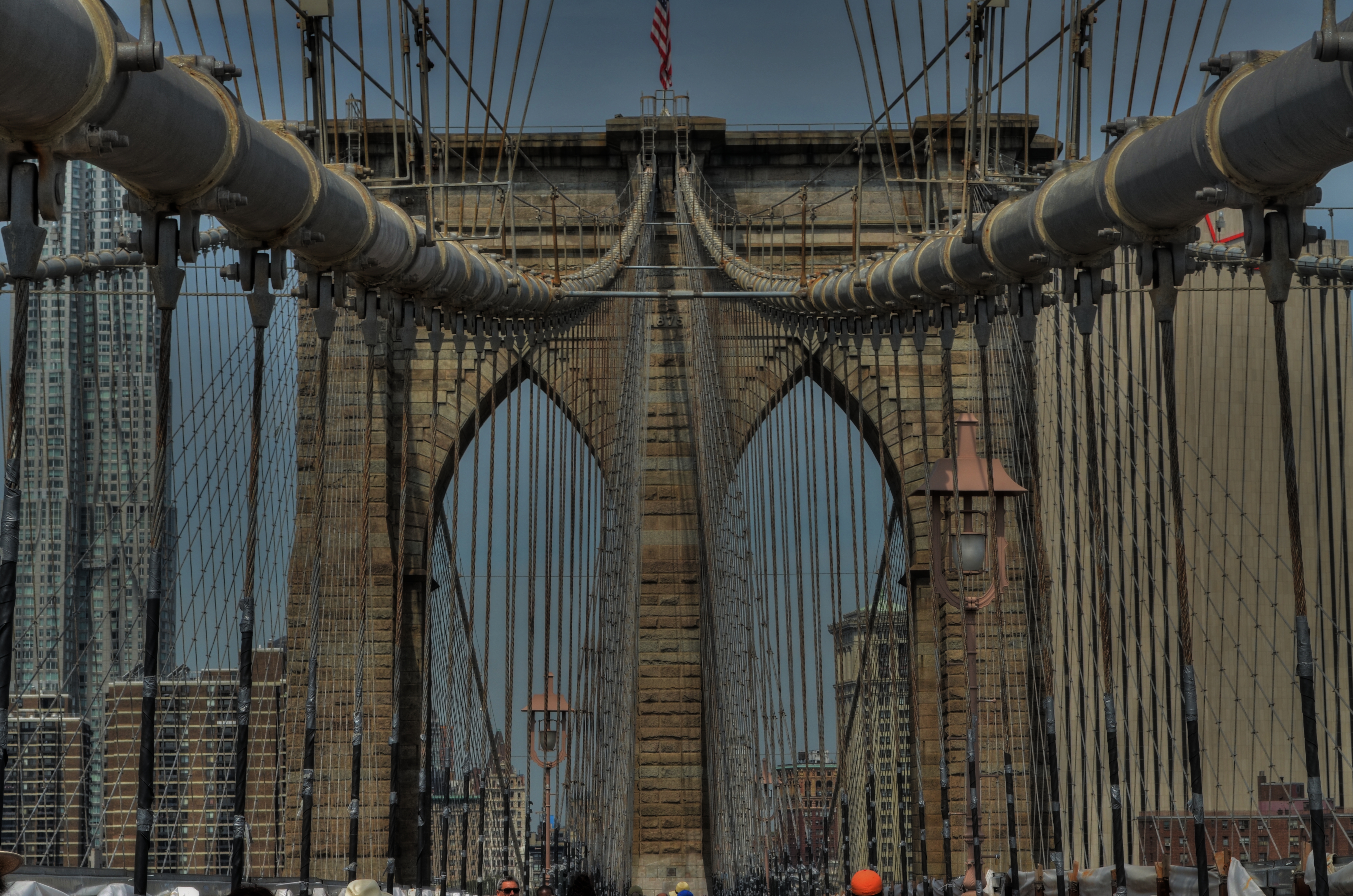
In many ways, the Brooklyn Bridge, although not a “land” edifice, is the first of New York’s skyscrapers, and an elegant reminder of a bygone era. Three-shot HDR blend, shutter speeds of 1/160, 1/200, and 1/250 sec., all F/11, ISO 100, 55mm.
By MICHAEL PERKINS
THERE ARE ANY NUMBER OF LANDMARKS IN THE GREATER NEW YORK AREA which reward repeated viewings. Their mythic impact is such that it is never dulled or diminished. On the contrary, these special places (in a city which boasts so many) actually reveal distinctly different things to different visitors, and, doing so, cannot be exhausted by the millions of interpretations of them that flood the photographic world.
We make pictures of these objects, pictures of the pictures, a tribute picture to someone else’s picture, an impression of someone’s painting. We shoot them at night, in close-up, in fisheye, in smeary Warholian explosions of color, in lonely swaths of shadow.
For me, the Brooklyn Bridge is about two things: texture and materials.
After more than a century over the East River, John and Washington Roebling’s pioneering span, the first steel cable suspension bridge in the world, shows its wear and tear as a proud trophy of its constant service. The delicate and yet sinewy cables, amazingly strong interwoven strands of what Roebling manufactured under the name “steel rope”, are the most amazing design elements in the bridge, presenting an infinite number of kaleidoscopic web patterns depending on when and where you look.
As simply stunning as its two towers are, it is its grid of steel that mutates, shimmers, and hypnotizes the visitor as he makes his way past the crushing mobs of walkers, runners, skaters and cyclists that clog the span’s upper promenade from dawn to dusk. To show the bridge and only the bridge is a challenging trick. To get the dance of angles and rays that the cables have to offer in a way that speaks to you is both frustrating and fun.
Browse through several hundred amateur views of the bridge in one sitting sometime: marvel at how many ways it stamps itself onto the human imagination. Here, I tried to show the steady arc of the master cables as they dip down from the eastern tower, lope into a dramatic dip, then mount to the sky again to pass through the anchors on the western tower. HDR seemed like the way to go on exposure, with three separate shots at f/11, blended to maximize the detail of this most decorated of urban giants.
Next time, some other picture will call out to me, and to you. The bridge will display all the ways it wants to be seen, like a magician fanning out a trick deck. Pick a card, it invites, any card.
Doesn’t matter which one you choose.
They’re all aces.
Thoughts?
Related articles
- Video: Building the Brooklyn Bridge (history.com)
- Brooklyn Bridge Manhattan (markd.typepad.com)
BEAUTIFUL LOSERS
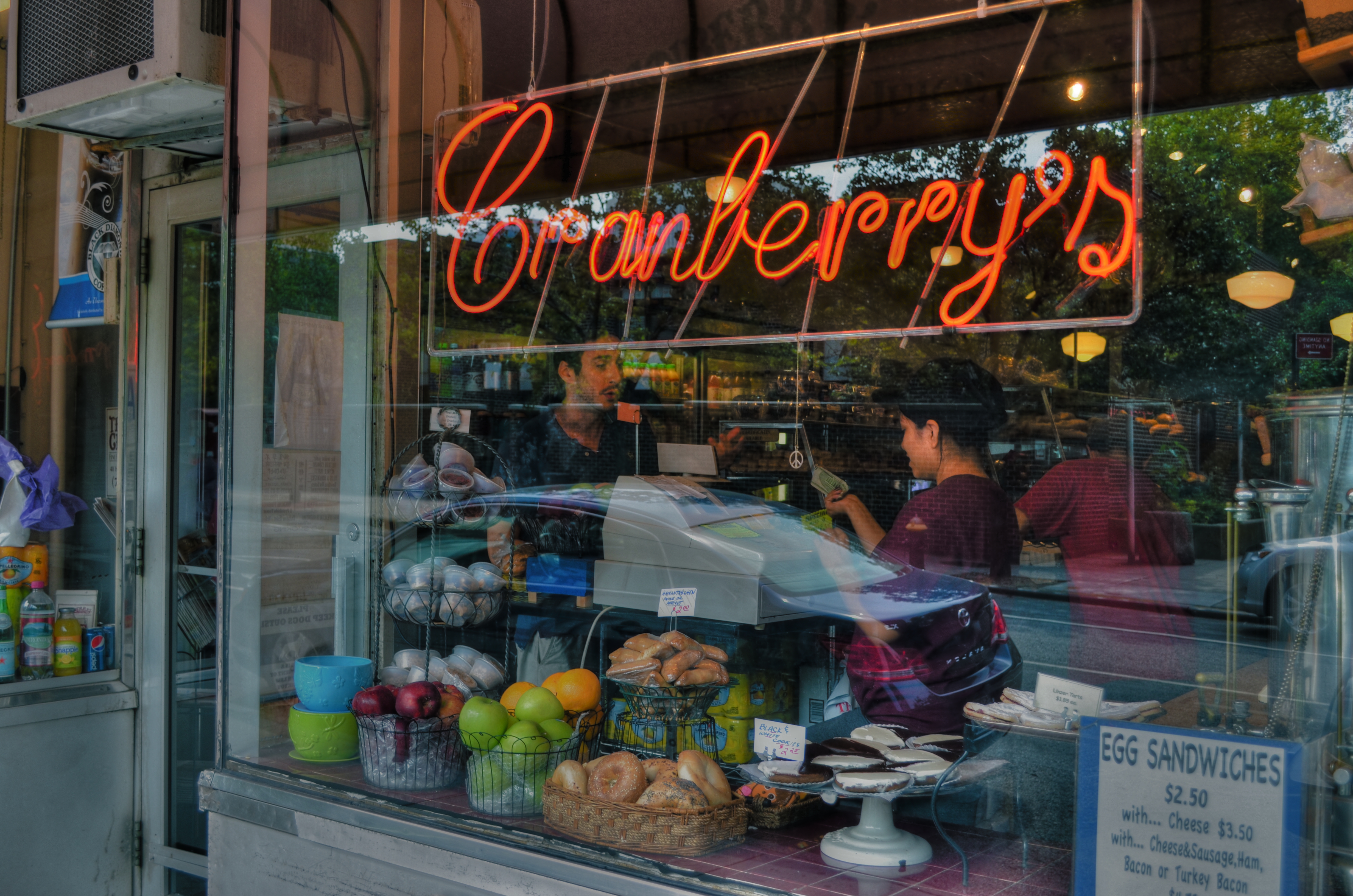
Shooting on the street is bound to give you mixed results. I have been messing with this shot of a Brooklyn coffee shop for days, and I still can’t decide if I like it. 1/80 sec., f/5, ISO 100, 24mm.
By MICHAEL PERKINS
THERE ARE A LOT OF INSTANTANEOUS “KEEP” OR “LOSE” CALLS that are made each day when first we review a new batch of photos. Which to cherish and share, which to delete and try to forget? Thumbs up, thumbs down, Ebert or Roper. Trash or treasure. Simple, right?
Only, the more care we take with our shooting, the fewer the certainties, those shots that are immediately clear as either hits or misses. As our experience grows, many, many more pictures fall into the “further consideration” pile. Processing and tweaking might move some of them into the “keep” zone, but mostly, they haunt us, as we view, re-view and re-think them. Even some of the “losers” have a sort of beauty, perhaps for what they might have been rather than what they turned out to be. It’s like having a kid that you know will always be “C” average, but who will never stop reaching for the “A”, God love their heart.
I have thousands of such pictures now,pictures that I study, weep over, slap my forehead about, ask “what was I thinking?” about. I never have been one for doing a reflexive jab on the “delete” button as I shoot, as I believe that the near misses, even more than the outright disasters, teach us more than even the few lucky aces. So I wait at least to see what the shot really looks like beyond the soft deception of the camera monitor. I buy the image at least that much time, to really, really make sure I dropped a creative stitch.
Many times my initial revulsion was correct, and the shot is beyond redemption.
Ah, but those other times, those nagging, guilt-laden re-thinks, during which I get to twist in the wind a little longer. Pretty? Ugly? Genius? Jerk? Just like waiting for an old Polaroid to gradually fade in, so too, the ultimate success or failure of some pictures takes a while to emerge. And even then, well, let’s come back and look at this one later…….
The above frame, taken while I was walking toward the pedestrian ramp to the Brooklyn Bridge, is just such a shot. My wife stepped into a coffee shop just fast enough to grab us some bottled water, while I waited on the sidewalk trying to make my mind up whether I had anything to shoot. As you can see, what I got could be legitimately called a fiasco. Nice color on the store’s neon sign, and a little “slice of life” with the customer checking out at the register, but then it all starts to mush into a hot mess, with the building and car across the street eating up so much of the front window that your eye is dragged all over the place trying to answer the musical question, “what are we doing here?” Storefront shots are a real crap shoot. That is, sometimes you have something to shoot, and sometimes you just have crap.
Even at this point, with more than a few people giving the shot a thumbs-up online, I can’t be sure if I just captured something honest and genuine, or if I’ve been reading too many pointy-headed essays on “art” and have talked myself into accepting a goose egg as something noble.
But as I said at the top of this piece, the choices get harder the more kinds of stuff you try. If you shoot your entire life on automode, you don’t have as many shots that almost break your heart. I wonder what my personal record is for how long after the fact I’ve allowed myself to grieve over the shots that got away. It’s tempting to hit that delete button like a trigger-happy monkey and just move on.
But, finally, the “almosts” show you something, even if they just stand as examples of how to blow it.
And that is sometimes enough to make the losers a little bit beautiful.
Thoughts?
 thenormaleye