CORNERING
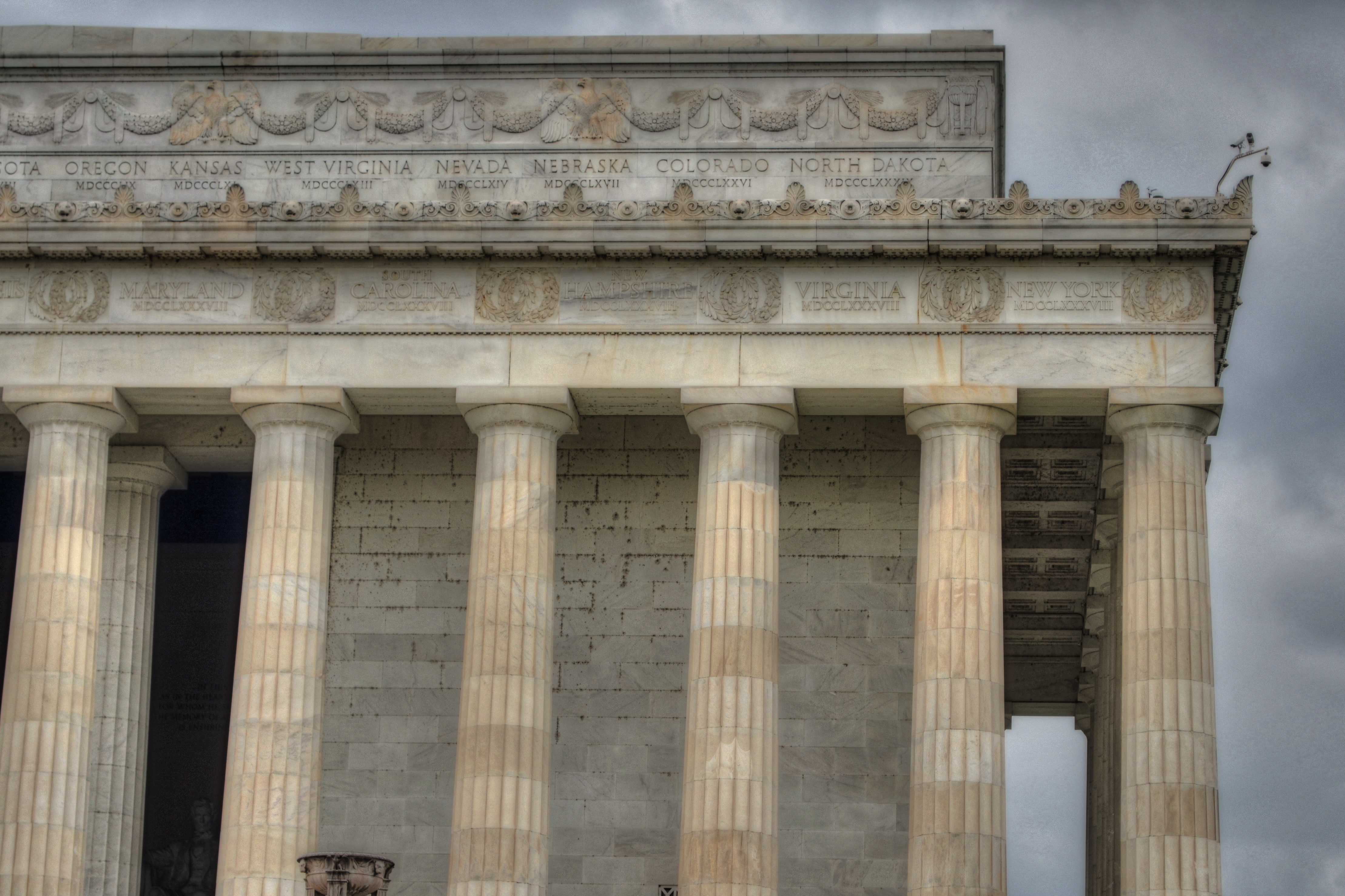
Tackle a big subject in parts, and thus re-frame its context. A blend of two bracketed exposures with varied shutter speeds, both f/5.6, ISO 100, 55mm.
By MICHAEL PERKINS
PHOTOGRAPHERS ALL HATE THE TASK OF SHOOTING OVERLY FAMILIAR SUBJECTS. The famous. The iconic. The must-stop, we’ll-be-getting-off-the-bus-for-ten-minutes “sights” that decorate every postcard rack, every gift store shelf, in their respective cities. The Tower, the Ruins, the Once-Mighty Palace, the Legendary Cathedral. Things that have more pictures taken of them by breakfast than you’ll have taken of you in three lifetimes. Scadrillions of snaps, many of them composed for the “classic” orientation, an automatic attempt to live up to the “postcard” shot. It’s dull, but not because there is no fresh drama or grandeur left in a particular locale. It’s dull because we deliberately frame up the subject in almost the same way that is expected of us.
There must be a reason we all fall for this.
Maybe we want everyone back home to like our pictures, to recognize and connect with something that is easy, a pre-sold concept. No tricky exposures, no “arty” approaches. Here’s the Eiffel Tower, Uncle Herb, just like you expected to see it.
Yeah, well…
On a recent walking shoot around D.C.’s National Mall, snapping monument upon monument, I was starting to go snowblind with all the gleaming white marble and bleached alabaster, the perfection of our love affair with our own history. After a few miles of continuous hurrahs for us and everything we stand for, I perversely looked for something flawed….a crack in the sidewalk, a chipped tooth on a presidential bust, something to bring forth at least a little story.
Then I defaulted to an old strategy, and one which at least shakes up the senses. Photograph parts of buildings instead of the full-on official portrait of them. Pick a fragment, a set of light values, a selection of details that render the thing new, if only slightly. Take the revered and venerated thing out of its display case and remove its normal context.
The Lincoln Memorial proved a good choice. The basic shot of the front looked like just a box with pillars. A very, very white box. But shooting a bracket of three exposures of just the upper right corner of the roof , then blending them in an exposure fusion program, revealed two things: the irregular aging and texture of the stone, and the very human bit of history inscribed along the crown: the names of the states, with the years they came into the union below them. All at once something seemed unified, poetic about Abraham Lincoln sitting inside not a temple to himself, but a collection of the states and passions he stitched back together, repaired and restored into a Union.
The building had come back alive for me.
And I didn’t even have to shoot the entire thing.
follow Michael Perkins on Twitter @mpnormaleye.
THE WOMAN IN THE TIME MACHINE
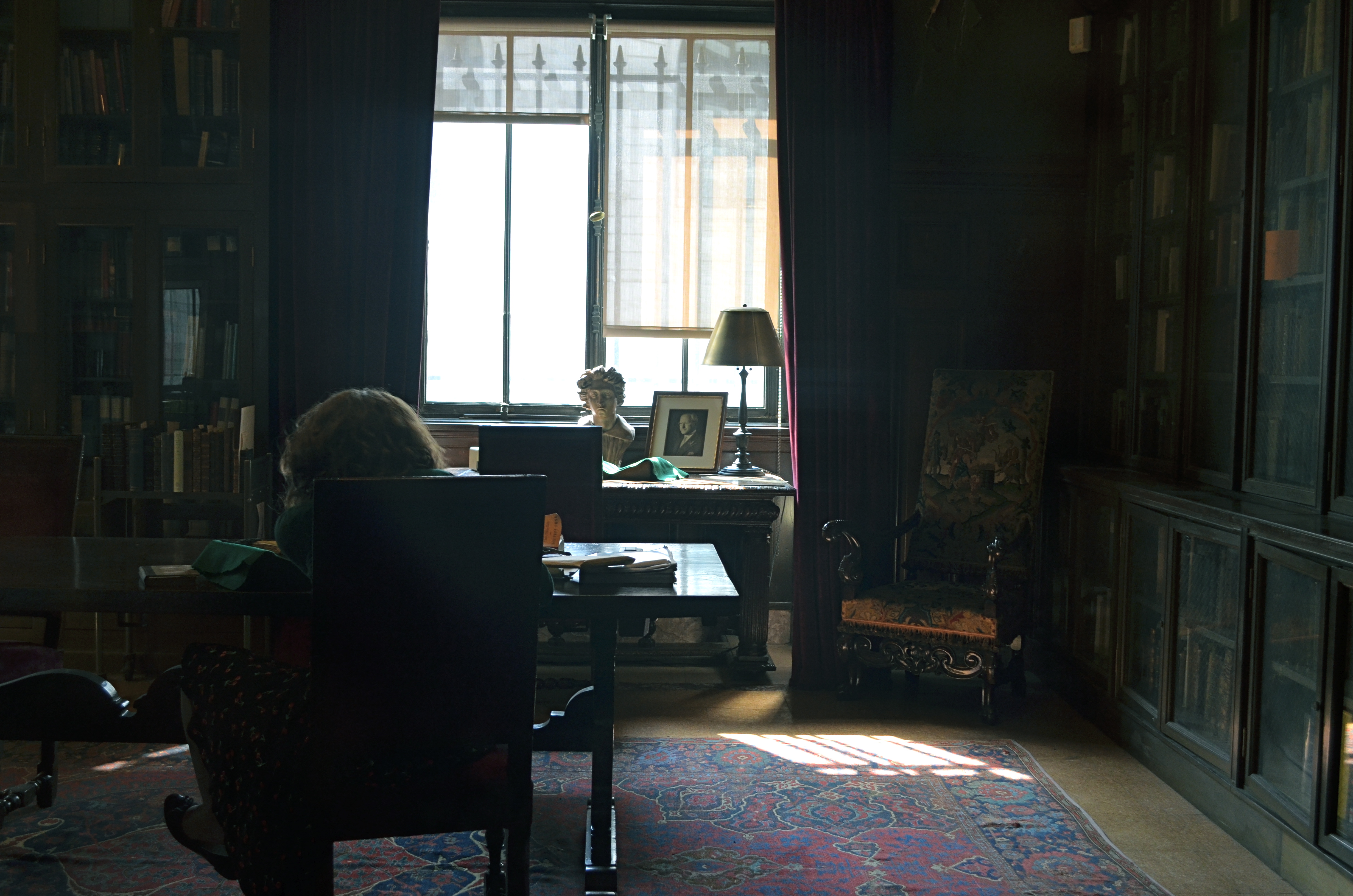
Where is this place? And how is it here, now? 1/40 sec., f/5.6, ISO 320, 24mm.
by MICHAEL PERKINS
THERE ARE TIMES WHEN A CAMERA’S CHIEF FUNCTION IS TO BEAR WITNESS, TO ASSERT THAT SOMETHING FANTASTIC REALLY DID EXIST IN THE WORLD. Of course, most photography is a recording function, but, awash in a sea of infinite options, it is what we choose to see and celebrate that makes an image either mundane or majestic.
And then sometimes, you just have the great good luck to wander past something wonderful. With a camera in your hand.
The New York Public Library’s main mid-town Manhattan branch is beyond magnificent, as even a casual visit will attest. However, its beauty always seems to me like just “the front of the store”, a controlled-access barrier between its visually stunning common areas and “the good stuff” lurking in untold chambers, locked vaults and invisible enclaves in the other 2/3 of the building. I expect these two worlds to be forever separate and distinct, much as I don’t expect to ever see the control room for electrical power at Disneyland. But the unseen fascinates, and recently, I was given a marvelous glimpse into the other side at the NYPL.
A recent exhibit of Mary Surratt art prints, wall-mounted along the library’s second-floor hall, was somehow failing to mesmerize me when, through a glass office window, I peeked into a space that bore no resemblance whatever to a contemporary office. The whole interior of the room seemed to hang suspended in time. It consisted of a solitary woman, her back turned to the outside world, seated at a dark, simple desk, intently poring over a volume, surrounded by dark, loamy, ceiling-to-floor glass-paneled book shelves along the side and back walls of the room. The whole scene was lit by harsh white light from a single window, illuminating only selective details of another desk nearer the window, upon which sat a bust of the head of Michelangelo’s David, an ancient framed portrait, a brass lamp . I felt like I had been thrown backwards into a dutch-lit painting from the 1800’s, a scene rich in shadows, bathed in gold and brown, a souvenir of a bygone world.
I felt a little guilty stealing a few frames, since I am usually quite respectful of people’s privacy. In fact, had the woman been aware of me, I would not have shot anything, as my mere perceived presence, however admiring, would have felt like an invasion, a disturbance. However, since she was oblivious to not only me, but, it seemed, to all of Planet Earth 2013, I almost felt like I was photographing an image that had already been frozen for me by an another photographer or painter. I increased my Nikon’s sensitivity just enough to get an image, letting the light in the room fall where it may, allowing it to either bless or neglect whatever it chose to. In short, the image didn’t need to be a faithful rendering of objects, but a dutiful recording of feeling.
How came this room, this computer-less, electricity-less relic of another age preserved in amber, so tantalizingly near to the bustle of the current day, so intact, if out of joint with time? What are those books along the walls, and how did they come to be there? Why was this woman chosen to sit at her sacred, private desk, given lone audience with these treasures? The best pictures pose more questions than they answer, and only sparingly tell us what they are “about”. This one, simply, is “about” seeing a woman in a time machine. Alice through the looking-glass.
A peek inside the rest of the store.
Follow Michael Perkins on Twitter @mpnormaleye.
Thanks to THE NORMAL EYE’s latest follower! View NAFWAL’s profile and blog at :
“C” NOTES (THOUGHTS ON POST #100)
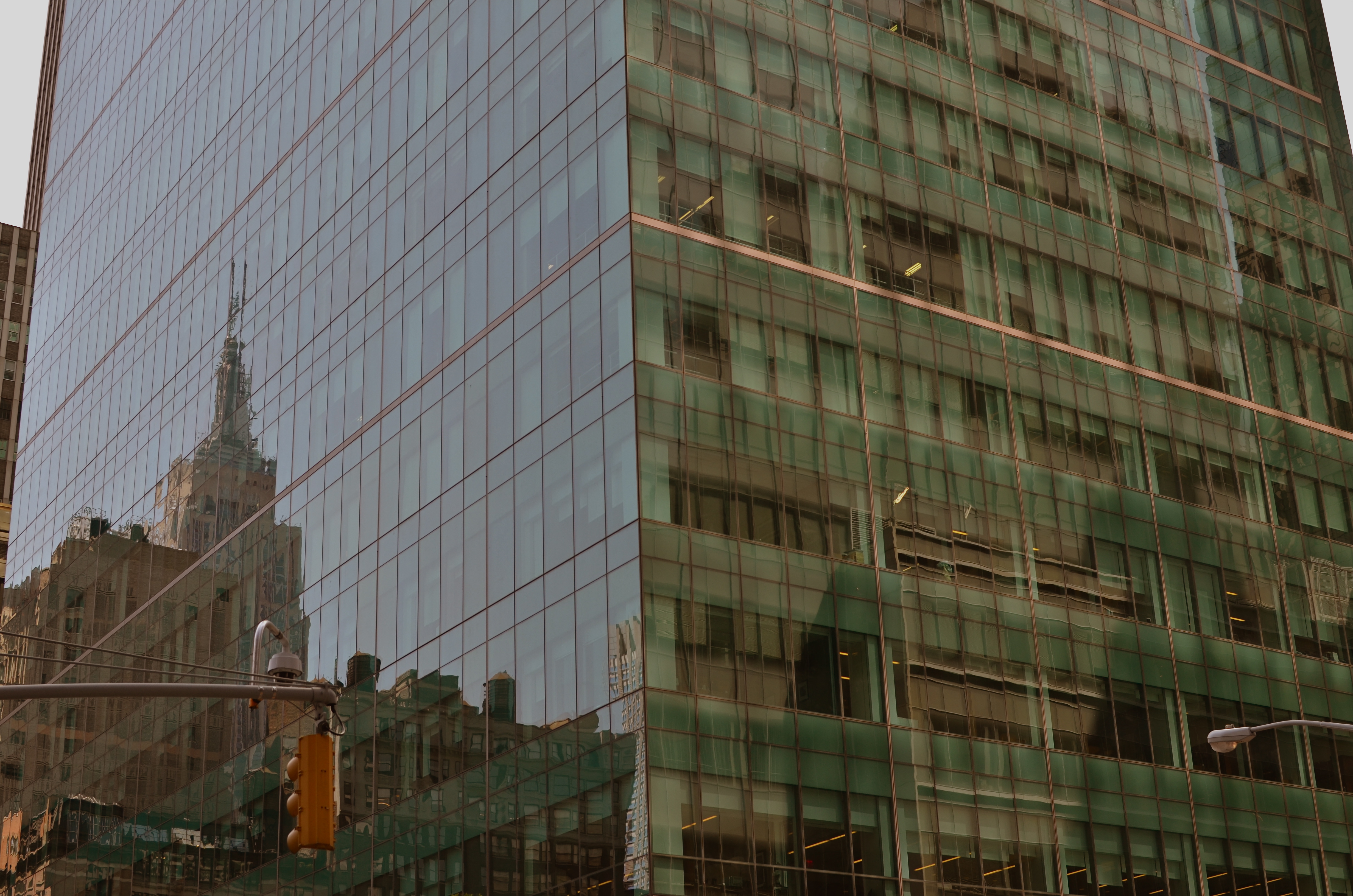
Hey, we’re all just trying to catch light in a box. Use any box you have, just grab something, like, say, the Empire State Building. 1/320 sec., f/5.6, ISO 100, 35mm.
By MICHAEL PERKINS
SOMETHING THAT LIVES IN THE NETHER WORLD BETWEEN A DIARY AND A PHILOSOPHIC SCREED, at the intersection of passion and obsession. That’s the no-man’s-land I aimed this blog at 100 posts ago, today. From Day One, The Normal Eye was, and remains, an attempt to get beyond the mere technical doing of a photograph and scratch away at the ticket of techtalk to reveal why I was trying to capture a given idea inside a box.
There are, and have ever been, far better teachers on a purely technical level than I can ever hope to be. And, let’s face it, knowing just the metadata on a shot is no guarantee that something magical will happen, just as high-end cameras don’t guarantee high-concept images. No, the only thing I’m expert at, in any way, is judging my own intentions, in hungering after a visualization of what I feel in my bones.
All of you patient ones out there already know me, because your dad or your corny uncle or your nerdly, bookish kid is just like me. I am “that guy”. I have always been that guy. The guy who pipes up, in completely unrelated conversations, with the observation that “it’s so cool what the light is doing right now”. The guy who comes back from a family gathering with, strangely, no pictures of the family whatever, but a killer shot of what everyone concurs is a colorful shmear of…something. The guy who is so busy looking for “the moment” that he forgets to be in the moment.
Guilty, guilty, guilty, and, ouch, guilty.
Funny thing is (and this is the mainspring that drives The Normal Eye), I’m almost as excited about where I’ll fail next than where I’ll succeed. If less than half of the pictures out of a new batch doesn’t make me groan, what the hell was I thinking?, then I’m not working hard enough, and certainly not reaching far enough. Nothing artistically good comes from a place of safety, and repeating your past choices doesn’t repeat your past successes.
Those of you who have done me the great honor of reading and following this mess have my undying gratitude. And as for those who have taken the extra time to comment as well, thanks for becoming the most vital link in the chain. Bloggers may be doomed to forever shout off the edge of a cliff, but it’s a real Robinson Crusoe moment when some man (or woman) Friday actually shouts back. Thank you, one and all.
As far as there are clearly stated goals for any enterprise such as this (except to keep on going), I can faithfully pledge to keep the process as honest as possible, and to let my inner child, the brat who first picked up a camera, to shout down the rational adult, who unlike the kid, occasionally forgets that this is all supposed to be about discovery, and wonder. If I lose track of that, the whole game is up. I also hope to act as a better conduit to the best work going on in photography today, in these pages and through my Twitter feed @mpnormaleye. The great news: the golden age of photography is happening here, now. Everything that has gone before, while amazing, is mere prologue to what is on the way.
That is pretty damned exciting.
So thanks for where this has taken us so far, and please sign up for another hitch. I can’t promise I’ll dazzle you. But I do promise I’ll be dazzled.
After all, it’s so cool what the light is doing, right now.
Where’s my box?
follow Michael Perkins on Twitter @mpnormaleye.
 thenormaleye