LEAVING BAD ENOUGH ALONE
By MICHAEL PERKINS
I never saw no miracle of science / that didn’t go from a blessing to a curse. Sting
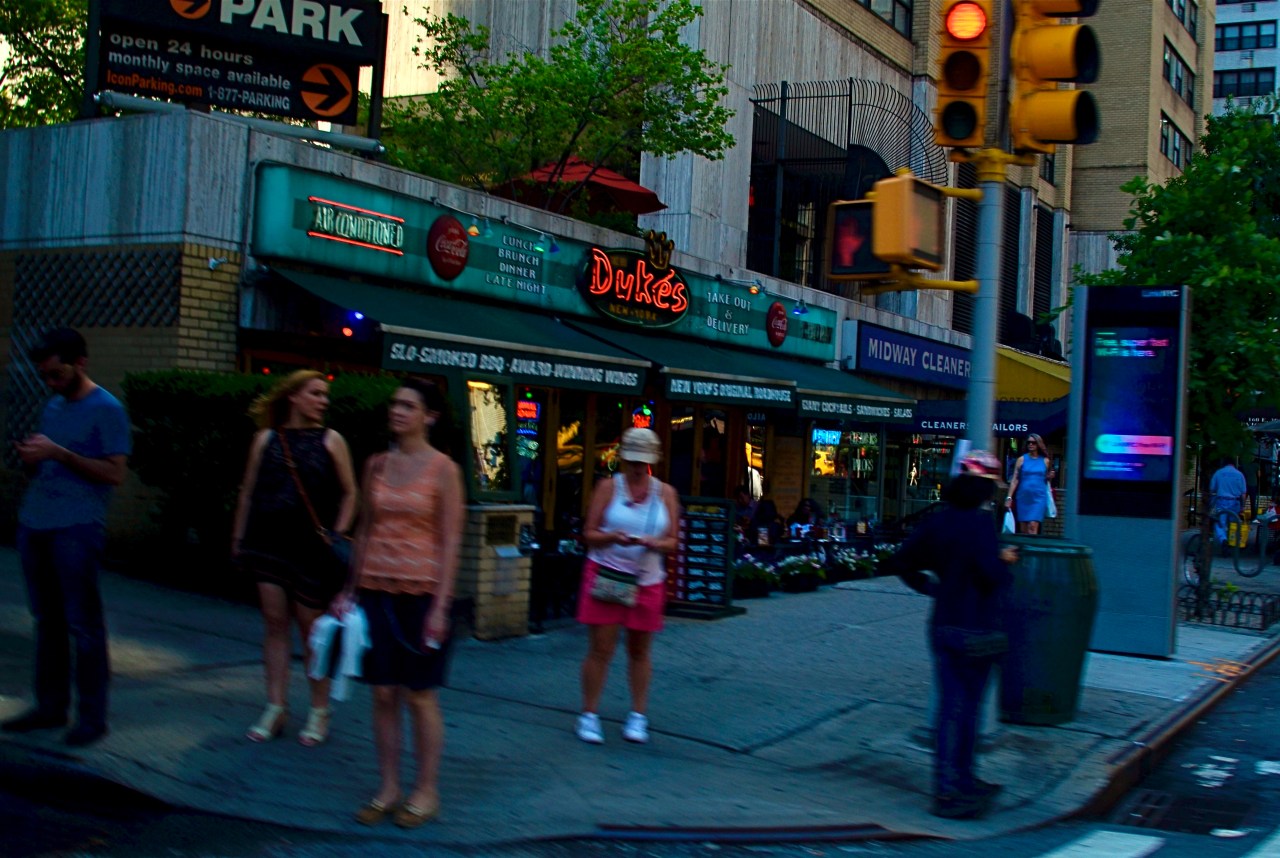
Duke’s, New York City, 2018
MY FIRST STUMBLING FIRST BABY STEPS WITH A.I. haven’t focused on creating photo-ish fantasy worlds or creating with a logarithm what can’t be accomplished with a camera. If I had wanted to be a painter, I would have become one. Full disclosure: I’m not yet certain what I truly need from this portentous tool, or if I need anything at all. And so my explorations have largely been in seeing how much more efficient or precise it can be as an alternative to standard post processing, an adventure that, as you’ll discover, has yielded mixed results.
In asking A.I. to make corrections in my images, I find myself somewhat amputated. My fingers are no long pushing sliders, but rather pushing words up against each other, trying to second-guess, in written prompts, what the entity will likely deliver for me. This all comes down to a crap-ton of trial and error, and, in many cases, lots of hair-pulling and screaming “no! no! NO!” at the monitor. Thus, most of my A.I. explorations are largely repair jobs, and the mildest and simplest repair jobs possible. The grander fix I envision for an image, the harder it is to get the beast to give me what I want without adding its own two cents in the bargain. Either it, or I, need more training, and I can’t yet decide which of us that is.
The image you see up top has been the subject of an earlier post, in which I argued for the fact that even your most technically imperfect pictures might also be among your favorites; that, on average, their overall “workability” outshines whatever technical flaws they contain. The shot was taken out of the window of a slow-moving, Uber on my way back to JFK, and I had nearly zero fine control in the moment over the taking of it, hence the underexposure and motion blur. There was nothing in standard Photoshop that allowed me to satisfactorily “correct” it, and so I had finally decided that it was a better picture left undisturbed. It was only recently that I decided to envision anew what it might have looked like without the mistakes, and so I wrote a very simple prompt in ChatGPT to see what was possible. The entire prompt read, “Sharpen image by 50% an even out the contrast.”
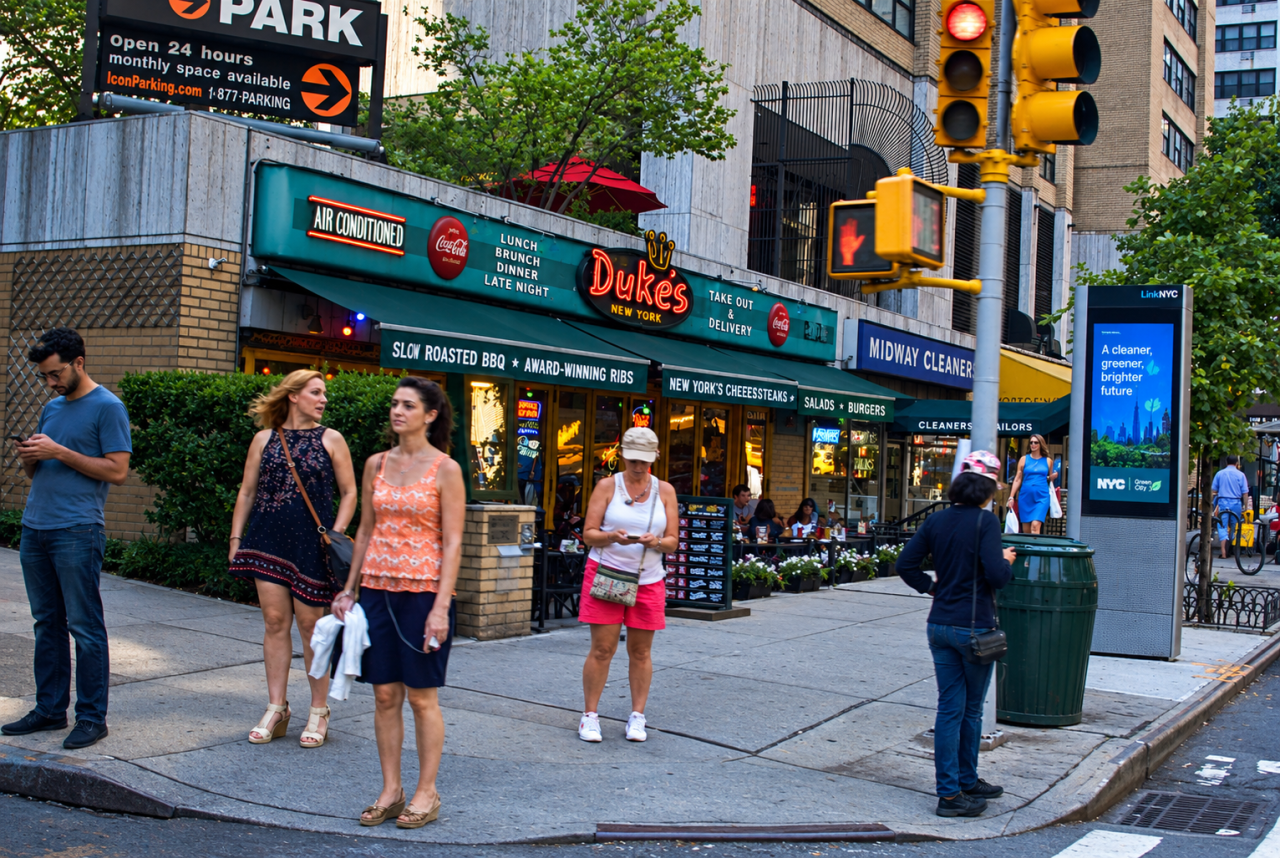
A botched A.I. enhancement of the above shot. Things that never were, words that appear from nowhere, night into day…
That was it. No “place details in the picture that weren’t originally there” or “replace the text on the various signs with whatever the hell you like” or “transform the mood from a dusk shot to a daylight image”. In fact, however, what I got improvised in all three of those areas, all without specific instructions from me. I wasn’t trying to get rid of all the shadows; I merely wanted to modulate them a bit. I also didn’t need to place details in the picture that weren’t in the original capture. And yet here we are. And I am right back to re-loving my original, warts and all (to be fair, A.I. did not add any warts to anyone).
In “Hal’s” defense, there are shots that originally came off softer than I wanted that have benefitted from the kind of A.I. sharpening that out-performs more standard processing. But the rule that seems to be emerging, at least for me is, a little is a lot, and a lot is way too much. I don’t want my pictures to suffer merely because I’m lousy at typing in instructions. A.I. as a scalpel is fine, but A.I. as a bludgeon is disappointing and a little scary.

