AT THE CORNER OF “WHAT THE” & “WHERE THE”
By MICHAEL PERKINS
PHOTOGRAPHS ARE AS MUCH ABOUT CONDITIONS AS OBJECTS. The first grand age of picture-making was chiefly about documenting the physical world, recording its everyday features like waterfalls, mountains, pyramids, cathedrals. The earliest photographs were, in that way, mostly collections of things. Next came the birth of photographic interpretation, in which we tried to record what something might feel like as well as what it looked like. Conditions. Sensations. Impressions.
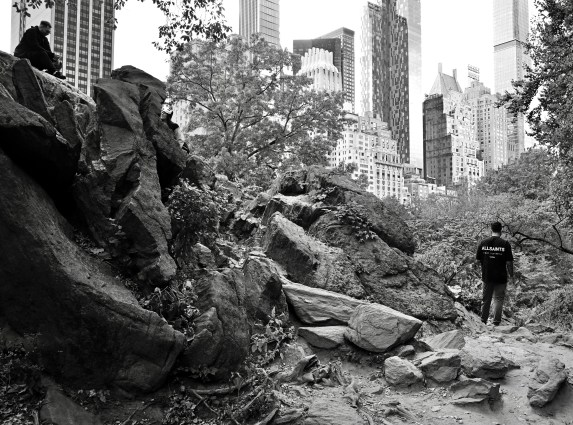
One thing that will invariably send me grabbing for a camera is when two seemingly disparate things create a unique relationship just by been juxtaposed with each other, as in the image you see here. The cheek-by-jowl relationship between the imposed order of Manhattan and the sacrosanct green space of Central Park has always been, to me, the ultimate study in contrasts. Acres of trees, lawns, playing fields, lakes, rolling hills, footbridges, and walking paths surrounded by a yawning, jutting canyon of steel and stone; the logic of the engineer yielding to the dreamy randomness of Nature.
The crags seen here just yards away from the skyscrapers of Central Park West look less like rock formations than the debris left after a war, as if the towers just beyond were somehow spared from an aerial bombardment. The contrast between order and chaos (and our shifting definitions of both of those terms) could hardly be sharper; so stark that, after shooting several frames of the scene in color, I decided that monochrome might better sell the entire idea of selective destruction, almost like unearthing an archived newsreel. The man on the upper left edge of the frame and the one standing alone in the gap between the rocks and the buildings both, to me, resemble the morning-after teams that might tour the damage a the previous night’s raid, salvaging what they can from the wreckage. Thus do photographs of things become documents of conditions, of the intersection between “what the” and “where the”. It’s a strange, and occasionally wondrous, juncture in which to find oneself.
New year-end galleries! Click on the tabs at the top of the page for new 2024 image collections.
HOW MUCH IS TOO MUCH?
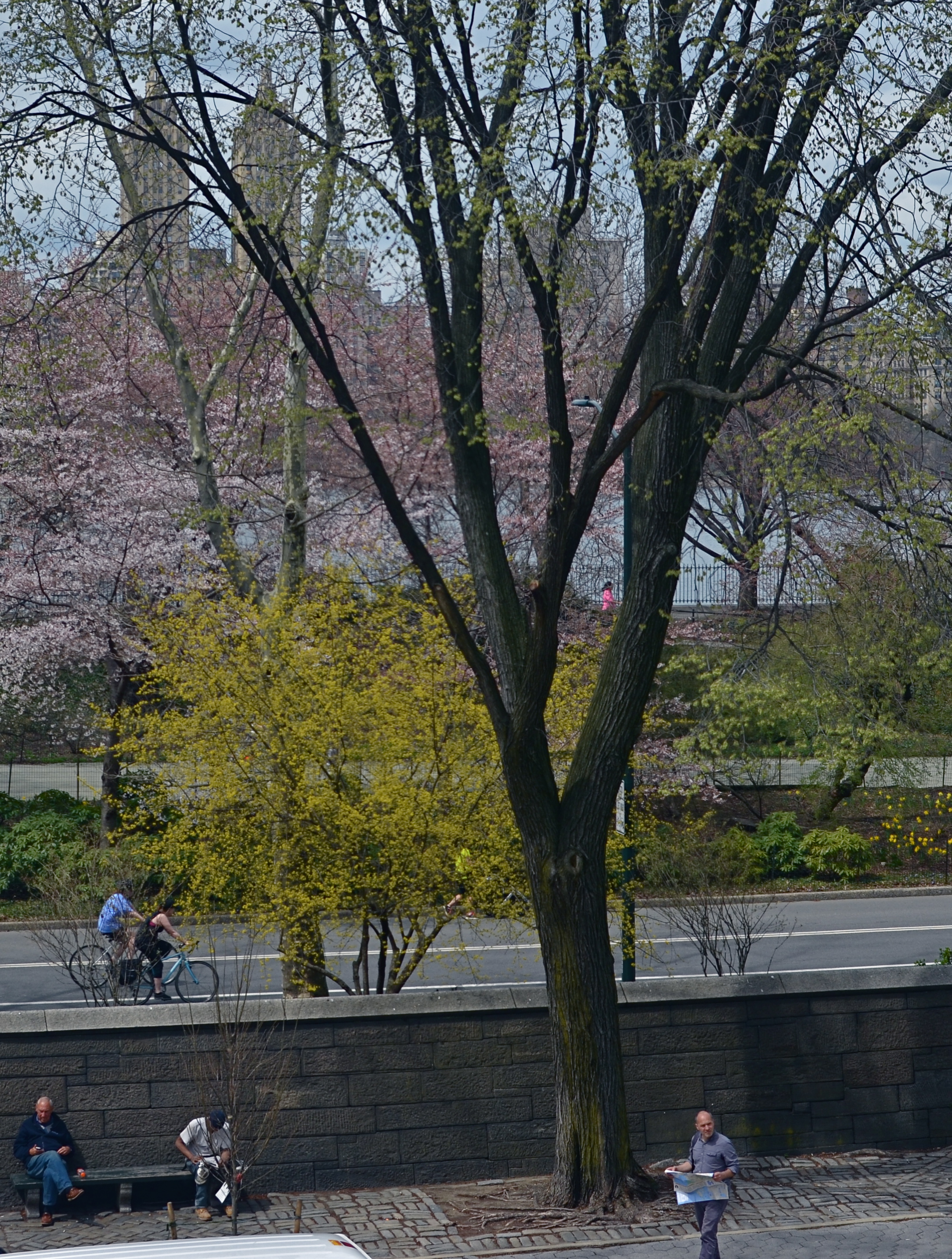
Lots going on here. Too much?
By MICHAEL PERKINS
THESE DAYS IT SEEMS TO TAKE LESS TIME TO SNAP A PHOTOGRAPH THAN IT DOES TO DECIDE WHETHER IT HAS ANY MERIT. Photography is still largely about momentary judgements, and so it stands to reason that some are more well-conceived than others. There’s a strong temptation to boast that “I meant to do that, of course” when the result is a good one, and to mount an elaborate alibi when the thing crashes and burns, but, even given that very human tendency, some pictures stubbornly linger between keeper and krap, inhabiting a nether region in which you can’t absolutely pronounce them either success or failure.
The image at left is one such. It was part of a day spent in New York’s Central Park, and for most of the shots taken on that session, I can safely determine which ones “worked”. This one, however, continues to defy a clear call either way. Depending on which day I view it, it’s either a slice-of-life capture that shows the density of urban life or a visual mess with about four layers too much glop going on. I wish there were an empirical standard for things like photographs, but…..wait, I really don’t wish that at all. I like the fact that none of us is truly certain what makes a picture resonate. If there were such a standard for excellence, photography could be reduced to a craft, like batik or knitting. But it can never be. The only “mission” for a photographer, however fuzzy, is to convey a feeling. Some viewers will feel like a circuit has been completed between themselves and the artist. But even if they don’t, the quest is worthwhile, and goes ever on.
I have played with this photo endlessly, converting it to monochrome, trying to enhance detail in selective parts of it, faking a tilt-shift focus, and I finally present it here exactly as I shot it. I am gently closer to liking it than at first, but I feel like this one will be a problem child for years to come. Maybe I’m full of farm compost and it is simply a train wreck. Maybe it’s “sincere but just misunderstood”. I’m okay either way. I can accept it for a near miss, since it becomes a reference point for trying the same thing with better success somewhere down the road.
And, if it’s actually good, well, of course, I meant to do that.
 thenormaleye