NEW ANGELS
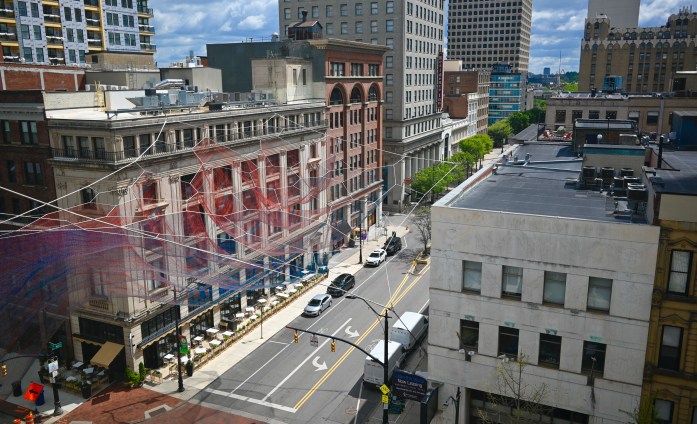
Current, a rope and cord art installation in Columbus, Ohio, created by “fiber artist” Janet Echelman
By MICHAEL PERKINS
FOR ME, ONE OF THE MOST EXCITING TRENDS IN URBAN DESIGN, in the twenty-first century, is not the latest generation of skyscrapers or town plazas, but a bold new redefinition of the concept of public art. Where once it was sufficient to plop down a statute of some wartime general near the county courthouse, commissioned works now make mere sculpture look as primitive as cave paintings. We have evolved past the commemorative earthbound seraphim that once graced our parks, to flights of fancy that connect and shimmer from the air. It is an age of New Angels, and Janet Echelman is one of its patron saints.
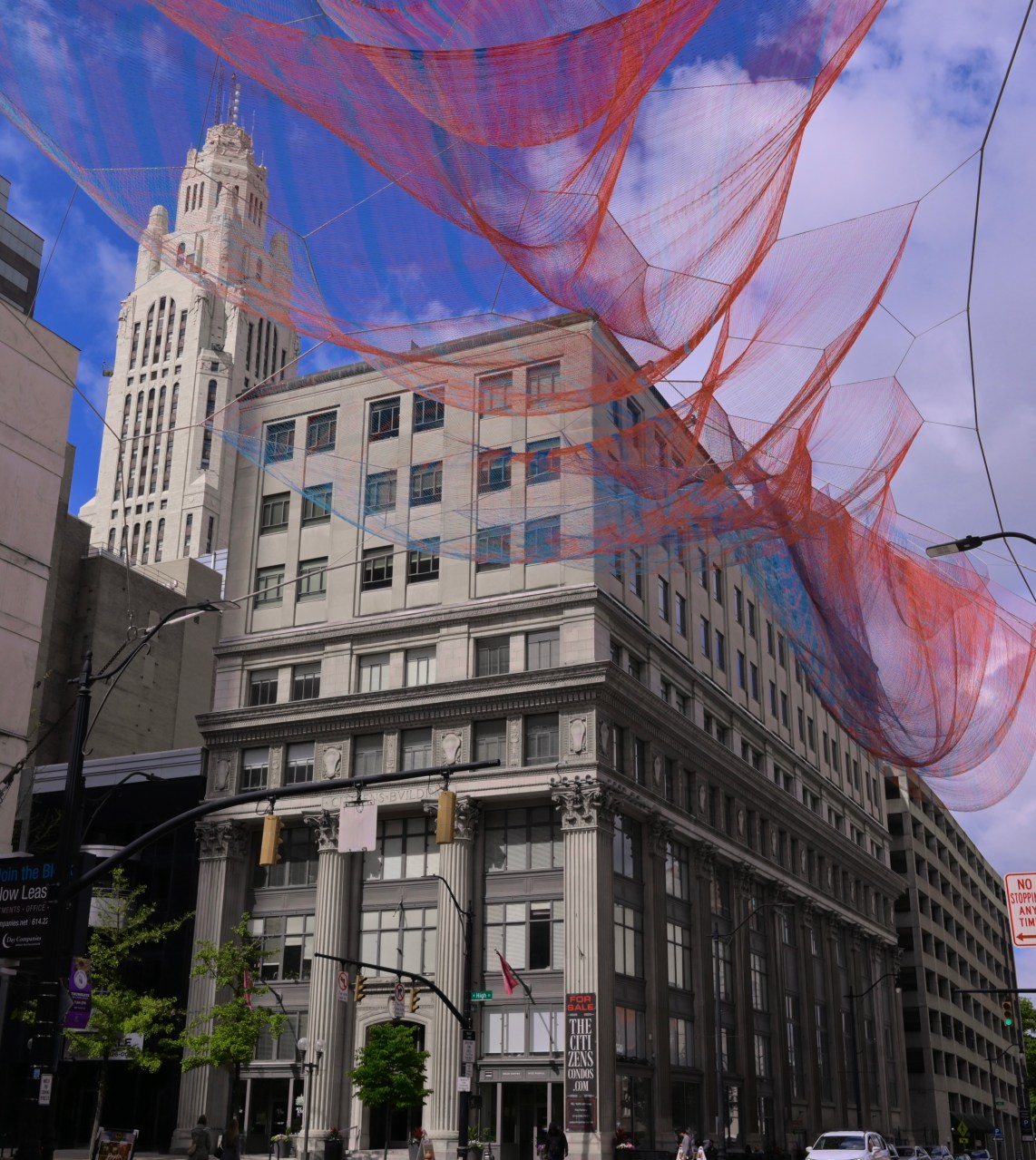
Echelman, a Guggenheim fellow and Harvard graduate, who refers to herself as a “fiber artist”, is, in fact, an altogether new kind of sculptor. Instead of being grounded on pedestals, her arrangements of shimmering color, created by mixtures of fiber, netting and rope, hang in suspension over cityscapes like vast spider webs, refracting the rainbow and generating waves of shifting hues depending on changes in sunlight, wind or the angle of view. Some of her creations are billowing circles and cones that resemble a whirlwind of cyclone; others look like sky-bound rivers, curling and twisting into tributaries of red and blue. Each is uniquely tailored to its specific location in cities like San Francisco, Vancouver, Seattle, and a half-dozen other cities around the world. They are, simply, magnificent, and the best challenge for any photographer, since they appear vastly different under varying conditions.
I first saw one of her works while working at Arizona State University, where Her Secret Is Patience floats like a phantom hot air balloon near the school’s Cronkite School of Journalism. And just this spring, I was thrilled to see her first work to be floated over an entire intersection, 2023’s Current, which spreads across the meeting of High and Gay Streets in Columbus, Ohio, anchored to the tops of buildings at the crossing’s four corners. Commissioned by a local real estate developer as a kind of front porch for his refurbished bank building (now housing deluxe condos), Current can be seen from any approach within a four-block distance of the area, an irresistible advertisement for the regentrification of the neighborhood. Janet Echelman is but one voice in a rising chorus that demands that public art re-define itself for a new age. That age will not only withstand controversy but actively court it, just as any art, including photography, needs to do.
BEYOND THE PATH OF THE GLACIER
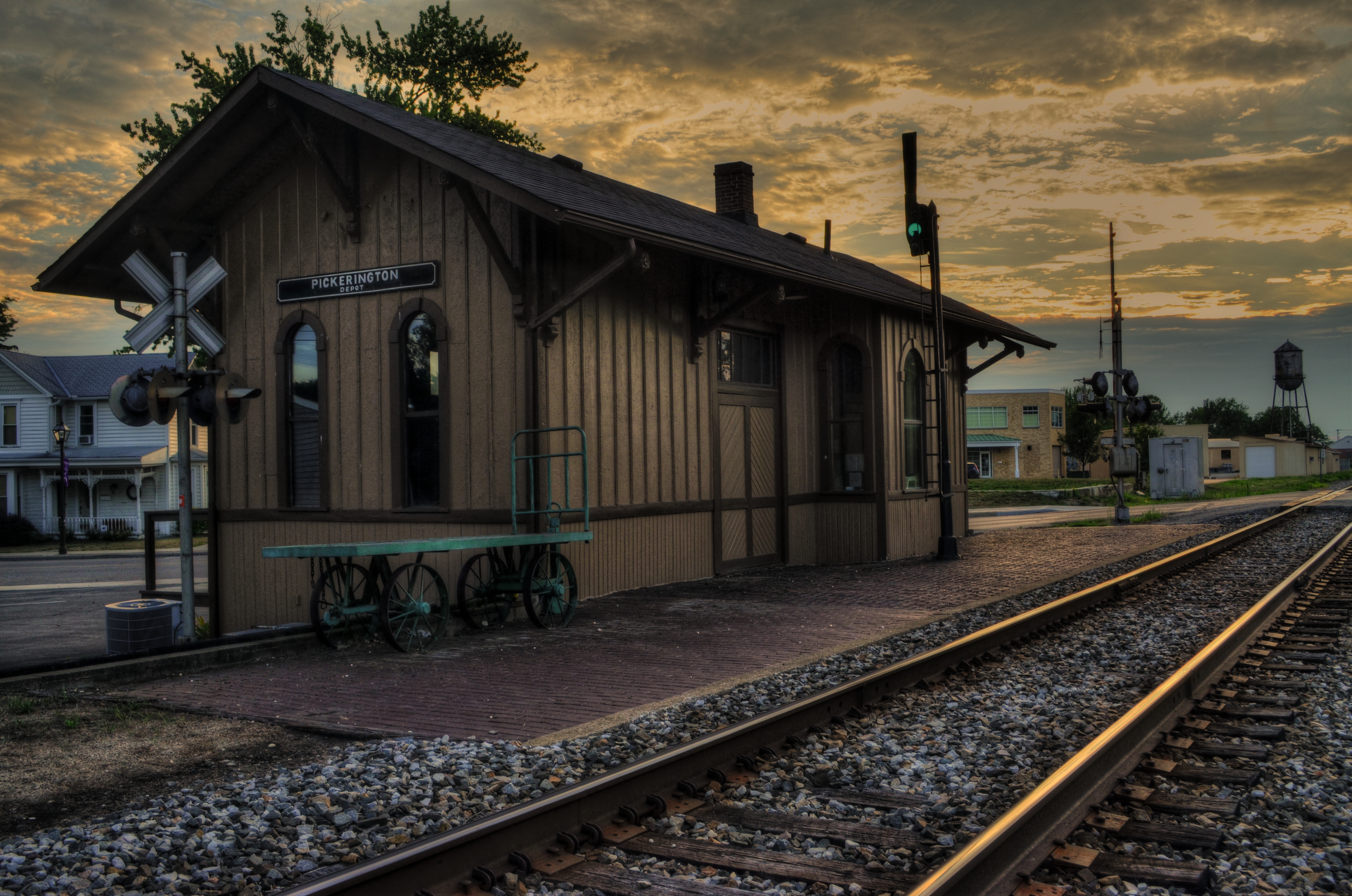
Sentimental Journey: the original depot building for the Toledo & Ohio Central railroad, still standing in Pickerington, Ohio. Just because.
By MICHAEL PERKINS
IN AMERICA WE GET ACCUSTOMED TO SEEING OUR URBAN HISTORY REGULARLY REDUCED TO RUINS, not because our cities are laid to waste by invaders or sacked by conquerors, but because we are such paltry stewards of the architectural legacies we share in this essentially young nation. Obvious nationalistic images aside, the wrecking ball, our answer to the crushing glaciers of history, is the real visual signature of the USA. We get tired of looking at old stuff. We knock the old stuff down. And in doing so, we squander the value of things to which we once attached great importance, rendering them moot, as if we really never cared about them at all.
The change glacier usually sweeps through the vast canyons of our larger cities, cutting a swath of wreckage that levels, implodes or simply knocks down any testimony to history, fashion, flair, whimsey, and the thing we most dread, uselessness. Every town has its casualties; stadiums, grand hotels, transportation hubs, retail centers, neighborhoods…it’s simply not American to get too attached to anything. It’s all going away, all of it, and with it, any sense of continuity, memory, or a contextual place in time.
Fortunately, it is the tendency of the glacier to “think big” that keeps the crushing onslaught of “renewal” concentrated in the larger urban centers, often leaving more survivors in small towns and rural communities. That means that some things in off-track towns, being below the radar of macro-change, are simply left alone, allowed to survive, because they are neglected by the bigger sweep of things.
This means that the “in-between” parts of the country still hold some treasures, a few gentle ties to times we have largely disposed of in the major hub cities. And while no one is suggesting that we bring back the village blacksmith and the local cobbler’s shop, it’s comforting in some way to be able to see and touch what in other parts of the nation are merely footnotes in books. That is, if we haven’t burned the books.
The building pictured at the top of this post is such a survivor. Built in 1879 just as the Toledo & Ohio Central railroad was being cut across the small village of Pickerington, Ohio (just southeast of Columbus), this compact little structure was the nerve center of trade and travel for “Picktown” for more than half a century. Its three rooms included an entry area for freight, an arrival room for passengers, and, in the center, an office for the combined jobs of depot agent and Western Union telegrapher. It was not until the hiring of its first female depot agent in 1947 that the facility could boast indoor plumbing, but the T&O’s tracks, during rail’s heyday, criss-crossed the tiny town with spur lines to a lumberyard, a grain mill, a hoop factory and warehouses.
Amazingly, the depot survived an extended closure from 1958 to 1975, when private money made its restoration possible. Lanterns, tools, bottles, wall maps, schedules, freight wagons, and a fully functional Western Union telegraph key were all assembled to visually cement the station in time. And there it stands to this day, serving no other “function” than to mark where the town, and we, have passed on our way to the inevitable.
Better than my luck in finding this place was in finding it just as dusk was streaking across the sky, giving me the perfect visual complement to the passing of time. And yet, here, out of the path of the glacier, time was allowed to tick just a little slower, slower enough to teach. And remember.
Thoughts?
 thenormaleye