TURN YOUR HEAD TO THE LEFT, PLEASE
By MICHAEL PERKINS
THE HISTORY OF PHOTOGRAPHY IS OFTEN PRESENTED AS IF IT WERE WRITTEN SOLELY by the medium’s inventors, but the complete story is a bit more complicated; in fact, many people who never clicked a shutter in their lives had a profound effect on photography’s societal impact.
Consider, for example, the humble mug shot.
Photographs had only been around for a few years before someone hit on the idea of using them in basic criminal identification. And while no one knows for sure who was the very first person to either pose the bad guys or be forced to pose for the good guys (Belgium, Australia, the U.K. and Philadelphia are all suspects), the record is clear on the non-photographer who turned the practice into a system, one of the first criminological data bases on earth, a “rogues’ gallery” as it used to be called, that even pre-dates the universal use of fingerprinting.
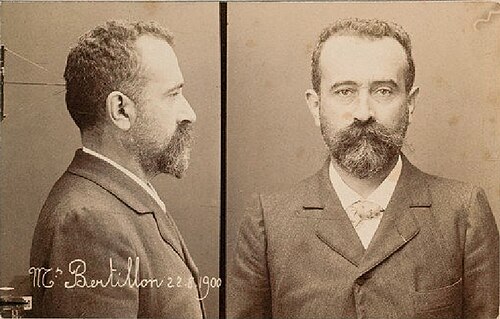
Meet Alphonse Bertillon, a French police officer and biometrics researcher who pioneered a system called anthropometry, a series of body measurements designed to create a specific physical record of everyone who fell under arrest, the first law enforcement reference work to identify features, marks, scars, etc., anything unique to the individual being detained. The first reference photos of criminals began sporadically in the 1840’s, but Bertillon had standardized the practice into a strict set of procedures by 1888. It was only one of many innovations he brought to crime detection, including casting procedures for taking molds of footprints and early comparative tables on ballistics.
Bertillon developed the format that, generally, is still used to the present day: one full-on view, accompanied by a right profile, with both shots housed in the same catalog entry: a neutral or blank background to minimize confusion about head and hair contours: a standard camera and lens used for all images. The photographs were initially added to the other elements of the anthropometric system, which consisted of several baseline measurements: head length, head breadth, length of middle finger, length of the left foot, etc. Together, they took what would, in any other context, be a simple candid photograph and make it an essential tool in crime detection, redefining at the same time what photography is “for”. Images are purposed and intended differently, depending on who creates them. We who receive them assign a variety of values to what we see. Can a photograph provide evidence based solely on how we judge a human face? Do we project a sense of menace or evil purely because of how and when we were photographed? Clearly, we are in an area where there are way more questions than answers.
GENTLEMEN, START YOUR LENSES
By MICHAEL PERKINS
NEW CAMERA START-UP PACKAGES IN THE YEAR OF OUR FORD 2026 are marketed in almost the opposite way they were a generation ago. Back in the days of Ronald Reagan, manufacturers that had been accustomed to selling permanently attached lenses to their bodies suddenly saw an explosion in SLR sales, and with it, the demand for detachable glass in various focal lengths. Thus came the idea of the “kit” lens, which, for quite a while, tended to be of a single focal length. Indeed, lots of us elders’ first “grown-up” cameras came with a 50mm or 35mm prime. Back then, this made more sense than equipping bodies with lenses of variable focal lengths, since zooms of the period were bulkier, slower and more expensive. Primes were more compact and reliable.
Fast forward to the current market, and you see the complete reversal of this thinking. Selling a kit lens with a variable focal length, say, a 24-70 or 18-55, is now thought to afford new photographers more versatility, an easier break-in period for a wider range of techniques. This has been made possible by vast technical improvements that allow zooms to be smaller and far more responsive than was the case forty years ago, including greater ranges for maximum aperture. There is also the consideration of price, as a variable optic allows the user to save money on the purchase of separate specialized (limited?) optics. As a consequence, new cameras today are almost never packaged with a prime as its kit.
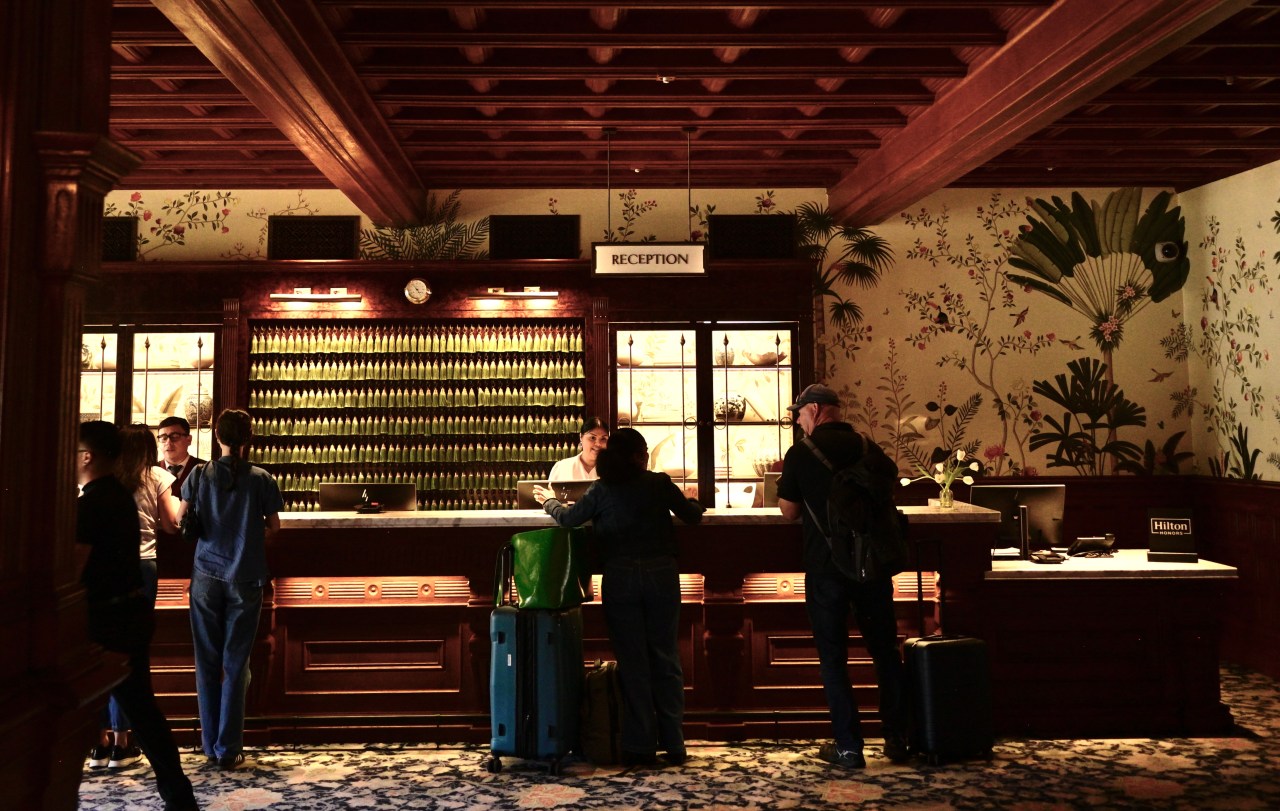
These days, both a prime and a zoom can make this shot, but the prime is still faster and sharper by far.
This where we inject the Joni Mitchell line about “something’s lost, but something’s gained”, since, in photography, new choices often obliterate old choices. Fact is, there is still an argument to be made for primes as a learning tool for newbies, if for no other reason than that, since they contain fewer glass elements than zooms, less light is diffracted on its way to the sensor, which greatly affects sharpness. Primes’ performance at lower light is also still leaps and bounds beyond that of zooms. And, of course, even primes can be “zoomed” to a degree (an old technique we call “walking”), which actually promotes more compositional mindfulness than just hitting the “tele” toggle.
My point is that, still, today, some photographers might be more than glad to learn on a prime, if it were on offer. I would therefore love to see manufacturers offer two basic kit packages when introducing a new camera, one with a zoom and one with a prime. Neither option should obviate the other for the consumer. This is merely reflective of the fact that there can never be just one way to gain experience, and that no options are strong enough to be universal decrees. I can really only speak to what works for me, and yet I strongly support more choices for more platforms. Camera tech needs to be as inclusive as possible so that photography can fully thrive.
BRIGHT SMILING LIES
By MICHAEL PERKINS
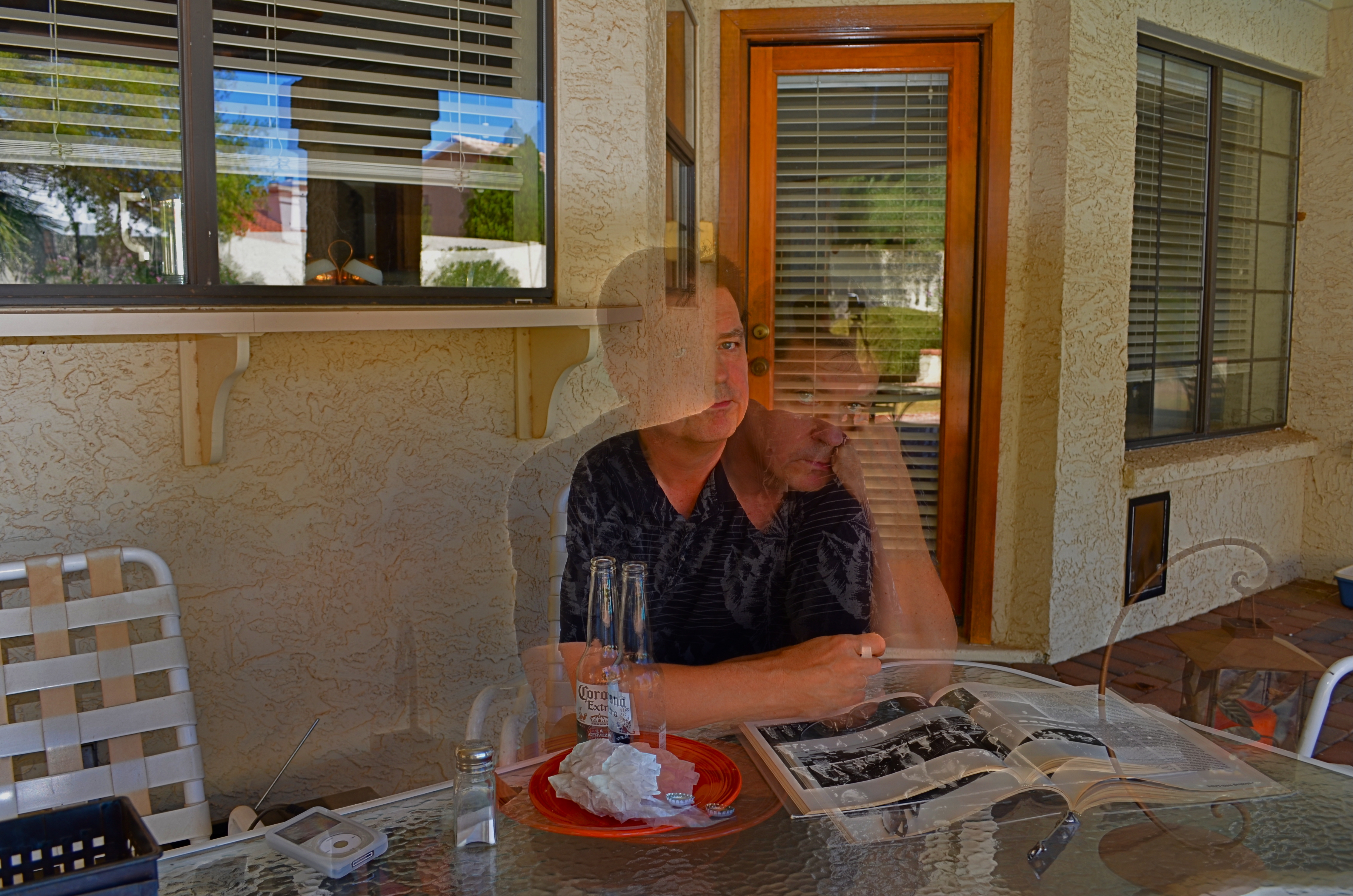
PHOTOGRAPHY HAS PRETTY MUCH INHERITED ITS CONCEPTION OF PORTRAITURE FROM THE TRADITIONS OF PAINTING. A portrait, to us, is something done on purpose, with purpose, deliberation, a plan. There is at least an attempt on the part of the photographer to strip away the studied facades of the modern world and reveal something of the real person within. And there is ample evidence that you can come compellingly close to doing just that.
Turn the camera around toward ourselves, however, and we all become liars. Bright, smiling liars.
This is not a burn per se on the current pandemic of “selfies” that litter the internet like crushed beer cans along the highway, although many of them deserve to be burned because they are banal or technically inept. No, the self-portrait process itself, cool camera or cheapie, invites deception, the creation of a mask designed only for public consumption. It is a license to hide.
Can anyone be so self-aware or confident that they are able (or willing) to present something raw and unvarnished for a camera lens in the same way we would seek that authenticity from another subject? Or will we come to the camera as if to the edge of a stage, our makeup and “serious” aspect pasted on for a performance?
Back for a moment to the tselfie tsunami of our current era, it’s easy to see this torrent of poses as play-acting, images that actually prevent us from understanding or knowing each other. You have to ask, at some point, is this how this person sees himself? Far from inviting the viewer deeper inside, selfies act as digital “Do Not Disturb” signs that, in fact, discourage discovery. And yet, let’s not let our brethren with tripods, studio lighting and stern demeanours escape blame, either, as their work can be just as riddled with artifice as any quickie-in-the-mirror Instagram. It’s said that people who act as their own lawyers have fools for clients, and the same holds for anyone who takes his own picture.
This is not necessarily cause for despair. All of photography is, after all, an interpretation of reality, not a representation of it. We don’t discount black & white simply because it doesn’t show the world “as it is”, nor do we rule out the “truth” of pictures made from a host of other techniques that are all, certainly interpretive in nature. So the self-portrait will always be a tough nut to crack.
There is nothing more penetrating than the idea of a camera. But, in the carapace we construct around our all-too-secret souls, it may have met its match.

